
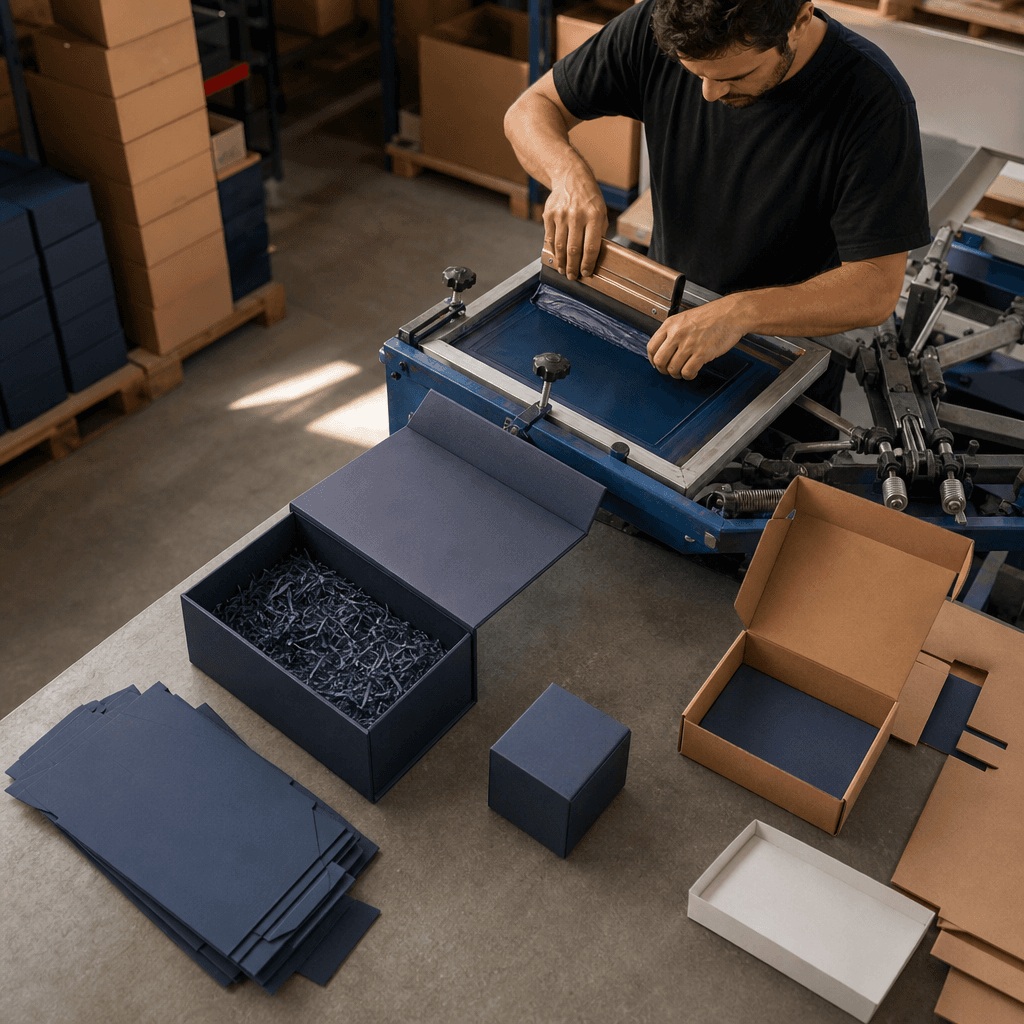
When a white logo really needs to "stand out" on a dark cardboard box, screen printing is often the first solution that comes to mind. That's because screen printing can transfer a thicker and more opaque ink layer onto the packaging surface than many other techniques. But this strength is not an automatic advantage for every packaging project: when it comes to photographic imagery, numerous color transitions, very fine detail, or high personalization, it may not be the right choice on its own. In this guide, we explain at which decision points screen printing is a winning technique in packaging and at which points it becomes challenging; and how you should evaluate it in terms of surface, design, durability, food contact, and cost.
Apart from our What Is Screen Printing? How Is It Applied? guide where we cover the basic working principle and stages of the application in detail, this article focuses on the print selection and purchasing decision.
Table of Contents
What screen printing does in packaging
Screen printing is based on transferring ink onto the packaging surface through a mesh texture. Certain areas on the mesh are blocked; from the open areas, ink is pushed onto the surface with the help of a squeegee. In this way, the print forms only in the areas defined in the design. The difference from offset or digital printing is that the ink layer can be applied more thickly; this makes a difference when high opacity, bold color, and a special effect felt on the surface are desired.
There are four main variables that determine the result, and each of these is a technical detail that should be discussed during the quote and sample stages:
- Mesh pores: Determine how much ink will pass through and at what level of detail. Fine detail requires a tightly woven mesh, while high coverage requires a more openly woven mesh.
- Stencil: Separates the areas to be printed from those not to be printed; the sharpness here determines the limit of the smallest text and line thickness.
- Ink: Directly affects surface adhesion, opacity, drying, and scratch resistance.
- Squeegee pressure and movement: Determine how evenly the ink is transferred to the surface.
If the mesh is not sufficiently taut, it can cause the print to spread, the image to distort, or ink to accumulate. In other words, screen printing is not as simple as "lay down thick ink"; it is a process where surface cleanliness, ink preparation, and mesh tension are controlled together.
Which packaging surfaces it works on
Screen printing can be used on both paper-based packaging and some rigid or special-surface packaging. Suitability depends not only on the material but also on the surface coating, absorbency, roughness, and ink system. Let's distinguish where it is strong and where it requires care, depending on the surface.
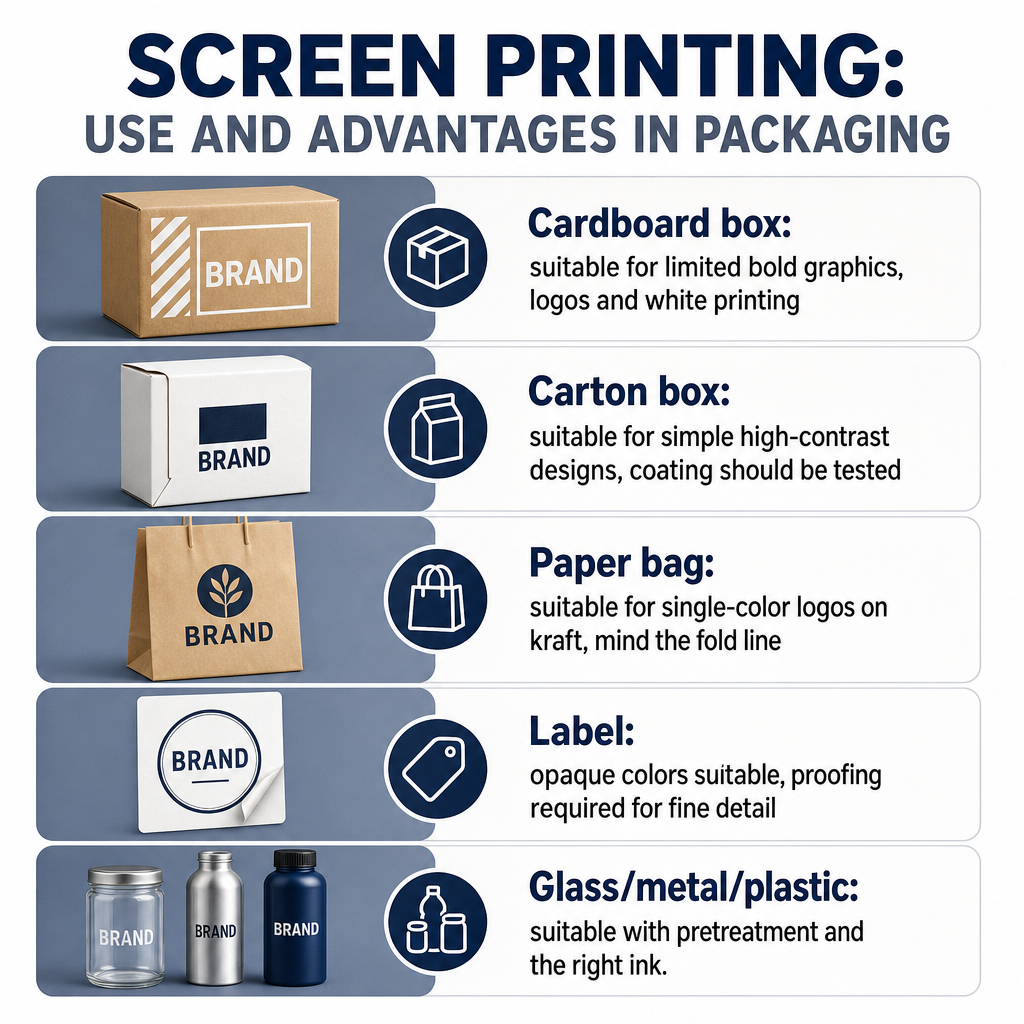
Cardboard box. On premium cardboard boxes, screen printing is valuable for highlighting a limited number of strong graphic elements rather than covering the entire surface: a logo or monogram, white print on a dark background, a single-color brand mark, a tactile ink effect, or special-edition box graphics. If you want to cover the entire surface with a multicolor, photographic image, offset or digital printing works more efficiently than screen printing; here, screen printing is a complementary accent technique.
Carton box. It gives good results in clean, high-contrast designs such as minimal cosmetic boxes, soap packaging, candle boxes, and boutique food packaging. The carton's weight, surface absorbency, and any coatings such as cellophane or lamination must be tested beforehand; on coated surfaces, ink adhesion and drying time differ from uncoated paper.
Paper bag. A white, black, or metallic single-color logo on a kraft background creates a natural and premium appearance. However, the bag's fold lines, handle holes, and curved areas must be taken into account in the design; applications too close to the fold line increase the risk of cracking during use.
Label. It can be preferred for labels that require thick and opaque color, have dark-colored surfaces, or are special editions. For barcodes, small-point text, and very fine lines, mesh selection and proof control are critical.
Glass, metal, and plastic. It is used on cosmetic bottles, candle containers, beverage packaging, and promotional products. Not every surface accepts the same ink system; pre-print surface cleaning, surface energy, pretreatment, and the appropriate curing method must be verified.
The advantages screen printing offers in packaging
What sets screen printing apart from other techniques comes down to a few concrete capabilities. Reading these alongside real packaging scenarios shows which one is meaningful for you.
High opacity. The thick ink layer gives a more covering result on dark, colored, or transparent surfaces. If you want a light-colored logo to appear distinctly on a black cardboard box, screen printing's dense ink layer creates a strong visual impact.
Highlighting the brand mark. It allows emphasizing a single area without filling the entire packaging with a complex image. A logo, symbol, short message, or product name can be applied so that it stands out from the rest of the packaging. In clean and luxurious designs, the brand's visual identity can be conveyed through a single strong mark.
Tactile effect. Thick ink application makes the print felt on the surface; the packaging offers not just a visual but a tactile experience. However, a high ink layer is not always an advantage: its compatibility with folding, stacking, adhesion, and subsequent surface processes must be checked before production.
Special inks. It is suitable for working with white, metallic, fluorescent, or specially formulated inks; it can also be considered for varnish or decorative coating in specific areas. These options gain meaning in premium cosmetic boxes, jewelry boxes, candle packaging, corporate gift boxes, and limited-edition packaging. If you want to plan the packaging form decision together on the jewelry side, the jewelry packaging types and options for brands guide provides guidance.
Cost advantage in selected areas. If the design contains few colors and printing will only be done in specific areas, screen printing can be economical. In contrast, for multicolor, photographic, or variable-data jobs, other techniques become more practical due to stencil and preparation costs. The printing technique should be evaluated not only by unit price but by total project cost: mesh preparation, number of colors, print area, quantity, curing, waste rate, sample, and subsequent coating processes are included in this cost.
Limitations and production risks
Screen printing is a strong effect technique, but it is not ideal for every design. Discussing these risks clearly at the quote stage prevents surprises on the sample.
Fine detail limit. Very small text, fine lines, high-resolution photographs, and complex transitions require careful technical planning. If the mesh selection and ink viscosity are not suitable, fine details can close up and edges can lose their sharpness. The smallest point size, line thickness, and negative areas in the design file should be evaluated together with the manufacturer.
Color transitions and photographic imagery. Screen printing is successful with limited-color and high-contrast graphics; if producing a photo-realistic image is the main goal, the requirements for color separation, number of stencils, and alignment increase rapidly. In this case, to compare techniques, the What Is Digital Printing? Packaging Usage Guide and Offset Printing vs Digital Printing: Which Is Right for You? content provide a more accurate starting point.
Surface adhesion. Wrong ink selection leads to the print rubbing off, scratching, or peeling. On plastic, glass, metal, and glossy coated surfaces, surface preparation is decisive; some plastics require corona or flame pretreatment to increase surface energy.
Drying and curing. The way ink dries varies depending on the type, surface, and production line. Insufficient drying causes the print to smear, packages to stick to each other, reduced scratch resistance, and deformation during folding. Therefore, not only the appearance of the print when it first comes out but also its performance after stacking, handling, folding, and use should be tested.
Alignment and stencil cost. When each color requires a separate mesh or print pass, alignment precision and preparation cost increase. In low-quantity jobs, the stencil cost raises the unit price; if numerous variants or personalized packaging are planned, comparison with alternative techniques is essential.
Screen printing, digital, or offset
The table below helps make the initial direction according to the project's basic need. The final selection is made based on the packaging's actual material, print area, usage conditions, and sample result.
| Decision criterion | Screen printing | Digital printing | Offset printing |
|---|---|---|---|
| Thick and opaque ink | Very suitable | Depends on application | More limited |
| White print on dark background | Strong option | Depends on system | May require special setup |
| Photographic imagery | Limited | Suitable | Suitable |
| Low-quantity production | Depends on preparation | Generally suitable | Less advantageous |
| High-quantity standard production | May be suitable | Cost may increase | Often advantageous |
| Variable data, personalization | Limited | Very suitable | Limited |
| Tactile ink effect | Strong | May require special system | Supported by finishing |
| A few strong brand elements | Very suitable | Suitable | Suitable |
Decision criteria for your project
Choosing the right technique starts with clarifying the answers to a few questions before design. The headings below shape your quote brief.
Packaging surface. Uncoated carton, coated carton, lined cardboard, kraft paper, cellophaned surface, glass, metal, plastic, or varnished/laminated surface: each affects ink behavior differently. The surface's absorbency, roughness, and flexibility directly determine the print result.
Print area and design density. Screen printing is strong at emphasizing specific areas rather than printing a complex image over the entire surface. In the brief, the area to be printed, number of colors, smallest text and line thickness, white or metallic ink requirement, logo position, folding and gluing areas, and whether the print will be on the inner or outer surface must be clear.
Use and durability. Conditions such as long waiting on the shelf, shipping and friction, moisture or oil contact, frequent handling, folding, cold chain, or hot environment change the print selection. The print should be tested on a sample that represents real usage conditions.
Food contact. In food packaging, the risk of the ink coming into direct or indirect contact with the product must be examined separately. In Turkey, regulations regarding materials and articles in contact with food include provisions that also cover printing and labeling practices on packaging. For this reason, in food, chocolate, coffee, and beverage packaging, the suitability of the ink, whether the print comes into direct contact with food, the inner/outer surface distinction, the suitability of the paper used, the declaration of compliance, and the odor/migration risk must be clarified in writing with the manufacturer. Food contact suitability should not be assumed merely from the phrase "food packaging."
Sustainability. The recycling performance of screen printing depends not only on the printing technique; the type of paper or carton, lamination, varnish, ink system, adhesive, and service life are evaluated together. In Turkey, it is essential to prioritize recyclable and reusable solutions in packaging design. The brand should ask whether the print and coating are compatible with the intended recycling stream, whether unnecessary plastic lamination is used, and whether the packaging can be designed as a single material. The "recyclable" claim should not be made by looking only at the printing technique.
What must be checked on the sample
Before mass production, the physical sample is the most reliable test of the screen printing decision. Check the following on the sample: color tone and opacity; the edge sharpness of the logo; the legibility of small texts; pinholes or gaps on the print surface; drying and smearing; scratch and friction resistance; cracking at fold lines; compatibility with gluing areas; sticking after stacking; contact with the product or inner packaging; odor; the legibility of barcodes and legal information.
In the sample request, in addition to the printing technique, the actual material, actual surface treatment, and if possible the actual color recipe should be used; an impression taken from a screen or an approximate material does not represent production. To plan sample and proof decisions step by step, you can benefit from the How to Request a Packaging Sample? Step-by-Step Guide content.
Planning screen-printed packaging with Kosapack
We offer cardboard boxes, carton boxes, corrugated cardboard boxes, paper bags, labels, and complementary packaging products under one roof. We coordinate the design, prototype, production, and logistics stages within a managed service model; we work with proofs that ensure color accuracy, quality control, and verified production partners. Since the winning decisions in screen printing are mostly made before the quote, the more we clarify your brief, the more we shorten the sample rounds.
When getting a quote for a project involving screen printing, we recommend adding the following to the brief: packaging type (cardboard box, carton box, paper bag, or label), inner and outer dimensions, material and weight, the surface to be printed, print color and number of colors, the need for white/metallic/special ink, print area, surface coating, estimated order quantity, product weight, usage and handling conditions, food or cosmetic contact requirement, sample expectation, and target delivery date.
In our publicly available information, we state that we provide a quote within 24 hours and a physical sample within 7–15 business days; the exact time and minimum order quantity are clarified separately depending on the project scope. If you want to see the cost items of the printing side through a product, the guide on the factors that determine paper cup prices concretely shows the relationship between print, coating, and quantity.
In summary, screen printing is the right option for brands that want high opacity, a prominent logo, a limited number of strong colors, tactile effect, or visibility on a dark background. A clean logo on a premium cardboard box, white print on black packaging, a strong brand mark on a kraft bag, tactile emphasis on candle/cosmetic/jewelry packaging, a limited-edition collection, or durable printing on glass, metal, and suitable plastic surfaces are at the forefront of these scenarios. If photographic imagery, many colors, variable data, or high personalization are required, other techniques are more efficient. The most reliable decision is made by examining the technical brief together with a physical sample taken on the actual material.
Frequently Asked Questions
Can screen printing be used on cardboard boxes?
Yes. On cardboard boxes, it can be used especially for logos, white printing, metallic effects, and limited-color designs. However, the cardboard's surface, coating, and the box's fold areas must be tested beforehand.
Which is better, screen printing or digital printing?
There is no single right answer. Screen printing stands out for opacity, thick ink, and tactile effect; digital printing, on the other hand, is more advantageous for short runs, variable data, and multicolor imagery.
Is screen printing durable on packaging?
It can be durable when appropriate ink, surface preparation, and curing are used. Durability varies according to surface type, friction, moisture, folding, and usage conditions; testing should be done on a sample.
Can screen printing be used on food packaging?
It can be used; however, the printing ink, surface, type of contact, and compliance documents must be examined together. Food contact suitability is not determined solely by the printing method.
Does screen printing give good results on dark-colored boxes?
Yes. The high ink coverage of screen printing significantly increases the visibility of white and light-colored prints on dark backgrounds.