

The product's weight is not the only thing that determines the cost of a shipment; often the actual bill is based on the space the box occupies. That's why the question of what is desi shipping box is a direct budget question for e-commerce and premium brands. Desi is the value of the volume a package occupies during transport as reflected in the fee. A light but large parcel may be charged based on a high desi even if it appears low on the scale. In this guide, we explain how desi is calculated, how it differs from kilograms, and why box design changes this cost so dramatically; in the end, we clarify how to plan the most efficient box that protects your product.
Table of contents
What is desi and what does it change in cost?
Desi is the measure that expresses the volume a shipping package occupies. Because cargo companies carry limited space in the vehicle and warehouse, they look not only at weight but also at the area the package occupies. The commonly used calculation for domestic shipments in Turkey is based on multiplying the three sides taken in centimeters.
Desi = Width × Length × Height ÷ 3,000
The critical point here is this: desi alone is not a fixed shipping price. The value on which the fee is based is the value the carrier determines according to actual weight, volumetric weight, and its own tariff rules. Each company's rounding, minimum fee, and service zone practices may differ; the final fee is usually finalized after the measurement and weighing performed at shipment acceptance. In other words, your box size is one of the most controllable components of the amount you will pay.
How is desi calculated for a shipping box?
The calculation starts with the outer dimensions of the parcel ready for shipment. For a sample parcel, let's take a width of 30 cm, a length of 20 cm, and a height of 15 cm:
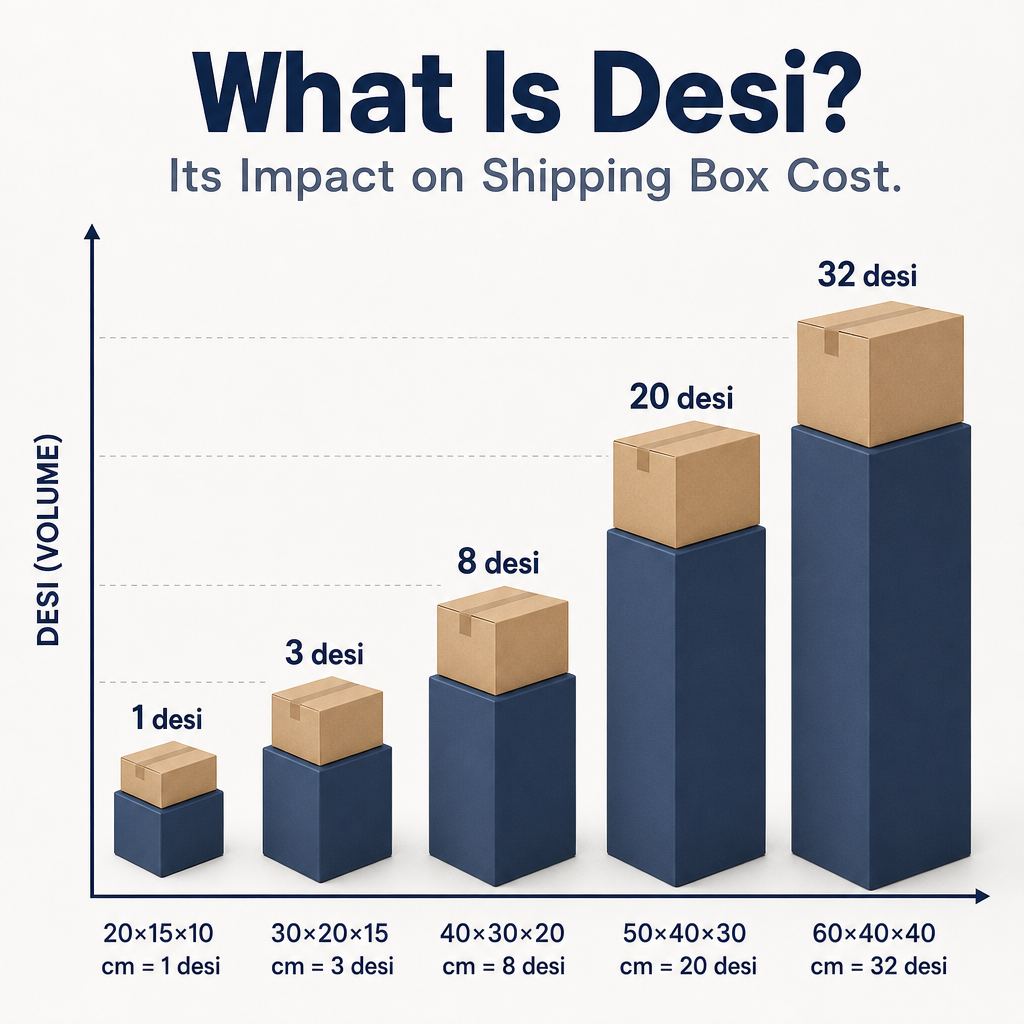
30 × 20 × 15 ÷ 3,000 = 3 desi
Even if the scale weight of this package is 1.5 kg, since its volumetric value is 3 desi, the charge can be based on 3 desi. In common practice, the actual weight and the volumetric value are compared, and the higher one is taken into account when determining the chargeable value.
| Shipping box outer dimensions | Volume (cm³) | Approximate desi |
|---|---|---|
| 20 × 15 × 10 cm | 3,000 | 1 desi |
| 30 × 20 × 15 cm | 9,000 | 3 desi |
| 40 × 30 × 20 cm | 24,000 | 8 desi |
| 50 × 40 × 30 cm | 60,000 | 20 desi |
| 60 × 40 × 40 cm | 96,000 | 32 desi |
The values in the table are approximate calculations. The cargo company may re-measure the dimensions during acceptance; how fractions are rounded and which tier the fee starts from may vary by carrier. Therefore, this table should be read not as a definitive price, but as a scale showing the effect of box size on volume.
The difference between desi and kilograms
Kilogram shows the physical weight of the package, while desi shows the volume it occupies. These two measures are not the same thing, and most cost misconceptions arise from this. A large plush product may weigh 2 kg but occupy 10 desi of space; a small, dense electronic part may weigh 5 kg but have only 2 desi of volume.
Shipping cost is not determined by the scale alone, because the cargo company evaluates weight and volume together to more accurately reflect vehicle capacity. In public transport services, both kilogram and desi upper limits may be defined together for shipments; in some delivery areas, both limits apply for address delivery. The practical result is this: even when you sell a light product, if you don't control the box volume, you may face a cost that has nothing to do with weight.
Why does box size increase desi cost so quickly?
Because desi is based on the multiplication of three dimensions, a few centimeters added to each side creates a much larger jump in total volume than expected. A 30 × 20 × 15 cm box is 3 desi; when the same product is placed in a 40 × 30 × 20 cm box, the value rises to 8 desi. Even if the product weight does not change at all, the volumetric value more than doubles.
This increase is most often seen in the following packaging decisions:
- Choosing a box that is larger than necessary for the product
- Determining the box size without planning the amount of protective filling
- Not accounting for the margin needed for an inner cardboard box, corrugated box, or gift wrapping to fit into the outer shipping box
- Making the box unnecessarily large to reduce the risk of breakage
- Trying to ship different products in a single large parcel
The goal here is not to reduce the box to the smallest possible size. The goal is to leave safe space that will protect the product while not creating unnecessary volume. For those who want to see the cost impact of folding carton and corrugated structure selection more closely, folding carton structure and areas of use is a good starting point that complements this decision.
Which measurements are used in desi calculation?
The calculation is made not from the bare dimensions of the product, but from the outer dimensions of the cargo ready for shipment. This total volume generally includes the following:
- The width, length, and height of the outer shipping box
- The folded and closed state of the box
- The total volume created by the inner packaging
- The space the filling material occupies inside the box
- The effect of the lid or locking mechanism on the outer dimension
- The margin added by labels, tape, and outer protective layers
Cargo carries not the bare product but the product packaged with its protective materials. For fragile products, about 2–4 cm of safe space can be planned, and 4–6 cm for more delicate products; as an alternative approach, a margin of 10–15 percent can be added to the product dimensions. This margin is not an automatic standard for every product: the protection need for products such as glass bottles, ceramics, electronics, cosmetics, or jewelry is determined according to fragility, transport distance, and the filling to be used.
Balancing cost and protection with the right box
Only shrinking the box to reduce desi is a misleading move. A sound box decision evaluates four elements together: product protection, volume, packaging operation, and brand experience. The box should protect the product during transport, stacking, and handling; at the same time, it should minimize unused volume. Locking and easy-closing structures can reduce tape consumption and processing time in some product groups. For premium brands, the outer shipping box is one of the first points of contact with the customer; elements such as the logo, inner layout, thank-you card, and tissue paper strengthen the experience, but should not make the box unnecessarily large.
When striking this balance, it is more efficient to choose the box type according to the shipment scenario rather than individual products:
| Shipment scenario | Suitable approach |
|---|---|
| Light and durable products | Single-wall corrugated shipping box or mailer |
| Fragile products | More durable corrugated box, inner nest, and filling |
| Heavy products | Double-wall corrugated box and transport strength check |
| Jewelry and premium cosmetics | Cardboard box inside, protective shipping box outside |
| Apparel and low-volume products | Mailer envelope or low-volume locking mailer |
| Multi-product orders | Dividers and product-appropriate compartmentalization |
For brands with a very wide product range, producing a separate box for each product is usually inefficient. Determining a few optimized sizes for small, medium, and large product groups simplifies storage, increases packaging speed, eases box stock management, and consolidates purchasing. When determining standard sizes, the packaged outer dimensions of the best-selling products should be taken as the basis. In the end, the box that appears cheapest is not always the option with the lowest total cost; the correct calculation is made based on the sum of box cost, shipping cost, filling, packaging time, and damage/return risk.
Common mistakes in shipping box design
The most expensive mistakes are made at the design stage, before even a single parcel is shipped. Forgetting that light products can also result in high desi is at the top of these; for bulky textiles, decorations, gift sets, and multi-product orders, the cost arises from volume, not weight.
Other common pitfalls are: not specifying whether the dimension given in the quote or production is internal or external (the shipment-ready outer dimension matters in cargo calculation); adding the filling margin after the box size is finalized, thereby enlarging the box or squeezing the product; not verifying current conditions such as the carrier's desi coefficient, price tier, minimum fee, rounding, and regional limits; and perhaps most critically, moving to mass production without testing with a physical sample. In high-volume shipments, a design difference of a few centimeters turns into not a one-time error but a continuously recurring cost item.
Information to prepare before a quote
Getting a sound quote for a shipping box or branded shipment packaging starts with the right inputs. Clarifying the following information before a quote speeds up both the desi calculation and the material decisions:
- The dimensions and weight of the product or product set
- The total dimensions of the packaged state
- The fragility level and the inner packaging/filling to be used
- The number of products shipped in a single order
- The target cargo company and domestic/international information
- The estimated monthly or annual quantity
- Printing, brand applications, and sustainability expectations
- The desired box type and closing method
This information determines not only the desi but also the corrugated material, flute type, print surface, inner layout, and production quantities. For a concrete example showing how cost items are built together, you can review the paper rope bag cost and process guide and, in terms of the factors that determine the price in cardboard products, the factors that determine paper cup prices.
Desi-focused shipping box with Kosapack
We handle the e-commerce shipping box not just as an outer parcel; we treat it as a shipment system consisting of the outer shipping box, inner packaging, dividers, labels, tissue paper, and thank-you card. In brand-specific shipping packaging, we create custom sizes according to the product and packaged volume, and plan the corrugated shipping box together with the corrugated box and inner protection.
We evaluate the material and flute type according to product weight and fragility, and prepare the printing and graphic design according to the brand identity. Most importantly, we make the box's size, closure, and inner layout testable through a physical sample; thus, desi optimization, protection, and brand experience are handled at the same table. According to the service plan we share, depending on the project detail, we prepare a quote within 24 hours and a physical sample within 7–15 business days. A properly designed shipping box does not just reduce cost; it improves product safety, the packaging operation, and the customer's first contact with the brand together.
Frequently Asked Questions
What is desi, and how does it differ from kilograms?
Desi is the volumetric value of the package, while kilogram is its physical weight. In large but light packages, desi can be higher than the actual weight, and the fee may be determined based on this higher value.
How is the desi of a shipping box calculated?
For domestic shipments in Turkey, the common formula is Width × Length × Height ÷ 3,000, and the dimensions are taken in centimeters. The cargo company's own calculation and rounding rules should also be checked.
Is the box's outer dimension or inner dimension used?
In desi calculation, the outer dimension of the shipment-ready package is generally taken as the basis. Therefore, the width, length, and height after the box is closed should be taken into account.
Does shipping cost necessarily decrease if the box is shrunk?
Desi may decrease; however, if the box is too small for the product, the costs of damage, returns, and re-shipment may increase. The goal is not the smallest box, but to design the most efficient box that protects the product.
Is the same formula used for international shipments as well?
Not every carrier and service type may use the same division coefficient. While the 3,000 coefficient is common within Turkey, different volumetric weight rules may be seen in international shipments; the relevant carrier's current tariff should be checked before shipping.