

Most brands researching what folding carton is are not actually after a single answer; they seek clarity about the box structure that fits their product, the right closure type, and the technical decisions that must be made before ordering. The short answer is this: a folding carton is a foldable paperboard package created by die-cutting, creasing, folding, and—when needed—gluing a printed paper or board sheet, transported flat throughout production and shipping, and formed by opening it at the point of use. It combines shelf visibility, product protection, and brand communication on a single surface. In Turkey, this packaging is most often referred to as a folding box, folding carton packaging, or folding carton box, and it is not the same product as a thick, rigid-body rigid box.
In this guide, we cover the structure of folding carton, closure options, production logic, industry usage, and the decision criteria that determine whether it is suitable for your product. Our goal is not only to provide a definition; it is to prepare you to approach the quote and sample process ready to go.
Contents
The key difference between folding carton and rigid box
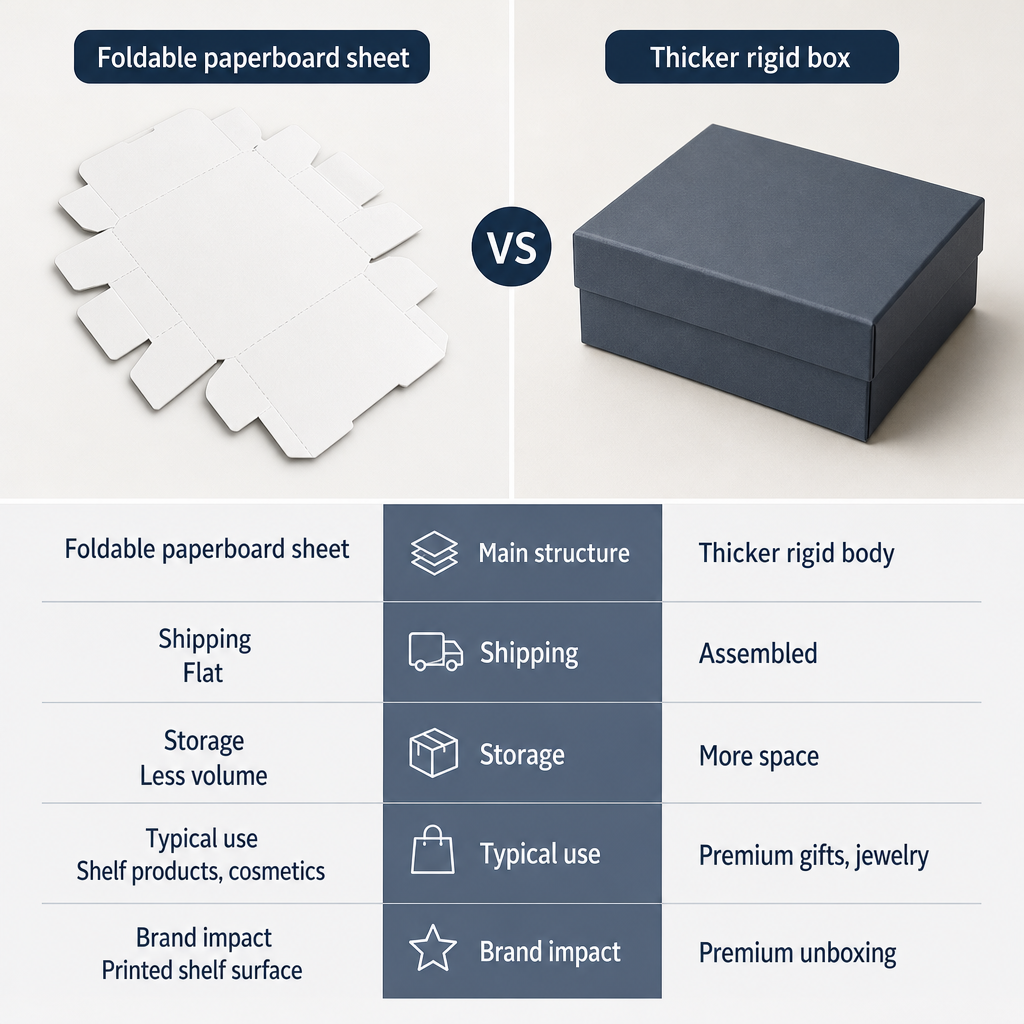
Folding carton and rigid box may look similar from the outside; however, their production logic and usage scenarios differ. Folding carton is built on thin, foldable paperboard and is shipped flat. A rigid box, on the other hand, is a structure that is thicker, has a fixed body, and is mostly transported in its assembled form. This difference affects every decision, from cost logic to storage volume, from brand impact to protection level.
| Criterion | Folding carton | Rigid box |
|---|---|---|
| Main structure | Foldable paperboard sheet | Thicker rigid board body |
| Shipping | Usually flat | Mostly assembled |
| Production | Die-cutting, creasing, printing, gluing | Wrapping, lamination, cutting, assembly |
| Storage | Less volume | May require more space |
| Typical use | Shelf products, cosmetics, food | Premium gifts, jewelry, perfume |
| Brand impact | Printed shelf surface | High volume, premium unboxing |
Folding carton is strong in light and medium-weight scenarios where the product needs to be presented visibly and neatly within the packaging. If higher impact protection, reusability, or a sturdier body for heavy and valuable products is required, a rigid box is considered. You can also review the detailed usage scenarios of these two products in our guide explaining the main use areas of the folding box and in our article covering the structure and features of the rigid box.
What is the structure of a folding carton?
A folding carton consists of the flat layout of a single-piece paperboard sheet. This layout includes the panels that form the body when the box is assembled and the flaps that close the box. Understanding the structural logic is the most practical way to prepare your quote brief correctly.
Body panels
The front, back, and side panels form the main body of the box. The front panel is the surface where the logo, product name, and key brand message are located. The back panel is used for content, usage instructions, manufacturer information, and legal disclosures. The side panels can be allocated to the barcode, ingredient list, or secondary brand messages. A narrow or wide panel structure is determined according to the product's form, shelf orientation, and print area. If the panel widths are not compatible with the product dimensions, bulging, looseness, or misalignment may be observed when the box is assembled.
Crease and fold lines
Crease lines are pressed lines that enable the board to be folded in a controlled manner. Unlike a cut line, they do not separate the material; they determine in which direction and how easily the board will fold. The crease design must be adjusted according to the board's thickness, grain direction, coating or lamination type, fold angle, the speed of the automatic filling line, and the weight of the product inside the box. Incorrect creasing leads to problems such as surface cracking, crooked closing, the box opening on its own, or stoppages on the filling line. For this reason, not only the graphic file but a production-ready technical layout must be prepared.
Glue flap
The glue flap is the section that forms the side seam of the folding carton. The presence of ink, varnish, or foil on the surface of this area negatively affects the adhesion performance. The flap must be of sufficient width, perfectly aligned with the opposite panel, left suitable for gluing in terms of surface treatments, and designed according to the structure of the mass-production machine. If the seam is positioned incorrectly, an unwanted joining line may appear on the front face.
Closure and dust flaps
The top and bottom flaps form the closure mechanism; their directions and lengths affect how the box opens, the filling speed, and how well the product is held inside. Straight tuck, reverse tuck, lock bottom, auto bottom, glued closure, and sleeve structure are the main options. Dust flaps, on the other hand, are the small side flaps at the top and bottom openings; they reduce the product's contact with the glue area, provide better closure from the sides, and offer an additional barrier against dust and limited moisture ingress.
Windows and custom cuts
If the product is intended to be directly visible, a window cut can be added to the front or top panel. Here, not only the visual effect but also the structural strength should be evaluated. The distance of the window from the panel edges, the remaining board width after cutting, the food-contact suitability of the window film to be used, the product's sensitivity to light and air, and the film's effect on the recycling process must be planned together.
How is folding carton produced?
Folding carton production is not merely a matter of sending the graphic design to print. Structural design, printing, and converting processes are planned together. The process typically proceeds as follows: first, the product dimensions, filling method, and usage scenario are analyzed; a suitable technical layout is prepared accordingly; graphic printing is applied to the paperboard sheet; surface treatments such as varnish, lamination, foil, or embossing are added; the outer contours and openings are cut with a custom die; crease lines are created; the cut-off waste is separated; the box is prepared flat on the folder-gluer machine; and during the filling stage it is opened and the product is placed inside.
Cutting and creasing are evaluated together in the same production plan. While cutting determines the box's outer form, creasing ensures the box is assembled in a controlled manner. A registration mismatch between printing and cutting can cause the logo, window, or texts to shift on the panel. For this reason, the print proof and technical layout must be finalized simultaneously with the graphic design. You can find the decision logic for the printing method in detail in our guide explaining the use of digital printing in packaging.
Folding carton types and closure styles
Folding carton does not refer to a single box shape. Different structures are designed according to the closure and usage style, and the right closure is determined based on product weight and filling method.
A straight tuck box is a structure where the top and bottom flaps tuck in the same direction; it is advantageous for brands that want the front panel to look clean in cosmetics, skincare, perfume, light electronic accessories, and small personal care products.
A reverse tuck box is a structure where the top and bottom flaps close in opposite directions; it can be efficient in sheet layout and is frequently used for mascara, lipstick, supplement products, and standard shelf products.
An auto-bottom box has a pre-glued bottom base; when the box is opened during filling, the base assembles itself. It is suitable for heavy glass bottles, candles, jars, large-volume cosmetics, and gift sets. Reducing manual assembly time makes this structure useful during fast filling or busy order periods.
A lock-bottom box locks the base with interlocking flaps instead of adhesive; the product weight, board thickness, and lock geometry must be tested together. A glued closure box provides a more sealed and secure presentation by gluing the top and bottom sections; it is evaluated for food, supplements, and some pharmaceutical products with systems suitable for the filling line.
A sleeve-type folding carton, on the other hand, is a paperboard tube open at both ends; it slides over an inner tray, holder, jar, or another package. It is used for candle jars, perfume bottles, jewelry boxes, chocolate trays, and premium gift presentations. The sleeve uses less board; however, it does not provide product protection on its own and must be considered together with an inner carrier or a separate box.
In which industries is folding carton used?
Folding carton is used in many industries where the product is light or medium weight, where shelf presentation is important, and where the printed surface carries brand communication.
In cosmetics and personal care, serums, creams, soaps, shampoos, mascara, lipstick, sunscreen, and skincare sets increase shelf visibility while carrying content information. For glass bottles or heavy pump products, an auto bottom, inner paperboard carrier, or higher grammage may be required. In perfume and fragrance products, color accuracy of the front face, securing the bottle, and premium surface treatments are important; while a tuck-closure structure is sufficient for daily mass products, inner-cradle, more striking solutions are preferred for launches and gift sets.
In food and chocolate, the critical distinction is this: using the box as outer packaging and it directly contacting food do not have the same technical requirements. Board that will come into direct contact with food must not change the product's composition or sensory properties, must not allow leakage, and must have suitable surface properties. In Turkey, the relevant regulation for materials and articles intended to come into contact with food must also be taken into account.
In food supplements, the box is the outer protector of primary packaging such as a bottle, blister, or sachet, and sufficient panel area must be planned for the barcode, usage instructions, content, warnings, and batch information. In electronics and accessories, it supports shelf or e-commerce presentation for headphones, cables, small devices, and charging accessories; since it may not be sufficient against impact on its own, an inner paperboard cradle, paperboard separator, or additional protection may be required. In candles and decorative products, while a standard tuck-closure structure is sufficient for light candles, an auto bottom and inner support are safer for glass-jar or heavy candles. In fashion, jewelry, and gift products, folding carton carries brand colors and campaign messages directly onto the packaging; for products requiring higher perceived value, it can be designed together with a rigid box or fabric pouch.
What criteria should be considered when choosing a folding carton?
The right box structure is not chosen based only on product dimensions. The following criteria should be evaluated together.
- Product weight and fragility: A standard closure may be sufficient for light products; for heavy glass, jars, or set products, higher grammage, a reinforced or auto bottom, an inner cradle, and a paperboard separator may be required.
- Filling method: In manual filling, a flexible and easy-to-assemble structure stands out; on an automatic line, dimensional tolerance, opening behavior, and gluing accuracy become more critical. This decision directly affects the flap type, glue flap, and crease geometry.
- Shelf orientation and brand face: Which panel the product will show on the shelf should be determined from the outset. If the front face is intended to appear seamless, the glue seam and flap slits can be moved to the back or side surface.
- Printing and surface treatments: Offset and digital printing; matte/gloss lamination, soft-touch lamination, spot varnish, foil, embossing, debossing, and window cuts can be applied. Digital printing is considered for short runs, variable data, or multiple SKUs; offset printing for high volumes and color consistency.
- Grammage and thickness: Thicker board does not always give a better result. As thickness increases, the folding force changes, the crease geometry is readjusted, and the risk of surface cracking and cost may increase. The most accurate choice is determined through a sample test made together with product weight and box form.
- Storage and logistics: Flat shipping reduces storage volume; however, humidity, temperature, and pressure conditions must be controlled. Board may exhibit curling or dimensional changes depending on environmental conditions.
- Sustainability: The evaluation should not be made only with the phrase "paper-based." The recyclability of the board, plastic windows, lamination and coating, foil film, unnecessary inner parts, correct sizing, and supply chain documents should be examined together. In Turkey, the management of packaging waste covers the design, placing on the market, collection, sorting, recovery, and reporting processes; which waste stream the product will enter after use should also be included in the brief in accordance with the regulation on the management of packaging waste.
Common risks in folding carton use
The most common mistakes are not technical but stem from planning, and most are not noticed before the sample stage.
Giving the box dimensions only as outer dimensions comes first; the product dimensions must be determined according to the inner dimensions of the box, taking the board thickness into account. Otherwise, the product gets stuck or moves around inside the box. Overlooking inner protection is the second common mistake: folding carton does not always provide impact protection on its own; a box used without an inner carrier for glass, ceramics, or sensitive electronics may fall short during shipping.
A print design incompatible with the layout reduces readability; placing the logo, text, or barcode too close to the fold line should be avoided, and the graphic design should not be completed before the technical layout is finalized. Overlap of coating and gluing areas weakens the side seam; lamination, varnish, or foil must not overflow into the gluing area, and the glue flap must be marked in the technical file before printing.
Assuming food contact is a serious risk: the term "board" alone does not mean food-contact suitability; if the product directly contacts the box, the material, ink, coating, and supplier documents must be separately verified. Finally, moving to mass production without taking a sample can be costly, because the on-screen design does not show the box's actual folding force, surface cracking, and opening behavior on the machine. A physical sample is an important control stage in projects involving custom dimensions, heavy products, windows, auto bottoms, or multiple surface treatments.
To speed up the quote and sample process, your brief should include the product name and usage area, exact dimensions, weight, fragility, in-box placement, the need for an inner cradle or separator, the box's inner dimensions, closure type, filling method, estimated quantity, print surfaces, brand colors, desired coating and effects, food-contact status, barcode and mandatory information, storage/shipping conditions, and sample expectations. When comparing quotes, ask not only about the unit price but also about the scope of die, sample, print proof, waste, packaging, delivery, and quality control.
At Kosapack, in our custom packaging approach, we handle structural and graphic design, prototyping, production coordination, and logistics together. For premium cosmetics, jewelry, candle, chocolate, fashion, and e-commerce brands, we design folding carton—when needed, together with complements such as a rigid box, paper bag, separator, tissue paper, or label. If shelf presentation and cost balance are the priority, folding carton should be considered; if higher body rigidity, inner protection, and a premium unboxing experience are required, a rigid box should be considered.
Frequently asked questions
What does folding carton mean in Turkish?
Folding carton is generally used in Turkish to mean folding box, folding carton packaging, or folding carton box.
Are folding carton and cardboard box the same?
Every folding carton is a type of paperboard packaging; however, "cardboard box" is a broader term. The key feature that distinguishes folding carton is that the printed paperboard sheet is cut and creased so that it can be folded for flat shipping.
Can folding carton be used instead of a rigid box?
It depends on the product's weight, fragility, sales channel, and expected brand experience. For light and medium-weight shelf products, folding carton may be sufficient; for heavy, sensitive, or high-premium-perception products, a rigid box may be more suitable.
Can folding carton be used for food products?
Yes; however, in the case of direct contact with food, the material, ink, coating, and production process must comply with the relevant food-contact requirements. Outer packaging and the surface in direct contact with food are not evaluated in the same way.
Is folding carton shipped flat?
Usually yes. After production, it is stacked flat and formed into the box shape by opening it during filling; this feature provides an advantage in terms of storage and transport volume.
Is a physical sample required for folding carton?
A physical sample is recommended if there are custom dimensions, a custom closure, a window, an inner cradle, a heavy product, or multiple surface treatments. A sample allows you to check product fit, folding behavior, print appearance, and closure performance before mass production.