
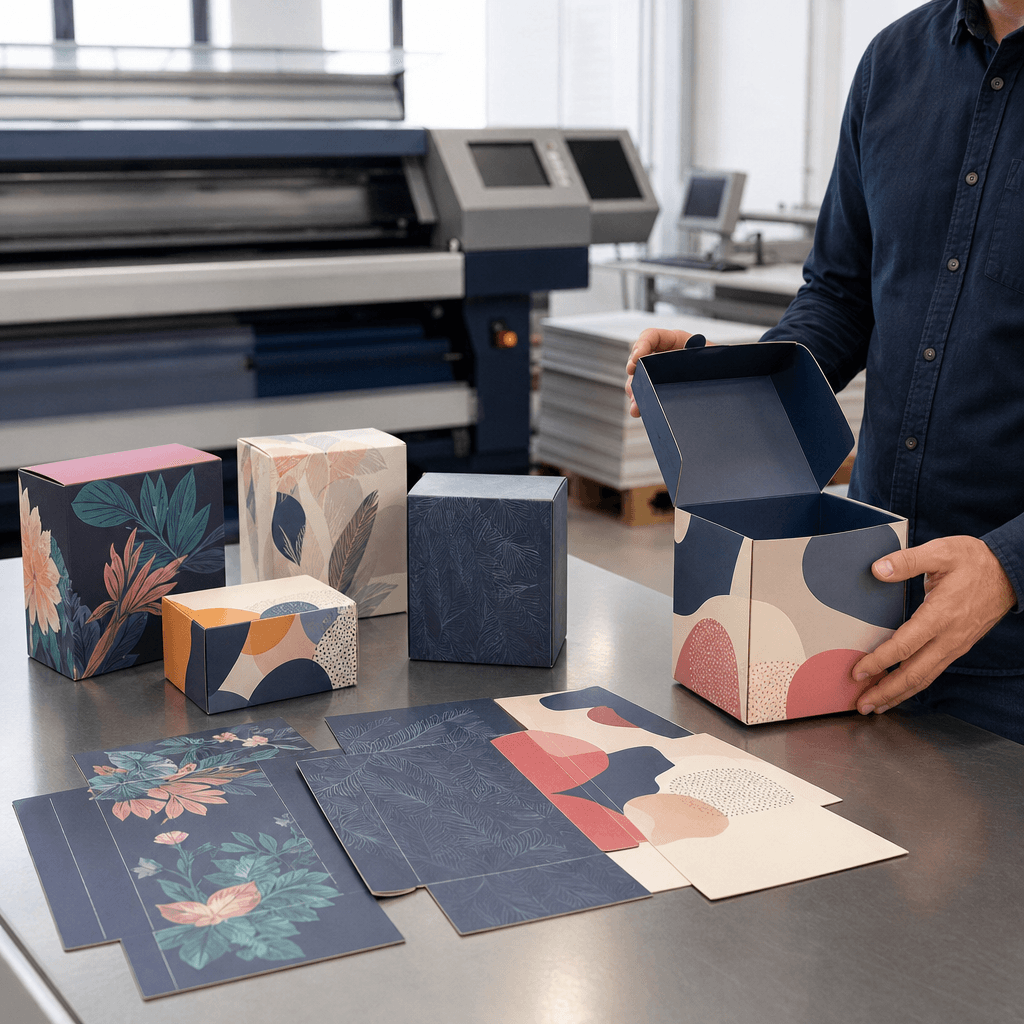
Brand owners asking what digital printing is are often looking for a single machine; yet the right question concerns the project's quantity, number of variants, and delivery schedule. Digital printing is the transfer of a graphic file prepared on a computer directly onto paper, cardboard, chipboard, or corrugated surfaces without the need for a physical plate. Because it does not require a plate or extensive machine setup, it stands out in short runs, rapid samples, and personalized packaging. On the packaging side, the real decision is not made based on the printing method alone; it is made together with the box structure, color expectation, stock risk, and approval flow.
This guide explains, in a decision-focused way, how digital printing works, which parts of packaging it is useful for, its advantages and limitations, and which brands it is the right choice for. As a team providing end-to-end packaging services to over 500 brands, we address the printing decision in every project together with the realities of materials and samples.
Table of Contents
How does digital printing work?
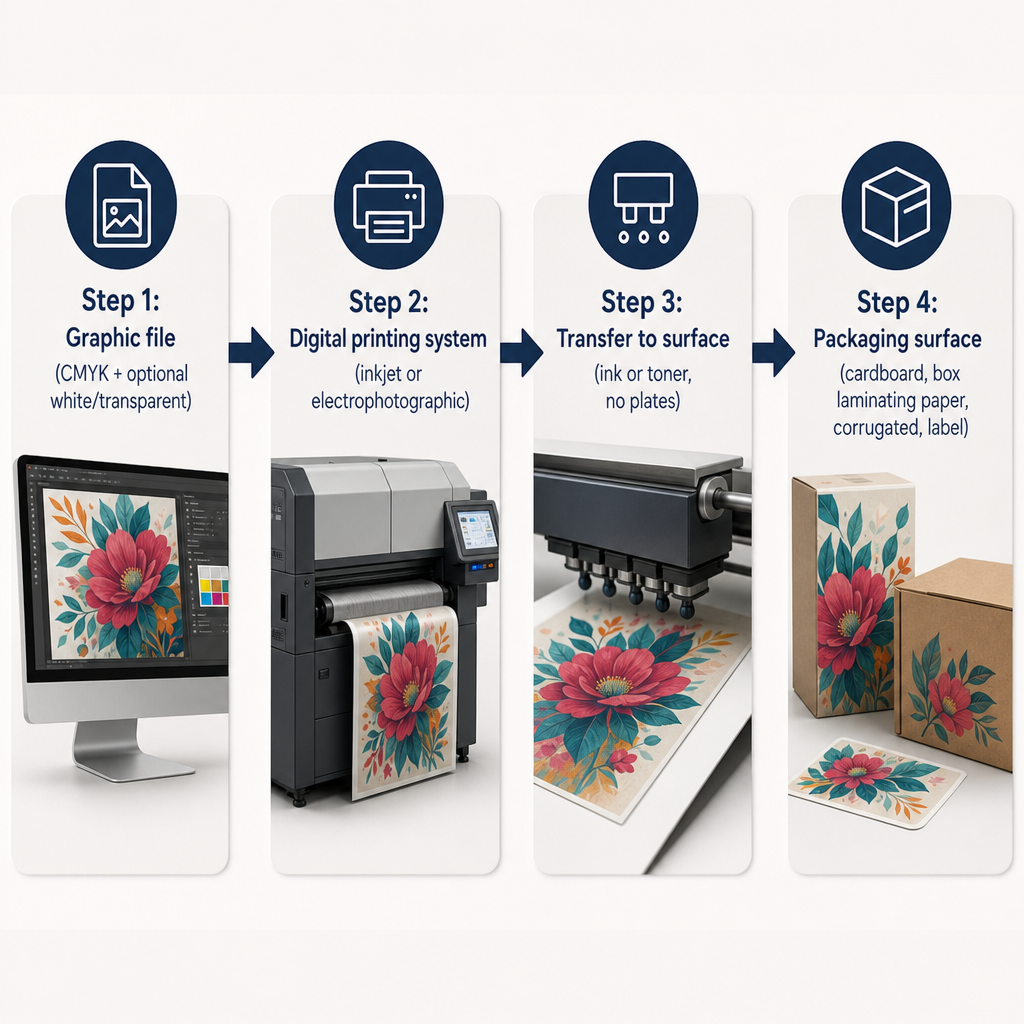
At the core of digital printing lies the direct processing of the visual data in the print file by the printing system. The image is transferred to the surface via toner or ink, depending on the machine used. In practice, you encounter two technology groups: in inkjet systems, very small ink droplets are sprayed onto the surface; in electrophotographic systems, toner is transferred to and fixed on the surface by laser or electrostatic methods.
The critical detail here is this: not every digital printing machine works with the same material, weight, surface, or size. The answer to the question "Can it be digitally printed?" depends not only on the file but also on the printing line to be used and the packaging material. Some systems offer options for white, transparent, or an extended color gamut in addition to CMYK; this directly determines which effects are possible.
What does not using a plate provide?
Since the design file is sent directly to the printing system, the need to prepare a physical plate is eliminated. As a result, short-run production becomes more feasible, different designs can be printed in the same production flow, design changes are implemented more quickly, prototyping and pilot production become easier, and personalized packaging can be produced.
Thanks to variable data printing, a different name, QR code, serial number, barcode, campaign message, or product variant can be used on each package. This feature makes digital printing especially functional for labels, promotional packaging, and limited-edition special collections.
Where is digital printing used in packaging?
Digital printing can be considered both for the main body of the packaging and for complementary parts. Its suitability varies according to the material's surface, the printing machine's features, and the production quantity. Seeing how it is positioned according to the packaging part makes the printing decision concrete.
Folding carton boxes. Digital printing provides an advantage for low- and medium-run products, series with many variants, and launches where the design is frequently updated. Cosmetic series with different scent or color variants, seasonal food products, limited-edition campaign boxes, new product launches, and packaging that varies by sales channel stand out in this group. For high-volume designs that will remain unchanged for a long time, a cost comparison with offset printing should be made.
Rigid boxes. In premium gift, jewelry, candle, perfume, and cosmetic packaging, the printing decision cannot be considered separately from the box structure. In a rigid box, the final appearance is determined together by the surface of the wrapping paper, matte or glossy lamination, soft touch application, foiling, embossing, accessories such as magnets and ribbons, inner tray and separators, and printed interior surfaces. Therefore, even if digital printing is chosen, the color and surface result must always be evaluated on a physical sample. For the basics of box structure, you can refer to the What Is a Rigid Box? Features and Uses content.
Corrugated shipping boxes. For e-commerce and DTC brands, digital printing provides flexibility for short-term campaigns or boxes sent to different customer segments. Here, in addition to visual quality, the print area on the outer surface, friction during shipping, the surface of the corrugated material, box dimensions and volumetric weight, and production quantity are also decisive. For long-term, high-volume shipping boxes with a fixed design, other printing methods should also be evaluated. To clarify which body suits your needs, you can take a look at the Rigid Box vs Corrugated Box: Which Is Right? comparison.
Labels. In label printing, the area where the digital method is strongest is variable data. Different barcodes, QR codes, batch numbers, expiration dates, serial numbers, product names, and campaign messages can be printed within the same production process. For fixed-design, high-volume labels, flexographic, offset, or other options may be more favorable in terms of total cost. For label material and technical selection, you can go to the What Is Label Printing? Types and a Guide for Brands page.
Complementary parts. Thank-you cards, tissue paper, paper bags, in-product information cards, and limited gift inserts can also be planned within the same brand language. However, if the box, label, and card are to be produced with different printing methods, how closely the colors will match must be tested in advance.
Advantages of digital printing in packaging
The value of digital printing for packaging is not found in a single feature but is gathered under several mutually supporting headings. Each corresponds to a different brand need.
Flexibility in short runs. Since it does not require a plate or extensive initial preparation, it is more flexible for short-run jobs. This is decisive for new brands, product tests, and limited productions.
Personalization. The ability to use different data in each print sample turns packaging into a personalization tool. Name-based boxes for influencer shipments, special messages in loyalty campaigns, separate QR codes for different cities, serial numbers for product safety, and numbered limited collections can be produced this way.
Lower stock risk. Printing large quantities of packaging before demand is confirmed creates idle stock when the design changes or the product sells more slowly than expected. Digital printing reduces this risk by enabling production as needed and more frequently. This advantage should be read not only in terms of printing cost but together with storage and unused packaging costs.
Fast design change. When a new campaign message, regulatory information, product content, or barcode is updated, the digital production file can be changed more quickly. In short-lived campaigns and brands that frequently refresh products, this translates directly into speed.
Prototyping and pilot production. Digital printing can be used to see the design's effect on the actual material before mass production. However, it should be planned from the outset that there may be differences in color, surface, and print character between a digital sample and offset mass production.
Limitations and risks of digital printing
Digital printing is not automatically the best or cheapest option for every packaging project. Knowing its limits prevents later surprises in cost and color.
Unit cost at high volumes. The absence of plate cost is an advantage in short runs; however, at very high volumes the unit cost may remain higher than offset. The decision should be made based on total production volume, not just the initial quote price.
Color consistency. Digital printing can produce high-quality results; but the result depends on the printing machine, color profile, file preparation, the cardboard or paper used, surface coating, proofing method, and post-press processes. In premium packaging where the brand color is critical, the phrase "let the color be consistent" is not enough on its own; the brief must specify a color reference, surface type, material, proofing method, and acceptance criteria. Calibrating the screen, proof, and print output helps reproduce the color more consistently across stages.
Material incompatibility. Not every system is suitable for every surface. The following should be answered before production: Is the weight to be used suitable for the machine? How does the result change on coated, kraft, or textured surfaces? Will the printing be done directly on the chipboard or on wrapping paper? Does the flute structure of the corrugated material affect the printing? Is white ink needed? Will lamination or varnish change the color?
The sample not representing mass production. The sample may be digital while mass production is offset. In such a case, the sample shows the design, size, and structure but may not represent the color and surface result in mass production exactly. In the quote and approval process, the printing method of the sample, the printing method of mass production, the material to be used, the proofing standard, the color approval process, and post-press surface treatments must be clearly stated.
Digital printing or offset printing?
The table below provides a general decision framework to start with. The final decision is made by examining the machine, material, size, number of colors, post-press processes, and order plan together.
| Decision criterion | Digital printing | Offset printing |
|---|---|---|
| Printing plate | Not required | Required |
| Short run | Generally more favorable | Less advantageous due to setup cost |
| High run | Unit cost may rise | Can provide economies of scale |
| Personalization | Strong | More limited or requires extra preparation |
| Design change | Easy via the file | May require new setup |
| Variable data | Suitable for QR, barcode, name, serial no. | Limited or requires extra processing |
| Stock management | Supports on-demand production | Can lead to large batch stock |
For a detailed comparison, you can take a look at the Offset Printing vs Digital Printing: Which Is Right for You? content.
Which brands should consider digital printing?
Digital printing is a strong candidate especially in the following scenarios: brands testing a new product in small batches, cosmetic brands with multiple product variants, limited-edition jewelry, candle, or gift collections, personalized corporate gift projects, influencer and PR shipments, rapidly refreshed e-commerce campaigns, brands using different packaging information for different countries or cities, products with changing QR codes or batch information, and growth-stage brands that do not want to hold large stock.
On the other hand, for high-volume packaging that will remain unchanged for a long time and be produced with a single design, offset printing should definitely be included in the quote scope. For example, in a high-volume chocolate box production whose design will remain fixed for a long time, offset's scale advantage may become more meaningful.
Information to prepare before requesting a quote
To reduce uncertainty in the printing method decision, the following information should be clarified before requesting a quote:
- The product's name and dimensions
- Packaging type: carton box, rigid box, corrugated box, label, or bag
- Box outer and inner dimensions
- Estimated order quantity
- The number of product and design variants and the likelihood of the design changing
- The material to be used and surface expectation
- Brand color or color reference
- Matte, glossy, or textured appearance and the need for varnish, lamination, foiling, or embossing
- Sample request and target delivery date
- Whether the product has any food, cosmetic, or other compliance requirement
In our end-to-end packaging service model, structural and graphic design, prototyping, production coordination, and logistics are handled together. Once the project details are clarified, we share a target of a quote within 24 hours and a physical sample within 7–15 business days. These timeframes vary according to the project's material, scope, quantities, and approval flow.
Is digital printing used in food packaging?
Yes, but in food packaging, the food contact scenario should be evaluated before the printing method. The printed surface must not come into direct contact with the food, and the ink or other substances must not transfer to the contact surface through the substrate or stacking. The European Union's good manufacturing practices regulation clearly states that the printed surface must not come into direct contact with food and that printing substances must not migrate to the food side; for details, you can refer to the EU good manufacturing practices text. In Turkey, too, the relevant regulations for materials and articles intended to come into contact with food cover printing applications on packaging and labels.
For this reason, in chocolate, coffee, confectionery, or other food products, the print surface, inner coating or barrier, ink and adhesive compliance, migration risk, direct food contact, compliance certificates, and the packaging's production and storage conditions must be checked in writing with the supplier. The final compliance decision must be verified on a case-by-case basis according to the product and the usage scenario.
Frequently Asked Questions
Which is cheaper, digital printing or offset printing?
For short runs, digital printing can be more economical because it does not require a plate or extensive setup. For high runs, offset printing can provide an advantage by spreading the initial cost over more products. The decision is made based on total production volume.
Can custom boxes be made with digital printing?
When the appropriate machine and material are used, variable information such as names, QR codes, serial numbers, barcodes, campaign messages, and product variants can be printed on packaging individually.
Is digital printing of good quality?
Yes. However, quality depends on the printing machine, color management, file preparation, material, surface, and proofing process. The technology alone does not guarantee the result.
Can digital printing be used on rigid boxes?
It can; however, it must be determined whether the printing will be done directly on the chipboard or on paper to be wrapped onto the chipboard. The box structure and surface treatments affect the result.
Does a digital sample show the mass production result?
Not always. If different printing methods are used in the sample and in mass production, the color and surface perception may differ. A color-accurate proof compatible with the mass production method should be requested.