
Before making the offset printing vs digital printing decision for your packaging project, one thing needs to be clear: there is no single "best" method. The right choice depends on order quantity, packaging type, whether the design is fixed or variable, delivery date, color expectations, and stock risk. For packaging that requires short runs, fast delivery, or carries different information in each version, digital printing is usually more flexible. For high-volume jobs with a fixed design where color consistency must be maintained throughout the run, offset printing can be more advantageous. At Kosapack, we jointly manage the structural design, graphic design, proofing, production, and logistics processes for printed packaging, carton boxes, rigid boxes, and e-commerce shipping boxes; and we clarify the printing method decision based on the packaging brief and target quantity.
Table of contents
The real point where the two methods diverge is how the image is transferred to the printing surface. This mechanical difference determines everything from the cost curve to delivery time and personalization capability.
The fundamental difference between offset and digital printing
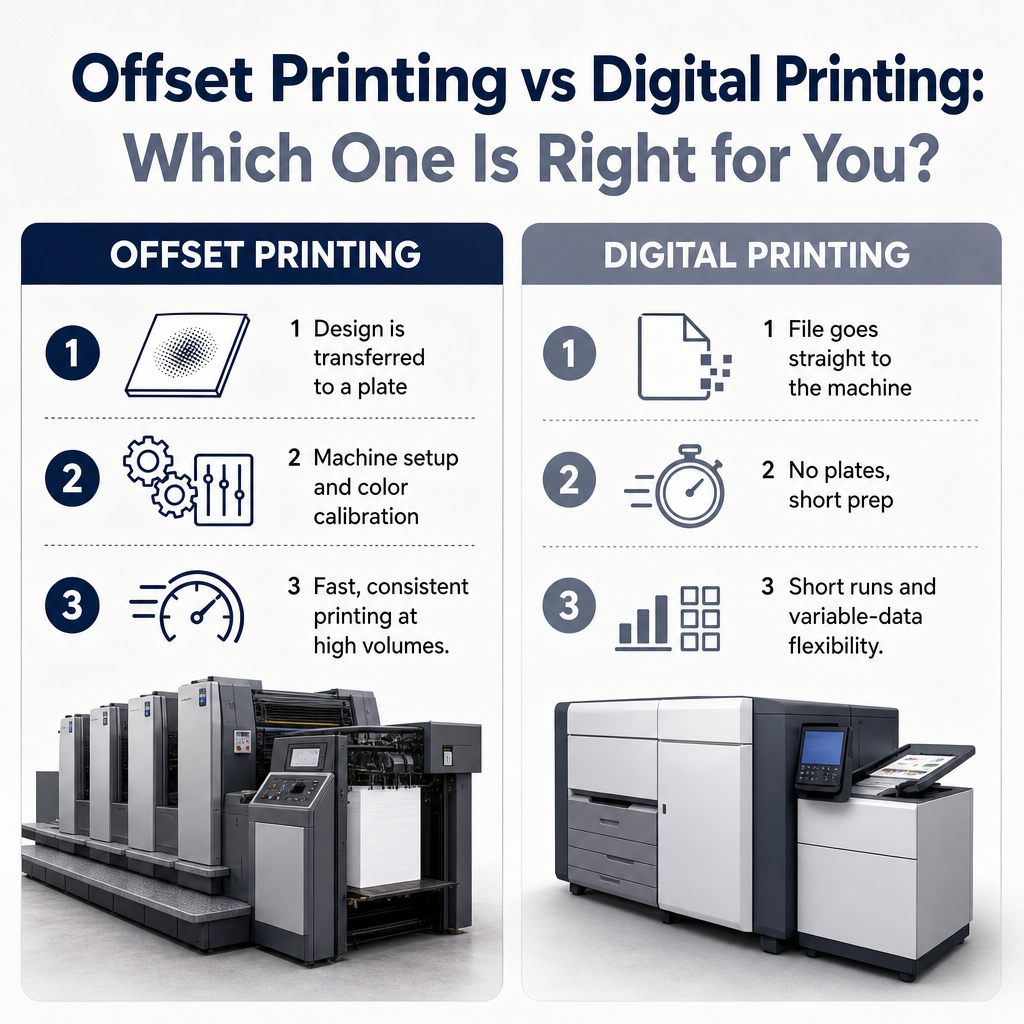
In offset printing, the design is first transferred to printing plates. Plate preparation and machine setup create time and cost at the start of production; once production begins, however, fast and consistent printing is achieved at high volumes. In digital printing, the file is sent directly to the digital printing machine. Since no physical plate is required, the preparation process is shortened; short runs, quick reorders, and different versions are managed more easily. HP also notes that digital printing requires no plates and is used for short runs and fast delivery.
For this reason, the decision should not be made solely with the question "which is higher quality?" Modern digital printing systems can offer high quality. The real advantage of offset printing is that the per-unit impact of setup costs diminishes at high volumes. In other words, the question is not about quality, but about which mechanism is economical at which quantity.
How does offset printing work and when is it advantageous?
Offset printing is based on the principle of transferring the print image from the plate to a rubber blanket cylinder, and from there to the paper or cardboard surface. In color printing, separate plates are usually prepared for CMYK color separations. This mechanism produces three practical outcomes.
The first is that an initial setup cost arises. Plate preparation, machine adjustment, color registration, and initial print checks create extra work before production; for a small order, this noticeably raises the unit price. The second is that the unit cost can decrease as quantity increases. Since plate and setup expenses are fixed to a certain extent, in high-volume printing this expense is spread over more products, and when the design remains fixed, offset becomes economical. The third is that repeatability is strong in mass production. Heidelberg's technical explanations regarding its offset systems also emphasize features such as high production speed, automatic plate changing, and precise sheet alignment.
In practice, offset stands out under these conditions: If a cosmetics brand will produce high quantities of the same box design over a long period, the total unit cost advantage becomes clear. If the brand color or corporate identity must look consistent on the shelf, offset provides controlled repetition together with the proofing and print control process. A caution is essential here: do not make the decision assuming "offset gives more accurate color." The cardboard, surface, ink, and proof type to be used must be checked together. In a premium rigid box, lamination, coating, edge cleanliness, and a color-accurate proof determine the final result just as much as print quality.
How does digital printing work and in which scenario does it stand out?
In digital printing, the print file is sent directly to the digital printing system. Since traditional plates are not prepared, design changes or different print files can be moved into production much faster. This is a decisive advantage for samples, pilot runs, low-volume orders, and packaging with frequent design changes.
The second strength of the digital method is variable data. Different QR codes, serial numbers, names, campaign messages, or product variants can be printed within the same production flow; HP notes that digital printing can be used to produce unique barcodes, QR codes, and sequential numbers. Its third strength is reducing stock risk. Printing large quantities of packaging before demand is confirmed creates idle stock if the design changes or the product sells more slowly than expected. Digital printing reduces this risk through on-demand production and more frequent reorders; Xerox also explains that digital printing can lower storage, obsolescence, and waste risks through its on-demand production and short-run approach.
These mechanics make digital a clear favorite in these scenarios: producing a small initial batch instead of stocking high quantities during new product or market testing, file-based changes for packaging with numerous scent/color/size variants, personalized boxes such as corporate gifts or influencer shipments, and fast reorders in e-commerce. Sample or pilot production is also practical and cost-effective with digital. However, there is a critical point: it should not be assumed that the sample will yield the same result as the printing method to be used in mass production. Before the final decision, request a color-accurate proof appropriate to the production method.
Offset printing vs digital printing comparison
| Criterion | Offset printing | Digital printing |
|---|---|---|
| Printing plate | Required | Not required |
| Setup process | More extensive | Shorter |
| Short run | Usually less advantageous | Usually more advantageous |
| High volume | Strong in unit cost | Unit cost may increase |
| Design change | May require new preparation | Easy to change the file |
| Variable data | Limited or additional process | Directly applicable |
| Sample/pilot | Can be costly | More affordable |
| Stock management | Large batch stock | On-demand production |
| Personalization | May be limited | Strong |
The table is a general framework. The actual result varies according to the printing machine, material, size, number of colors, surface treatments such as varnish or foil, order quantity, and production workflow. That's why, when comparing the two methods, requesting two separate quotes prepared with the same technical scope is the only reliable way to compare apples to apples.
Don't make the decision based on quantity alone
Run length matters, but it is not the only criterion. Two different brands may choose entirely different methods for the same quantity, because the product life cycle, the likelihood of design changes, the delivery plan, and the stock cost differ.
First, look at the total cost, not just the unit print price. Evaluate these items together: print preparation and plate cost, paper or cardboard cost, print quantity and waste, varnish/lamination/foil/embossing, cutting-folding-gluing, sample and proof, packaging, storage, shipping, and the risk of unusable stock. Despite its high setup cost, the offset unit price can be advantageous at high volumes; while digital starts without plates, it can fall behind in unit price at very high volumes. To see the cost items in detail, you can benefit from our guide explaining how custom box production cost is calculated.
Second, consider how long the design will remain fixed. If the packaging will be renewed within three months, even if a high-volume offset print appears economical today, there is a risk of unused stock. If the design will not change for a long time, high-volume production makes sense. Third, check the packaging's contact with the product. For food, cosmetics, pharmaceuticals, or products that may come into contact with skin, material and compliance requirements must be evaluated before the printing method; having the printing on the outer surface does not automatically eliminate the contact risk—the adhesive, inner coating, ink, and barrier must also be examined.
Fourth, put the color expectation in writing. The phrase "close to the brand color" is not clear enough for production. The brief should include the color reference to be used, the printing surface and cardboard type, the coated or kraft preference, the matte or glossy appearance, the proof type, the acceptable color tolerance, and the post-print coating. Before production begins, we carry out the color-accurate proof and approval process as part of our service model. Fifth, ask about material compatibility: not every digital machine can process every grammage, coated surface, or corrugated material the same way; similarly, not every offset line is suitable for all sizes and surface treatments.
General guidance by packaging type
For folding carton boxes, offset printing is one of the options frequently considered for high-volume jobs with a fixed design; for low-volume, multi-variant, or frequently renewed products, digital is more flexible. Our carton box solutions can be adapted to different product categories with a lightweight structure and wide print customization; for the logic of this structure, you can check out our guide explaining what a folding box is and its uses.
For premium gift, cosmetics, jewelry, and candle packaging—that is, on the rigid box side—printing should be handled together with lamination, coating, magnets, ribbons, inner dividers, and other structural details. Here, the texture of the surface and the color perception are as decisive as the printing method. For corrugated shipping boxes, the print preference is evaluated together with the outer surface, print area, shipping durability, and production quantity. For large and fixed campaigns, offset pre-printing stands out; for short runs or variable campaigns, digital stands out.
For labels, if variable data, barcodes, QR codes, expiration dates, or batch information are required, digital printing provides a clear advantage; for high-volume labels with a fixed design, different printing technologies can be more economical. For cardboard bags, thank-you cards, tissue paper, or in-box cards, the printing method should be planned together with the product's total packaging set. If a box will be produced digitally and the additional parts offset, how the colors will match must be tested in advance. If you are also considering screen printing, which is part of the printing family, our article explaining how screen printing is applied clarifies the technical differences.
Common risks and how to avoid them
The first trap is the assumption that "digital printing is always cheaper." Digital can be advantageous in short runs; but for very high-volume jobs, offset's economies of scale are stronger. The second trap is the assumption that "offset is always higher quality"; quality depends not only on technology, but also on file preparation, color management, material, the proofing process, and finishing.
The third risk is mistaking the sample for the mass production result. The sample may be digital while mass production is offset, or vice versa; in that case, a difference arises in color and surface perception. Ask that both the sample method and the mass production method be clearly stated in the quote. The fourth risk is choosing the printing method independently of the box structure. The box form, folding lines, gluing areas, inner surfaces, and bleed allowances affect the print decision; the graphic design must be prepared in accordance with the production die line. The last risk is comparing only the quantity price: a low unit price can turn into a disadvantage due to a high minimum order, long delivery, storage, or waste costs. Read the packaging quote in terms of total cost of ownership.
What information should you share with us for a quote?
So that you can receive accurate guidance on the printing method, we need to clarify the following information in your quote request:
- Product name and product dimensions
- Packaging type: carton box, rigid box, corrugated box, label, or bag
- Desired outer and inner dimensions
- Estimated order quantity and number of product variants
- The likelihood of the design changing
- The color or brand reference to be used and the desired surface treatments
- The product's sales channel and target delivery date
- Sample requirement
- Any food, cosmetics, pharmaceutical, or other compliance requirement
We coordinate the process under a single program, from discovery and specification analysis to design, prototyping, managed production, and logistics. On our page, we share a target of a quote within 24 hours and a physical sample within 7–15 business days. Once your project's quantity, material, and delivery date are clarified, we can make the printing scenario suitable for you concrete at the quote stage.
If you need short runs, fast delivery, multiple variants, or personalization, digital printing may be more suitable for you; if you are aiming for high volume, a fixed design, long-term production, and strong batch repetition, offset printing may be more suitable. For premium packaging, the most accurate decision is not to choose the technology alone, but to evaluate the material, box structure, color accuracy, surface treatments, sample, stock, and logistics together.
Frequently Asked Questions
Which is cheaper, offset printing or digital printing?
For short runs, digital printing is usually more economical because it does not require plates or extensive preparation. For high-volume jobs with a fixed design, offset provides an advantage because it spreads the preparation cost over more products.
Is digital printing high quality?
Yes, digital printing can deliver high-quality results. However, the result depends on the machine's features, the material, the color profile, file preparation, and the proofing process.
Is there a minimum quantity in offset printing?
There is no single universal minimum quantity. The economic threshold varies according to the printing machine, size, material, number of colors, plate preparation, and production planning.
Can digital printing produce personalized boxes?
When the appropriate machine and material are used, variable data such as names, QR codes, serial numbers, campaign messages, or product variants can be printed.
Can the sample be digital and mass production offset?
Yes. But a difference in color, surface, and print perception may arise between the two methods. For this reason, a color-accurate proof appropriate to the production method must be approved before mass production.