
Requesting a packaging sample is far more than asking a supplier, "could you send me an example?" The short answer to the question how to request a packaging sample is this: prepare a clear brief that defines your product and target quantity; share the box type, inner and outer dimensions, material, print expectations, inner layout, usage channel, and delivery date; distinguish the digital proof from the physical sample; test the sample together with your product and approve it in writing before mass production. The right sample shows not how the design looks on a screen, but how the packaging behaves in real life.
This guide explains what information cosmetics, jewelry, candle, chocolate, e-commerce, fashion, and corporate gift brands should prepare when requesting a sample, how to manage the process, and how to evaluate the sample. Our aim is not to rush the design into production, but to reduce mass-production risk in a controlled way.
Contents
What exactly does a packaging sample verify?
A packaging sample is a prototype that allows the packaging to be examined through a real or near-real example before mass production. Its purpose is not just to show the design, but to measure the physical behavior of the packaging in advance.
The design on screen does not reveal the rigidity of the cardboard, the lid tolerance, the magnet strength, how the inner tray fits, or the transport durability. How a box's fold lines crease, whether the lid touches the product, or how the corners behave during shipping can only be reliably evaluated on a physical example.
In practice, the sample answers five questions: Does the product sit correctly in the box? Does the packaging behave as expected when opened and closed? Does it provide sufficient protection during transport? Do the print color and surface perception match the brand expectation? Is the structure suitable for mass production? If you cannot confidently answer any of these questions on screen, a physical sample is not a luxury but a risk management tool.
Information to prepare before requesting a sample
When incomplete information reaches the supplier, unnecessary revision cycles occur at the quote, design, and sample stages. A well-prepared brief, on the other hand, allows the right material and construction recommendation to be made faster.
First, share the basic details of the product to be packaged: product name and category, width-length-height dimensions, weight, fragility, whether it is a single product or a set, how the product will be placed inside the box, and any additional parts to be used together. Specify the dimensions based on the inner dimension of the packaging where possible; the product's outer dimension alone is often not enough to account for movement allowance, protective material, and inner tray needs.
Few things are as decisive as where the packaging will be used. Store shelf, e-commerce shipping, gift presentation, corporate distribution, subscription box, or launch scenarios each create different structural priorities. A cardboard box to be used in a store is evaluated in terms of shelf impact and unboxing experience; in an e-commerce shipment, cargo impacts, outer box durability, dimensional weight, and keeping the product fixed inside the box take precedence. Instead of saying "premium box" or "shipping box," describing the usage scenario leads to a more accurate recommendation.
Finally, clarify the quantity and timeline. The estimated order quantity for the initial quote affects the evaluation of material, print method, die, and unit cost. If you have a fixed date such as a launch, campaign, or season start, you need to plan not just the mass-production time but all of the design, revision, sample, approval, production, and logistics timelines together.
A cosmetic product containing a glass bottle does not require the same box approach as a lightweight textile product. For products like chocolate or candles, in addition to appearance, food contact, odor, temperature, and surface durability should be included in the brief from the outset.
How does the sample request process work?
A sample request consists of several consecutive decision stages, and each stage lays the groundwork for the next.
The first stage is the brief and preliminary assessment. The product, brand, channel, quantity, delivery date, and budget framework are shared. If your design file is not ready, brand colors, logo files, sample inspirations, and the packaging feel you want are also sufficient to get started. In Kosapack's service model, the brief is evaluated together with the product range, target audience, sales channel, planned quantity, budget, and sustainability expectations; the box type and material direction become clear at this stage. Explore the process of creating custom packaging for your brand in more detail.
In the second stage, structural decisions are made: box type, inner and outer dimensions, material and weight, closure style, fold and glue points, inner tray or divider, complementary elements such as handles, ribbons, or magnets, and how the product is secured inside the box. Deciding based on aesthetics alone at this stage is risky; while a thin and lightweight structure may be inadequate for the product's weight, an overly thick structure can increase cost and logistics burden.
The third stage is graphic design and print preparation. Once the structural form is determined, the graphic work is applied to the box dieline; logo, text, color, imagery, barcode, and mandatory warnings are placed. It is not enough for the file to look visually appealing: the alignment of graphic areas with cut lines, bleed margins, safe areas, text or logos falling on fold lines, barcode readability, and the suitability of colors for the print system must all be checked. If you want to delve deeper into print technique and dielines, the use of digital printing in packaging and the effect of lamination on the packaging surface help you decide your surface preference early.
Color management is critical for brand identity. The color seen on screen and the color on the printed surface may differ due to screen settings, paper or cardboard surface, print technique, and coating. For this reason, digital approval does not replace a physical sample.
The difference between a digital proof and a physical sample
These two checks are not alternatives to each other but complementary. Knowing which problem you catch where saves both money and time.
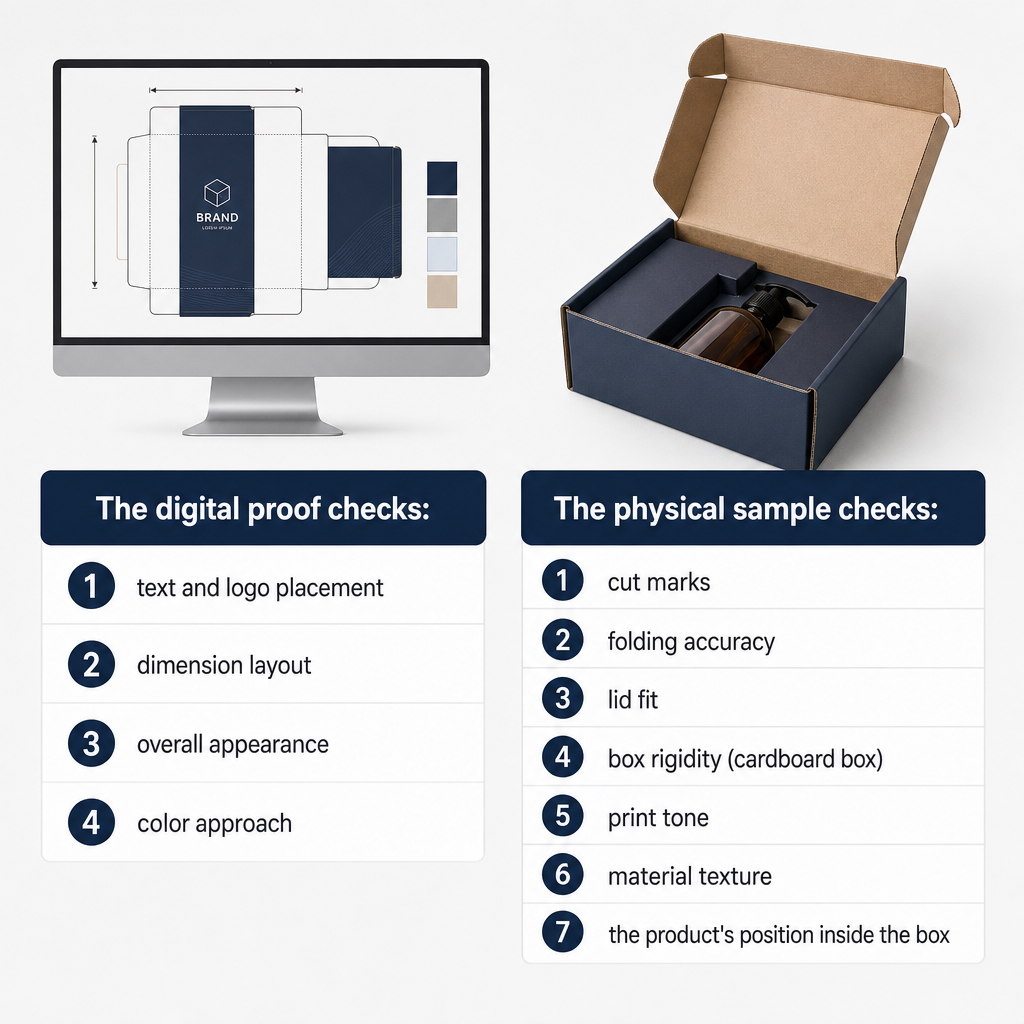
A digital proof allows the design to be checked on screen or on a digital printout before printing. Text, logo position, dimensions, design layout, and overall appearance are examined at this stage. It is an early and inexpensive filter for graphic errors.
A physical sample, on the other hand, tests the actual structure and usage behavior of the packaging. Cut marks, fold accuracy, lid fit, box rigidity, print tone, material texture, coating effect, and the product's position inside the box are evaluated realistically here. A digital proof catches graphic errors early; a physical sample makes structural and usage-related risks visible.
After the brief and design approval, a physical prototype is prepared. Kosapack states that, depending on the project brief, it aims to deliver the price quote generally within 24 hours and the physical sample generally within 7–15 business days; the actual time is finalized based on the packaging structure, material, print and surface applications, revisions, and scope. Receiving a quick quote does not mean the sample will be completed at the same speed; especially for projects that are custom-sized, with inner trays, magnetic, multi-part, or with surface applications, production preparation takes longer.
What should be checked when the sample arrives?
Examining the sample only visually on a desk is misleading. The most accurate evaluation is to test the product in a real usage scenario.
Dimension and product fit. Does the product fit into the box without forcing, is there excessive gap inside, does it move, does the inner tray secure the product adequately, does the lid touch the product, is the packaging damaged when the product is removed? Test the product not once but several times, repeating the open-close and removal operation; ease of use is decisive in the store and gift experience.
Closure and mechanical structure. The lid should close properly, the box should not open where it shouldn't, and it should open easily when needed. In magnetic or drawer designs, the consistency of the mechanism should also be examined. If you see cracking at the folds, separation at the glue points, or deformation at the edges, request a revision before mass production.
Print, color, and surface. Examine the sample under different lighting conditions, as close to daylight as possible. The closeness of the brand color to the target tone, detail loss in dark areas, readability of small text, the homogeneous distribution of print on the surface, and how the coating affects the color should be checked. Applications such as matte, glossy, or soft touch can make the same color appear warmer or darker on different surfaces; therefore, the coating choice should be decided not from a catalog but, as much as possible, on the physical sample.
Transport and durability. In an e-commerce or cargo scenario, place the product in the box with its real inner layout, close the box, position it inside the outer cargo box, observe any movement that may occur during transport, and inspect the corners and inner protection. This controlled test does not replace a laboratory durability test; however, it reveals early on problems such as the product sliding inside the box, inner parts coming loose, or the packaging being too weak.
Points to consider for food, cosmetics, and regulated products
For food packaging, sample approval is not just color and dimension control. Whether the packaging material comes into contact with the product, the position of the printing ink, and the suitability of the coating and other components must also be evaluated.
The Turkish Food Codex Regulation on Materials and Articles in Contact with Food contains provisions regarding materials in contact with food and also sets requirements for labeling and not misleading the consumer for active and intelligent materials. The Food Hygiene Regulation, on the other hand, stipulates that packaging material must not be a source of contamination and that the packaging process must be carried out in a way that prevents contamination.
For this reason, when requesting a sample in regulated categories such as food, cosmetics, personal care, or similar, share the following information from the outset: whether the product is in direct contact with the packaging, whether the packaging is primary or secondary, whether the product is oily, moist, acidic, or hot, the required warnings and content information, the need for recycling marks, and the compliance or test documents requested. Even if you receive support on design and layout, the legal compliance responsibility specific to the product category must be verified together with the brand and relevant technical consultants.
How to write a sample request and approval message?
A clear request sent to the supplier makes it easier to recommend the right box structure and to plan the sample timeline realistically. A sample template might have the following structure:
Hello,
We would like to request a custom-sized packaging sample for our brand.
Product: 50 ml glass cosmetic bottle Product dimensions: Width / Length / Height Packaging type: Cardboard box Usage channel: E-commerce and gift shipping Estimated order quantity: … units Desired inner solution: Inner tray to secure the product Print: Logo and brand colors attached Surface expectation: Matte finish Target delivery date: …
Could you share your recommended material, estimated timeline, sample scope, and the quoting process? We would like to test the sample together with our product.
At the approval stage, instead of saying "approved," clearly write out the scope. The approval message should include the approved packaging type, inner and outer dimensions, material and weight, print colors, coating or surface application, inner tray and divider details, closure style, print file or design version, the approved sample date, and revision notes. If the material, print, or production method used in the prototype differs from mass production, these differences must be clearly stated during the quote and approval process.
Common mistakes in sample requests
The same mistakes recur across different sectors, and most can be prevented at the brief stage.
- Requesting a sample by sending only a logo. A logo is just one part of the design. Without specifying the product dimensions, quantity, usage channel, and box expectations, the correct sample scope cannot be determined.
- Treating the on-screen design as the physical product. A screenshot does not show the rigidity of the cardboard, the texture of the coating, or how the lid closes. Going into mass production without seeing a physical sample carries serious risk.
- Testing the sample without the product. An empty box may look better or worse than it does with the product. The product's real weight and dimensions directly affect the box's closure, balance, and protection.
- Changing the file after sample approval. If the color, dimensions, material, or design change after approval, a new sample may be needed. Collecting all decisions in a single revision list before approval reduces loss of time and cost.
- Leaving legal information to the final stage. When content, warnings, barcodes, and recycling marks are added after the design is complete, the layout gets disrupted. For regulated products, this information should be shared in the first stage of the brief.
How does a sample request work with Kosapack?
In our custom packaging model, the process covers the stages of brief, structural and graphic design, digital proof, physical prototype, production, quality control, and logistics. After approval, we manage mass production through verified factory partners; we track print, cut, glue, and strength controls. We aim to deliver the price quote generally within 24 hours and the physical sample generally within 7–15 business days; the exact time is finalized based on the project's structure.
Because we can also plan complementary products such as labels, paper bags, tissue paper, thank-you cards, fabric pouches, and in-box dividers along with the box, brands can manage their entire packaging set within a single visual and operational framework. To plan your sample clearly, sharing your product dimensions, usage channel, estimated quantity, and target date helps us quickly prepare the right material and timeline recommendation for you.
Frequently Asked Questions
How long does it take to prepare a physical packaging sample?
Depending on the project brief, the physical sample timeline is generally planned as 7–15 business days. The time may vary based on the box structure, material, print, surface application, and number of revisions.
Is there a difference between the sample and mass production?
The prototype and mass production method may differ by project. If the material, print system, or surface application used in the sample will differ from mass production, request that the supplier clearly state these differences.
Can I request a sample if my design file is not ready?
Yes. The process can begin with product information, logo, brand colors, and usage expectations. Suppliers offering structural and graphic design support can also manage the packaging's dieline and print preparation.
Is the sample paid?
The scope of the sample fee may vary based on design, die, material, print, shipping, and project conditions. When requesting a quote, ask whether the sample cost is included in the production price, how many revisions it includes, and the conditions that will apply if a new sample is needed.
Is sample approval sufficient for food packaging?
No. A physical sample provides dimension, structure, and usage control. Food contact compliance, material, and production conditions must additionally be verified through the relevant legislation and technical documents.