
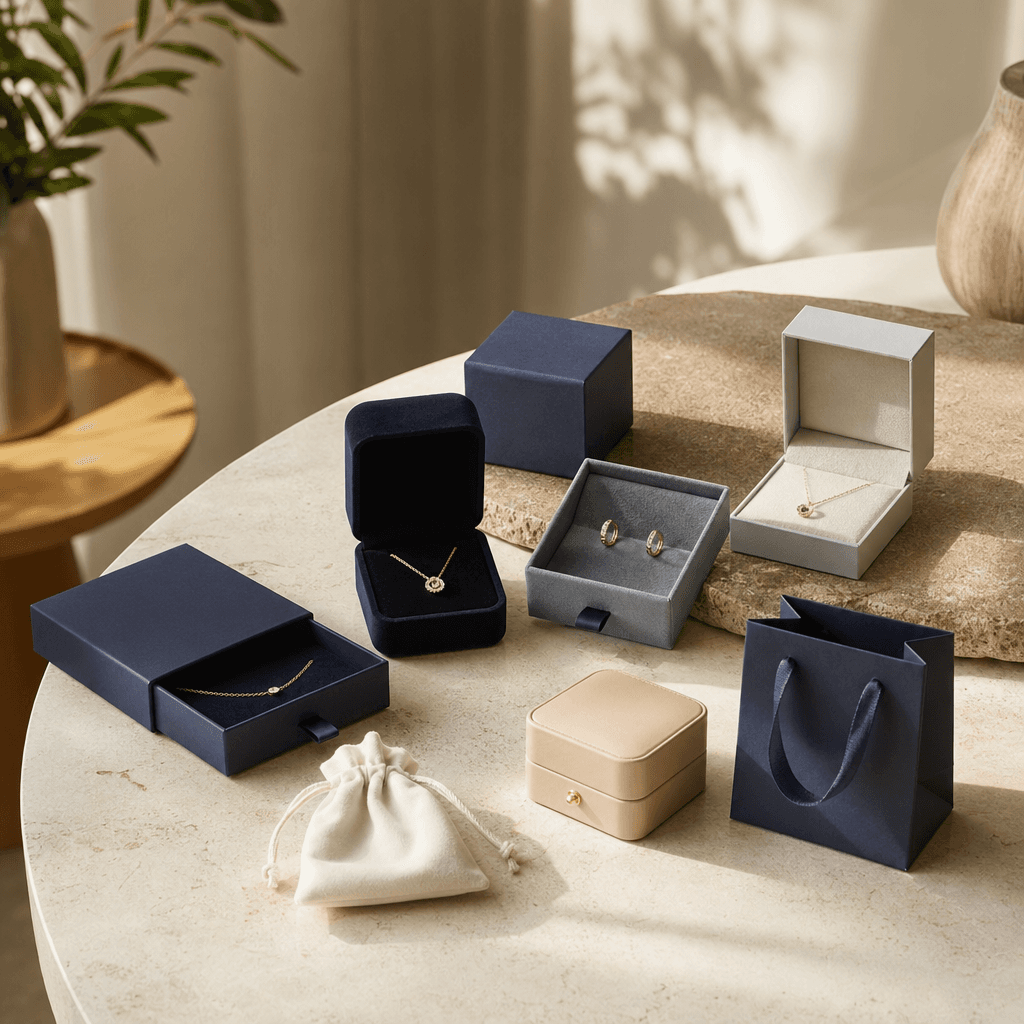
Choosing the right option among the various types of jewelry packaging requires more than just looking at a box's appearance. The geometry of a ring, necklace, earring, bracelet, or jewelry set; the sales channel; shipping conditions; brand positioning; and internal protection needs are all evaluated together. While a rigid magnetic-lid box may be the right choice for a premium jewelry brand, a high-volume fashion jewelry brand might opt for a folding carton box combined with a pouch. In e-commerce, a corrugated shipping box and protective filling come into play in addition to the inner jewelry box. Our goal is not to recommend a single "best" packaging; it is to determine together a jewelry packaging system suited to your brand's product and sales scenario.
Contents
What is the real decision in jewelry packaging?
A jewelry package is not merely a container that carries the product; it takes on four jobs at once. It protects the jewelry against scratching, friction, impact, and deformation. It reflects the product's brand positioning and perceived value. It shapes the store, gift, or e-commerce experience. Finally, it makes storing and reusing the product easier.
These four functions mean that the box form, material, print, internal layout, and external shipping protection should not be chosen independently of one another. The real decision is not "which box looks nice" but "in which channel, in what quantity, at what level of perception, and with what protection will this product be sold." In our guide to jewelry box manufacturing for brands, we elaborate on the importance of addressing these mechanisms together.
What are the types of jewelry packaging?
Rather than reducing jewelry packaging to a single form, it yields more accurate results to read the strengths and weaknesses of each option by looking at which product and channel it matches.
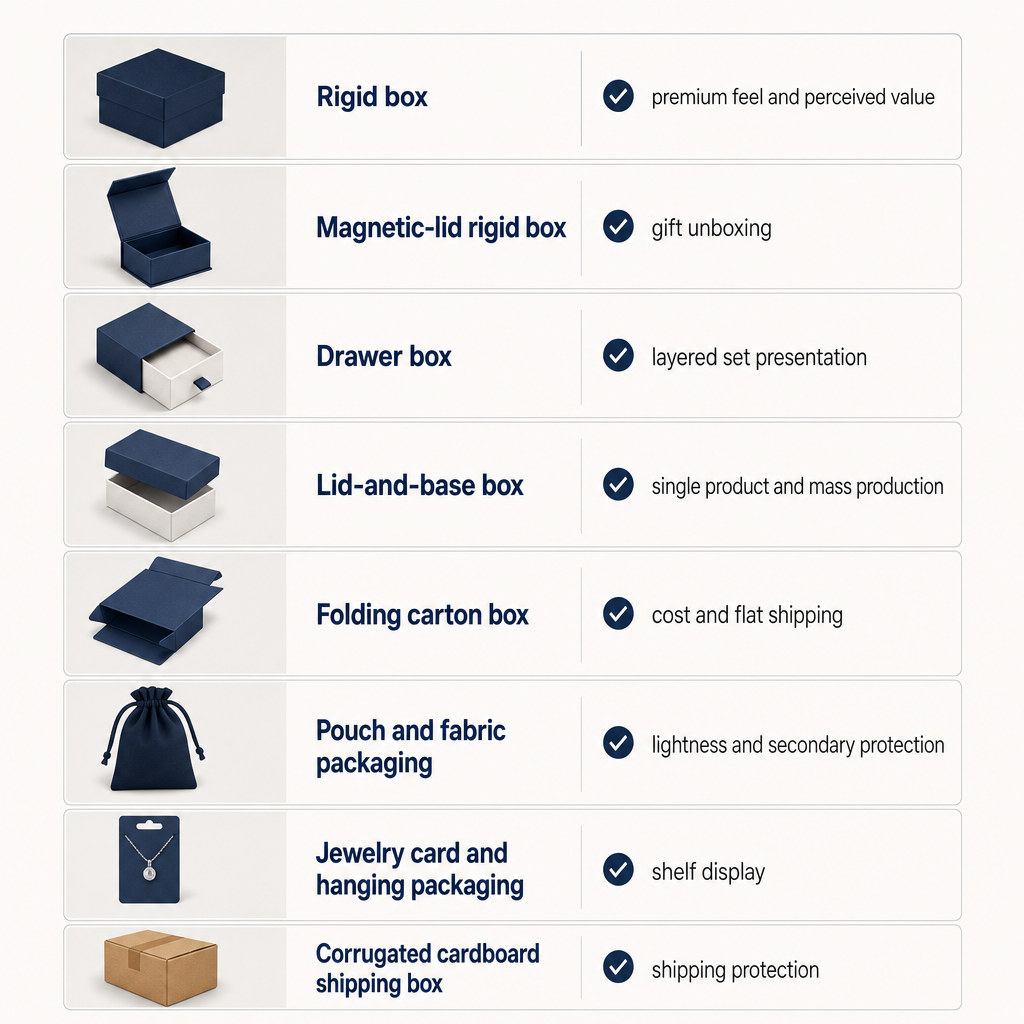
Rigid box
A rigid box is formed by wrapping a dense cardboard body with decorative paper, a printed surface, or fabric, and it stands at the forefront of premium jewelry packaging. It gives a solid, substantial product feel; offers different internal layouts for rings, earrings, necklaces, and jewelry sets; and is compatible with velvet pads, foam, microfiber, and cardboard separators. It can be produced in magnetic, drawer, or lid-and-base form and enriched with finishes such as foil stamping, embossing, and spot varnish.
It is especially suitable for fine jewelry, jewelers, niche jewelry, and premium gift sets: diamond and gemstone rings, premium necklaces, earring pairs, bracelet and watch sets, special collections, and corporate gift packages. It has higher material and labor costs; in return, its reusability and perceived value are strong. For structural details, you can also see our content What Is a Rigid Box? Its Features and Uses.
Magnetic-lid rigid box
In this model, the lid closes with hidden or visible magnets. The opening and closing motion creates a more controlled and premium feel compared to a standard box; it strengthens the gift reveal, offers a satisfying feel on closing, and leaves ample surface area for logos, foil stamping, and embossing. It makes for an effective presentation for jewelry sets and high-value products.
The magnet's position and strength should be tested in the prototype. An overly strong magnet can cause deformation on the box surface; in very small boxes, the magnet placement can reduce the internal volume. The compatibility of magnetic components with shipping and product specifications should also be checked separately. The model is suitable for brands that want to create a premium feel at the moment the product is opened.
Drawer box
A drawer box consists of an outer sleeve and a drawer section that slides inward; it presents the jewelry in a layered and controlled way. It is suitable for jewelry sets, collection launches, packages where multiple pieces are presented together, e-commerce unboxing experiences, and special-occasion products. Here, how the product comes out of the box is critical: if the drawer is too tight, use becomes difficult; if it is too loose, the box opens during transport. The rail effect, tolerances, and internal layout should be validated with a physical sample.
Lid-and-base box
This is the classic form in which the top lid and bottom body consist of two separate pieces. It is practical for rings, earrings, small necklaces, and single products; it offers simple use, ease of production in different sizes, the option to add inner pads and separators, a structure scalable between premium and mid-segment, and suitability for mass production. The lid's fit tolerance to the body must be set correctly; an overly tight lid spoils the experience, while a loose lid reduces protection during transport.
Folding carton box
Because a folding carton box can be shipped flat, it provides an advantage in logistics and storage; it gains its form through cut and fold lines. It stands out for fashion jewelry brands, high-quantity runs, shelf and store sales, secondary packaging, and a more accessible price positioning. It is lighter and generally lower cost than a rigid box; in return, its impact resistance and substantial feel may not be at the same level. The right carton weight is determined by considering the jewelry's weight, box size, inner pad, and sales channel. Carton that is too thin deforms easily; carton thicker than necessary increases cost and folding difficulty.
Pouch and fabric packaging
A fabric or velvet pouch is a lightweight and reusable option that reduces scratching of the jewelry. It can be used on its own or positioned inside a rigid box. It is suitable for minimal brand identities, costume and fashion jewelry, backup or complementary packaging, collection and promotional products, and a second layer of protection inside a box. A pouch does not provide as much protection against hard impacts as a box; in addition, separate compartments, card fixtures, or additional internal layout may be needed to prevent necklace chains from tangling.
Jewelry card and hang-tab packaging
Earrings, necklaces, or bracelets can be fixed to cardboard jewelry cards and displayed on the card; this card can be used together with a pouch, cardboard box, or clear protector. It makes in-store display easier, opens up space for the brand logo and product information, simplifies storage for low-volume products, and is practical for high-quantity fashion jewelry. In this solution, the puncture resistance of the cardboard, the way the product is fixed, and the friction of metal parts against the card should be tested.
Corrugated shipping box
A corrugated shipping box is used for shipping protection rather than direct presentation; especially in e-commerce, it forms a second protective layer around the inner jewelry box. A typical e-commerce jewelry package can be built from the following components: an inner rigid or folding carton jewelry box, a pouch, pad or separator, a thank-you card, tissue paper, a corrugated shipping box, and filling material when needed. Although jewelry is small and light, during shipping it is exposed to risks such as box compression, dropping, vibration, and contact with other packages. For this reason, we recommend adding a corrugated shipping box and filling around the jewelry box in online sales.
Why is internal protection the heart of packaging?
The jewelry moving inside the box leads to surface scratching and pieces tangling with one another. That is why the internal layout is not an aesthetic detail but a fundamental part of the protection mechanism.
For rings, cut foam, a velvet roll, or a custom cardboard slot can be used; the slot's dimensions are determined by the ring's band thickness and stone height. A punched card, foam, or custom-cut inner tray helps keep earring pairs from separating. Necklace chains carry a high risk of tangling and knotting; fixing the chain, using a separate channel, or placing the necklace on a card reduces this risk. In sets where multiple pieces are in the same box, a cardboard separator, foam divider, or custom thermoformed inner tray limits the pieces from colliding and rubbing.
When choosing the inner surface material among velvet, microfiber, foam, kraft, or coated cardboard, the following criteria are weighed: the surface's scratching risk, the likelihood of fiber shedding, moisture behavior, chemical compatibility with the product, brand feel, recycling target, and cleanability. These variables show that the inner material should be chosen according to the product; the same velvet is not the best option for every piece of jewelry.
How should you interpret tarnishing and moisture risk?
On silver and some metal surfaces, tarnishing can occur as a result of chemical reaction with sulfur-containing gases in the air. The Canadian Conservation Institute states that the rate of silver tarnishing increases as relative humidity rises and that it is appropriate to store silver in dry conditions below 50 percent relative humidity.
This information carries several concrete implications for the packaging decision. Jewelry should not be left for long periods in a completely sealed and humid environment; the packaging material, adhesive, and inner lining must be compatible with the product; and certain materials that may contain rubber and sulfur should be avoided. In humid climates, the outer shipping packaging and storage conditions should also be evaluated separately; if anti-tarnish paper or strips are to be used, their compatibility with the product and service life should be verified with manufacturer data.
The claim that packaging definitively prevents tarnishing should not be used without a test or a material technical document; the design goal is to reduce the risk of air, moisture, friction, and contamination.
How do printing and surface treatments build brand perception?
The brand perception of jewelry packaging is determined as much by printing and surface details as by the box form. Offset printing is suitable for colorful patterns, gradient transitions, fine lines, and photographic graphics, and is preferred for boxes that tell a collection story. Pantone or single-color printing provides controlled color consistency in minimal and corporate identities; it is effective for a single-color logo, monogram, or plain typography. Foil printing increases the luxury perception with gold, silver, or metallic effects and gives a more controlled result in short brand messages. Embossing and debossing make the logo tactile; it can be used together with foil or on its own in a plain design. Spot varnish, meanwhile, creates shine and contrast in specific areas to highlight a logo or pattern on a matte background.
Color and finish decisions should be validated on a physical sample, not on a screen. The paper surface, coating, printing technique, and lighting conditions can produce a result different from the on-screen appearance. To compare label and printing techniques more closely, you can make use of our content What Is Label Printing? Types and a Guide for Brands.
Packaging selection by brand scenario
The same product category is not always tied to a single box; a brand may use folding carton for its everyday collection and a rigid box for its high-value collection. The matching below should be read with this logic.
| Brand or sales scenario | Suitable packaging system | Key priority |
|---|---|---|
| Luxury jeweler | Magnetic or drawer rigid box + velvet inner slot | Perceived value and presentation |
| Premium jewelry brand | Rigid box + custom inner tray + foil stamping or embossing | Product protection and brand experience |
| Fashion jewelry brand | Printed folding carton + jewelry card or pouch | Cost, quantity, and shelf presentation |
| E-commerce and DTC brand | Inner jewelry box + corrugated shipping box + thank-you card | Shipping protection and unboxing |
| Brand selling jewelry sets | Drawer or lid-and-base rigid box + separator | Keeping pieces separated |
| Corporate gift project | Magnetic rigid box + card or pouch | Gift presentation and visibility |
| Collection launch | Custom-shaped rigid box + limited-edition print | Differentiation and memorability |
Key criteria weighed in the selection
The variables that determine the suitable packaging influence one another; they need to be read together rather than one by one.
Product geometry: A ring, earring, necklace, and bracelet cannot be protected with the same internal layout. The product's length, thickness, stone height, and range of movement should be measured.
Sales channel: Visual presentation comes to the fore in stores; in e-commerce, the risk of impact and compression gains importance. If a shipping box is to be used, box size, amount of filling, and shipping conditions are evaluated together.
Brand positioning: Economy, accessible, premium, and luxury segments may use the same box form; however, the level of material, inner lining, printing, and finish differs.
Order quantity: At high quantities, die, print, and material optimization affect the unit cost. In low-quantity or limited runs, digital printing or solutions with fewer components can provide an advantage.
Storage and logistics: The storage volume of rigid boxes and the flat-shipping advantage of folding carton boxes are taken into account. In e-commerce, the dimensional fit between the inner box and the outer shipping box is important.
Sustainability: Recyclable paper and cardboard, certified raw materials, reduction of unnecessary components, and carbon footprint tracking are evaluated together. For a recyclability claim, the separability of the coating, magnet, fabric, adhesive, and different materials should also be examined. For brands exporting to the EU, packaging legislation should also be followed: under the Packaging and Packaging Waste Regulation, the Ministry of Trade has published a Turkish FAQ regarding the applications starting as of August 12, 2026. The document explains that packaging must be identifiable and traceable and that, in some cases, manufacturer and contact information must be present on the packaging or accompanying documents.
Common risks in jewelry packaging
The most costly mistakes usually arise from small mismatches that go unnoticed before mass production. The inner slot not fitting the product is chief among them: too large a slot causes the jewelry to move inside the box, while too narrow a slot causes scratching during placement. Appearance taking precedence over protection is also common; foil stamping, embossing, or special coating adds aesthetic value, but it is a mistake to invest only in the outer appearance without resolving the internal layout and logistics protection.
Choosing a box size larger than necessary increases the product's movement during transport and the need for filling, and on top of that raises storage and shipping costs. Incompatible inner material is a separate risk: some fabrics, papers, rubbers, or adhesives may be incompatible with metal surfaces, and material tests should be conducted especially for silver and plated products. Mass production without a sample, meanwhile, magnifies all these risks at once; a screen design does not fully show the real print color and box feel. Before mass production, a physical prototype should be checked in terms of lid, magnet, drawer, inner slot, color, and surface.
Jewelry packaging project with Kosapack
In jewelry packaging projects, we jointly manage the stages of needs analysis, structural and graphic design, prototyping, production, quality control, and logistics. We can plan rigid boxes, folding carton, corrugated shipping boxes, paper bags, labels, and auxiliary packaging components within the same project. We explain in detail how we approach the entire packaging process in our content What Is Packaging Consultancy? A Guide for Brands.
For preparing a quote, sharing the following information makes for a sufficient starting point: jewelry type and product dimensions, whether it is a single product or a set, target order quantity, store/e-commerce/gift scenario, brand colors and logo files, desired box form, inner slot or separator need, sustainability goals, and delivery expectations. In our own process, we aim for a quote within 24 hours and a physical sample within 7–15 business days. Testing the sample together with the product before mass production enables a safer decision in terms of box closure, internal layout, print color, and transport durability.
Frequently Asked Questions
Is a folding carton box or a rigid box better for jewelry?
There is no single right answer. For a premium, high-perceived-value goal, a rigid box; for high quantity, flat shipping, and cost control, a folding carton box may be more suitable. The decision is made by reading the product, channel, and segment together.
Is the jewelry box alone sufficient in e-commerce jewelry packaging?
Usually no. The jewelry box needs to be supported with a corrugated shipping box and filling against crushing and impacts during shipping.
Does silver jewelry tarnish in the box?
Tarnishing is related to sulfur-containing gases, moisture, the product surface, and storage conditions. Packaging can reduce the risk but does not alone guarantee absolute protection. For silver, dry storage and appropriate material selection are important.
Should foam or velvet be used in a jewelry box?
The choice is made according to the product surface, scratching risk, brand feel, moisture behavior, and sustainability goals. Both options should be tested with a physical sample.
What information is needed when requesting a quote for jewelry packaging?
Product dimensions, product type, quantity, sales channel, box preference, internal layout, printing expectation, target delivery date, and sustainability criteria are the basic information for a quote.