

There is no single market price that fits everyone when it comes to cardboard box production prices. Two boxes of the same size can be priced noticeably differently depending on cardboard thickness, covering paper, printing, magnets, internal layout, assembly, and order quantity. For this reason, the question to ask is not merely "what is the price per box?" but rather "what cost items make up the total project cost of the box I need?" In this guide, we break down the items that make up the price one by one, explain what you need to prepare to get a comparable quote, and share the hidden risks in offers that appear low.
At Kosapack, we do not publish a public fixed cardboard box price list; because each project carries a different combination of box type, size, material, and scope. We prepare the quote by evaluating box type, dimensions, material, printing, surface treatments, quantity, internal layout, sample, and delivery conditions together. The sections below make it clear how these decisions reflect on the cost.
Contents
What cost items make up cardboard box production prices?
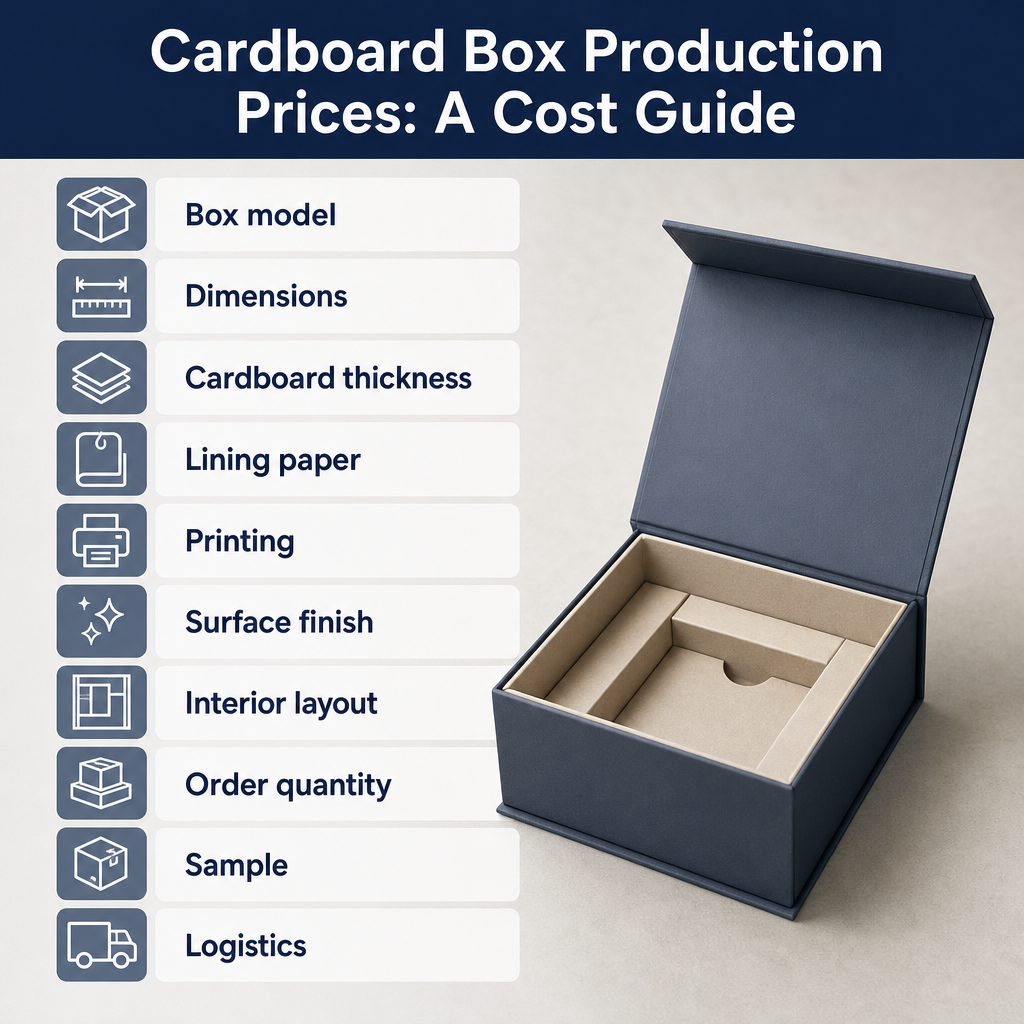
Cardboard box production prices cannot be reliably expressed as a single range before the project brief is clarified. Especially in premium boxes, items such as covering, lining, magnets, handcraft, and assembly can significantly change the total cost. When evaluating an offer, you need to look not at a single unit price but at the sum of the items below.
| Cost item | How does it affect the price? |
|---|---|
| Box model | The production complexity of lidded, drawer-type, magnetic, or hinged structures differs. |
| Size | A larger box requires more material, storage space, and shipping volume. |
| Cardboard | Thickness, density, load resistance, and surface structure change the cost. |
| Covering paper | Paper type, grammage, texture, and printability affect the price. |
| Printing | CMYK, spot color, printing surface, and color accuracy expectations are reflected in the cost. |
| Surface treatment | Lamination, soft touch, spot varnish, foiling, embossing, and relief create additional cost. |
| Internal layout | Separators, foam, cardboard inserts, or custom molds are a separate cost item. |
| Order quantity | Fixed costs such as mold and machine setup are distributed across a larger batch as quantity increases. |
| Sample | A physical prototype is a pre-mass-production control cost. |
| Logistics | Palletizing, shipping, storage, and delivery method are added to the total amount. |
The practical result of this table is this: even if two suppliers give you a price for the same "cardboard box," comparing them without seeing in writing which items they include is misleading. A figure that appears low may be excluding the mold or sample cost.
Which is more economical: a cardboard box or a carton box?
There is no single answer to this question; because the two boxes serve different usage scenarios. A folding carton box is often a lighter, less material-consuming solution that can be shipped flat. It can be economically preferred for cosmetics, soap, lightweight retail products, and some non-food products.
A cardboard box, on the other hand, provides a premium perception, durability, and a strong opening experience with its thicker and more rigid structure. It stands out for jewelry, perfume, candles, chocolate, gift sets, and products aiming for high value perception. However, since cardboard boxes may involve additional processes such as covering paper, lining, assembly, magnets, ribbon, or custom internal inserts, the total cost is generally more comprehensive.
The correct interpretation is to evaluate the two boxes not only by material price but together with the presentation and protection value they provide. For a product that needs to create value perception on the shelf, a cheap folding box may seem like "savings" but can cause a loss in brand perception; conversely, for a lightweight and standard product, a cardboard box may be an unnecessary cost. You can examine the fundamental differences in material selection in detail in the guide Cardboard Box vs Corrugated Box: Which Is Right?
Decisions that most affect the price
Within the same box brief, the impact of a few decisions on cost is much greater than others. Directing your energy toward these items when planning your budget both prevents unnecessary spending and makes the price predictable.
Box model and mechanism
A simple lidded box and a magnetic, drawer-type, or hinged box do not carry the same production load. Structural features that can increase cost include magnetic lids, drawer structures, hinged lids, windowed lids, custom-shaped bodies, multi-part internal layouts, and details requiring hand assembly. Our portfolio includes various structures such as reverse-lidded, flat-lidded, tuck-top, auto-bottom, pillow boxes, hinged, tray, and sleeve. This diversity shows that the price is calculated not just according to the "cardboard box" definition, but according to the chosen structure.
Size and material usage
As the box size increases, it is not only the amount of cardboard used that increases; the covering surface expands, the printing area grows, and the storage volume and dimensional weight cost in e-commerce shipments may rise. When determining the size, in addition to the net dimensions of the product, the internal filling allowance, closing gap, separator thickness, and protective material requirement must also be taken into account. A box larger than necessary; instead of looking premium, causes the product to move inside the box, additional filling needs, and increased logistics costs. A box smaller than necessary may cause the product to be squeezed or deformed during transport.
Printing and color accuracy
Printing cost does not consist only of the number of colors. Single or double-sided printing, CMYK or spot color, printing area, use of dark backgrounds, metallic or light-colored logos, and print proofing are evaluated together. Especially in premium packaging, a tone difference may occur between the design on screen and the printed result. For this reason, a physical sample or color proof is not just visual approval but a control stage that reduces quality risk.
Covering and surface treatments
Processes such as matte or glossy lamination, soft touch surface, spot UV varnish, water-based varnish, foil gilding, embossing, relief, and textured special paper change the box's tactile feel, scratch resistance, and shelf appearance. However, not every process is necessary for every product. In a box that is continuously shipped, scratch resistance is a priority; while in a perfume box presented on a store shelf, gilding or a soft touch surface makes more sense. You can check out the content What Is Lamination Coating? Its Use in Packaging for how lamination works, and the guide What Is Soft Touch Lamination? A Premium Touch Guide for the advantages and limits of the soft touch option.
Order quantity and stock balance
Expenses such as mold, preparation, print setup, and machine setup occur independently of the order quantity. When the quantity is low, these fixed costs are distributed across a small number of boxes and the unit price rises; when the quantity increases, the unit price drops. However, a high quantity is not always the right decision. Overproduction creates risks such as storage costs, cash flow being tied up in stock, boxes left on hand in case of logo or design changes, and unnecessary stock in case of low demand. For this reason, when requesting a quote, it is healthier to compare the initial production and subsequent replenishment scenarios together rather than a single quantity.
Internal layout and protection
For jewelry, chocolate, candle, or cosmetic sets, the internal layout of the box is just as important as its external appearance. Product-specific cardboard inserts, separators, foam, tissue paper, multiple product compartments, and manual placement directly affect the cost. Internal layout both prevents the products from touching each other and organizes the opening experience; however, as the number of compartments and assembly increases, the total project cost also increases.
What information should you prepare when requesting a quote?
To get a clear cardboard box production price, providing the supplier with only the quantity information is not sufficient. The brief below allows different offers to be compared within the same scope and speeds up the process by reducing back-and-forth questions.
| Information needed for the quote | Its role in pricing |
|---|---|
| Product name and usage scenario | Determines protection, presentation, and box structure. |
| Product dimensions and weight | Determines internal dimensions, cardboard thickness, and carrying requirements. |
| Desired box model | Clarifies lid, drawer, magnet, or hinge structure. |
| Estimated order quantity | Affects the distribution of fixed production costs. |
| Print file and color expectations | Indicates the printing method, spot color, and proofing needs. |
| Surface treatments | Clarifies the scope of lamination, varnish, gilding, or soft touch. |
| Internal support requirement | Indicates the cost of separators, foam, inserts, or custom molds. |
| Food contact situation | Required for selecting suitable material and surface. |
| Delivery city and date | Determines shipping, sample, and production planning. |
For an offer to be comparable, the scope must be in writing. Clearly ask whether structural and graphic design, mold and cutting, print preparation, physical sample and its revisions, surface treatments, internal separators, assembly, packaging, shipping, VAT, waste and tolerance conditions, and the offer's validity period are included. You can examine how this scope management works in packaging projects in the article What Is Packaging Consultancy? A Guide for Brands.
What risks are hidden in low-priced offers?
The lowest unit price does not always mean the lowest total cost. In offers with an unclear scope, the cost rises later and quality becomes unpredictable. The most common risks are as follows:
- Technically undefined material: Expressions such as "thick cardboard" or "premium paper" are not sufficient. The cardboard thickness, type of covering paper, surface treatment, and printing scope must be in writing.
- Mass production without a sample: Going into production without seeing a sample can cause errors in size, color, closure, or internal layout to spread across the entire batch.
- Out-of-scope costs: If the mold, assembly, shipping, VAT, or print preparation are not included, an offer that initially appears low rises later.
- Unnecessary features: Not every project requires magnets, gilding, or custom internal molds. Processes that do not contribute to the usage scenario inflate the budget.
- Excessively large size: A large box, in addition to high material and logistics costs, also causes the product to move inside the box.
The healthy way to lower the price is not to randomly cut quality, but to optimize the box size, eliminate unnecessary surface treatments, simplify the internal layout, and align the order quantity with a realistic demand forecast.
How is sustainability cost evaluated?
In Turkey, all packaging placed on the market and the waste from this packaging fall within the scope of the Regulation on the Control of Packaging Waste. The regulation governs the scope of packaging placed on the market and the basic obligations regarding packaging waste. For this reason, when evaluating cardboard box cost, you should look not only at the purchase price but also at the post-use phase of the packaging.
Criteria you can include in the evaluation are: reducing unnecessary material use, the compatibility of the box size with the product, the easy separability of different materials, the recycling impact of covering and lamination, management of production waste, and reduction of logistics volume. In our carton packaging solutions, we can benefit from FSC® and SFI® certified papers as well as plant- and waste-based alternatives, and recyclable and compostable options. The suitability of these options must be verified together with the intended use of the product and the preferred surface treatments; for example, since some lamination layers can make recycling difficult, the surface preference should be decided together with the sustainability goal.
To clarify the price scope for your cardboard box project, you can share the product dimensions, box model, estimated quantity, printing and color expectations, internal support requirements, delivery city, and target date. We manage consultancy, structural and graphic design, sampling, production, and delivery within the same project scope; as the information becomes clearer, the scope of the quote also becomes comparable. Once the project brief is clarified, we aim for a quote within 24 hours and usually a physical sample within 7–15 business days; this time is not the mass production delivery time, but the physical sample time.
Frequently Asked Questions
Why are cardboard box production prices not fixed?
Because the price is calculated by evaluating box model, size, cardboard thickness, covering, printing, surface treatments, internal layout, order quantity, sample, and logistics together. As these items change, the price of a box of the same size also changes.
Which is cheaper, a cardboard box or a carton box?
A folding carton box, which is generally lighter and can be shipped flat, may be more economical in terms of material and logistics. A cardboard box, on the other hand, provides a more rigid and premium presentation; covering, assembly, and accessories can increase the total cost.
What is the minimum order quantity in cardboard box production?
The minimum order quantity varies depending on the box structure, printing technique, mold requirement, and production model. For this reason, the same minimum quantity should not be assumed for every project.
Are the sample and VAT included in the price quote?
This depends on the scope of the offer. You need to ask in writing whether the sample cost, number of revisions, VAT, shipping, palletizing, assembly, and mold cost are included.
What is the most effective way to lower the cardboard box price?
Instead of randomly reducing quality, optimizing the box size, eliminating unnecessary surface treatments, simplifying the internal layout, and aligning the order quantity with a realistic demand forecast are healthier methods.