
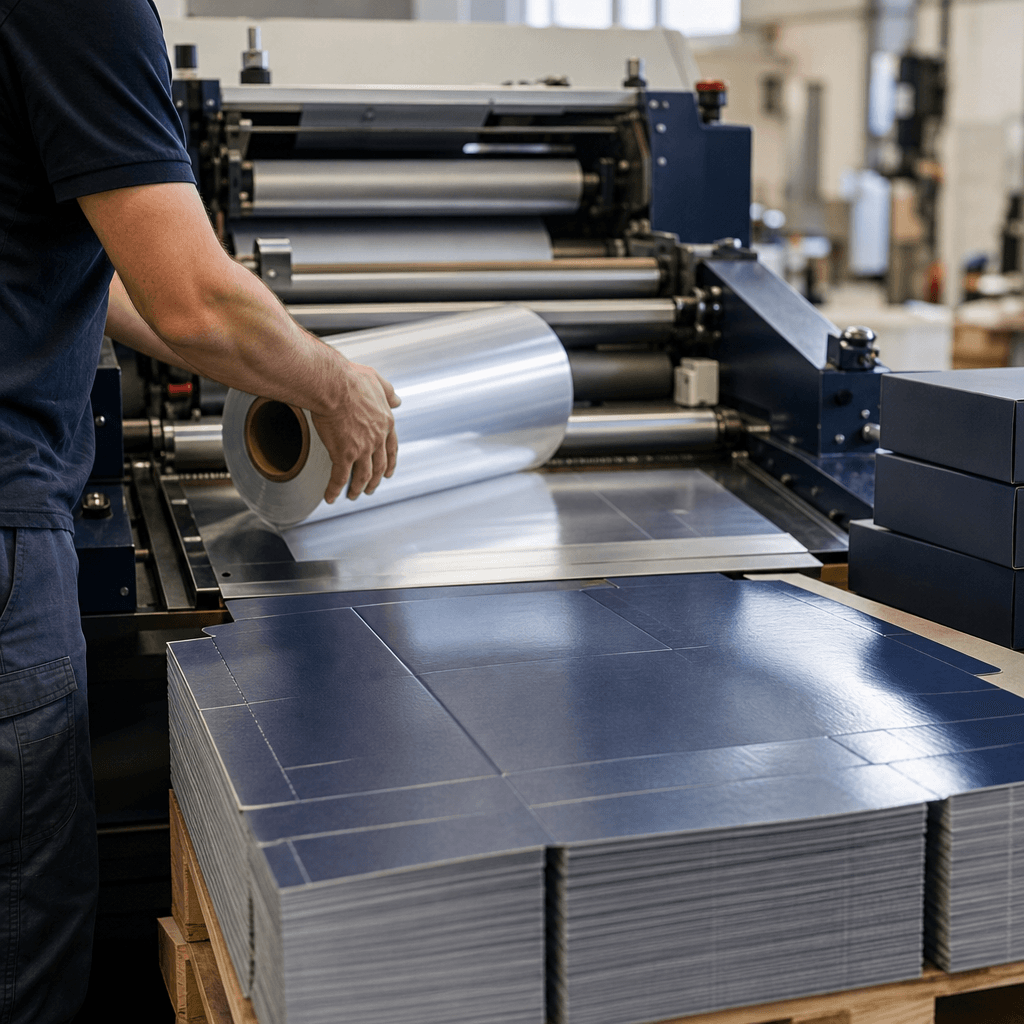
When you ask what lamination coating is, the shortest answer is this: it is the process of laminating a thin and transparent film layer onto a printed paper or cardboard surface. Often also referred to as lamination in printing, this application protects the printed surface of the packaging from friction, dirt and light while giving the surface a glossy, matte or velvety character. In packaging projects, we treat this decision not merely as an aesthetic preference, but as a structural choice that collectively affects the box material, print colors, usage conditions, food contact and recycling goals.
This guide explains how lamination coating works, its types, the difference between it and varnish, as well as its advantages and risks; it then clarifies the matte vs. glossy question through concrete packaging scenarios. We also provide links to other surface finishing techniques where relevant.
Table of Contents
How does lamination coating work in packaging?
The lamination film is applied onto the printed paper or cardboard with the help of heat, pressure or adhesive. When the film adheres to the surface, a thin protective layer forms between the print and the usage environment. This layer performs three jobs at once.
The first is to protect the print. A box or bag is constantly subjected to friction throughout shelving, storage, shipping and use. Lamination helps the print look clean for longer by reducing the direct contact the ink receives. However, this protection does not mean waterproofing. A laminated box is not fully safe against prolonged exposure to water or moisture seeping in from the edges; fold lines, cut edges and glued areas must also be evaluated.
The second is to change the surface perception. The same design looks different with matte versus glossy lamination. A glossy film reflects more light and can make colors appear more vivid; a matte film reduces reflection, giving a calmer and more refined result. Since the film surface affects color perception, in packaging with high color sensitivity, relying on the on-screen design alone is not enough; a physical sample or approved proof should be seen before production.
The third is to add a tactile quality. In premium packaging, the consumer doesn't just see the box, they pick it up. A matte or soft touch surface changes the texture of the paper and the feel it leaves in the hand, becoming part of the brand experience. That is why we make the lamination decision not with the question "which surface is prettier," but with the quality, use and brand feel the packaging needs to convey to the customer.
What are the types of lamination coating?
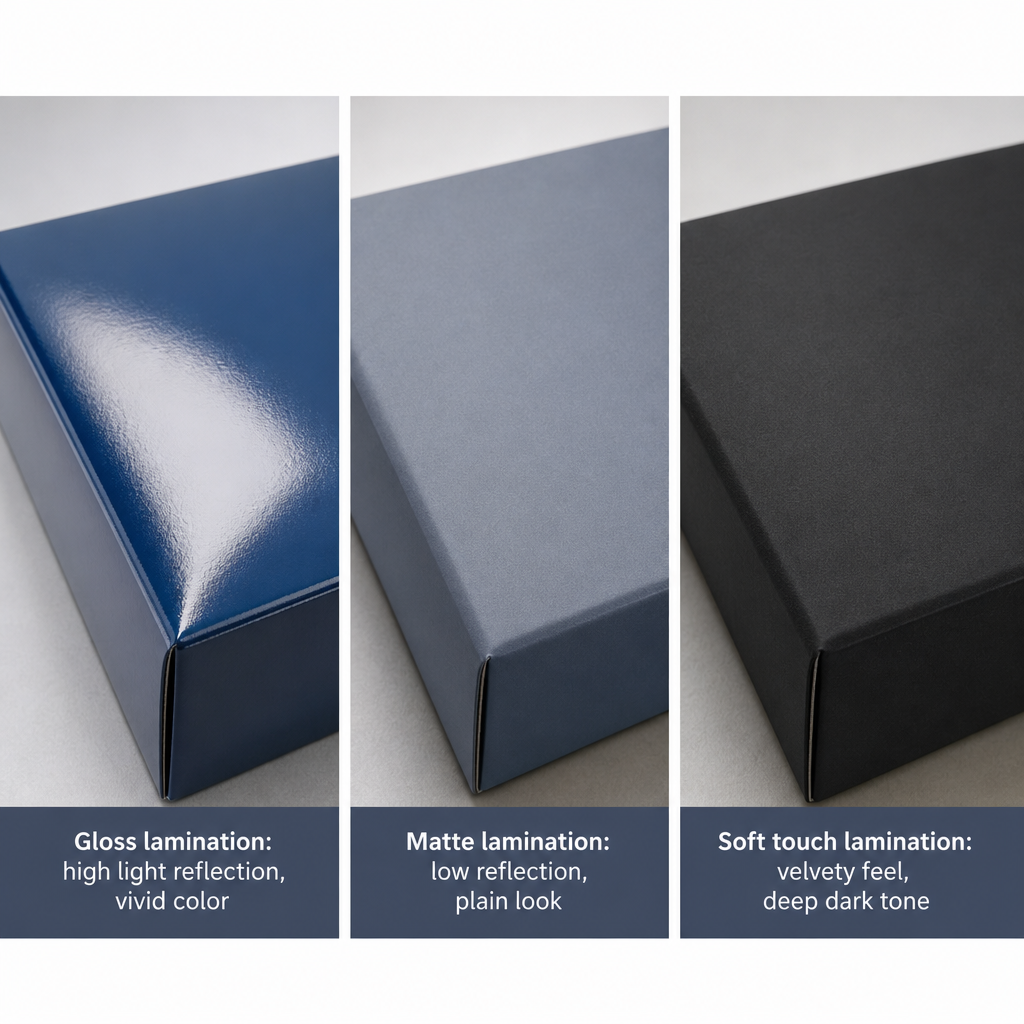
There are three lamination families we encounter most often in packaging, and each serves a different brand language.
Glossy lamination gives the surface high light reflectivity. It is preferred in designs where photos, product imagery and vivid colors are meant to stand out. Food and chocolate packaging, colorful cosmetic boxes, campaign and promotional packaging, and visually heavy folding cartons are typical use areas. It makes colors appear more vivid, can make the printed area easier to wipe clean, and supports shelf visibility. On the other hand, on dark-colored, frequently touched surfaces fingerprints become more noticeable; high gloss may give a flashier result than desired in some natural or minimal brand identities.
Matte lamination reduces light reflection on the surface. It is frequently used by brands wanting a plain, elegant and corporate look. It is suitable for perfume and cosmetic boxes, jewelry and gift boxes, premium cardboard boxes and minimally designed carton boxes. It provides a more sophisticated appearance, can improve readability, and creates a strong contrast with glossy details such as spot varnish or foil. A matte surface is especially effective on black and dark-colored designs; however, its scratch and mark resistance performance varies by film type, production quality and usage conditions. Deciding based solely on the word "matte" can be misleading.
Soft touch or velvet lamination is a special film type that, in addition to a matte appearance, offers a soft and velvety touch. It is used in luxury boxes, cosmetic and perfume packaging, and premium gift boxes. It gives a silky feel, creates a deep look in dark-colored designs, and provides strong contrast with applications such as foil, embossing and spot varnish. Soft touch lamination and standard matte lamination are not the same: standard matte focuses more on the optical surface effect, while soft touch film adds a tactile layer as well. On these surfaces, scratch, friction and fingerprint behavior should be tested per product.
The mechanism of soft touch film, how it differs from standard matte, and its risks are covered technically in a separate guide; for a deeper comparison, you can see the What Is Soft Touch Lamination? A Guide to the Premium Touch page.
The difference between hot and cold lamination
There are two basic methods in lamination application, and which one is chosen depends on the printing material and the desired surface quality.
In hot lamination, the film with a heat-activated adhesive layer is passed between rollers that apply heat and pressure. The heat activates the film's adhesive layer and the film adheres to the printed surface. In this method, the film type and thickness, the cardboard weight, roller temperature, pressure, machine speed, the print's drying time, and dust-powder residue on the surface are determining factors. Incorrect settings can cause problems such as bubbles, wrinkles, edge peeling or surface waviness.
In cold lamination, a pressure-activated or self-adhesive film is used instead of heat. This method is considered for heat-sensitive surfaces or for jobs where hot application is not suitable.
Rather than just saying "add lamination" at the order stage, it is much safer to approve the method and film to be applied on a sample. During the quotation process, we clarify this decision specifically for the project by determining the film type, cardboard structure and surface expectation together.
Where is lamination used in packaging?
Lamination provides the most benefit in packaging types with large printed surfaces; however, each structure requires different cautions.
In cardboard boxes, lamination is preferred to improve both surface protection and visual quality together. It is frequently seen in cosmetic, perfume, jewelry, candle, chocolate and gift boxes. A few typical combinations can be read as follows: matte lamination with foil creates a luxurious look on a perfume or jewelry box; soft touch with embossing creates a tactile experience on a premium gift box; glossy lamination gives vibrancy to colorful cosmetic or chocolate packaging; while a laminate-free natural surface preserves the kraft or natural material perception. For the structural differences between cardboard boxes and folding cartons, the What Is a Cardboard Box? Its Features and Use Areas guide is a good starting point.
In folding carton boxes, lamination protects the print surface and affects the shelf appearance; however, the possibility of the film cracking or peeling at the fold lines must be checked at the design stage. Especially in thin cardboards, the fold direction, grain direction, cutting and die lines, film adhesion, and post-fold cracking should be evaluated together.
In paper bags, lamination can increase the resistance of the outer surface to dirt and friction. However, the carrying capacity of the bag is not determined by lamination; the paper weight, handle structure, base and glued areas are more critical. Since lamination can also affect the recycling profile of a paper bag, brands with sustainability goals should also consider alternative coatings. For the cost and process items of bag production, you can see the Paper Rope Bag Making: A Cost and Process Guide content.
In packaging inserts such as labels, thank-you cards, instruction sheets and promotional cards, lamination protects frequently touched surfaces. However, the surface where the label will adhere, the adhesive type and the application temperature must also be tested.
The difference between lamination coating and varnish
Lamination is the lamination of a separate film layer onto paper or cardboard. Varnish, on the other hand, is a varnish-like surface finish applied to the surface that dries to form a thin coating. The two are not used in place of each other but are often used together.
| Feature | Lamination | Varnish |
|---|---|---|
| Application method | A film is laminated | A liquid coating is applied |
| Surface effect | Matte, glossy or soft touch | Glossy, matte or in a selected area |
| Tactile effect | Pronounced depending on film type | Limited in standard varnish |
| Purpose of use | Protection and durability | Gloss and emphasis |
| Design usage | Usually the entire surface | Entire surface or selected area |
| Recycling | Film and adhesive are examined separately | Examined according to varnish type and amount |
Lamination makes more sense in jobs where a protective film is wanted over the entire surface; spot varnish, on the other hand, is used to highlight a logo, pattern or a specific graphic area. Applying spot UV or embossed varnish over matte lamination creates a strong contrast between the matte and glossy areas. This combination gives an effective result in premium boxes; however, the die, overflow and surface compatibility must be checked before production.
Risks and limitations of lamination coating
Lamination is a powerful tool in the right project, but when applied without knowing its limits, it creates costly surprises.
The most commonly misunderstood topic is recycling. Combining paper or cardboard with a plastic film can make the recycling process more complex than pure paper. Cepi notes that coating and lamination provide certain functions in paper-based packaging; however, the combination of different materials can make recycling more difficult. For this reason, a general judgment such as "laminated packaging is definitely non-recyclable" or "every laminated packaging is recyclable" is not correct. The outcome depends on the type of film and adhesive, the amount of film, the paper-to-cardboard ratio, the local collection-sorting system and the facility's process characteristics. The Cepi guide recommends reducing non-essential plastic or metal components and designing lamination in a way that does not disrupt the fiber separation process.
The second risk is cracking at the fold lines. If the film is not processed correctly at the cutting or folding areas, it can crack or separate at the edges. This risk increases with very sharp fold lines, low-weight cardboards, large-surface dark-colored prints, incorrect grain direction, and unsuitable film-adhesive combinations.
The third is fingerprints. Glossy lamination can accentuate fingerprints and micro-scratches, especially on dark backgrounds. On bags or boxes constantly carried by hand, this should be tested with a physical sample.
The fourth is color perception. Since the coating changes the way light reflects, print colors may be perceived differently. In cosmetics, jewelry and premium products where color standards are important, a coated proof should be taken.
The fifth is food contact. A laminated surface does not automatically mean the packaging is suitable for food contact; the film, ink, adhesive and cardboard must be evaluated together. Technical guidelines emphasize that coating materials on paper and cardboard must comply with the relevant food contact regulations. For chocolate, confectionery or packaging that comes into direct contact with food, compliance certificates, technical data and, if necessary, migration tests should be requested from the supplier.
Should matte or glossy be chosen for packaging?
There is no single correct option. The decision is made based on the packaging's usage conditions and brand positioning. The table below is a starting framework; two brands in the same category may make different surface decisions because their target audiences and channels differ.
| Packaging scenario | Option to consider | Main rationale |
|---|---|---|
| Vividly colored cosmetic box | Glossy lamination | Color and visual vibrancy |
| Minimal perfume box | Matte lamination | Plain and refined appearance |
| Premium jewelry box | Matte or soft touch | Tactile and luxurious perception |
| Chocolate packaging | Glossy or suitable barrier | Visual impact and usage condition |
| E-commerce box | Laminate-free or durable alternative | Balance of cost and recycling |
| Gift box | Matte or soft touch | Unboxing and touch experience |
| Natural/kraft brand language | Laminate-free or low coating | Preserving the natural feel of the material |
The table only provides direction; the final decision should always be matured through a physical sample.
What criteria should be considered when choosing a lamination coating?
The lamination decision rests not on a single variable, but on several interrelated topics.
The product's usage pattern is the first question: will the box sit on a shelf, will it go through the shipping process, will it be held by hand frequently? The choice is made according to this scenario. Brand positioning is the second topic; matte and soft touch surfaces generally support premium perception, while glossy surfaces bring visual vibrancy to the fore. The cardboard type and weight is the third critical point: not every cardboard gives the same result with every film, and adhesion and cracking should be tested in advance on low-weight or absorbent materials.
Print and color management are also determining factors; it is important to take a coated proof in sensitive areas such as dark backgrounds, skin tones, brand red or metallic effects. Other surface finishes should be designed together with lamination: applications such as foil, embossing, spot UV, debossing and varnish have different production sequences and surface compatibility. If the recycling goal is a strategic priority, water-based varnish or suitable barrier alternatives can be examined instead of lamination; the alternative's performance should be verified with a real production sample.
The final topic is sampling and quality control. In the pre-production sample, color and contrast, surface gloss, touch feel, film adhesion, fold lines, cut edges, scratch behavior, foil-varnish compatibility, as well as odor and food contact conditions should be examined. Because we coordinate design, prototyping, production management and logistics within the same project, we evaluate these checks not only at the printing stage, but while preparing the packaging brief. Specifying the lamination type, cardboard structure, printing technique and sample expectation together during the quotation process yields a more accurate result.
Is lamination coating sustainable?
The sustainability of lamination is not determined by the film type alone. The packaging's total material structure, lifespan, recycling infrastructure, production volume and design purpose are evaluated together.
For a better decision, avoid using unnecessarily thick or wide film, consider coating only on surfaces where it provides a function, ask whether single-sided lamination is sufficient, check the collection-sorting conditions in the target market, request the film-adhesive-cardboard technical information, and do not use the "eco-friendly" claim without testing or documentation. Cepi guides recommend, when plastic or metal laminate is necessary, using only the required amount, designing to facilitate the separation of components, and evaluating performance in real recycling processes. For more, you can review the Cepi recyclability guide.
In short, lamination coating is an effective application for protecting the print, changing the surface appearance and giving the packaging a stronger tactile experience. The right decision is made not only with visual preference, but by evaluating the box material, fold structure, print colors, usage conditions, food contact, recycling goal and other surface finishes together. The safest approach is to approve the lamination choice through a physical sample and to consider the coating together with the entire life cycle of the packaging.
Frequently asked questions
Are lamination coating and lamination the same thing?
In packaging and printing, they usually refer to the same application. "Selefon" (lamination coating) is the common term describing the application of a thin film to printed paper or cardboard; lamination is the more technical name for the process.
Is lamination coating waterproof?
Lamination can make the surface more resistant to moisture, but it does not make the packaging completely waterproof. Edges, fold lines and glued points may still be open to water and moisture.
Which is more durable, matte lamination or glossy lamination?
Durability does not depend solely on the matte or glossy choice. Film thickness, cardboard, adhesive, production settings and usage conditions are determining factors. The decision should be made with a physical sample and usage test.
Is a laminated box recyclable?
Some laminated paper and cardboard packaging can be recycled at suitable facilities; however, the plastic film and adhesive can make the process more difficult than pure paper. A definitive evaluation should be made according to the material structure and the local recycling infrastructure.
Can lamination be used in food packaging?
It can be used, but the film, ink, adhesive and cardboard's suitability for food contact must be verified together. Compliance certificates and necessary test information should be requested from the supplier.
What is the difference between soft touch lamination and matte lamination?
Matte lamination mostly offers a low-reflection surface. Soft touch lamination, in addition, gives a soft, velvety touch feel. In premium boxes, the two options should be compared through a physical sample.