
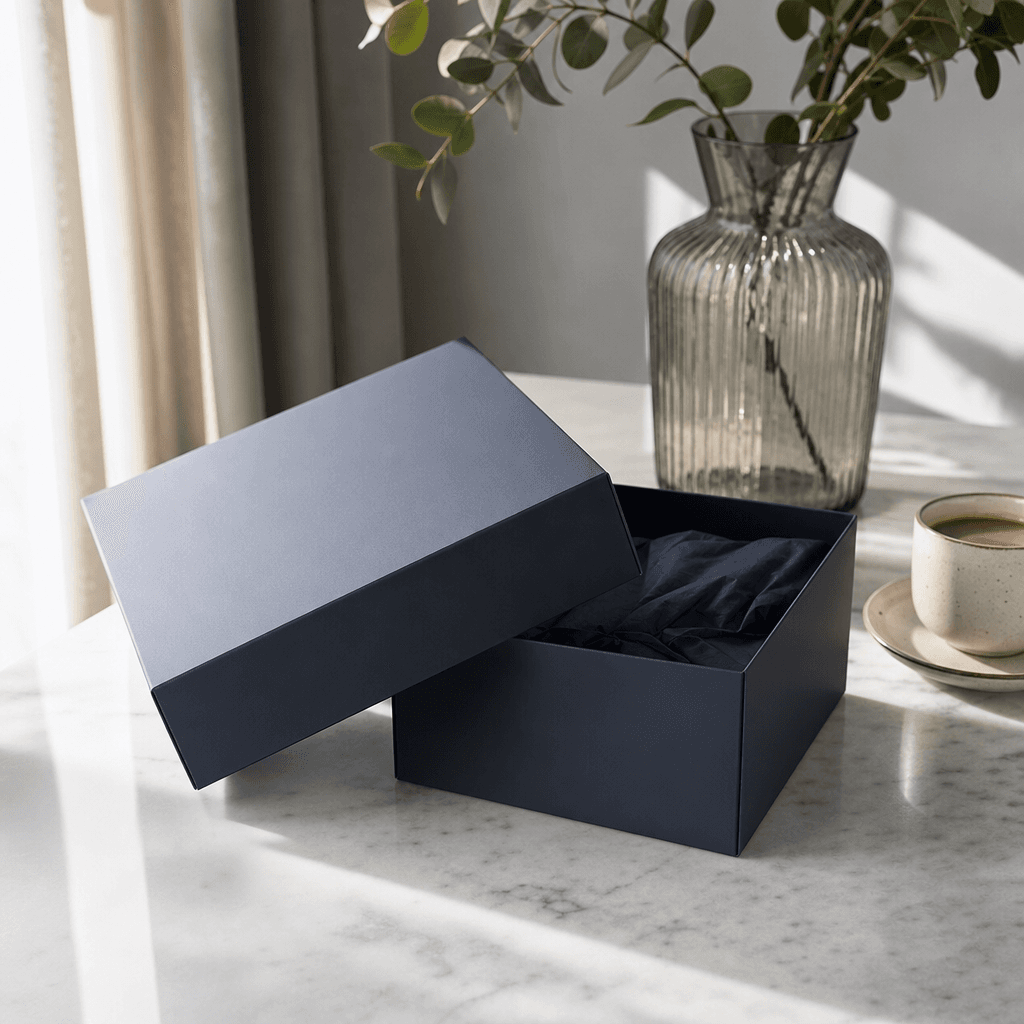
The short answer to the question of what soft touch lamination is: it is a finishing process that applies a specially textured BOPP film over a printed board, cardboard box, or paper surface, giving the surface a velvety, soft, and matte feel. The film is laminated to the printed sheet with heat and pressure; this is why the process does not only change the color or gloss, but together affects the packaging's tactile experience, surface appearance, and durability in use. For premium brands, the real decision is not "does it look luxurious?" but rather "does this surface meet my technical and sustainability goals while retaining a premium feel under my product's real-world usage conditions?" In this guide, we explain the mechanism, use cases, limitations, and decision criteria from the perspective of premium packaging.
Table of contents
How does soft touch lamination work?
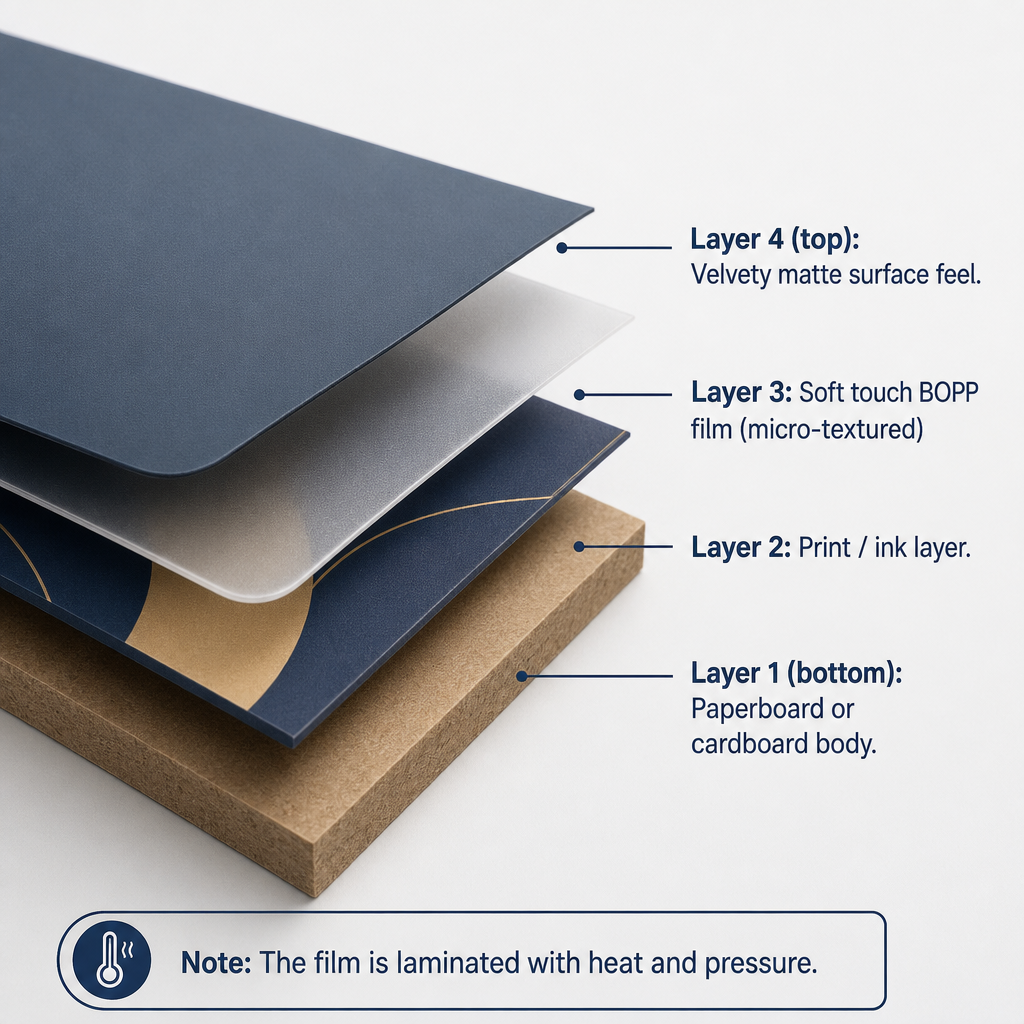
Soft touch lamination is a film-based surface treatment applied after printing is complete. The printed paper, board, or cardboard surface is prepared; the micro-textured soft touch BOPP film is bonded to the surface with heat and pressure, forming a continuous layer that covers the print. This micro-textured surface scatters light, reducing gloss. Instead of gliding across the surface, a finger moves with a slight "velvet" or "peach skin" feel.
The distinctive aspect of the process is that it forms a physical film layer on the surface. This layer places a barrier between the ink and external contact, strengthening the tactile effect. The presence of the film is also a technical parameter that determines behavior against water, cost, recycling considerations, and the additional finishes that can be applied over it. For this reason, soft touch is a decision that covers not only the visual but also the tactile layer of the design.
Appearance, touch, and the difference from soft touch coating
The typical characteristics of a soft touch surface are a deep, low-gloss matte appearance, a velvety or peach-skin-like touch, reduced light reflection, and a richer, more sophisticated perception on dark colors. However, this surface is not a textile; it does not create a fibrous structure like real velvet or suede. It consists of a thin, smooth, micro-textured polymer film. The effect becomes more pronounced on backgrounds such as black, navy, burgundy, dark green, and dark brown; on the other hand, scratches, friction, or fingerprints can become more visible on dark, large printed areas.
The distinction between soft touch lamination and the frequently confused soft touch coating directly affects the purchasing decision. While lamination forms a film layer, a coating is a thinner varnish layer; this difference changes the tactile intensity, water behavior, cost, and recycling considerations.
| Criterion | Soft touch lamination | Soft touch coating |
|---|---|---|
| Structure | Film layer such as BOPP | Thin varnish or coating |
| Tactile effect | Pronounced, velvety | Lighter, muted |
| Visual effect | Deep matte | Matte or silky |
| Water and surface barrier | Generally stronger | Depends on the varnish formula |
| Recycling | Contains plastic film, requires separate evaluation | Contains no film, different evaluation |
The two terms should not be used interchangeably: one is film-based, the other is varnish-based, and each manages both the feel and the technical behavior of the packaging differently.
Where does soft touch lamination create value?
Soft touch lamination is valuable especially in scenarios where the packaging is held in hand and the first contact influences the purchase perception. In cosmetic boxes, when combined with simple graphics for creams, serums, perfumes, and makeup products, it can create a clean and refined appearance; here, when selecting the surface treatment, the product's shelf life, transport conditions, interior fitting, and consistency of brand colors should be evaluated together. If you are planning your cosmetic box structure, you can check out our cosmetic box design guide.
In jewelry and accessory boxes, despite the small surface area, the feel of the material is decisive; when combined with hot foil stamping, embossed logos, or spot UV, soft touch lamination can bring the brand mark forward both tactilely and visually. In candles, room fragrances, and decorative lifestyle products, the surface can support a calm and sensory positioning; however, in this category, heat, oil, and transport conditions should be tested separately.
In chocolate and gift boxes, the tactile experience begins before the box is even opened. Together with the cardboard body, interior divider, and foil, soft touch lamination can raise perceived value; if there is a possibility of food contact, the relevant compliance documents should also be evaluated. In e-commerce and DTC packaging, the surface can create a premium unboxing feel when the customer picks up the box. If the box will be subjected to heavy friction during shipping, surface performance must be checked with a full and realistic shipping test. For choosing a premium box body, our magnetic closure box guide can help with the structural decision.
Use together with other premium finishes
The power of soft touch lamination often emerges not on its own but with the finishes it contrasts against. A glossy detail on a matte and soft background creates both a visual and tactile distinction. It is useful to think of soft touch lamination as a base for your project.
- Hot foil stamping: Metallic shine on a matte background creates a dramatic contrast.
- Spot UV varnish: Creates a glossy, raised feel on logos or selected areas.
- Debossing and embossing: Strengthens the tactile effect by adding physical depth to the surface.
- Custom color applications: Supports a rich and sophisticated appearance on dark backgrounds.
It is important to plan these combinations during the design stage, because the application order and surface preparation directly affect the result. We offer soft touch lamination as a base that can be used for hot foil stamping, spot UV, and embossing/debossing; the packaging's soft and low-gloss feel, when designed together with the material, color, typography, and box structure, supports "minimal," "sophisticated," and "luxury" brand associations. The effect arises not from lamination alone but from the harmony of these components.
Limitations, risks, and recycling uncertainty
Soft touch does not mean "scratch-proof" or "fingerprint-free." The film type, production quality, color intensity of the design, and usage conditions change the result. For this reason, the decision should be based not on the on-screen design but on a physical sample.
If the box is stacked in a warehouse, moves inside a shipping carton, or changes hands frequently in a store, friction marks may appear on the surface; these marks are more easily noticed on large dark backgrounds. Fingerprint performance depends on the film and color used, so the generalization that "soft touch never shows fingerprints" is not reliable. The laminated surface requires care during folding, gluing, and corner processing; the possibility of film lifting, cracking, or whitening at box edges depends on the cardboard thickness, structural design, and production settings. Additionally, the matte film can change the perceived contrast and color saturation of the print; this is why during the proofing process, not only the color but also the intensity of black areas, the clarity of the logo, the contrast of metallic foil, the corner regions, and the feel of opening and closing the box should be checked.
Evaluating not the empty box, but the box filled with the product and placed in its shipping packaging, shows the real usage risk far more accurately.
On the recycling side, since soft touch lamination contains plastic film, the recycling behavior of the packaging cannot be determined solely by whether it is "paper-based." The film type, amount of film, adhesive, whether the lamination is single- or double-sided, and the local recycling infrastructure must be evaluated together. FEFCO recommends using the lowest possible amount of non-paper components in paper-based packaging, applying lamination single-sided where possible, and preferring designs that make it easier to separate the film from the fibers; for details, you can refer to the FEFCO recycling guidelines. The 4evergreen protocol also addresses recyclability through laboratory testing, technical evaluation, and scoring; that is, the decision is made according to the specific structure of the product. If sustainability is your priority, it is wise to request the film type and thickness, single/double-sided application, adhesive type, whether a recycling test has been performed, and the certification information of the paper/cardboard used.
Soft touch lamination in food packaging
The decision on whether it can be used in food packaging depends on whether the lamination comes into contact with food and on the compliance of all components used. Materials that come into direct contact with food or whose components are expected to migrate to food under normal usage conditions are covered by the Turkish Food Codex Regulation on Materials and Articles in Contact with Food.
For this reason, in products such as chocolate, confectionery, or similar, the surface in direct contact with food must be separated from the outer surface; the suitability of the film, ink, adhesive, and cardboard must be evaluated together; a declaration of compliance and technical documentation must be requested from the supplier; and the actual usage conditions of the packaging must be taken into account. The presence of soft touch lamination on the outer surface does not by itself mean suitability for food contact. The decision must always be made based on the entire packaging and the contact scenario.
Soft touch or matte lamination? Decision criteria
Both applications can reduce gloss; however, their intended uses are not the same. Matte lamination primarily offers a simpler appearance, while soft touch adds a distinct tactile layer to the matte look. The right choice is not the "most luxurious looking" surface, but the surface most suitable for the usage scenario.
| Need | More suitable starting option |
|---|---|
| Pronounced velvety touch | Soft touch lamination |
| Simpler matte appearance | Matte lamination |
| Heavy shipping and friction | Film and anti-scratch should be tested |
| Recycling priority | Film amount and alternatives should be compared |
| Contrast with hot foil / UV | Soft touch + selected glossy finish |
Choosing soft touch directly without evaluating alternatives is risky in some situations: if the packaging will be subjected to heavy friction for a long time, if the box is dark-colored and has large flat surfaces, if the recycling goal limits film use, if the food contact documents are not clear, if there are very fine lines or small text on the surface, or if the project will go into mass production without seeing a physical sample. Under these conditions, comparing matte lamination, soft touch coating, anti-scratch film, or film-free surface solutions on a sample offers a safer path. For the box body decision, our comparison of rigid cardboard boxes and corrugated boxes helps clarify the structural choice.
Technical information to provide when preparing a brief
When requesting a quote, simply saying "make it soft touch" is not enough. A sound technical brief should include the product name and area of use, the box type (rigid cardboard box, folding box, or corrugated box), the outer dimensions along with the inner product dimensions, the material and approximate grammage, the printing technique, the background color and the proportion of dark areas, the surfaces to which lamination will be applied, hot foil/spot UV/embossing requests, the estimated quantity, storage and shipping conditions, the food contact situation, the recycling or certification goal, and the sample-shipping test expectation.
Since the soft touch texture, the box's opening resistance, and the real surface behavior cannot be verified on screen, a physical sample is a critical control point. Depending on the project, we offer unprinted or printed physical sample and 3D digital mockup options; in our general service model, we aim to provide a quote within 24 hours after the brief and a physical sample within 7–15 business days. The actual timing is confirmed according to dimensions, sample type, printing, and finishing scope. To strengthen the decision for your project, it is useful to request three outputs from us: a material-finish specification including the film type and application surface, a physical sample showing the color and corner-folding feel, and a usage test for stacking-friction-shipping (and food contact if needed). If, along with the surface treatment, there is also a label decision, our label printing guide is a complementary resource.
In this way, soft touch lamination ceases to be merely an aesthetic preference and becomes a packaging decision validated against the real-world use of your product.
Frequently Asked Questions
Are soft touch lamination and matte lamination the same?
No. Matte lamination primarily reduces gloss. Soft touch lamination, in addition to the matte appearance, creates a distinct velvety surface feel.
Does soft touch lamination scratch?
Yes, depending on the film type and usage conditions, it can scratch or show friction marks. These marks may be more pronounced on dark and large color areas.
Is soft touch lamination water-resistant?
The film layer can provide an additional barrier to the surface; however, the entire packaging does not automatically become waterproof. The cardboard, board, edges, and adhesives must also be evaluated.
Is soft touch lamination recyclable?
This depends on the film type, amount, adhesive, whether the lamination is single- or double-sided, and the local recycling facility. Technical testing and supplier documentation specific to the project should be requested.
Can soft touch lamination be used on a food box?
Usability depends on the food contact scenario and the regulatory compliance of all components used. Applying it on the outer surface alone does not mean suitability for food contact.