

If choosing the right box for your brand isn't enough on its own, the answer often lies in the question of what packaging consultancy is. This service is a strategic effort to select, design, test, prepare for production, and make logistically viable the packaging suited to a product's and brand's needs. In other words, the focus isn't only on "which box?"; it's about solving product protection, brand perception, sales channel, print quality, sustainability, quantity, cost, storage, and shipping decisions together. At Kosapack, we treat packaging not as a single product but as a system operating between the brand, the product, and the supply chain.
In Turkey, packaging covers the materials used while transporting, protecting, storing, and offering products for sale. Legislation stipulates that packaging be developed—starting from the design stage—to produce less waste, be easy to recover, and cause less harm to the environment (Regulation on the Control of Packaging Waste). Consultancy combines this framework with commercial decisions to produce a solution that is manufacturable and fits operations.
Table of contents
Where does packaging consultancy differ from design?
Packaging design focuses on structurally and visually creating the packaging. Consultancy, on the other hand, starts a step earlier: it first defines the right problem, then leads to a manufacturable solution. Design is a part of this process, not the whole of it.
| Packaging design | Packaging consultancy |
|---|---|
| Develops the box or packaging form | Analyzes the brand's packaging needs |
| Works on graphics, color, and print | Evaluates product, channel, quantity, budget, and logistics together |
| Prepares the dieline, dimensions, and visual application | Selects the right packaging type, material, and production method |
| Usually delivers a design output | Coordinates design, sampling, production, quality control, and shipping |
Let's make the difference concrete: a box that is visually striking but cannot bear the product's weight or gets crushed in transit—even if considered a design success—is a commercial failure. Consultancy catches such disconnects before production. We run the design, prototype, production, and logistics stages under the same project; that way, no one in the decision chain becomes detached from the others.
What services does packaging consultancy cover?
Although the scope varies by project, the decisive topics for brands feed into one another. Each is an input for the next decision.
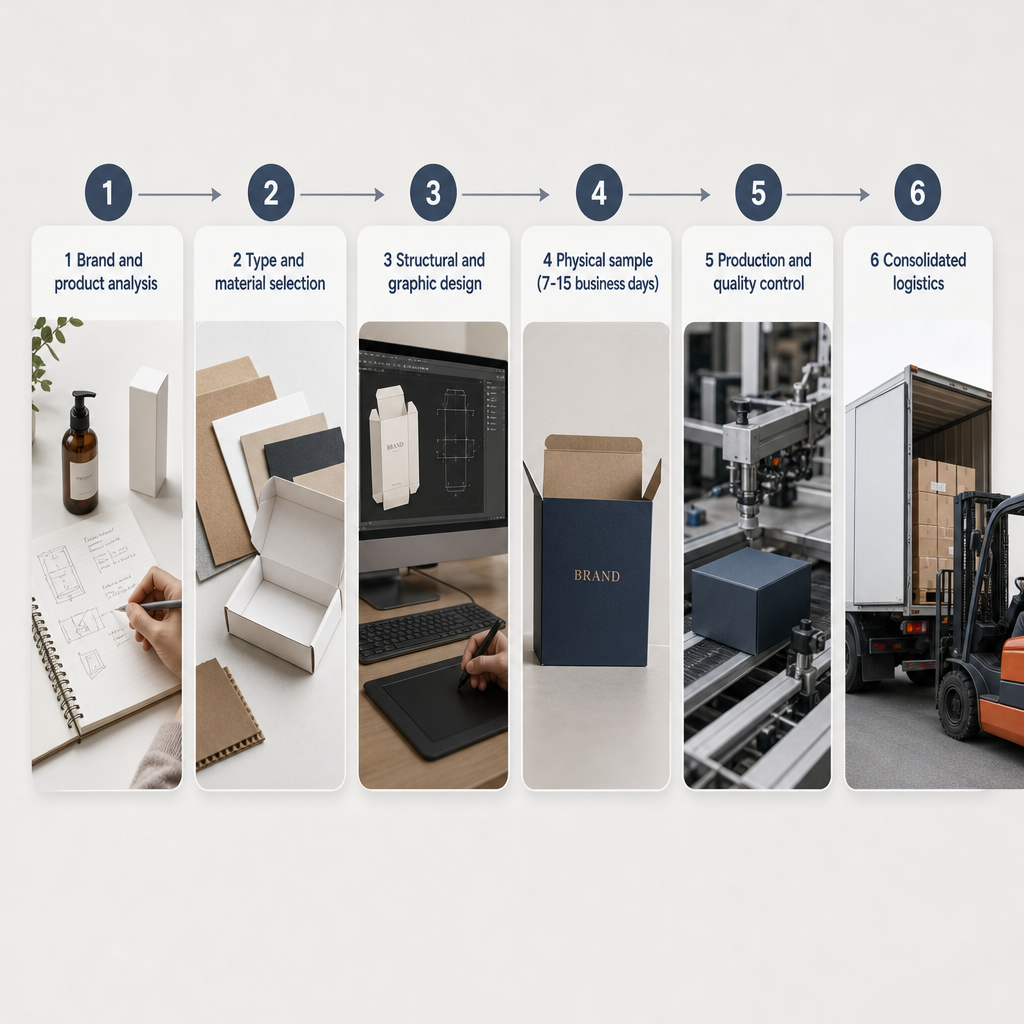
Brand and product analysis. In the first stage, the product's dimensions, weight, and risk profile are determined: is there a chance of breakage, scratching, leakage, or crushing? Will the product be sold through the shelf, store, shipping, or gift channel? Is the packaging expected to convey a premium, natural, minimal, or accessible perception? Will the product come into direct contact with the packaging, and will it be offered individually or as a set? For example, a perfume brand's priority of shelf visibility and perceived value does not lead to the same packaging decision as a glass jar shipped via e-commerce whose priority is impact protection.
Packaging type and structure selection. Depending on the need, rigid boxes are considered for premium presentation and high perceived value; folding boxes for lightness and high-volume production; corrugated boxes for shipping durability; paper bags for store delivery; mailer boxes for the e-commerce unboxing experience; and labels, tissue paper, separators, and inner inserts for complementary functions. The choice rests not only on appearance but on weight, dimensions, shipping method, storage space, and quantity. For related structural decisions, you can review our guides what is a rigid box? and what is corrugated cardboard?
Material and weight (gsm) selection. The weight to be carried, the risk of crushing and tearing, the way it contacts the surface, print quality expectations, folding-lamination-gluing requirements, recycling conditions, and quantity are weighed together. Thicker material is not always better; more than necessary increases both cost and waste. The regulation also stipulates that packaging should not have more volume and weight than needed to ensure the required level of safety and health, and that it be designed suitable for reuse or recovery.
Structural and graphic design. Structural design resolves the form, the product's placement inside, the lid-lock system, whether it will be delivered flat or set up, and shipping durability. Graphic design covers the logo, color, typography, information areas, visual hierarchy, and surface applications such as foil, embossing, varnish, or lamination. The two must progress together. If a premium touch is targeted, surface decisions such as soft touch lamination need to be matched early with the structural choice.
Prototype and physical sample. A 3D rendering on screen doesn't show the packaging's real behavior. With a physical sample, you check how the product sits in the box, whether the lid works, print colors, the stiffness and texture of the material, and whether the separator holds the product in place. Depending on project scope, we generally target 7–15 business days for a physical sample; this duration varies according to product structure, sample type, and surface applications.
Production and quality control. Consultancy doesn't end when the file is sent to production. In mass production, we track material matching the approved sample, print color consistency, cutting and folding precision, gluing quality, surface treatments, and intra-batch dimension/color differences. We manage production through verified factory partners and build quality control into the process.
Logistics and shipping. A manufactured packaging falls short if it doesn't fit the brand's operation. We evaluate whether boxes will be delivered flat or set up, where they will be stored, palletizing-boxing, whether delivery will be in a single batch or split, and desi (volumetric) cost. Consolidating parts such as boxes, bags, labels, tissue, and thank-you cards in a single shipment provides operational ease for brands using multiple packaging types.
Why does it make a difference for brands?
The value of consultancy is not abstract; it lies in preventing measurable risks. When packaging is chosen with only aesthetic expectations, protection, storage, and shipping problems arise; consultancy reduces this risk by matching the usage scenario with the packaging decision.
On the brand perception side, packaging is one of the consumer's first points of contact with the product. Material, the feel of touch, print, unboxing, and inner layout determine whether the product is perceived as premium, natural, technical, or economical. At the same time, a dimension, color, or structural error caught during the sampling and proofing stage is corrected at a far lower cost than one noticed after mass production.
Cost reading is also not done by unit price alone. A low-unit-price packaging can end up costing more overall due to excess stock, high shipping volume, damaged products, extra packing, or slow assembly. Consultancy makes the total cost of ownership visible. On the sustainability side, "eco-friendly" rhetoric is not just about using kraft-looking material; the number of materials, surface applications, adhesives, recyclability, and transport volume must be examined together. The regulation also prioritizes reusable or recyclable packaging and focuses on reducing environmental risks from design until the packaging becomes waste.
Which brands is it suitable for?
Packaging consultancy does not belong to a single industry; the need profile varies by sector.
In cosmetics and personal care brands, shelf impact, protection, and premium perception come to the fore for perfume, skincare, makeup, and hair care products; forms such as glass bottles, jars, or tubes require inner insert and fixation solutions. In e-commerce and DTC brands, the unboxing experience is as important as shipping durability; mailer boxes, corrugated boxes, tissue, thank-you cards, and labels are planned together. Fashion and accessory brands use rigid boxes, cardboard bags, and complementary packaging together for store delivery, gift presentation, and reusability.
In jewelry brands, it is decisive that the product does not move within the box, does not get scratched, and that small parts are presented neatly; inner inserts, separators, and custom print options come into play. In food and chocolate brands, product contact, hygiene, barrier needs, and label information are evaluated together; for prepackaged foods, the mandatory information required on the label must also be reviewed separately (food labeling information). In corporate gift and promotional projects, having different products look neat within a single set, being fixed in place, and delivered on time requires planning the box, bag, tissue, label, and thank-you card together.
What to look for when choosing the right consultant?
Evaluating a consultant solely by the box models they offer falls short. For a healthier comparison, keep the following topics on the same scale:
- Service scope: Is only a graphic file prepared, or are structural design, prototype, production, quality control, and logistics also included?
- Physical sample approach: Is the pre-mass-production sample tested with real material and, as much as possible, real print conditions?
- Production network and quality control: Which partners handle production; how are color, dimension, cutting, gluing, and quantity controls done?
- Material and sustainability knowledge: Can the impact of material selection on recycling, waste, and service life be explained?
- Project communication: Are the brief, revisions, sample approval, and production decisions written and traceable?
- Logistics capacity: Can different parts be combined in a single shipment; can flat/set-up delivery, palletizing, and storage be planned?
- Scope of the quote: Does the quote clearly include not just unit price but also sampling, die/mold, print, surface treatment, packing, and delivery?
We run full project support from consultancy to design and logistics—structural design, graphic design, 3D prototyping, production management, and quality control—all together.
What information should you prepare when requesting a quote?
A comparable and accurate quote starts with a clear brief. Information that is useful to share:
- The product's name, use area, dimensions, and approximate weight
- Inner or outer dimension expectation and the desired packaging type
- Estimated production quantity and whether it is one-time or periodic
- Sales channel: store, e-commerce, wholesale, or gift
- The product's breakage and transport risk
- Brand logo and corporate identity files
- Desired print and surface applications; inner insert or separator needs
- Delivery address, desired deadline, and shipping preference
After the brief is shared, we aim to deliver the initial pricing within 24 hours and to target 7–15 business days for a physical sample; the exact duration and scope of the quote are finalized according to the project's specifics. To clarify your requirements on the label side, our guide on label printing types helps at the decision stage.
Common mistakes
The same mistakes recur across different brands; most can be prevented at the brief and sample stage.
Choosing based only on appearance is the first trap: an impressive box may not suit the product's weight or shipping conditions. The second is going into production without taking a physical sample; a dimension, color, or closure that looks right on screen may not work as expected on the actual product. Failing to share the product's real dimensions also throws off the system by a few millimeters, especially with inner inserts and precise closures.
Planning components separately is another frequent mistake: when the box, label, tissue, bag, and thank-you card are sourced from different suppliers, color, deadline, and shipping coordination become difficult. Using a sustainability claim without verifying it is also risky; the phrase "eco-friendly" must be evaluated together with material, surface application, and components. Finally, not comparing quotes within the same scope is misleading: one quote may cover the physical sample while another covers only mass production; the scope must be equalized before comparing.
Packaging consultancy with Kosapack
As a premium custom packaging team based in Zeytinburnu, Istanbul, we combine consultancy, structural and graphic design, prototyping, mass production managed with verified production partners, and consolidated logistics within the same project flow. Among the solutions we offer brands are rigid boxes, folding boxes, corrugated boxes, paper bags, labels, tissue paper, thank-you cards, mailer envelopes and boxes, fabric bags, and box separator and inner insert solutions.
This approach is suitable for businesses in sectors such as cosmetics, e-commerce, fashion, jewelry, food, chocolate, electronics, and corporate gifts that want to address packaging decisions together with product and brand goals. When determining the right packaging for your brand, the question to ask is not merely "which box is more stylish?" but which solution supports the product, the customer, the sales channel, and operations together.
Frequently asked questions
What is packaging consultancy?
It is a service for determining, designing, sampling, preparing for production, and managing the procurement process of a packaging solution suited to the brand's product, sales channel, target audience, budget, and logistics needs.
Are packaging consultancy and packaging design the same thing?
No. Packaging design focuses on structural and graphic design. Consultancy, on the other hand, covers broader decisions such as product analysis, material selection, production, quality control, sustainability, and logistics.
What products is packaging consultancy used for?
It can be used for cosmetics, perfume, jewelry, fashion, chocolate, food, electronics, e-commerce products, corporate gift sets, and premium consumer products.
Is a physical packaging sample necessary?
It is necessary in most custom packaging projects. A sample allows points such as dimensions, closure, material, print, product placement, and durability to be checked before mass production.
How long does it take to get a quote for packaging consultancy?
Once the brief information is shared, we set a target of 24 hours for the initial quote. The physical sample time is generally in the range of 7–15 business days depending on the project scope.