

If you want premium presentation, shelf impact, and a lasting unboxing moment, a rigid box is the way to go; if high protection during shipping, warehousing, and transport is your priority, a corrugated box is the right choice. The practical answer to the question rigid box vs corrugated box often lies not in a single product but in how the two work together: a rigid box inside representing the product, and a corrugated box outside securing the transport. In this guide, we examine together how these two structures truly differ, which one wins in which scenario, and what you need to clarify before requesting a quote.
Here, by "rigid box" we mean the term used in the market for premium and rigidly structured boxes. A corrugated box, on the other hand, is based on a corrugated cardboard structure in which a wavy middle layer is fixed between flat paper layers.
Contents
What is the main difference between the two boxes?
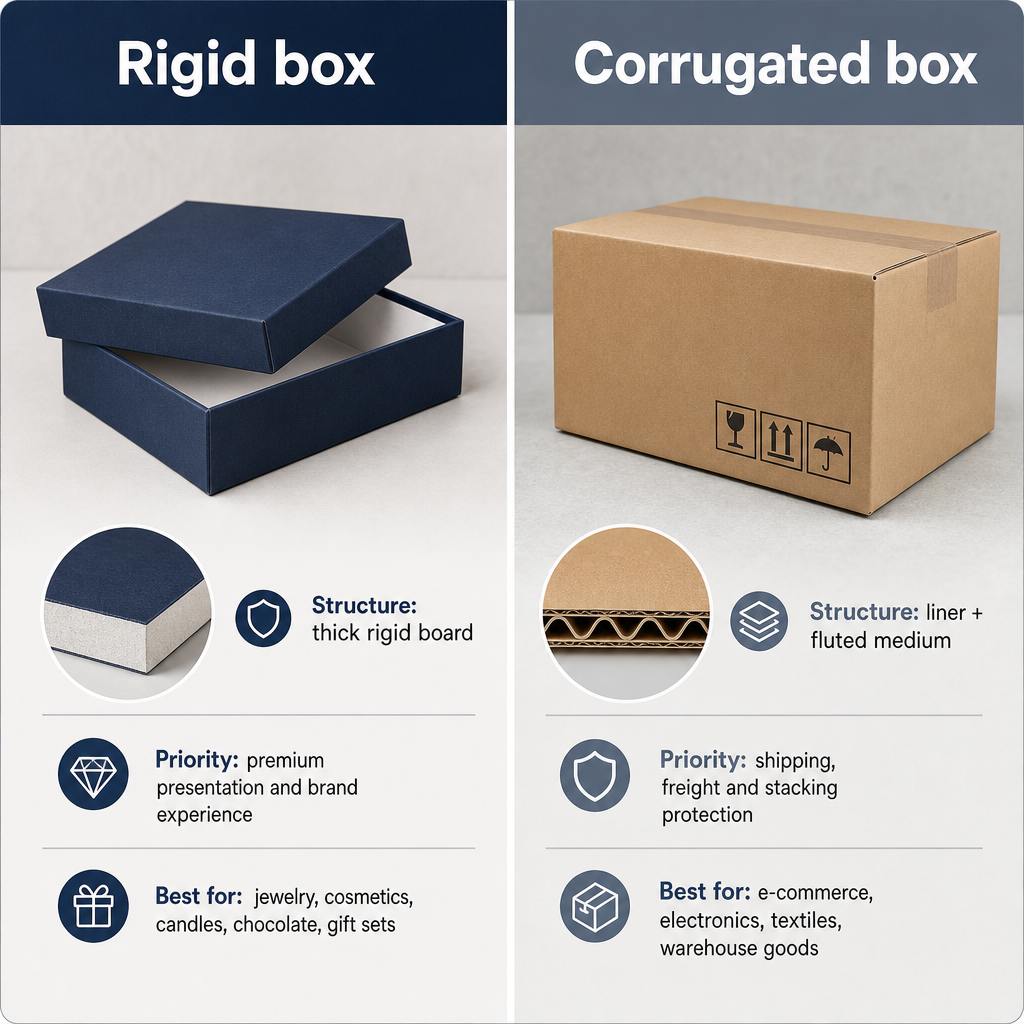
A rigid box and a corrugated box are not just two differently appearing packages; they are two structures that prioritize different jobs. A rigid box takes on the product's presentation, brand perception, and unboxing experience. A corrugated box, on the other hand, works on the side of impact absorption, stacking, and shipping durability.
To understand this difference, one must look at the mechanics of the corrugated structure. In corrugated cardboard, the flat outer layers are called liners, and the wavy paper in between is called the medium. The wavy structure behaves like a column under pressure, increasing the bending resistance of the board; the gaps between the layers also provide a certain amount of cushioning. In a rigid box, however, protection comes not from the wave structure but from the thickness, form, and internal support of the board.
This distinction is also clear in the Kosapack portfolio: the rigid box is positioned for a premium and lasting unboxing experience, while the corrugated box is positioned for e-commerce shipping and warehouse logistics. Since we can evaluate both sides within the same custom packaging service, the choice begins not by advocating for a single product but by correctly reading the path the product will follow.
What does a rigid box do well?
A rigid box is a type of custom packaging that highlights presentation and brand experience, usually prepared by transforming a thick and rigid board into box form. It gives a solid feel when held; it can be designed in magnetic, lidded, drawer, or two-piece forms. It is customized with coated paper, special printing, gilding, embossing, cellophane, and different textures. Depending on the product, an inner tray, foam, velvet, tissue, or separator can be added.
Its main advantage is not just durability. The way the box opens, the surface texture, the print quality, and the internal layout work together to influence the perceived value of the brand. A few concrete scenarios clarify this logic: a velvet-lined rigid box for jewelry and precious metal products, a custom-sized and printed lidded box in cosmetics, a premium gift box for candles and chocolate, and a compartmented rigid box for corporate sets all create a meaningful experience.
For its structure, varieties, and difference from folding boxes, you can check the guide where we discuss the features and uses of rigid boxes in detail. The content where we explain the use of coated paper in packaging, which is often preferred for premium surfaces, also helps at the decision stage.
What does a corrugated box do well?
A corrugated box is a transport and shipping package produced by gluing at least one wavy paper layer between flat liner layers. In a single-wall structure, one medium is placed between two liners; in a double-wall structure, more than one wavy layer is used. The flute type directly determines the performance of the box.
| Flute type | General character | More suitable use |
|---|---|---|
| A flute | Higher cushioning and vertical compression resistance | Transport of sensitive or heavy products |
| B flute | Thinner and surface-area-efficient structure | More compact transport boxes |
| C flute | General-purpose balance | Common use in shipping and logistics |
| E flute | Thin surface and good printing capability | Retail and branded e-commerce boxes |
| F flute | Very thin flute structure | Small products and refined printed boxes |
Larger flute profiles generally provide higher cushioning and vertical compression resistance; smaller profiles offer advantages in printing and surface appearance. E and F flutes can deliver higher structural performance in retail packaging compared to classic folding cartons. A corrugated box stands out especially if the product is transported by shipping companies, will be stacked in a warehouse, may be exposed to external impacts, will have filling placed inside, if desi optimization is important, and if the box needs to be both printed and durable for transport.
For layers, flute types, and durability tests, you can turn to the guide where we explain the structure and uses of corrugated cardboard.
Side-by-side comparison
To make the decision concrete, reading the two structures through the same criteria is the most practical way.
| Criterion | Rigid box | Corrugated box |
|---|---|---|
| Main purpose | Premium presentation and brand experience | Transport, shipping, and logistics protection |
| Structure | Thick, rigid board or multi-layer box | Liner and wavy medium layers |
| Impact protection | Depends on box structure and internal support | Higher thanks to the flute structure |
| Stacking durability | Depends on product and design | Generally advantageous in transport boxes |
| Printing | Suitable for premium surface treatments | Direct or coated laminate depending on flute type |
| Storage | May take up more volume | Generally more efficient for logistics |
| Most suitable products | Jewelry, cosmetics, candles, chocolate, gifts | E-commerce, electronics, textiles, shipping |
| Typical risk | An unnecessarily heavy/bulky solution | Premium perception falling short |
This table is not meant to declare an absolute "winner," but to see which row represents your priority. If the priority is presentation, the left column prevails; if it is supply chain security, the right column prevails.
If premium appearance and shipping durability are needed together
For many e-commerce brands, the right answer is not to close the question by choosing a single product. Three applicable structures stand out.
Rigid box + corrugated outer box. The product is placed in the premium rigid box the customer will see; this box is protected during shipping by a printed or unprinted corrugated outer box. It is functional for cosmetic sets, jewelry, candles and home fragrances, premium chocolate, and corporate gift boxes.
Thin corrugated printed mailer box. The product goes directly into a printed E or F flute mailer box. Both transport durability and a branded unboxing experience are achieved without using a separate premium box.
Corrugated outer box + inner separator. In orders where multiple products are shipped together, a cardboard or corrugated separator is added to the corrugated outer box; collisions between products are reduced and the layout is secured.
Criteria to consider when making a decision
Product weight and sensitivity. Weight alone is not sufficient. For glass bottles, ceramics, electronics, or liquid products, the risk of breakage and leakage must also be evaluated separately.
Distribution channel. Will the box be opened in the store, transported by shipping, or used in both? A rigid box is advantageous in the store and on the shelf, while a corrugated box is advantageous in shipping and the warehouse; for both channels, a combination of a rigid box and a corrugated outer box is considered. In the specification analysis, we recommend documenting the dimensions, weight, distribution channel, and compliance requirements from the very beginning.
Internal protection needs. If the product moves inside the box, even the highest-quality outer box may not prevent damage. Cardboard separators, molded pulp, foam, die-cut cardboard trays, fabric or velvet lining, tissue paper, and filling materials can be considered. For thin intermediate protection, the content where we discuss the use of tissue paper in packaging provides guidance.
Printing and surface treatments. A rigid box offers a wide area for coated surfaces, special paper, gilding, embossing, and different coatings. In a corrugated box, there can be a difference in visual quality, cost, and durability between direct printing and laminate printing. While small flute profiles provide a smoother printing surface, the correct flute and liner combination for transport protection must also be checked.
Dimensions and desi. A box that is larger than necessary requires more filling, increasing product movement and shipping costs. A box that is smaller than necessary compresses the product and raises the risk of impact. The inner dimension, outer dimension, product tolerance, and closure allowance must be designed together.
Moisture and environmental conditions. Paper-based boxes are affected by moisture. In warehouses, cold chains, long shipments, or high-humidity environments, liner selection, coating, adhesive, and stacking conditions must also be evaluated.
Food contact. For chocolate, bakery products, coffee, and confectionery, it must be clarified whether the box is in direct contact with the food. The fact that the outer surface is printed does not automatically mean the inner surface is food-safe; a food contact compliance declaration, paper and cardboard technical specifications, ink-coating information, required migration tests, and the usage scenario must be requested from the manufacturer. We detail how these decisions are handled in food-contact chocolate packaging in our chocolate box production guide.
Recycling and sustainability. Being "paper-based" does not mean every box can be recycled in the same way. Plastic lamination, metallized surfaces, heavy varnish, magnets, fabric and foam lining, the inability to separate different materials, and adhesives affect this decision. For a more sustainable solution, it is necessary to reduce the number of materials, use separable parts, prefer recyclable paper, and avoid unnecessarily large dimensions. We too are working on recyclable papers, plastic-reducing alternatives, certified materials, and carbon footprint reporting.
Reading the cost correctly
Saying "a rigid box is more expensive" or "a corrugated box is cheaper" is misleading on its own. The total cost is the combination of custom dimensions, production quantity, board or flute type, printing method, surface treatments, die and cutting, inner tray, closure mechanism, sample, storage, shipping, cargo desi, and the risk of damage and returns.
The unit price of a rigid box can be high; however, in premium products, brand perception and reuse contribute to the customer experience. A corrugated box offers an advantage in e-commerce with its protection and transport efficiency; but the wrong dimensions, a weak liner, or insufficient internal support raise the costs of damage, returns, and reshipping. Therefore, when comparing quotes, look not only at the per-box price but at three values together:
- Production cost per box,
- Transport and storage cost,
- The total cost of damage and return risk.
The most common selection mistakes
- Using a standard shipping carton for a premium product. The product is protected; but the shelf impact and brand perception weaken.
- Focusing only on aesthetics for a shipping product. If a flashy box is not suitable for transport and stacking conditions, it results in product damage.
- Choosing the flute type based only on thickness. Thickness alone is not an indicator of durability; dimensions, liner quality, moisture, stacking arrangement, and product weight are also determining factors.
- Shipping a sensitive product without an inner tray. Even if the outer box is sturdy, a moving product gets scratched, broken, or crushed.
- Going into mass production without seeing a sample. Print color, lid tolerance, product placement, and shipping durability must be checked with a physical sample.
- Assuming food contact. Being made of paper does not prove direct food contact suitability; compliance certificates must be clarified before production.
How to clarify the right box with Kosapack?
We evaluate rigid box and corrugated box options within the same custom packaging service. The scope includes consulting, structural and graphic design, prototyping, production, quality control, and logistics coordination. To quickly determine the right solution, it is enough to share the following before requesting a quote: the product's exact dimensions, weight, single or multiple packaging, box usage channel, monthly or total quantity, target budget, printing and surface expectations, whether there is food contact, shipping and stacking conditions, and the sample delivery date.
After you share your needs, we provide a quote within 24 hours and a physical sample within 7-15 business days. At this stage, color accuracy, dimensions, closure, internal placement, and material performance are checked together before mass production. In summary: if the product will represent the brand on the shelf and during unboxing, a rigid box; if protection throughout the supply chain is the priority, a corrugated box; and for e-commerce, premium gifts, and sensitive products, the combination of a rigid box inside and a corrugated shipping box outside is often the strongest solution.
Frequently Asked Questions
Which is more durable, a rigid box or a corrugated box?
Durability depends on the structure and usage scenario rather than the type. For shipping and stacking, a corrugated box is generally advantageous. A premium rigid box can be rigid and sturdy; however, if it is not designed for heavy shipping conditions, it may not replace an outer transport box.
Can a rigid box be used for e-commerce?
Yes. However, the shipping conditions, box dimensions, and internal protection must be appropriate. For premium products, a rigid box can be used as the inner presentation box and a corrugated box as the outer shipping box.
Can a corrugated box look premium?
Yes. Thin flute profiles like E and F provide a more refined appearance with special printing and the right surface applications. Still, surface quality, printing method, and transport durability must be evaluated together.
Which box is more suitable for chocolate?
A rigid box can be preferred for premium gifts and shelf presentation; a corrugated outer box for transport or multiple shipments. For surfaces in direct contact with food, compliance certificates and food contact requirements must be checked.
Can a rigid box and a corrugated box be used together?
Yes. It is an effective solution for cosmetics, jewelry, candles, chocolate, electronics, and corporate gift products. The rigid box handles presentation, while the corrugated box handles outer transport protection.