
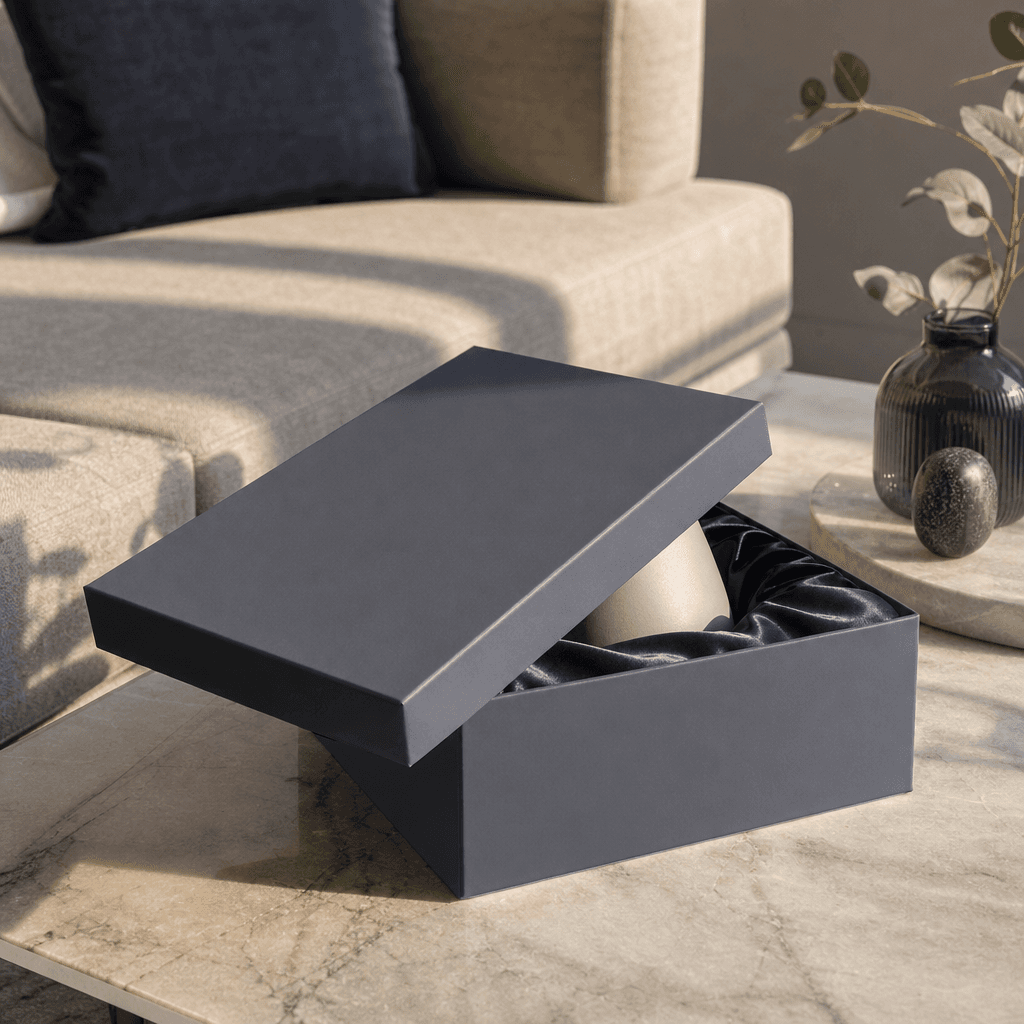
The shortest answer to the question of what a rigid box is: it is a premium, free-standing type of packaging produced by wrapping and gluing a body made of thick grey chipboard with a printed or custom cover paper. In the industry it is also referred to as a wrapped box or cardboard box. The key difference from a folding carton box is that instead of folding a thin blank, a thick skeleton is covered from the outside; this gives the box both a more solid feel and a stronger brand experience at the moment of opening. In this guide we bring together the structure, the production mechanism, the box models, the material and printing options, the use cases, and the risks that need to be checked before ordering, all in one place.
Contents
Is there a difference between a rigid box and a cardboard box?
In most projects, no. A rigid box actually describes the production method of the cardboard box. The process of gluing and wrapping a printed or custom paper around a thick chipboard skeleton is called wrapping or lining. For this reason, the terms rigid box, wrapped box, cardboard box, premium box and hard box describe the same product family in many projects.
The only point to be careful about is that the term "hard box" may be used a bit more broadly; not every hard box is necessarily produced with the same wrapping method. That is why it is not enough to simply state the product name when requesting a quote. Clarifying the body material, the covering type, the box model and the production technique together prevents dimensional and appearance surprises that may emerge later.
How does a rigid box work?
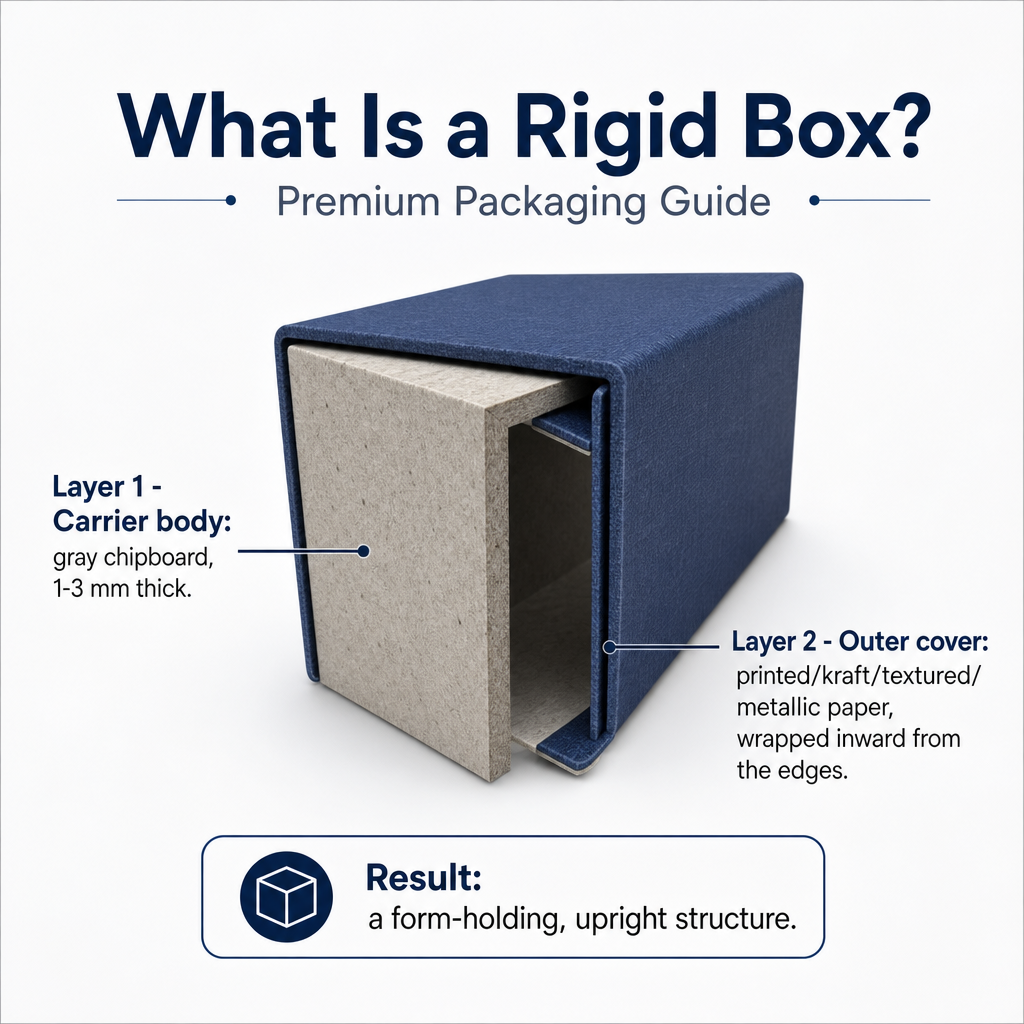
The structure of a rigid box rests on two layers. The first is the load-bearing body: it is usually made of grey chipboard 1–3 mm thick and gives the box its rigidity. The second is the outer cover; printed, colored, kraft, textured, metallic or special-effect paper is glued to the body and wrapped from the edges inward.
This two-layer construction gives the box distinct functions. It preserves the box's form, provides a more solid feel compared to a thin carton box, better supports heavy or delicate products, and offers a wide area for printing and surface finishes. Wrapping the cover paper from the edges inward creates a seamless and clean appearance on the outer surface. In projects where logos, color gradients and premium surface details matter, this seamless surface is the most concrete reason that puts the rigid box ahead of folding alternatives.
In which models is it produced?
The rigid box is not limited to a single lid form. Different models are designed according to the product's use scenario and the intended opening experience. The table below shows the most frequently preferred models together with their typical use scenarios.
| Box model | Prominent use scenario |
|---|---|
| Magnetic lid box | Cosmetics, perfume, jewelry, gift sets |
| Top-opening magnetic box | Watch, accessory, luxury product presentation |
| Lid-and-base box | Classic gift, jewelry, special-series packaging |
| Drawer box | Jewelry, watch, perfume set, small accessory |
| Book-style box | Corporate gift, perfume, creative presentation |
| Window box | Displaying the product without opening the packaging |
| Cylinder box | Candles, tea, cosmetic products of different forms |
| Collapsible box | Need to reduce storage and shipping volume |
Hinged boxes and specially shaped models (heart, star, logo form) are also part of this family. It is worth elaborating on three models separately, as they require additional review at the decision stage.
Magnetic lid rigid box
The magnetic lid allows the box to open and close easily and in a controlled manner; its alignment when closing strengthens the premium perception. On the other hand, the position of the magnet and the lid tolerances should be tested on a sample, and the closing margin must fit perfectly.
Drawer rigid box
In the drawer model, the outer sleeve and the inner drawer work together. The opening motion is effective in jewelry, watches and perfumes with high perceived value. It is important to test the inner drawer in terms of sliding, friction and product weight.
Collapsible rigid box
Collapsible boxes can be shipped flat or in a smaller volume, which can reduce storage and shipping costs. In return, the assembly points, folding strength and assembly tolerances should be checked before mass production.
Material, printing and surface finishes
The premium look of a rigid box is not determined solely by the thickness of the chipboard; the body, outer cover, printing technique and finishing are evaluated together. The main load bearer in the body is grey chipboard. It is mostly produced from recycled paper pulp and provides thickness and rigidity. When choosing thickness, the "thicker is better" approach is misleading; product weight, box dimensions, lid type, insert and shipping conditions should be read together. When direct printing or a clean inner surface is required, white-surfaced duplex chipboard can offer an advantage in designs where light tones are critical.
On the outer cover, however, the options are varied. Smooth-surfaced coated paper is often preferred for colorful and detailed prints; you can review our coated paper guide for its properties and use in packaging. Brands that want a natural and plain look turn to kraft paper; it supports the message of sustainability or craftsmanship in cosmetics, natural food, candles and lifestyle products. However, the natural color of the kraft surface alters the printed colors; if light tones or corporate colors are critical, color control on a sample is essential. Textured papers give a rich tactile feel, metallic papers a reflective surface, and holographic papers effects that change with the light; these special coverings increase the design impact but must also be addressed separately in terms of cost, print compatibility and recyclability.
On the printing side, offset printing is suitable for jobs where high volume and color consistency stand out; digital printing is suitable for jobs requiring low volume, variable design or personalization. UV printing can be used on certain surfaces for strong contrast or special effects. In projects where corporate colors are sensitive, Pantone references, a print proof and a physical sample should be read together; the color on screen may not look the same as the color on the printed paper.
In finishing, hot or cold foil stamping adds a metallic accent to the logo, while embossing and debossing add tactile depth. These applications are frequently seen in jewelry, perfume, premium cosmetics, corporate gifts and special-series chocolate. Soft touch lamination gives the box a velvety, matte touch; gold foil or a plain logo over a matte surface is one of the classic combinations of premium packaging. When using soft touch, scratching, fingerprints, edge wear and recyclability compatibility should be evaluated together; you can refer to our soft touch lamination guide for how this surface finish works and its decision criteria.
Why is the insert decision as important as the product?
The interior layout of a rigid box is as much a part of the product experience as its exterior appearance. The insert prevents the product from moving inside the box and provides an orderly presentation at the moment of opening. Options include sponge or foam inserts, cardboard inner separators, carton dividers, paper or tissue support, ribbon, fabric-covered inner surfaces and custom-cut product beds. If you need soft padding and interleaving paper, we cover the use of tissue paper in packaging in a separate guide.
When designing an insert, in addition to the product dimensions, tolerance, weight, surface sensitivity and the opening direction of the box must be taken into account. There is a two-way balance here: an overly tight insert makes the product hard to remove and spoils the opening feel; an overly loose insert creates the risk of movement and scratching during transport. The right tolerance is determined specifically for the product, between these two extremes.
In which products does it stand out?
The rigid box stands out in products where packaging carries not only protection but also the brand experience. In cosmetics and perfume, magnetic, lid-and-base or drawer models are used for bottle, jar and set products; the insert is critical to limit the movement of glass packaging. In jewelry, the product is small in volume but high in perceived value; the opening feel, inner arrangement and surface quality become decisive, and velvet, textured paper, foil and custom inserts are frequently considered.
In candles, room fragrances, design objects and gift sets, the rigid box strengthens the brand's visual identity; cylinder or specially shaped models can also be considered in this group. In chocolate and premium food, the box form, inner separator, materials in contact with the product and food regulations must be checked together. In Turkey, materials that will come into contact with food must comply with the relevant food regulations; the relevant regulation covers substances and materials intended to, or likely to, come into contact with food. For this reason, the outer rigid box and the inner packaging that is in direct contact with the product should not be considered the same thing, and compliance and technical documentation should be requested from the supplier for the parts in contact. In corporate gift sets, inner compartments, ribbons, cards and accessories become part of the design; the box dimensions should be determined to ensure the products fit together and do not bump into each other during transport.
Criteria to consider when choosing
The right rigid box decision depends not on a single criterion, but on seven interrelated headings that balance one another.
Product weight and sensitivity: For glass, metal or heavy products, the chipboard thickness, box dimensions and inner support are handled together. Deciding based only on exterior appearance increases the risk of deformation during transport.
Sales channel: For in-store, gift presentation and shelf experience, classic lidded or magnetic models stand out. In e-commerce, however, volume, storage space and outer shipping packaging must also be calculated. A rigid box does not always substitute for a shipping box on its own; for sensitive or high-value products, a protective corrugated shipping package may need to be added around the inner rigid box.
Box dimensions: Custom dimensions reduce unnecessary movement of the product inside the box. However, overly tight dimensions negatively affect production tolerances and ease of use. The inner product dimensions, the protective insert and the lid's closing margin should be calculated together.
Opening experience: Magnet, drawer, hinge and book-type openings offer different experiences. The most elaborate mechanism is not the right option for every product; the opening style should be compatible with the frequency of use and the need to access the product.
Printing and color accuracy: A dark kraft surface, metallic paper or textured covering makes the printing result look different from the standard white coated surface. Taking a sample with the actual covering material before mass production reduces the color risk.
Surface durability: Scratching and edge wear should be tested under bag, shipping, shelf and frequent-use conditions. On special surfaces such as soft touch, fingerprint and friction control is especially important.
Sustainability and recycling: Recycled content is a good start, but the box as a whole should be evaluated. Paper, chipboard, plastic lamination, metallic effects, magnets and other accessories affect the separation process. The European Union's packaging regulations aim for packaging to be designed to be economically recyclable. While this goal does not directly mean a technical specification for every project in Turkey, it is an important reference for questioning the number of materials, unnecessary coverings and hard-to-separate components at the design stage.
Limitations and risks
The rigid box is not automatically the best solution for every product, and before finalizing the decision one must see a few limits. The first is cost: thick chipboard, covering, labor, mechanisms, surface finishes and the insert raise the unit cost compared to a standard folding box. The second is volume; the form-preserving body takes up more space in storage and shipping. For very high-volume products with high cost sensitivity, a folding carton box may be more efficient.
Production-related risks are also important. The proper wrapping of the cover paper at the corners, the gluing quality and the drying conditions are decisive; moving to mass production without sample approval leads to problems such as corner lifting or bubbles. Since the cover paper, lamination and production batch changes can affect color perception, a physical proof or sample approval should be obtained, especially for corporate colors. Finally, on the recycling side, the covering, plastic lamination, magnet, metallic effect and different materials make it difficult to evaluate the box in a single fiber stream. For this reason, sustainability claims should be based not only on the term "paper-based" but on the actual composition of the product.
Production process and quote brief
In rigid box production, the process begins with understanding the product and the brand's goal. Dimensions, weight and purpose of use; box model and opening direction; chipboard thickness; cover paper and printing method; insert and accessories; surface finishes; sample and physical test requirements; and production quantity and shipping plan are evaluated in order. After the structural and graphic design is completed, an unprinted, printed or digital mock-up sample is prepared. After approval, the chipboard is cut, the cover paper is printed, surface finishes are applied; then the cover paper is glued and wrapped around the body, and the insert and accessories are added.
According to the cardboard box product information we have published, the standard production time is 10–25 business days after design approval, domestic shipping within Turkey takes 2–5 business days, and the minimum order quantity is 100 units. The actual time varies according to the model, sample, surface finish, quantity and supply plan. To get a sound quote, preparing the following information speeds up the process:
- The exact dimensions and total weight of the product
- Product quantity and estimated reorder frequency
- Number of products per box
- Preferred box model and opening mechanism
- Insert requirement
- Print file or brand guidelines and the desired surface finishes
- Food contact situation
- Sales channel and shipping conditions
- Sample expectation and target delivery date
As Kosapack, we jointly manage the consulting, structural and graphic design, prototyping, production and logistics stages in rigid and cardboard box projects. The product dimensions, estimated quantity and preferred model are the basic starting information you need to share for the quote to become clear.
Rigid box or folding carton box?
The decision depends on the product's positioning and use scenario. The rigid box stands out when high perceived value, lasting storage, a strong opening experience and physical durability are required. The folding carton box offers an advantage when high volume, low storage footprint, shelf efficiency and cost control are more important.
In this choice, looking only at the unit box price is misleading. When the outer shipping packaging, storage space, risk of damage, customer experience and reorder cost are also taken into account, the real difference between the two forms becomes apparent. For another decision within the same premium box family, our magnetic lid box guide addresses the mechanism, risks and selection criteria in more detail.
Frequently Asked Questions
Are a rigid box and a hard box the same?
In most packaging projects they refer to the same product family. Wrapping or lining is the process of wrapping the cover paper around the chipboard body. Nevertheless, the material and production method should be separately verified at the quote stage.
Does a rigid box fold?
A classic rigid box has a structure that preserves its form and does not fold. However, collapsible or custom-designed models can be produced to take up less volume for transport and storage.
Is a rigid box suitable for heavy products?
When the appropriate chipboard thickness, the correct box dimensions and a supportive insert are chosen, it can be used for heavy products. The final decision should be made by testing the product weight and transport conditions.
Can a rigid box be used as food packaging?
What is decisive is whether the product comes into direct contact with food. Materials in direct contact must comply with the relevant food regulations. The technical requirements of the outer box and the inner packaging in contact with food may not be the same.
Is a rigid box suitable for e-commerce?
It is suitable for the premium presentation of the product, but it usually needs to be separately protected against outer shipping impact and humidity conditions. The tasks of the inner box and the outer shipping box should be separated from each other.
Is a sample necessary when ordering a rigid box?
Yes. Especially in projects using a magnet, drawer, hinge, insert, special surface and sensitive color, a sample is a critical stage for checking dimensions, mechanism, printing and surface.