
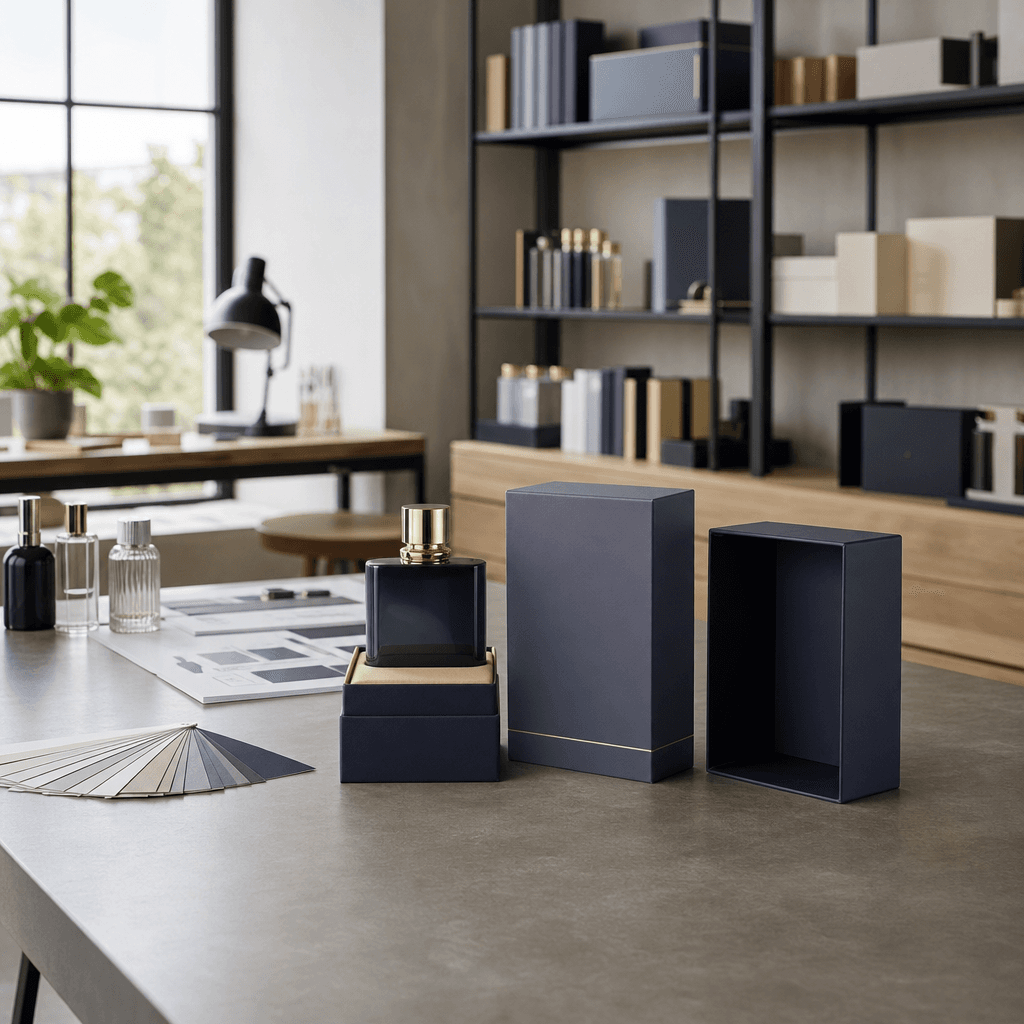
The right decision in perfume box production doesn't end with the box simply looking beautiful. The box must protect the glass bottle, represent the brand both on the shelf and in e-commerce channels, leave room for mandatory product information, and deliver the targeted premium perception within cost limits. For this reason, perfume box production means planning the outer packaging custom-designed to the product's dimensions together with its material, printing, surface finishing, inner tray, and logistics requirements. We at Kosapack bring together cardboard boxes, carton boxes, tissue paper, box separators, labels, and complementary packaging under one roof with design, prototyping, production, and logistics services.
This guide clarifies the decisions perfume brands need to make before requesting a quote: which box structure, which inner fixation, which printing and surface, which regulatory area. The goal is not an aesthetic preference list, but preparing a brief that protects the bottle, suits the brand, and moves smoothly into production.
Table of contents
What is the real decision in perfume box production?
The fundamental question a brand must ask is this: Based on the protection of the perfume bottle, brand perception, production quantity, and sales channel, which box structure and material combination delivers the best result?
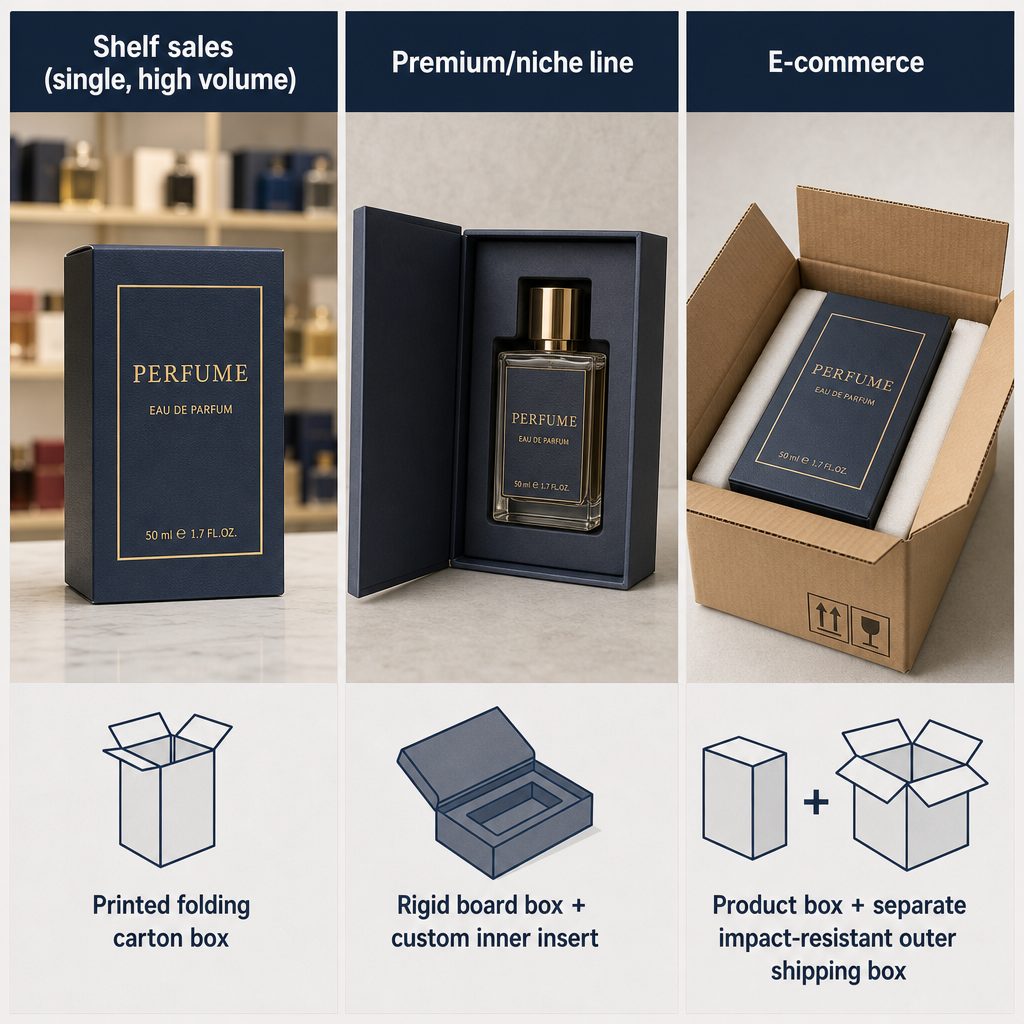
A single box type is not suitable for all perfume brands. While a printed carton box may be sufficient for a standard Eau de Parfum headed to the shelf, a cardboard box with a custom inner tray is more appropriate for a gift set, special edition, or niche perfume. In e-commerce shipments, the product box should not replace the outer shipping box. Sets containing multiple bottles may require a separator or molded inner carrier. Digital printing is more efficient for limited production, while offset printing is more efficient for high-volume collections.
A perfume box is not a decorative element independent of the product. It is the packaging component where protection, information carrying, brand positioning, and sales experience come together on the same surface. Because these four functions overlap, the box decision should not be made before the bottle dimensions and sales channel are determined.
Carton or cardboard box for a perfume box?
Carton boxes are lightweight, foldable, and print-friendly. They are preferred for single perfume products, shelf sales, and high-volume production where cost is critical. Their standout features are low volume and easy storage, a wide print area, suitability for mass production, the ability to be shipped flat, and a more accessible unit cost. However, the weight and structure of a carton box may not sufficiently secure a heavy glass bottle on its own. Movement of the bottle inside the box increases the risk of corner crushing, surface scratching, or cap damage.
Cardboard boxes, on the other hand, provide a thicker, more rigid carrier structure. They are suitable for premium perfumes, gift sets, launch boxes, and brands aiming for high perceived value. They offer a more solid and premium feel, higher structural support for heavy glass bottles, special structures such as magnetic lids, drawers, or hinged bodies, inner tray options of fabric, foam, or paper, and suitability for the unboxing experience. On the other hand, as material, labor, coating, and logistics volume increase, the total cost also rises.
For this reason, instead of reflexively choosing a cardboard box for every perfume product, the sales channel and product positioning should be evaluated. To see the structural differences between carton and cardboard in more detail, you can review our comparison of cardboard boxes and corrugated boxes.
Suitable structure options for perfume boxes
Structure selection depends on several variables, from the product's weight to presentation expectations. The table below summarizes which structure fits which scenario and which technical point stands out in each.
| Box structure | Suitable use | Strength | What to watch out for |
|---|---|---|---|
| Folding carton box | Single perfume, shelf sales, high volume | Lightweight and print-friendly | Heavy bottles may require inner support |
| Lidded cardboard box | Premium perfume and gift presentation | Lasting and strong perception | Higher volume and cost |
| Magnetic cardboard box | Special edition, gift set, launch | Impressive opening experience | Magnet, lid, and alignment control |
| Drawer cardboard box | Niche and luxury perfume collections | Distinctive use experience | Inner tolerance and friction must be designed correctly |
| Compartmented set box | Multiple perfumes or mini set | Separates and protects products | Separator dimensions must be precisely prepared |
| Sleeve box | Minimal and shelf-oriented design | Surface and presentation flexibility | Sleeve removal tolerance must be tested |
These options are not alternatives to one another but correspond to different product-channel pairings. For example, the same brand's standard line can come out with a folding carton box, while its limited collection can come out with a drawer cardboard box.
Inner placement: What secures the bottle in the box?
Perfume bottles are usually made of glass, heavy, and sensitive to impact. A sturdy outer box alone is not enough; the inner placement must limit the bottle's movement inside the box. Solutions that can be used include a folding carton inner tray, cardboard separator, molded pulp carrier, foam or EVA tray, tissue paper wrapping, a two-compartment structure that keeps the bottle and cap separate, and a cellular inner layout for multiple products.
When selecting an inner carrier, not only appearance but also physical behavior must be tested. Does the bottle shake inside the box? Can the cap separate from the bottle? Does the product go in and out of the box easily? Does the inner tray scratch or apply pressure on the bottle? When the box is opened, does the product appear in the correct orientation? Is there enough support against the risk of dropping and vibration during transport?
For single standard perfumes, a simple carton inner tray is often sufficient. For heavy glass bottles, special caps, or premium gift sets, a more comprehensive inner structure should be preferred. The inner placement decision cannot be considered independently of the outer box structure: the same cardboard box loses its protective function with a tray cut to the wrong tolerance.
Perfume box printing and surface finishes
Print selection is made based on quantity, number of colors, personalization needs, and surface quality. Offset printing provides consistent color and detailed graphics in high-volume production; it is a strong option for collections where brand colors and fine typography matter. Digital printing, on the other hand, offers advantages in low and medium quantities, different variants, or personalized series; because it does not require a die, it provides flexibility for short runs and quick sample work.
Foil printing highlights the logo and product name with gold, silver, rose gold, or colored metallic tones. Since it clutters the design when overused, the best result is usually achieved on the brand logo, series name, or small accent areas. While gloss varnish emphasizes certain areas, an embossed logo creates a tactile brand effect; in these applications, the production layers of the design file must be prepared correctly. For the print surface, coated paper, kraft paper, or various laminated surfaces can be considered; we covered how material affects the print result in detail in our guide on using coated paper in packaging.
Surface finishing changes not only the appearance of the box but also its tactile feel and durability. Matte lamination, gloss lamination, soft touch lamination, spot varnish, hot foil, embossing, specially textured paper, and protective coating are common options. Soft touch creates a velvety feel; however, scratch, fingerprint, and friction performance should be evaluated according to the use scenario. We explained this balance in more detail in our soft touch lamination guide.
For a premium look, there is no need to use every application at once. Single-focus approaches such as a matte background with a foil logo, a dark background with spot gloss varnish, natural paper with single-color printing, a light background with an embossed brand mark, or a soft touch surface with simple typography deliver a more controlled result. When many glossy effects, embossing, and metallic elements come together, production tolerances and cost increase. The design should be concentrated not on all surfaces of the box, but on the brand's most visible touchpoints.
Regulations and labeling for perfume boxes
In Turkey, the information that must appear on the inner and outer packaging of cosmetic products must be indelible, easily legible, and visible. The Cosmetic Products Regulation makes information such as the name or registered trade name and address of the responsible person mandatory.
When entering into packaging and label design for perfume products, the following areas in particular should be checked: responsible person information, product name and function, net quantity, production or batch number, usage warnings and special precautions, ingredient list, origin or other required information, the product's shelf life or period after opening, and the expression of perfume-fragrance ingredients in accordance with the relevant regulation. The regulation stipulates that perfumes and aromatic compounds be indicated with the terms "perfume" or "aroma"; and that certain ingredients be additionally shown in the ingredient list.
For this reason, before the design file is sent to production, the text areas should be reviewed by a competent team well-versed in cosmetics regulations. We provide support in terms of printing and applicability in packaging production; however, the brand's responsible team should not relinquish responsibility for the product's regulatory compliance. To look more deeply at label technique and surface decisions, you can benefit from our guide on label printing types.
How to design a sustainable perfume box?
A sustainability claim is not proven merely by using a "paper box." The box's material structure, coating type, printing inks, the separability of different components, unnecessary volume, and production waste must be evaluated together.
Decisions that work in practice are as follows: designing the box in the smallest functional volume that will protect the bottle; avoiding the use of unnecessary plastic windows and mixed materials; keeping paper and cardboard components as separable as possible; questioning recyclable or certified material options; evaluating the recycling impact of lamination and special coatings; separately analyzing additional parts such as inner trays, magnets, ribbons, and foam; and requesting verifiable documentation from the supplier for material and environmental claims.
ISO 18601 defines the general requirements for the packaging and environment standard series and covers suppliers who place packaging on the market. ISO 18602, on the other hand, addresses the optimization of material weight and volume while preserving the packaging's function. We include sustainability topics such as recyclable papers, plastic-reducing solutions, certified materials, and carbon footprint reporting within the scope of our services. That said, the recyclability of each perfume box must be verified by examining all selected components together.
Factors that determine cost and the production brief
In perfume box production, dimensions or quantity alone are not enough. For a quote to be comparable, the scope must be clearly defined. The main cost factors are: box type and structural complexity, width-length-height dimensions, material type and grammage, cardboard thickness, printing technique and number of colors, foil-varnish-embossing-lamination, inner tray and separator, accessories such as magnet-ribbon, sample and die costs, production quantity, packaging-logistics, and the number of different fragrance-color-volume variants.
When obtaining a quote, you need to ask not only about the unit price but also the scope: Is the physical sample included in the price? How are design changes managed after sample approval? With which proofing method is color accuracy checked? Is the inner carrier priced separately? Are waste, packaging, and shipping included? Can different product variants be produced in the same box structure? At which stages is quality control performed? After you share your requirement brief, we provide a quote within 24 hours and a physical sample within 7–15 business days; the MOQ varies according to structure, material, and finishing.
For an accurate quote and sample, telling the manufacturer only "perfume box with printed logo" is not enough. The brief fields below show the information that should be clarified in the first meeting.
| Brief field | Information to provide |
|---|---|
| Product | Perfume type, bottle volume, and number of variants |
| Bottle dimensions | Width, length, height; total dimensions including cap |
| Product weight | Approximate total weight of bottle and product |
| Sales channel | Shelf, boutique, e-commerce, gift, or launch |
| Box type | Carton, cardboard, drawer, magnetic, or compartmented |
| Inner placement | Inner tray, separator, foam, tissue, or another solution |
| Graphics | Logo, color codes, texts, and print file |
| Surface | Matte, gloss, soft touch, foil, embossing, or spot varnish |
| Quantity | First production and estimated annual need |
| Regulations | Mandatory texts and the person responsible for approval |
Before bottle dimensions are sent to the manufacturer, they should be checked not only with theoretical values but also on an actual sample. On glass bottles, cap tolerance, spray head, and decorative parts affect the box's inner dimensions.
Main risks in perfume box production
If the inner tray is not tight enough, the bottle moves during transport; an overly tight design, on the other hand, makes it difficult for the bottle to go into the box. For this reason, the inner placement must be tested with a physical sample. On the color side, the design on screen and the print result may not be the same; especially dark backgrounds, metallic colors, skin tones, and brand colors should be approved via a proof.
Although soft touch and matte surfaces look premium, they may carry the risk of scratching or leaving marks under transport and storage conditions; the box should be checked before and after shipment. The area reserved for logo and visual design should not squeeze the mandatory texts; when preparing the outer box dieline, text legibility and cut-fold zones should be taken into account. An oversized box, on the other hand, increases material cost, warehouse volume, and shipping cost, and moreover the product moves inside the box; the box dimensions should be limited to the product and inner protection need.
The most critical risk is moving to mass production without seeing a sample. A digital design file does not show the box's actual rigidity, cap alignment, print tone, or how the product sits inside. Before mass production, a physical sample should be seen and written approval should be given.
Decision summary for brands and the process with Kosapack
For most brands, a safe start establishes the product-channel pairing as follows: a printed folding carton box for a standard, single, high-volume product; a carton or cardboard box with an inner tray for a heavy or delicate glass bottle; a cardboard box with special surfaces and controlled inner placement for premium and niche series; a compartmented cardboard box or magnetic structure for a gift set; impact-resistant outer shipping packaging in addition to the product box for e-commerce; digital printing and a flexible sample process for a short run or variant launch; offset printing and a standardized box structure for high-volume continuous production; and reduced volume, separable components, and verifiable material information for a sustainability goal.
Although we have not published a separate product page for perfume boxes, we offer cosmetic packaging, premium cardboard boxes, carton boxes, tissue paper, box separators, labels, and gift packaging solutions within the same service structure. The advantage of this model is that the box design can be coordinated with inner placement, label, tissue paper, and shipping packaging without being scattered among different suppliers. Our service scope includes consulting, structural and graphic design, prototyping, managed production, quality control, and logistics stages.
When you send us your perfume box brief together with dimensions, product weight, quantity, sales channel, printing expectation, and delivery date, we can jointly evaluate the carton or cardboard box alternatives suitable for your brand and move them to the sample stage.
Frequently Asked Questions
Is a carton or cardboard box better for a perfume box?
There is no single right answer. A carton box is more suitable for shelf sales and high volume; a cardboard box is more suitable for premium presentation, heavy glass bottles, and gift sets. The decision should be made together with the product weight and the inner fixation need.
Is an inner tray necessary in perfume box production?
Yes, if there is a possibility of the bottle moving inside the box. An inner tray or separator provides protection especially for heavy glass bottles, decorative caps, and multiple sets.
Which printing technique should be used for a perfume box?
Offset printing can be considered for high volume and fixed design; digital printing for short runs, variants, or personalization needs. Foil, embossing, and varnish should be used selectively to enhance the brand effect.
What information should be written on a perfume box?
The responsible person information, net quantity, batch number, ingredients, warnings, and other mandatory information required by cosmetics regulations should be included in the outer packaging plan. This information must be indelible, visible, and legible.
Is a perfume box sufficient for e-commerce shipping?
Usually no. The product box provides brand presentation and product protection; in e-commerce transport, an additional outer shipping box, proper void management, and impact protection may also be required.
Can an order be placed without seeing a sample?
It can; however, especially in projects involving custom dimensions, cardboard boxes, magnets, inner trays, or multiple surface finishes, moving to mass production without seeing a physical sample increases the risk in color, dimensions, and protection.