

The short answer to the question of what corrugated cardboard is: it is a lightweight yet durable packaging material formed by joining flat paper sheets with a wavy-shaped paper sheet in between. The flat sheets are called liners, while the wavy inner layer is called fluting or corrugated medium, and these layers are usually bonded together with a starch-based adhesive. This seemingly simple structure is the actual engineering that determines how a box will behave in transit, in the warehouse, and on the shelf. To make the right decision, you should not look at the box's appearance; instead, you must consider product weight, handling conditions, flute type, number of layers, dimensions, and printing requirements together.
At Kosapack, we treat corrugated cardboard not as a material name but as a performance decision. This guide explains how corrugated cardboard works, what flute types mean, which structure makes sense for which sector, and which criteria should be evaluated together when making a selection. Our aim is to help you come to the quotation stage with the right questions.
Table of Contents
How does corrugated cardboard work?
The durability of corrugated cardboard comes not from the thickness of the material but from the arch-like structure formed by the wavy paper layer. The flute profile acts as a continuous support between two flat paper sheets. According to FEFCO data, the connected arches formed by the corrugated structure give the material rigidity and load-bearing resistance. For this reason, it becomes much more rigid than a flat paper, carries vertical loads better, and provides additional resistance against impact and compression.
The air gaps between the flutes also create a limited insulating effect, and all this protection is achieved at low weight. This is why it is misleading to think of corrugated cardboard as "thick cardboard." The material's performance arises from the combined work of paper quality and flute geometry; keeping one constant and changing the other can completely change the result.
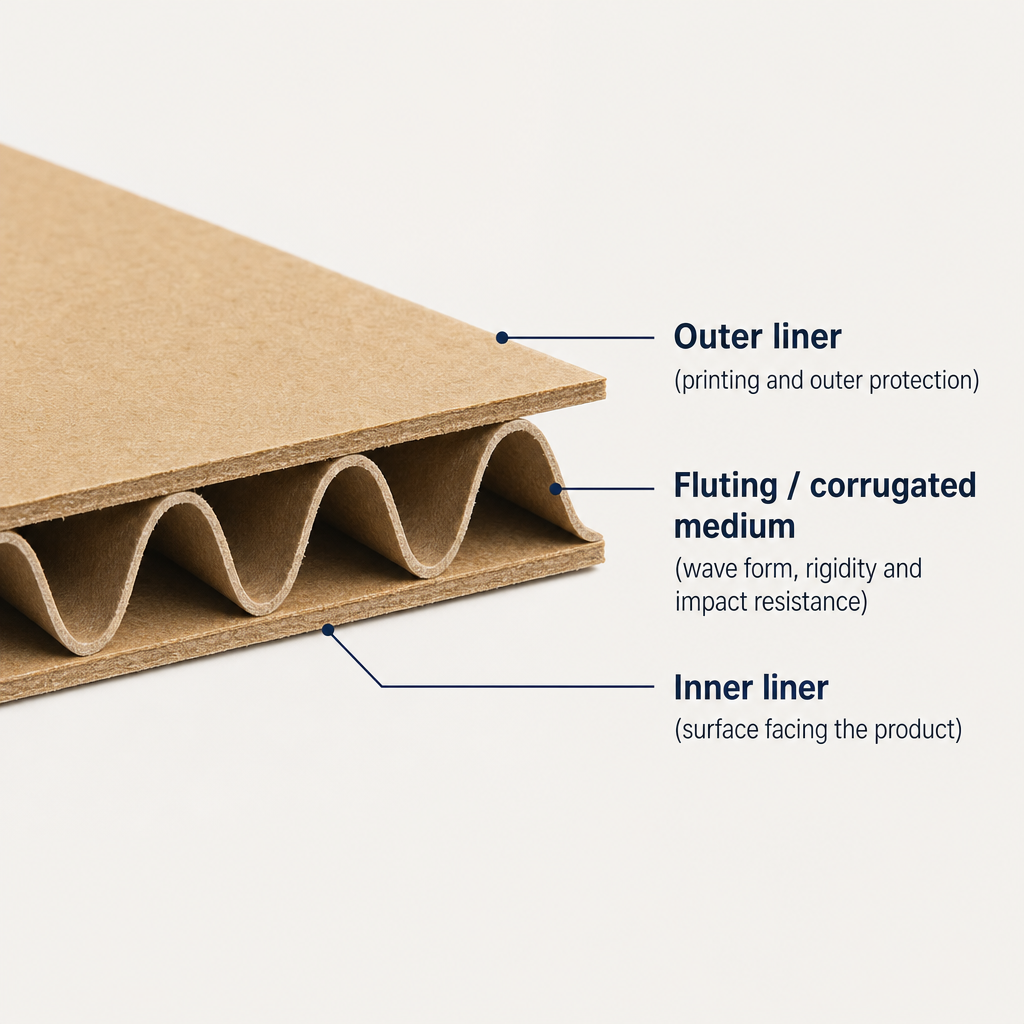
The structure of corrugated cardboard and number of layers
A standard single-wall corrugated cardboard consists of three basic paper layers. The outer liner forms the printing surface and the outer protective layer, the fluting provides rigidity and load-bearing with its wave form, and the inner liner forms the surface facing the product. Together, these three layers make up what is called the "single-wall" structure.
| Layer | Function |
|---|---|
| Outer liner | Printing surface, protection against external effects, and contribution to box form |
| Fluting / corrugated medium | Rigidity, load-bearing, and impact resistance through the wave form |
| Inner liner | Surface facing the product and contribution to structural integrity |
When higher strength is required, more than one corrugated layer and liner can be used together. FEFCO notes that in addition to single-, double-, and triple-wall structures, there is also a single face structure consisting of a corrugated layer bonded to just one liner. In practice, the decision is usually reduced to the number of layers. The single-wall structure is frequently used in the outer boxes of light and medium-weight products, e-commerce shipments, and general shipping packaging. The double-wall structure has two corrugated layers and an additional liner separating them; it is considered for heavier products, long-distance transport, or situations with a high risk of stacking. The triple-wall structure comes into play in heavy-duty packaging that requires high transport and stacking strength.
However, it is wrong to automatically consider triple-wall the "safest." Since it is thicker and heavier, storage volume, shipping volumetric weight, ease of folding, and cost must all be weighed together. If you want to explore the structural differences between box types in greater depth, our guide what cardboard box is and what features it has is a complementary reference point.
Flute types and what they are used for
The flute type refers to the height of the corrugated medium and the number of flutes per unit length. As the flute gets larger, the box's capacity to absorb impact and create volume increases; as the flute gets smaller, surface smoothness and printability come to the fore. According to FEFCO's technical data, the approximate heights for common flute types are about 4.8 mm for A flute, 3.6 mm for C flute, 2.4 mm for B flute, and 1.2 mm for E flute. Micro flute profiles such as F, G, and N are in the range of approximately 0.5–0.8 mm.
| Flute type | Approximate height | Standout feature | Typical area of consideration |
|---|---|---|---|
| A flute | 4.8 mm | High volume and impact absorption | Large-volume products requiring more protection |
| C flute | 3.6 mm | Balance of protection and rigidity | General shipping and courier boxes |
| B flute | 2.4 mm | Frequent flutes, smooth surface | Compact boxes, jobs requiring a good surface |
| E flute | 1.2 mm | Thin structure, print-friendly surface | Inner box, small product, branded packaging |
| F/G/N micro | 0.5–0.8 mm | Thin profile, surface smoothness | Light products, printed and layered solutions |
This table is not an "always choose this flute" rule. For a heavy product, looking only at flute height is not enough; the product's weight, box dimensions, transport orientation, stacking duration, moisture exposure, and internal support elements must also be taken into account. In some applications, two different flute types can be used together. For example, a large flute providing durability in the outer layer and a thinner micro flute in the inner or printing surface may be preferred. This combined approach increases outer box strength while smoothing the printing surface, reduces the product's movement inside the box, and establishes a performance balance without using a single thick material.
Which structure makes sense for which sector?
Corrugated cardboard is not limited to standard brown shipping cartons; by changing the structure, flute, and printing options, it is adapted to different sectors. In e-commerce and DTC shipments, the box provides basic protection against the impact, compression, and stacking risks in the shipping process, while outer printing, inner printing, and custom sizing can turn it into a brand touchpoint. Here, the first questions to ask are whether the product leaves gaps inside the box, whether the box size unnecessarily increases volumetric weight, and whether internal filling or separators are needed. We offer corrugated cardboard boxes both in the durable industrial box class and as inner-printed shipping boxes for branded e-commerce shipments.
In shipping and logistics, the priority is the product before visual impact. The box's outer dimensions, flute type, edge strength, and closure method together determine transport performance. Standardized designs use FEFCO codes; these codes help clearly define box shapes across different suppliers. In storage and shipment, the box's behavior on the shelf and on the pallet is as important as its strength at the moment of first use. Long-term stacking, high humidity, and the box being partially filled increase the risk of deformation; therefore, edge crush strength, base dimensions, and pallet arrangement should be planned together.
In cosmetics, candles, and personal care, corrugated cardboard is mostly used as an outer shipping box or a protective structure that holds products together. For a candle containing a glass jar, simply thickening the box is not enough; a separator or molded inner cavity that secures the product is needed. To detail the packaging decision for cosmetic products, you can refer to our guide brand tips for choosing a cosmetic box.
In food and beverages, corrugated cardboard can be used as an outer shipping carton, a multi-product box, or gift set packaging. However, standard corrugated cardboard should not be considered sufficient for surfaces in direct contact with food. The European Union's Regulation No. 1935/2004 sets safety rules for materials intended to come into contact with food or that may transfer components to food under normal use. In Turkey as well, printing ink migration, recycled paper use, and the intended contact purpose must be examined separately; therefore, instead of saying "corrugated cardboard box" in the brief, the use scenario, contact surface, and contact duration should be clearly stated.
In electronics, corrugated cardboard can be used as an outer box, but for sensitive products, relying only on the outer box is not correct. The risks of impact, product movement inside the box, static electricity, and surface scratching are solved together with molds, foam, or inner cavities. In fashion, jewelry, and corporate gifts, corrugated cardboard is usually the transport and outer protection layer rather than the main presentation box: a cardboard box on the inside, a printed corrugated shipping box on the outside. This hybrid setup preserves the premium unboxing experience while providing additional strength in transit. To review the differences between a cardboard box and a folding structure, our article what a folding box is and its uses is helpful.
What criteria should be considered when choosing corrugated cardboard?
The right material is determined not by a single variable, but by evaluating several criteria together. Two products of the same outer dimensions may have different protection needs; a light textile product and a glass bottle should not be packaged with the same flute and the same inner structure. Therefore, the product's net and gross weight, fragility level, whether it contains liquid, surface sensitivity, and the need for securing in the box should appear in the first lines of the brief.
The distribution channel is the second determinant. Store delivery, palletized shipment, delivery to the end user via a courier company, and export transport create different risks; the box choice must cover the entire distribution chain of the product. Box size and void space are also a separate decision: an overly large box requires more material and filling, while a too-small box puts pressure on the product. The ideal solution is a size that is as close as possible to the product but still accommodates production tolerances and the protective inner structure. We design dimensions and structures that match the product exactly; we address size, weight, and distribution channel together in the specification analysis.
The flute type and number of layers affect volume, surface, and strength potential, but thicker material is not always better. An unnecessarily thick box increases volumetric weight, enlarges storage space, makes folding and closing harder, raises costs, and creates constraints on the printing surface. In printing and brand appearance, the choice should be made according to quantity, number of colors, customization needs, surface, and color accuracy; in premium brands, it is important to check the printing decision on a physical sample. To compare printing methods, you can review our guide comparison of offset printing and digital printing.
Moisture and the external environment should not be overlooked either. Paper-based materials are affected by moisture; if cold chain, high-humidity storage, or use with liquid products is involved, surface coating and paper selection are evaluated. Instead of general expressions like "waterproof," the duration and conditions under which the packaging will be used should be defined. Finally, the sustainability goal cannot be evaluated by looking at the material name alone; printing, lamination, plastic windows, adhesives, coatings, and product residue affect the recycling process. The content of the paper used, the certified fiber ratio, composite components, and ease of post-use separation should be examined together. We work on recyclable papers, plastic-reducing solutions, certified materials, supplier audits, and carbon footprint reporting.
How is durability checked?
The box's appearance alone does not provide sufficient information about its strength; material and box performance must be verified with appropriate tests before production. Edge crush strength, i.e., ECT (Edge Crush Test), measures the edgewise compression strength of corrugated cardboard and is especially decisive for boxes that are stacked on top of each other. Among the standards published by TAPPI for fiberboard shipping containers are test methods for both the bursting strength and the edge crush of corrugated cardboard.
Bursting strength relates to the tearing resistance against the pressure applied to the surface of the material and gives an idea about sharp impact, friction, or pressure on the outer surface; TAPPI lists this test under the T 810 standard. The box compression test, on the other hand, measures the behavior of the completed box against the load applied from the top and is important for palletized shipment, long-term storage, and heavy products. In e-commerce boxes, drop, vibration, impact, and friction risks are also evaluated together. If the product moves inside the box, redesigning the internal layout gives a more accurate result than simply thickening the cardboard.
Common selection mistakes
The most common mistake is looking only at the grammage. Paper grammage alone does not explain box performance; flute type, layer structure, paper properties, box size, and joining points are also determining factors. The second common mistake is automatically choosing the thickest material. A thicker box is not always safer or more economical; unnecessary material use raises shipping, storage, and production costs.
The third mistake is neglecting inner protection. A fragile product will be damaged if it moves inside despite a strong outer box; separator, cavity, or filler design is as important as the box structure. The fourth mistake is approving the print without a sample. The texture of the corrugated surface, the paper color, and the printing method change color perception; a physical sample or color verification process should be carried out before mass production. The fifth mistake is assuming food contact. Carrying food products in an outer box and packaging in direct contact with food are not subject to the same requirements. The final mistake is determining the size based only on the product dimensions. Inner protection, closure allowance, production tolerance, and transport orientation should be added to the product dimensions; otherwise, the box either compresses the product or creates excessive void space.
Planning corrugated cardboard boxes with Kosapack
When requesting a quotation for a corrugated cardboard box, the information you share directly speeds up the process. When the product name and area of use, product dimensions and weight, fragility or liquid content, estimated monthly or one-time quantity, in-box protection needs, courier-store-pallet scenario, printing surfaces and brand files, target delivery date, and sustainability or food contact requirements are included in the first brief, we recommend the right structure in the first round.
We coordinate custom sizing, structural and graphic design, prototyping, managed production, quality control, and logistics within a single service model. We offer a 24-hour frame for quotations and a 7–15 business day frame for physical samples; the actual timelines need to be clarified according to the project specifications. If your product needs both a premium unboxing experience and shipping durability, we can design a combination of a corrugated outer box with a printed inner structure or a cardboard box together.
Frequently Asked Questions
What is the difference between corrugated cardboard and cardboard?
Cardboard is generally a single-layer or more compact paper-based board. In corrugated cardboard, flat liner layers are combined with a wavy middle layer. This wavy structure provides higher rigidity and protection at low weight.
Is corrugated cardboard water-resistant?
Standard corrugated cardboard is not waterproof. Moisture, water, and high humidity reduce its strength. Under these conditions, the paper type, coating, duration of use, and the product contact scenario should be evaluated separately.
Is corrugated cardboard recyclable?
Paper-based corrugated cardboard can enter the paper recycling stream under suitable collection and sorting conditions. However, plastic lamination, windows, heavy coating, adhesives, and product residue can affect recycling suitability.
Which flute type should be used for e-commerce?
A single flute type is not correct for all e-commerce products. Thin flutes are considered for small and light products; higher or combined flutes are considered for products requiring more impact or stacking resistance. The decision is made according to product weight, fragility, box size, and shipping duration.
Should a corrugated cardboard box or a cardboard box be preferred?
Corrugated cardboard generally stands out for transport, shipping, and outer protection; the cardboard box stands out for premium presentation, shelf appearance, and brand experience. If the product needs both, the two structures can be used together.