
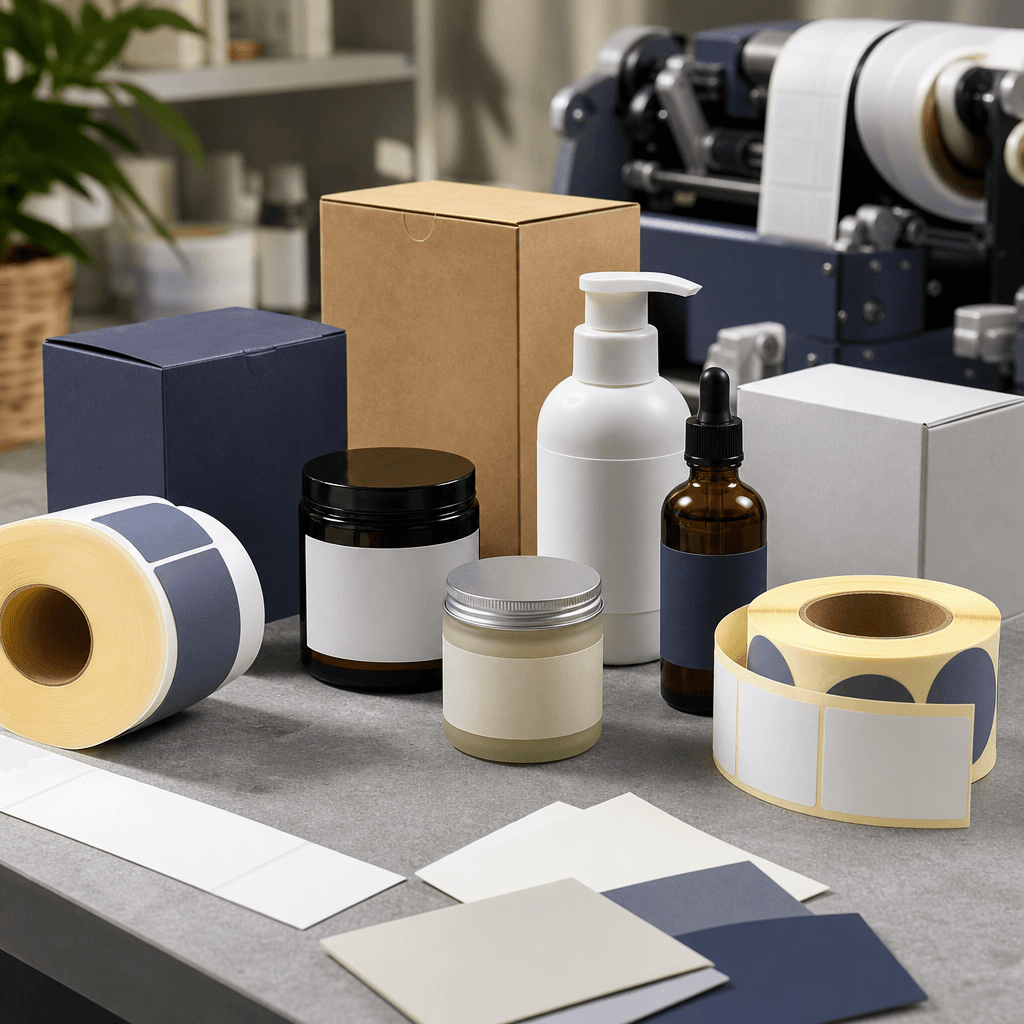
A significant part of the first impression a product leaves on the shelf or in a shipping box lies in its label. This small surface, carrying the brand name, ingredient information, usage instructions, barcode, and legal warnings, manages both information and brand perception at the same time. Label printing is the process of preparing this information to be applied to the product by printing it onto paper, film, kraft, metallized, or textured materials. But the right label often starts not with the question "how should it look?" but with "where, for how long, and under what conditions will it be used?"
This guide brings together label printing types, material and surface treatment options, industry preferences, common mistakes, and pre-print checkpoints in the decision-making language of brands. The aim is to help you ask the right questions before requesting a quote.
Table of Contents
What does label printing mean?
Label printing is the production of labels to be applied to a product, package, or shipping surface with a specific design, material, and printing technology. Labels are generally prepared in roll or sheet form; they are made ready for use after processes such as cutting, lamination, varnish, foil, or embossing.
Three components define a label project. The first is the carrier material: paper, kraft, PP, PE, PET, transparent film, metallized film, or textured paper. The second is the printing method: digital, flexo, offset, screen printing, or variable data printing. The third is application and protection: adhesive type, cutting shape, lamination, varnish, foil, and embossing.
Choosing a label based solely on design can lead to problems after production such as edge lifting, wrinkling, color fading, or an unreadable barcode. That's why the decision should be based on the usage scenario before visual preference.
What are the types of label printing?
Label printing types are divided according to the printing technology used, production volume, personalization needs, and expected surface quality. Each method has a sweet spot; when the wrong method is chosen, either the unit cost balloons or the quality expectation isn't met.
Digital label printing transfers the design directly to the machine; it does not require a mold or printing plate. This makes it flexible for short and medium runs. Economical production in low quantities, the ability to print variable names/numbers/QR codes, producing numerous design variations cost-effectively, and fast revisions are its standout advantages. Avery Dennison's technical resources note that digital label printing stands out in terms of short runs, variable information, on-demand production, and fast design changes; and that the absence of a printing plate in inkjet systems reduces setup costs. It is often the most flexible solution for brands launching new products, offering different flavor or color variants, or planning seasonal campaigns.
Flexo label printing is an industrial method that works with flexible printing plates and fast-rotating machines. High production speed, favorable unit cost in medium-to-high quantities, and suitability for roll label production are its main features. Since it involves a plate and setup stage, it may not be as advantageous as digital in very low quantities; however, as volume increases, its unit cost advantage becomes clear.
Offset label printing is preferred for jobs requiring high resolution and detailed color gradients. It produces strong results in designs with photographs, illustrations, and fine color tones; it is suitable for high-volume, paper-based flat or sheet labels. It is less flexible for low-volume jobs with many variable designs due to setup costs.
Screen printing labels are applied by transferring ink onto the surface through a mesh screen. It can create a dense ink layer, opaque colors, and tactile surfaces; it stands out on dark-colored surfaces, special packaging such as bottles and jars, and when heavy white is used. It is not always the most efficient method for very small text, high speed, and large-volume production.
Variable data printing allows different information to be printed on each label: serial number, batch code, QR code, campaign code, or personalized name. It is useful in e-commerce campaigns, limited-edition collections, products requiring traceability, and numbered collections.
Label materials and areas of use
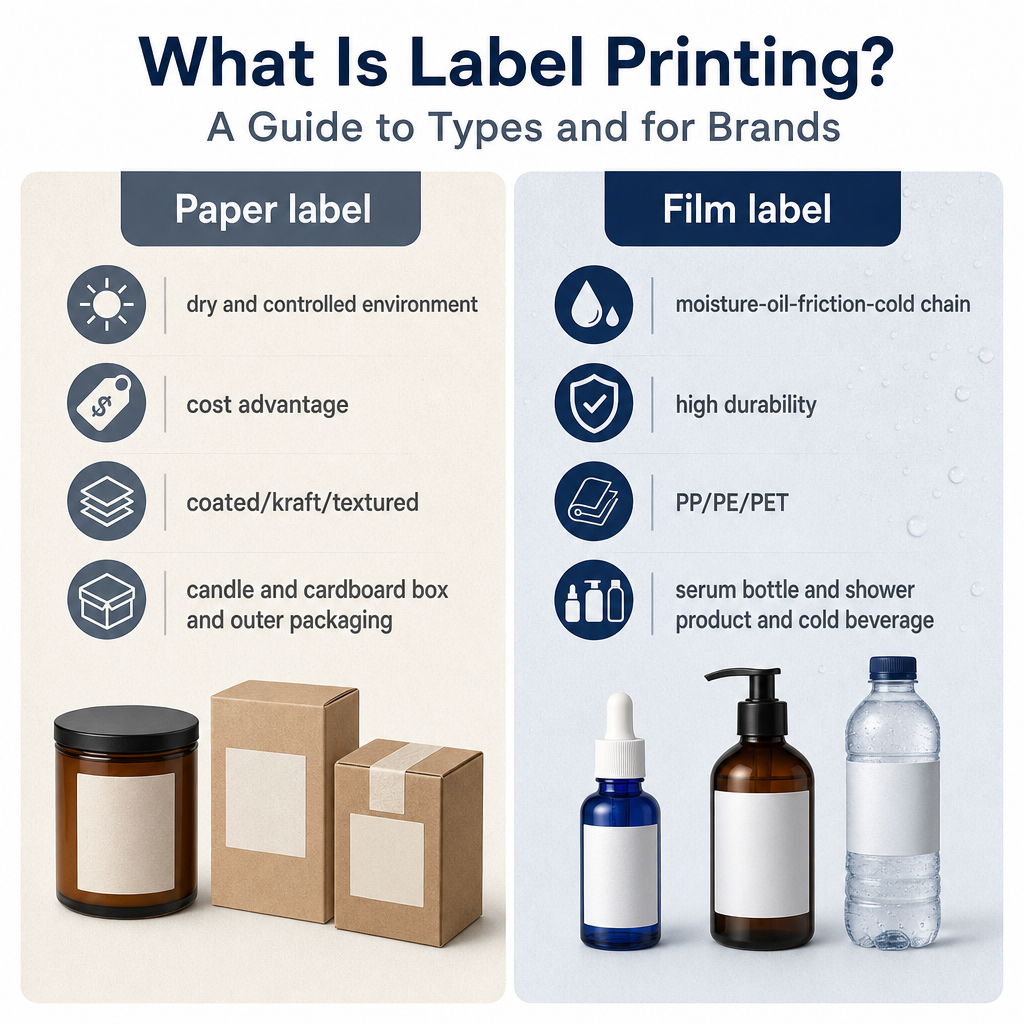
Material choice determines a label's performance as much as the printing technique does. Paper labels provide a cost advantage in dry and controlled conditions; film labels are more durable against moisture, oil, friction, and temperature changes.
| Label material | Key feature | Suitable area of use |
|---|---|---|
| Coated paper | Smooth surface, economical | Dry food, boxes, short-term indoor use |
| Kraft paper | Natural and warm appearance | Organic products, DTC, boutique food |
| Textured paper | Tactile, premium feel | Wine, chocolate, candles, perfume |
| PP film | Resistant to moisture and tearing | Cosmetics, cold products, bathroom |
| PE film | Flexible, compatible with curved surfaces | Bottles, tubes, flexible packaging |
| PET film | Durable, dimensionally stable | Chemicals, cosmetics, harsh environments |
| Metallized film | Glossy, eye-catching | Spirits, cosmetics, premium campaigns |
Avery Dennison's material guide states that applications such as digital, flexo, offset, screen printing, and hot foil should be evaluated together with the material surface. In practice, a few questions clarify the right decision: Will the product sit in a refrigerator or a humid bathroom? Will the label come into contact with oil, water, or chemicals? Is the packaging surface flat or curved? Should the label maintain its appearance throughout its shelf life?
For candles, soap boxes, or outer packaging sold in a dry environment, paper may be sufficient. For a serum bottle, shower product, cold beverage, or a product used outdoors, film materials are a safer starting point. If you want to make the label decision together with the box and other components, the comparison Cardboard Box vs Corrugated Box: Which Is Right? helps plan surface and material integrity.
What do surface treatments add to a label?
Label printing can be enriched with surface treatments beyond the basic print. These treatments change both the protection and the perceived value.
Lamination is a thin film layer that protects the printed surface. Matte lamination reduces reflection and gives a clean, premium look; gloss lamination makes colors pop; soft-touch lamination creates a velvety feel. Lamination strengthens the label, but it should be evaluated together with the material's recyclability, adhesive type, and sustainability goals.
Varnish and spot UV are applied to the entire surface or selected areas. Spot UV gives shine only to areas such as the logo, pattern, or product name, creating a matte-gloss contrast and tactile hierarchy; it supports premium perception.
Foil printing is the transfer of gold, silver, or metallic appearances to the label. It stands out in cosmetics, jewelry, spirits, candles, and gift products. There is an important limit: the areas to be foiled should not be barcodes, small legal text, or dense information blocks; metallic and reflective surfaces can make barcode scanning difficult.
Embossing and debossing create a tactile effect by forming raised and recessed areas on the surface. They are used on logos, frames, or brand symbols. For success, the material thickness must be suitable, very small details must be avoided, the surface the label will adhere to must be considered, and the cutting and embossing dies must be prepared correctly.
How should brands choose a printing method?
A single printing method isn't right for every brand. The decision becomes clear when several criteria are evaluated together.
Production volume is the first determinant. Low volume and frequent design changes point to digital printing; medium-to-high volume to flexo or offset; many different SKUs to a digital or hybrid solution; and continuous, repeated production to flexo. Comparing only the unit price here is misleading; printing plate, mold, setup, and waste costs should be read within the total quote.
The product's usage environment determines the durability threshold. A dry shelf, cold chain, bathroom, outdoors, or heavy handling each require different solutions. In a humid environment, simply requesting "waterproof printing" is not enough; the surface material, adhesive, and protective coating must be chosen together.
The packaging surface shapes the application. It may be glass, PET/PP/PE plastic, cardboard, metal, fabric, or a varnished-textured surface. Curved surfaces require flexible film and a suitable adhesive; paper labels are easier to apply on flat cardboard surfaces.
Brand positioning turns the material into a touchpoint. Kraft or textured paper for a natural and boutique look; transparent film or matte PP for modern-minimal; metallized surface, foil, and embossing for luxury; coated paper and standard cutting stand out for a simple-economical approach.
Information density is the final filter. If there are long ingredient lists, usage instructions, warnings, and a barcode, readability takes priority. Although transparent or metallized labels are aesthetically strong, they can cause problems with long texts due to low contrast.
Label printing preferences by industry
For cosmetics and personal care labels, resistance to moisture, oil, and the bathroom environment is important. PP, PE, or PET film can be evaluated together with matte lamination, transparent film, foil, and spot UV. The ingredient list, nominal quantity, batch information, usage warnings, and relevant symbols must remain legible at the final print size.
For food and beverage labels, in addition to aesthetics, presenting information in compliance with regulations is critically important. In Turkey, for prepackaged foods, elements such as the name of the food, ingredients, allergen information, net quantity, date information, operator information, and nutrition declaration must be considered according to the product type; food labeling rules are regulated under the regulation in the Official Gazette dated January 26, 2017. All legal texts must be clarified before starting the design; if added later, the logo, product name, or visual area may become smaller than necessary.
Candle and home fragrance brands generally seek a premium and tactile look. Textured paper, kraft, metallized details, embossing, and foil can be evaluated; however, it should be tested whether the label will be exposed to heat, oil, or fragrance components.
Jewelry and accessory labels work on small surfaces. Little information, high contrast, and a strong brand hierarchy are required. Foil, embossing, and quality textured cards support premium perception; very small font sizes, complex patterns, and low-contrast metallic text reduce readability.
In e-commerce and DTC brands, the label can be part of the product packaging, the shipping experience, or the thank-you card. The brand name, product variant, QR code, and recycling information can be used together. If the label is to look good in photos, during unboxing, and in social media posts, the brand colors and surface treatments need to be consistent.
Common risks in label printing
The most costly mistakes emerge after mass production, because correcting them at that stage affects thousands of labels.
Wrong material choice is the most common trap. Using paper in a humid environment causes wrinkling or edge lifting; on curved surfaces, materials that aren't flexible enough crease.
A difference between the screen color and the print color can disrupt brand identity. Colors seen on an RGB screen don't produce the same result in print; especially dark tones, neon colors, and brand colors change on different materials. In projects where brand color is critical, CMYK, spot color, and a physical proof should be evaluated together.
The adhesive not being suitable for the surface causes the label not to hold. On dusty, oily, rough, cold, or curved surfaces, standard adhesive may be insufficient.
The barcode not being readable is an operational problem. Placing the barcode on foiled, very glossy, or low-contrast surfaces creates scanning problems; the barcode should be tested in the actual material and actual print size before mass production.
Adding legal information later disrupts the hierarchy. If legal texts are squeezed in at the final stage, the font size shrinks, the safe area is compromised, or product information gets lost in the visual.
Not making a physical proof renders all these risks invisible. The on-screen design does not show the texture of the actual material, color behavior, adhesion, appearance on a curved surface, or barcode performance. Taking a physical proof before mass production reduces the cost of high-volume errors.
Pre-print file and supplier check
A few points in the file to be sent for printing cause problems again and again; closing them off from the start speeds up the process.
- The cut line and bleed should be defined, and text and logo should stay within the safe area.
- Images should be at sufficient resolution, and logos and small texts should be vector-based if possible.
- Color mode and spot color use should be clarified; foil, varnish, and embossing layers should be defined separately.
- The barcode's size and contrast should be verified; texts should be checked for spelling and regulatory compliance.
- The design should be approved with a physical proof on the actual material.
When choosing a supplier, look not only at the quoted price but at their control capacity. Can they provide the requested material and printing method? Do they offer a physical proof on the actual material? How are color control and quality approval carried out? Do they perform application tests, barcode, and small-text checks for curved or problematic surfaces? Can they manage different SKUs and variants and coordinate surface treatments within the same production plan? Can they explain delivery and sustainability claims on a material and process basis?
At Kosapack, we handle the label not on its own but within the brand's entire packaging language: we manage consulting, graphic and structural design, prototyping, production coordination, and logistics processes under one roof. Having the label progress within the same brand language as the cardboard box, paper bag, tissue paper, thank-you card, or shipping packaging creates a more consistent experience, especially for premium and e-commerce brands. In projects where the box and label are planned together, the content of Drawer Box Production: A Guide for Brands also helps align structural decisions with the label decision.
Frequently Asked Questions
What is the difference between label printing and label design?
Label design is the preparation of content, color, typography, and visual layout. Label printing, on the other hand, is the transformation of this design into a physical product with the chosen material and printing technique. For a good result, the two processes should be planned together; for details, you can check the How to Design a Label? guide.
Which method is suitable for small-volume label printing?
Digital printing is generally more flexible. The fact that it doesn't require a mold makes it easier to produce different designs and variable information in short runs. The definitive choice should be made together with the material, surface treatment, and quantity.
Should paper or film be used in label printing?
Paper is more suitable for dry and controlled environments; film materials are more suitable for conditions involving moisture, oil, friction, cold chain, or the bathroom. The most accurate choice is determined by a test in the product's actual usage environment.
Can a transparent label be used on every product?
No. For transparent labels, the surface color, the product's appearance, and text contrast are important. On products with long ingredient lists or mandatory small texts, readability problems may occur.
What determines label printing cost?
The main factors are material, label size, quantity, printing technique, number of colors, cutting shape, adhesive, lamination, foil, varnish, embossing, proofing, and logistics. For this reason, not just the "price per label" but the total project scope should be compared.