
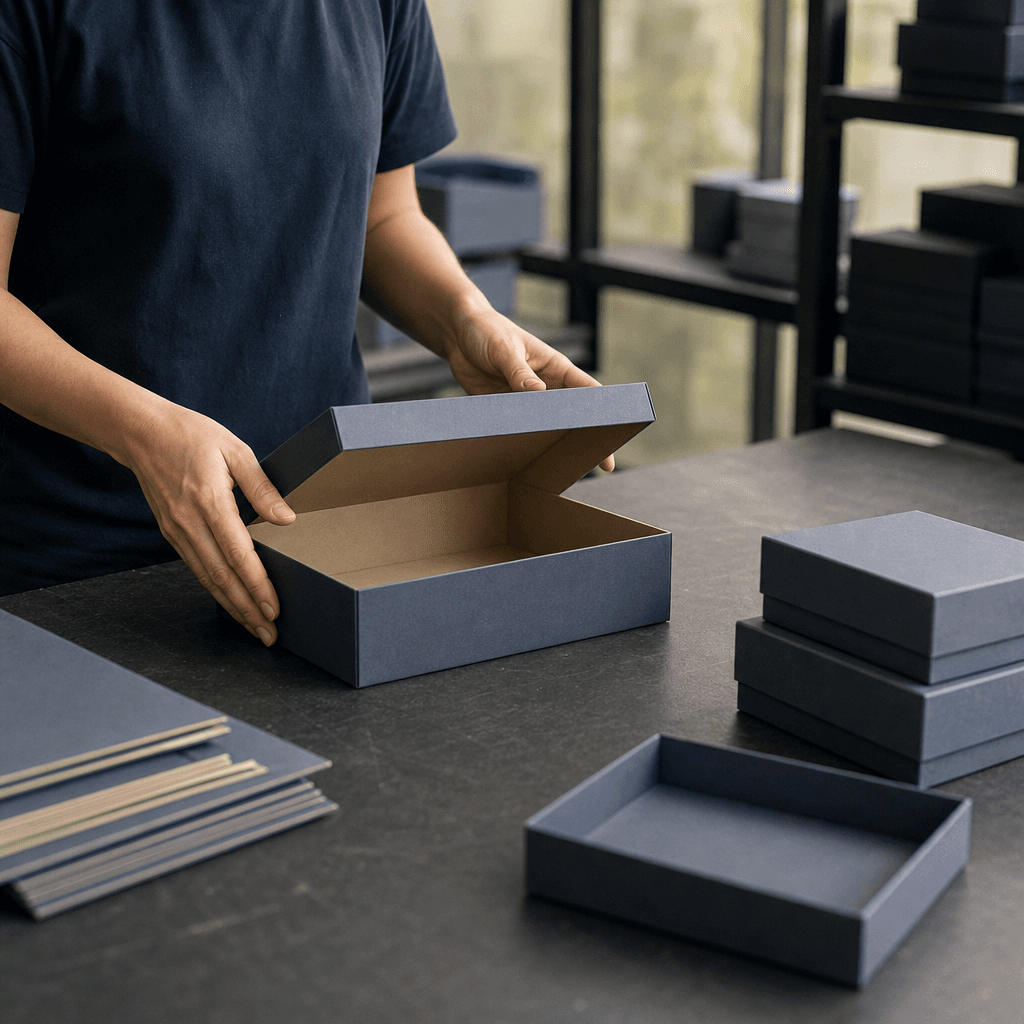
Putting a product in a box is not just a matter of transport; it simultaneously determines the product's level of protection, the impression the brand leaves on the shelf and in shipping, and the customer's first moment when opening the box. In categories such as cosmetics, jewelry, candles, chocolate, and corporate gifts, the box decision becomes as strategic as the product itself. At this point, one of the most frequently asked questions is: what is a rigid box, what features does it have, and in which situations is it the right choice?
A rigid box is a type of box produced by covering a fixed body made of thick cardboard sheets with a printed or colored wrapping paper; it does not fold and is intended for premium presentation. It is also called a set-up or wrapped box. Its fundamental difference from a folding box is that it retains its form after production and cannot be shipped flat. In this guide, we address the box's structure, varieties, areas of use, limitations, and correct selection criteria all together.
Table of contents
The structure and components of a rigid box
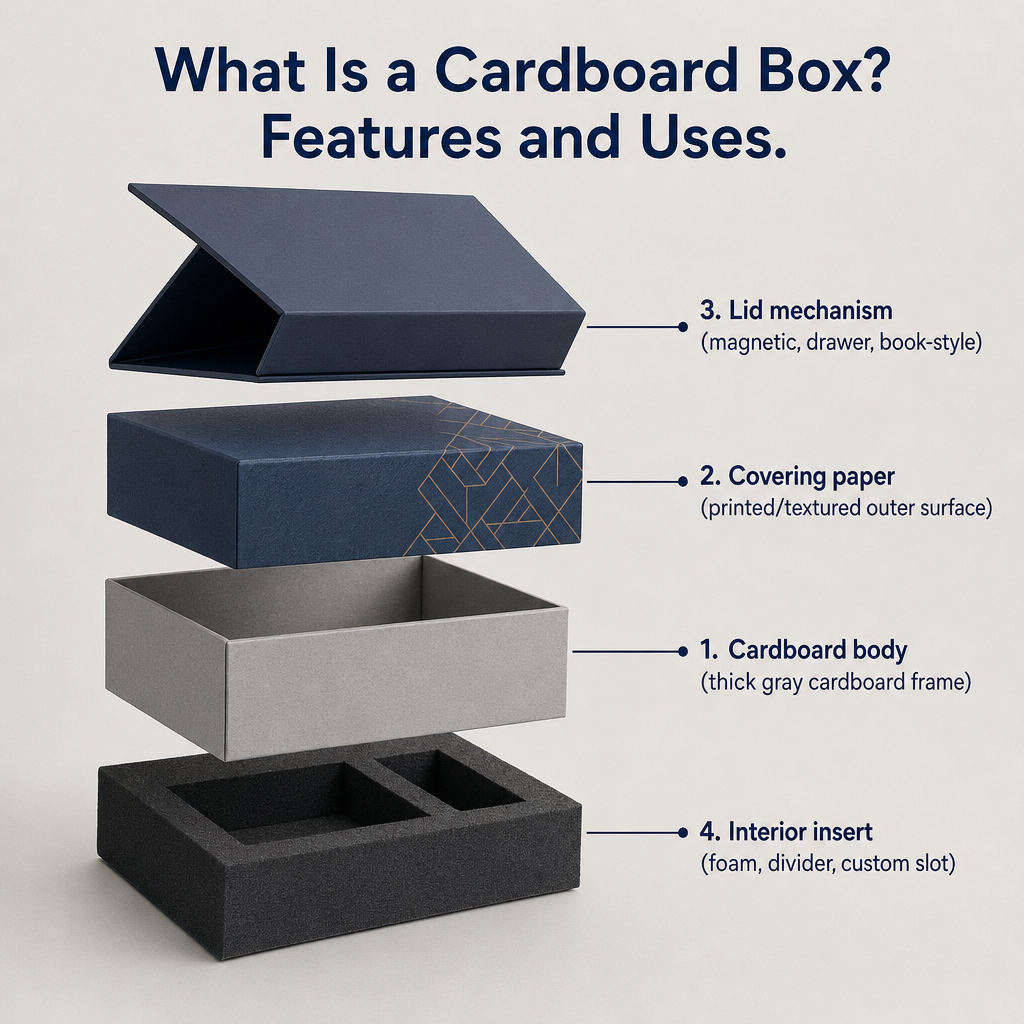
What distinguishes a rigid box from other box types is its layered structure designed as a whole. Four main components determine both the box's durability and its perceived value.
The cardboard body is the box's load-bearing skeleton. Thick gray cardboard sheets are cut to form the base, side walls, and lid parts. The body thickness is determined according to the intended use, box dimensions, product weight, and desired durability. This skeleton is the fundamental element that enables the box to retain its form without folding.
The wrapping paper is applied to the outer surface of the body and determines the box's appearance and tactile feel. Printed coated paper, kraft-look paper, textured paper, colored paper, or fabric-like surfaces can be used. This layer is not merely aesthetic; logos, colors, patterns, and surface effects are applied on this wrap.
The lid mechanism directly affects the box's opening feel and ease of use. Options such as a classic lift-off lid, magnetic lid, drawer structure, book-style opening, folding lid, or shoulder-fit lid are determined according to the product's positioning.
The inner insert is used to prevent the product from moving inside the box or to present multiple products in an organized way. Depending on the product's shape and sensitivity, EVA, foam, cardboard, rigid board, paper dividers, or custom compartments can be chosen.
Prominent features of the rigid box
Behind brands' preference for rigid boxes lie several complementary technical features. The most defining is its ability to retain its form: unlike thin and easily bendable packaging, the fixed body helps the product stand upright on the shelf and makes the box look neat.
The thick body and wrap structure give the box a tangible weight and a solid feel. This tactile perception can reinforce the perceived value, especially for high-priced or gift-like products. In parallel, the box is visually customizable; with different colors, printing techniques, and surface applications on the wrapping paper, logos, brand patterns, and campaign messages are integrated into the design.
Magnetic, drawer, or book-style models change the way the customer opens the box; this makes the rigid box well suited for different opening experiences and unboxing content. Since a box is not just about outer dimensions, components such as product cavities, dividers, brochure compartments, and gift cards can be planned together with the interior design.
Finally, its durable structure allows the box to be reused for storage or organization after the product is finished. However, this potential depends on the surface coating, moisture resistance, and structural quality, and is not guaranteed for every box.
The difference between a rigid box and a folding box
Although rigid boxes and folding boxes share some purposes, their structures and usage scenarios differ. A folding box is formed by cutting and folding a printed cardboard sheet. In a rigid box, however, a thicker body is prepared and finished with wrapping paper. This fundamental difference affects many decisions, from cost to storage.
| Criterion | Rigid box | Folding box |
|---|---|---|
| Body structure | Thick cardboard skeleton | Printed cardboard sheet |
| Form | Fixed, non-folding | Foldable |
| Perceived value | High and premium | Varies by product and print |
| Storage | More volume | Can be shipped flat |
| Opening | Magnetic, drawer, custom lid | Usually classic lid and lock |
| Typical use | Jewelry, perfume, gift set, luxury product | Cosmetics, food, retail, mass product |
While the wrapping, assembly, and labor burden of a rigid box generally raises the cost, a folding box can be more economical depending on its structure and printing. To evaluate the structure of a folding box and its differences from a rigid box in more detail, you can take a look at the What Is a Folding Box? Areas of Use guide.
Types of rigid boxes
Choosing a rigid box is not done based on color or printing alone. The lid structure, product placement, and intended use determine the model. The table below compares the most frequently preferred models with their structural features and suitable areas of use.
| Type | Structural feature | Suitable use |
|---|---|---|
| Lift-off lid box | Classic structure where the base and top lid work separately | Jewelry, accessories, boutique products |
| Magnetic box | Structure where the lid closes with a magnet | Cosmetic set, perfume, corporate gift |
| Drawer box | Model where the product is pulled out of the inner compartment | Jewelry, watch, candle, special edition |
| Book-style box | Structure resembling a book, opening from one edge | PR boxes, launch, brand presentation |
| Box with dividers | Model where products are separated by inner dividers | Gift set, chocolate, care set |
| Box with custom inner insert | Cavity or foam shaped to the product | Bottle, jewelry, sensitive electronics |
In which areas is the rigid box used
In the cosmetics and personal care category, it is used for perfumes, serums, skincare sets, and makeup products. The cardboard body helps the product be perceived as more valuable, while the inner insert holds the product in place. For those who want to examine the right board-cardboard selection and structural form in cosmetics in more depth, we have a separate guide.
In jewelry and watch products, the small size and high value bring the inner insert decision to the fore. Foam, velvet, cardboard compartments, or custom cavities can be used for rings, necklaces, earrings, or watches. Planning the outer box, inner box, and shipping packaging together ensures the product delivers a consistent experience from the store to the customer.
In candles and decorative products, boxes are preferred for candles in glass jars and room fragrances in terms of presentation, protection, and giftability. For glass or ceramic products, the gaps inside the box must be controlled and supportive inner parts used when necessary.
In chocolate and specialty food sets, a rigid box can be used as outer packaging. However, if the food will directly contact the box surface, visual and structural decisions alone are not sufficient. The European Commission states that paper, cardboard, plastic, glass, and metal packaging in contact with food must comply with the relevant food contact materials rules. For this reason, inner pouches, packaging film, or a suitable food contact layer should be additionally evaluated for food products.
On the fashion and accessories side, for belts, scarves, bag accessories, and limited-edition products, the box supports brand positioning; the lid, printing, and wrap are customized according to the brand's aesthetic language. In corporate gift and launch boxes, different products can be combined in a single box and dividers keep the products looking organized.
For e-commerce and DTC brands, a rigid box does not always replace the shipping box. Especially for shipments where the risk of impact, moisture, and stacking is high, a suitable shipping package may also be needed outside the product box. When choosing a box, protection during the shipping process, dimensional weight, outer packaging, and the opening experience should be considered together; for this balance, you can benefit from the What Is a Mailer Box? A Guide for E-commerce content.
Limitations and risks to be aware of
A rigid box is not the right option for every product and every distribution channel. Its most obvious constraint is cost: thick material, wrapping, setup, assembly, magnets, and handwork can raise the unit price. For this reason, estimating the price by looking only at the box type without clarifying quantity, size, and intended use would be misleading. You can review the cost-affecting items in detail in the How Is Custom Box Production Cost Calculated? content.
Storage and transport volume is the second important constraint. Since rigid boxes are shipped retaining their form, they require more space than folding boxes shipped flat; in high-volume productions, warehouse volume and the shipping plan should be evaluated before the quote.
Sensitivity to moisture should also not be overlooked. Paper-based materials can be sensitive to moisture and liquids if there is no suitable surface protection. If the product will be used in a cold chain, a humid environment, or areas such as a bathroom, the coating and outer packaging selection should additionally be tested.
The wrong size also creates risk: if the inner volume is much larger than the product, the product moves during transport, while a box that is too tight can cause damage during placement. For this reason, not only the outer dimensions but also protective material and tolerances should be included in the design.
Finally, recycling depends on the surface composition. Coating, lamination, metallic surfaces, magnets, plastic parts, and adhesives can affect the separation process. The packaging waste legislation in Turkey covers packaging placed on the market and its waste, and defines material recycling as the priority approach. For this reason, a sustainability claim should not be based solely on the phrase "paper-based"; material composition, coating, and the post-use separation scenario should be evaluated together.
Criteria to consider when choosing a rigid box
The right box decision stems from the requirements of the product and the channel before the box's appearance. Evaluating the following criteria together secures both protection and brand perception.
- Product weight and sensitivity: A light accessory and a glass bottle do not have the same structural requirements. As weight increases, the base, side wall, inner support, and lid connections should be re-evaluated.
- Product size and inner tolerance: The box should allow the product to fit easily but leave no unnecessary room for movement. If a brochure, card, or sample will be included alongside it, these should also be added to the inner dimensions.
- Sales channel: Store shelf, boutique delivery, corporate gift, and e-commerce shipment create different box needs. In e-commerce, outer shipping packaging and impact risk come to the fore, while in-store, shelf appearance stands out.
- Brand positioning: For a minimalist brand, a plain, textured wrap may be sufficient, while a luxury collection may require a magnetic lid, special paper, foil, or embossing.
- Inner insert balance: The product should stay in place, but the customer should be able to remove it easily; an overly tight placement negatively affects the usage experience.
- Printing and surface application: The logo, color accuracy, and print quality determine the brand's outward perception. Seeing a sample on the actual material before print approval is important for evaluating color and surface feel.
- Storage and shipping: Where the box will be stored, how it will be shipped, and with which outer packaging it will be sent should be determined at the outset; at high quantities, product volume affects total logistics cost.
The rigid box process with Kosapack
In rigid box projects, we manage consulting, structural design, graphic design, prototyping, production coordination, and logistics under one roof. We handle the box model, dimensions, lid, inner layout, wrap, and printing decisions together according to the product's intended use. The process begins with consulting, where product dimensions and intended use are evaluated; then structural and graphic design is prepared, a sample is taken before mass production, and after approval, the cutting, printing, wrapping, and inner insert stages proceed.
A physical sample is a critical threshold in this process, because approving the graphic design alone is not sufficient. With the sample, we check whether the product sits correctly in the box, whether the lid opens and closes comfortably, whether the magnet or lock mechanism works, whether the print color matches the expected tone, whether there are surface defects in the wrap, and whether the inner insert holds the product sufficiently in place.
Before design approval, we offer unprinted, printed, or 3D digital mockup options. In our rigid box service, we state the standard production time after approval as 10–25 business days, and domestic shipping within Turkey as 2–5 business days; the 7–15 business day target we share for a physical sample depending on the brief is also a planning range that can vary according to the scope of the project. These times are not definite delivery dates but ranges that become clear along with the scope.
A rigid box is a strong choice especially when the product is intended to be perceived as premium or as a gift, when a branded opening experience is aimed for, when a custom inner insert is required, and for small-to-medium-volume, high-value products. In contrast, for high-volume, low-cost products requiring flat shipping or exposed to intense shipping conditions, folding cardboard or corrugated board may be more suitable. If you share your product's size, quantity, sales channel, and budget with us, we can evaluate these criteria together and prepare the box model and sample plan suitable for your brand.
Frequently Asked Questions
Are a rigid box and a cardboard box the same?
No. Although the two terms can be used interchangeably in daily use, a rigid box usually describes a thicker structure with a fixed body. Cardboard boxes, on the other hand, can be produced in different structures such as thin cardboard, folding cardboard, or corrugated board.
Is a rigid box water-resistant?
A standard rigid box is not completely waterproof. For products that will be exposed to moisture or liquid, suitable coating, inner packaging, and outer protection should be planned separately.
Can a rigid box be used as food packaging?
It can; however, whether the food directly contacts the box surface and whether the paper, printing, adhesives, and coatings used are suitable for food contact should be checked. For food-contact packaging, the relevant safety and compliance certificates should be requested.
Can a rigid box be used for e-commerce shipments?
It can be used as a product box; however, its role in the shipping process should be evaluated separately. If the risk of impact, moisture, and stacking is high, a mailer or corrugated shipping box may need to be used outside the product box.
Is a rigid box recyclable?
A paper-based body and wrap can provide an advantage in terms of recycling; however, lamination, metallic surfaces, plastic parts, magnets, and some adhesives can complicate the separation process. The assessment should be made based on all components of the box.