
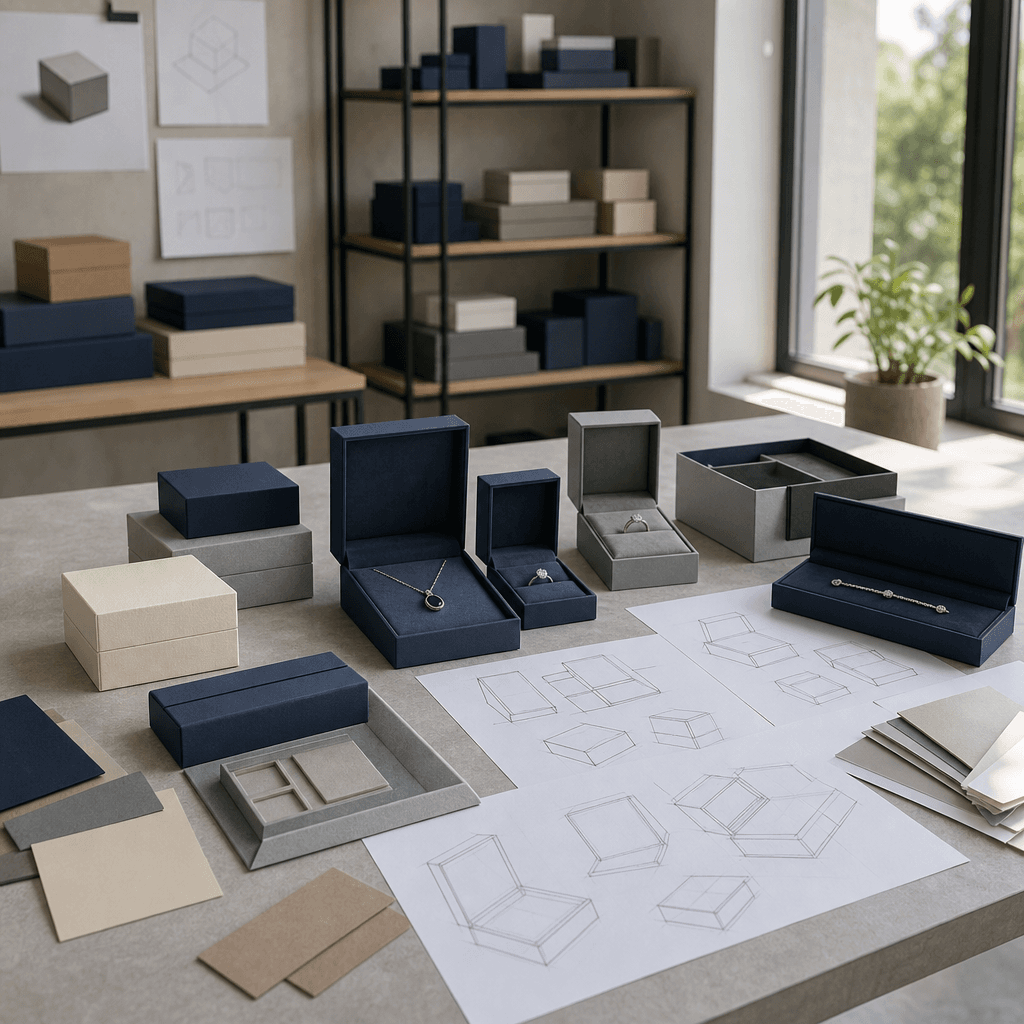
Choosing jewelry packaging may look like a simple box decision at first glance, but it is actually an investment decision that simultaneously defines your brand's price segment, gift perception, and unboxing experience. When jewelry box production for brands is set up correctly, the box form, material, printing, and internal protection work together to increase the perceived value of the product. As your end-to-end packaging partner based in Zeytinburnu, we at Kosapack manage these decisions under one roof from design to production, bringing rigid cardboard box and folding carton solutions together in a single portfolio.
Contents
Defining the decision: what does jewelry box production for brands solve?
A jewelry box represents far more than a container that protects the product: it determines the character of the first physical contact your customer has with your brand. That is why the jewelry box production decision is based not on a single question, but on defining several components together.
In practice, the following areas need to be clarified at the same table:
- Product type: Different geometries such as rings, necklaces, bracelets, earrings, sets, watches, or prayer beads require different internal layouts and box forms.
- Usage scenario: Store sales, a box that comes out of e-commerce shipping, a corporate gift set, or a campaign launch; each carries a different protection and presentation priority.
- Perceived value target: Accessible, premium, or luxury positioning directly determines the material and finishing budget.
- Protection need: The scratch risk of stone and metal surfaces, fragility, and logistics conditions shape the internal structure.
- Sustainability and budget: Preference for recyclable materials, order quantity, unit cost, and total project cost form the economic foundation of the decision.
When these five areas are considered not separately but together, the jewelry box project rests on a secure foundation from both a creative and operational standpoint. The goal is not a single print job, but building a holistic packaging decision that simultaneously represents product, brand, and logistics strategy.
Main components and options of a jewelry box
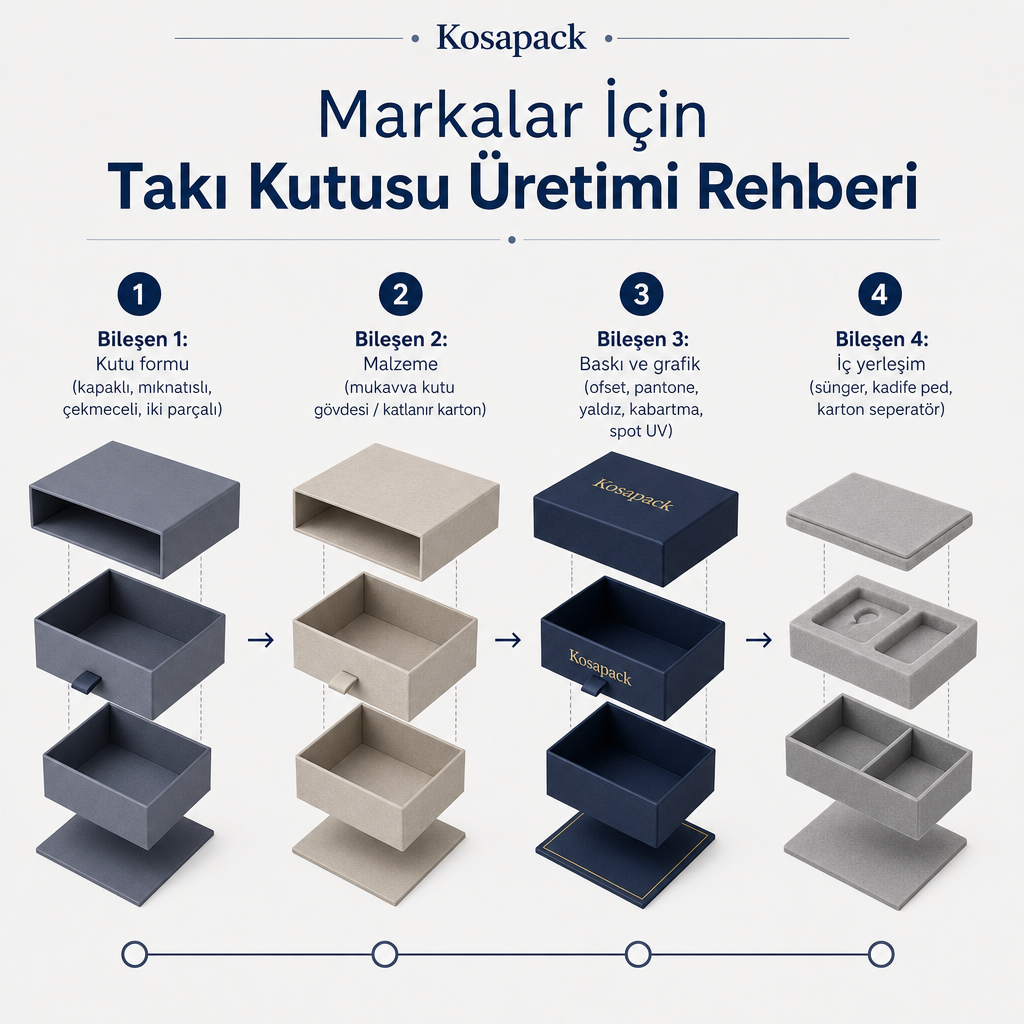
Four mechanisms work together in jewelry box production: box form, material, printing and graphic design, and internal layout with protection. Choosing one of these independently of the others often leads to an inconsistent result.
Box form and structural design
The box form determines how you present the jewelry and the feel of the first contact with the user. The main forms frequently used in jewelry and accessory packaging in Turkey are:
- Classic lid-and-base boxes: A practical and economical solution for rings, earrings, and small necklaces.
- Magnetic-lid rigid cardboard boxes: For premium jewelry, sets, and corporate gifts; the closing sensation elevates perceived value.
- Drawer boxes: Preferred for jewelry sets, collection products, and the e-commerce unboxing experience.
- Two-piece cylindrical boxes: For custom-design-focused brand projects that want to stand out.
During the structural design stage, we finalize the form with engineering calculations by analyzing product dimensions, handling, and protection requirements; critical details such as magnet placement, wall thicknesses, and internal separators are decided precisely at this stage.
Material: rigid cardboard box and folding carton
Material selection determines both durability and perceived value; since these two often pull in opposite directions, striking the right balance is important.
Rigid cardboard box (hard-bodied solutions): Produced by covering a dense cardboard (greyboard) body with decorative paper or fabric. In jewelry, premium cosmetics, and gift sets, it provides a "heavy and solid" feel in hand, creating a high value perception. The ease of integrating structural parts such as foam, velvet pads, or cardboard separators inside is also a major advantage.
Folding carton box: It is economical and suitable for flat shipping. It is especially preferred for outer packaging, shelf-front faces, or nested combinations; for e-commerce shipping boxes and the outer box of the jewelry box.
By offering rigid cardboard box and folding carton box options under a single portfolio, we transform the inner box, outer box, and shipping box for jewelry into a consistent, single packaging experience. To evaluate the relationship between material thickness, print surface, and cost in more depth, you can review our printed cardboard box production guide.
Printing, color, and graphic design
The outer surface of the box is the most visible canvas for your logo and brand story. The prominent mechanisms in printing:
- Offset printing: For full-color designs and fine, detailed patterns.
- Single-color (pantone) printing: For minimal designs aligned with corporate identity.
- Finishing effects: Layers such as hot foil stamping (gold/silver foil), embossing (emboss/deboss), and spot varnish (spot UV) make the tactile and visual difference stand out.
By focusing on color verification and print quality control via samples, we minimize the tone and contrast differences between the on-screen design and the physical box. Since the graphic design stage is a process that addresses the packaging type, the design layout, and the brand language together, we manage it with a consulting model.
Internal layout, separators, and protection
Since jewelry products are delicate, the internal layout turns into a technical design area that protects stone and metal surfaces:
- Foam or velvet pads: Secure pieces such as rings and earrings with cut slots.
- Cardboard separators: Reduce impact and friction in sets containing multiple pieces.
- Interior lining materials: Velvet, microfiber, or kraft; selected according to both the desired feel and the sustainability goal.
In material selection, we recommend verifying technical criteria such as burst strength, moisture resistance, and adhesive strength through sample testing; this approach applies equally to jewelry boxes.
Decision criteria: which jewelry box for which scenario?
When choosing the right jewelry box, four criteria must be weighed together. Looking only at the budget or only at the visuals often produces a result that is either overly costly or insufficiently protective.
Product and collection structure
First, the product architecture must be mapped out: is it a single product, a set, or a collection? Is it a frequently stocked line or a limited series? In the jewelry and accessory segment, it is common for a single brand's portfolio to use different box forms together for rings, necklaces, sets, and watches. That is why we map out the product architecture from the outset when designing projects.
Brand positioning and unboxing
In the jewelry and premium accessory segment, the use of rigid cardboard boxes has become almost standard for increasing perceived value. The practical distinctions by segment are as follows:
- Luxury jeweler or fine jewelry: A heavy-feeling, magnetic or drawer-style rigid cardboard box; with a velvet pad and gold-foil logo print inside.
- Mid-segment fashion/accessory brand: A combination of a printed folding carton outer packaging with a simpler inner rigid cardboard box.
- E-commerce and DTC brands: The unboxing is designed by considering the shipping box, inner jewelry box, and thank-you card together.
We discuss in detail how we design the unboxing experience through packaging in our e-commerce shipping box custom printing guide.
Protection and logistics requirements
Most jewelry products are small and light; however, the risks of scratching, stones falling out, and form deformation are real during handling, storage, and return processes.
- If online sales are heavy: Adding a corrugated cardboard shipping box and cushioning material around the jewelry box increases the protection layer.
- If focused on a store network: The box mainly serves presentation and storage functions; handling risk is relatively lower, and visual quality comes to the fore.
To strengthen packaging against handling risks, we recommend burst and drop simulations at the sampling stage, testing the protection side with an engineering perspective.
Budget, quantity, and sustainability
The most decisive factors in custom box production costs are box type, dimensions, material quality, printing and finishing options, order quantity, and logistics requirements. We prepare quotes by evaluating these parameters together; we optimize the rigid cardboard box, carton box, shipping box, and paper bag within a single packaging system. You can see how the cost items combine in more detail in our custom box production cost guide.
For brands with sustainability goals, the use of recyclable paper and cardboard, FSC-like certified raw materials, and carbon footprint reporting are among the distinguishing advantages we offer. To see how we structure packaging decisions in neighboring premium categories such as cosmetics, you can also check out our cosmetic packaging production brand guide.
Jewelry box production with Kosapack: the end-to-end model
As a consulting-focused premium packaging company serving 500+ brands, we apply an end-to-end model in jewelry box projects. This model allows you to manage the decision as a whole rather than piece by piece.
- Needs analysis and consulting: We put the product, channel, target audience, and budget on the table together; we determine the right packaging types for the jewelry segment (rigid cardboard box, folding carton, shipping box, paper bag, labels, and auxiliary materials).
- Structural and graphic design: The box form, internal separators, material thicknesses, and graphic design proceed in parallel; thus protection and brand language take shape simultaneously.
- Sampling and prototyping: We test color, print quality, material feel, and box form with a physical sample; we try the unboxing experience on a small-quantity example.
- Production and logistics with verified partners: Series production proceeds from the approved sample with our verified factory partners and quality control processes; thanks to logistics consolidation, different packaging types can be combined into a single shipment plan.
With our fast pricing approach, we aim to provide a quote within 24 hours and a physical sample within 7-15 business days. This rhythm provides agile project management for both premium and growth-stage brands. If you want to clarify the information you have on hand when starting your project; bringing together the product types and dimensions, target quantity, sales channel, brand colors, and sustainability goals forms a sufficient starting set for us to prepare a proposal tailored to you.
Frequently Asked Questions (FAQ)
Should I choose a rigid cardboard box or a carton box for my jewelry brand?
For most jewelry brands, the balanced solution is to use both together: a rigid cardboard box for the inner packaging for high perceived value and longevity, and folding carton for the shelf and shipping. The right combination varies depending on the product type and sales channel.
Is it possible to produce a custom jewelry box in a small-quantity launch project?
Custom box production costs are directly related to quantity. Nevertheless, in launch and campaign projects, production can also be planned in lower quantities with optimized dimensions and finishing choices.
How should a jewelry box be protected in e-commerce shipments?
Building multi-layered protection with a rigid cardboard jewelry box inside, a corrugated cardboard shipping box outside, and intermediate cushioning materials significantly reduces the risk of scratching and breakage.
Does using sustainable material in a jewelry box spoil its appearance?
No. When correctly chosen recyclable paper and cardboard are combined with premium printing and finishing, they both align with environmental goals and support the luxury perception.
What information should I prepare when starting a project with Kosapack?
Product types and dimensions, target quantity, sales channel (store, e-commerce, or corporate), brand colors, and sustainability goals form the starting information needed for a healthy packaging brief.