
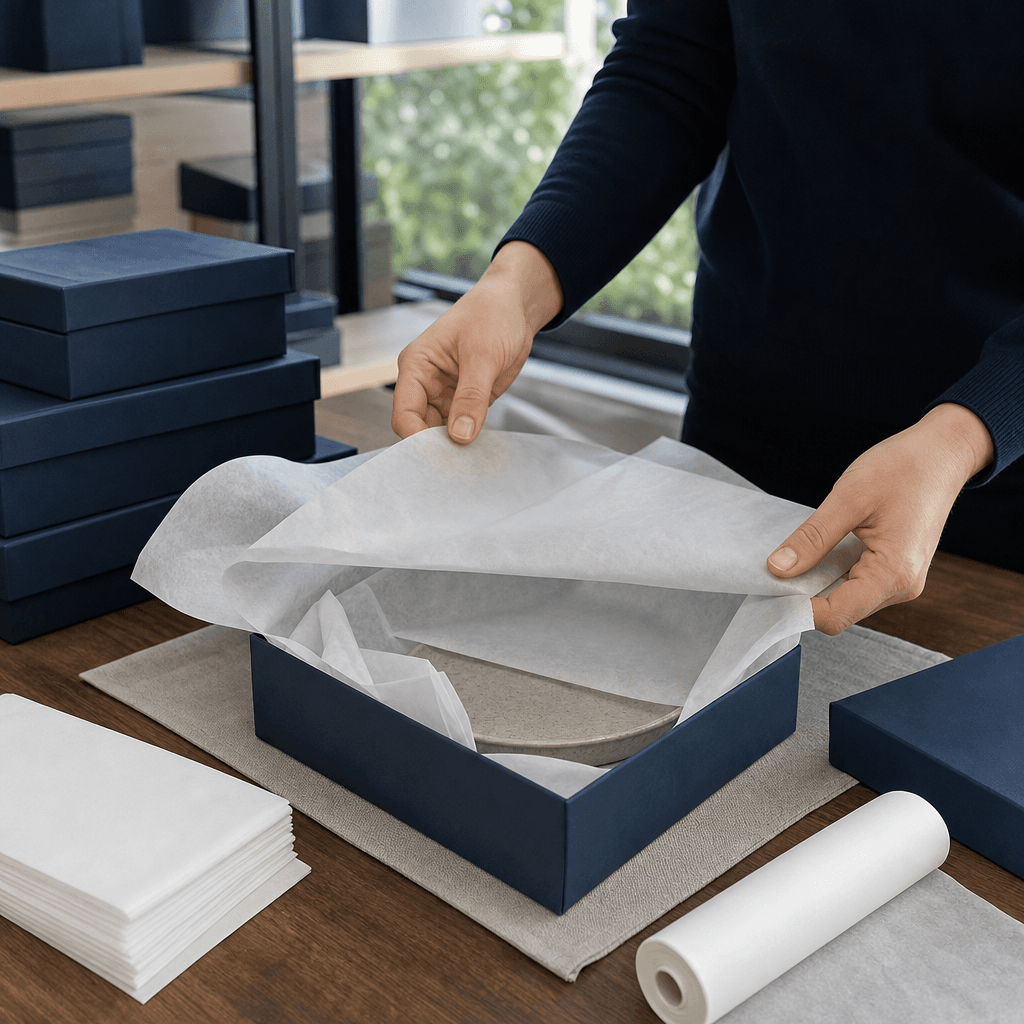
Tissue paper is a thin, lightweight, flexible, and mostly translucent packaging paper used to wrap products, separate them inside a box, and enrich the unboxing experience. In English it is generally referred to as tissue paper. It is not the main packaging that carries the product on its own or protects it against impacts; it is a complementary inner layer that works between the product and the cardboard box, carton box, paper bag, or shipping packaging. To achieve the right result in premium packaging, you need to look not only at the appearance of this paper, but also at its weight, printing method, contact with the product, and whether it will be exposed to moisture and oil. Below you will find everything together: how tissue paper works, where it is useful, where it falls short, and how to choose the right one for your brand.
Table of Contents
What is tissue paper used for?
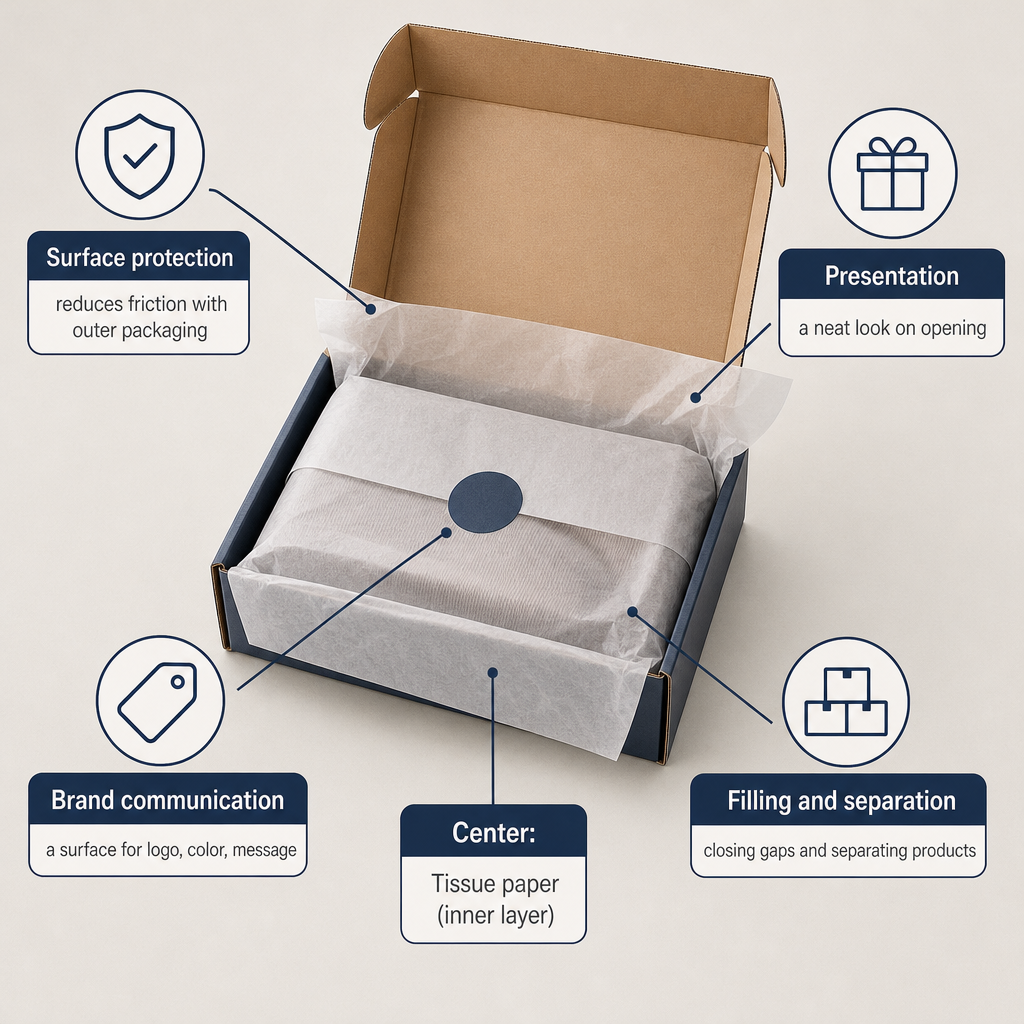
The main function of tissue paper is to create a light and flexible inner packaging layer around the product. The paper can be wrapped around the product, placed at the base of the box or under its lid, or used as a divider between products. This simple structure addresses four separate needs at once: it provides surface protection by reducing direct friction of the product against the outer packaging, it creates a more orderly presentation when the box is opened, it offers an additional brand surface for a logo or color, and in lightweight products it visually fills gaps and separates products from one another.
For this reason, tissue paper combines aesthetics and function in the same layer. However, its limits should be known from the start: it is not an impact-absorbing material. For heavy or fragile products, it does not replace protective solutions such as bubble wrap, foam, molded inserts, or corrugated cardboard. It complements them.
Are pelur paper and tissue paper the same thing?
In the packaging industry, the terms pelur paper, pelür paper, hışır paper, gömlek paper, and tissue paper are sometimes used for the same or similar product groups. The problem is this: a trade name alone does not guarantee technical specifications. Two papers bearing the same name may have different weights, different levels of translucency, and different print suitability.
For this reason, a few details need to be clarified before ordering: the paper's weight, whether it is white, colored, or kraft-looking, its level of translucency, its suitability for printing, whether it will be in direct contact with food, whether it needs to resist moisture and oil, and its compatibility with the post-use recycling stream. Rather than treating the name "pelur" as a sufficient technical definition, it is much safer to clearly describe the product to be used and the packaging scenario.
How does tissue paper work in packaging?
The effect of tissue paper comes not from providing thick and rigid protection, but from creating a light, formable layer that separates surfaces. There are four different ways it works, and each corresponds to a different need.
Product wrapping. The paper is wrapped around the product and placed in the box or bag. It stands out for products whose surfaces must not be scratched, such as textiles, accessories, shoes, and jewelry. The paper does not secure the product or absorb impacts; but it reduces movement inside the box, friction, and direct contact with the cardboard surface.
In-box layer. Placed under the lid, at the base, or over the product, tissue paper creates a layered presentation upon opening. In cosmetics, candles, chocolate, jewelry, and gift products, the factor that raises perceived value is often this layering.
In-box separation. In sets where multiple products are presented in the same box, tissue paper reduces direct contact between the products. If physical securing is needed, custom-cut separators, cardboard inserts, or inner trays should be used in addition to the tissue paper.
Shipping and e-commerce experience. In e-commerce shipments, tissue paper does not increase the structural strength of the shipping box; instead, it strengthens the brand experience at the moment of opening. For this reason, it is usually designed together with a corrugated shipping box, a thank-you card, and a label. In our guide to choosing the right packaging materials for your brand, we also discuss it among the complementary components that evaluate corrugated boxes, printed kraft paper, tissue paper, and thank-you cards together for e-commerce and DTC brands.
Which products and sectors use it?
Tissue paper is most preferred in textiles, cosmetics, jewelry, shoes, accessories, candles, gift products, and e-commerce packages. It can also be used in electronics or products with sensitive surfaces to reduce direct contact between the product and the box. The table below shows together the role of the paper in each sector and the risk that should not be overlooked.
| Use case | Role of tissue paper | What to watch out for |
|---|---|---|
| Cosmetics | Wrapping bottles, boxes, or set products; premium presentation | Does not provide protection against leakage risk on its own |
| Jewelry and accessories | Separator layer against scratching | Compatibility of metal surface, ink, and paper must be tested |
| Fashion and textiles | Wrapping garments, bags, shoes | It is important that it does not bleed color and does not tear easily |
| Candles and gifts | In-box presentation and wrapping | Suitability check for oily or scented surfaces |
| E-commerce | Enhancing the unboxing experience | Shipping protection must be planned separately |
| Corporate gifts | Layering set products and branded presentation | Printing consistent with brand colors is required |
Advantages of tissue paper
The appealing aspect of tissue paper is that it can contribute both visually and functionally at low cost. Because it is low-volume, it does not take up much space in the box and bag; its foldable structure facilitates storage and shipping and adds only a limited amount to the total weight of the packaging. Its thin structure allows it to be wrapped around different product forms and adapted to corners and gaps within a set; this supports visual integrity in custom-sized packaging.
On the presentation side, tissue paper layers the opening instead of taking the product directly out of the box. Colored, printed, or textured options strengthen the positioning of cosmetics, jewelry, candle, fashion, and gift brands. The brand logo, pattern, or campaign message can be applied to the paper; the critical point here is to evaluate how the design looks not only on a flat surface but also when folded and crumpled.
Another strong aspect is that tissue paper works not as a standalone packaging system but as one of the inner layers of the system. It can be designed together with a cardboard box, carton box, paper bag, shipping box, label, and thank-you card. In our article on why branded packaging is important, we also address tissue paper as one of the complementary components that support the brand language.
Being paper-based is also a source of advantage, but it is not an automatic sustainability label. Uncoated and properly produced paper products can be an alternative to some plastic-based inner packaging; however, processes such as lamination, heavy ink, adhesive, metallic effect, or a water-oil barrier can change recycling performance. According to Cepi's guide to paper-based packaging, coatings, barriers, and chemicals that provide oil resistance should be separately evaluated in the recycling process; recyclability should not be assumed based solely on the base fiber material.
Limitations and risks
Tissue paper is a strong complement for aesthetics and surface protection, but it does not meet every packaging need. When used in the wrong scenario, it can fail protection expectations or create regulatory risk.
Impact protection is limited. Due to its thin structure, it does not provide sufficient impact protection for heavy or fragile products. In shipping, the gaps inside the box must be separately filled according to the product's weight, fragility, and transport conditions.
It is not a default barrier against moisture and oil. Standard tissue paper does not act as an automatic barrier against water, oil, heavy moisture, or leakage. For products such as oily food, cosmetics containing liquids, or beeswax, a special barrier paper or a secondary inner packaging may be needed.
It carries the risk of print transfer and color bleeding. If the paper will be in prolonged contact with the product, it should be checked whether the ink transfers to the surface. Sample testing is especially important for light-colored textiles, leather, metal, stone, or glossy surfaces.
Food contact suitability is separately documented. For a paper to be considered suitable for food contact, "being paper" is not enough. In Türkiye, the relevant legislation for materials and articles in contact with food aims to protect human health and consumer interests. Similarly, the European Commission also states that all food contact materials, including paper, must not transfer harmful substances to food and must not change the composition or taste-odor in an unacceptable manner. For this reason, when wrapping chocolate, cookies, or food to be consumed directly, food contact suitability, conditions of use, and, if necessary, a declaration of conformity should be requested from the supplier.
The recycling claim must be verified. The recyclability of tissue paper depends on its fiber structure, printing, coating, adhesive, and post-use contamination. The performance of a product with plastic lamination, heavy metallic printing, or oil contamination differs from that of plain, uncoated paper. For brands with sustainability goals, the phrase "recyclable" alone is not enough; how the material will actually be separated in real use, its compatibility with local infrastructure, and any test documents should be examined together.
What criteria to consider when choosing tissue paper?
The right tissue paper decision requires looking not at a single feature but at the entirety of the product and packaging scenario. The headings below put the decision on a solid foundation.
Product surface. It should be determined whether the product is sensitive in terms of scratching, friction, color transfer, or static electricity. Sample testing is especially important for jewelry, dark-colored textiles, leather, and polished surfaces.
Weight and tearing behavior. Lower weight gives a lighter and more easily formable structure, but the risk of tearing during wrapping may increase. Higher weight offers a firmer feel and better usage durability. The choice should be made not with a "thickest paper" logic, but together with the product's wrapping method and movement within the box.
Printing and color. With printed tissue paper, it should be checked how the background color will affect the appearance of the ink. On translucent or colored papers, brand colors may not come out as they appear on screen. Keeping the logo and pattern legible between creases is also part of the design decision.
Contact scenario. Will the paper be in direct contact with the product, or will there be a secondary packaging in between? This distinction changes the material choice in the food, cosmetics, soap, candle, and textile categories.
Moisture and oil resistance. If storage and transport are not dry, specially treated or barrier paper may be needed instead of standard tissue paper. However, the effect of barrier coatings on recycling and compostability must be separately verified.
Compatibility with the packaging system. Tissue paper should be designed together with the inner dimensions of the box, the closing margin of the lid, the height of the product, and the inner insert, if any. Too much paper makes the box difficult to close; insufficient paper makes the wrapping look messy.
Designing tissue paper with other packaging components
If the brand's goal is not only to wrap the product but to create a cohesive unboxing experience, tissue paper should be planned not on its own but as part of the system. In practice, it is designed together with the following components: a cardboard box for premium gift, cosmetics, and jewelry presentations; a carton box for shelf products and lighter solutions; a corrugated box for e-commerce and shipping protection; a paper bag for store delivery and gift presentation; a thank-you card for a personal message; a label or sticker to close the wrapping and increase brand visibility; an in-box separator to divide multiple products.
We treat tissue paper as a complementary product designed within the same brand language as the box, paper bag, label, and thank-you card; we manage the design, prototype, and production under one roof. When starting a project, sharing the following information in the brief from the outset speeds up the work: product category and size, whether it will be wrapped or laid out inside the box, whether there will be direct contact with the product, paper color and desired printing, estimated quantity and frequency of use, box or bag size, food contact or special regulatory requirements, moisture-oil-odor and long-term storage conditions, and recycling and certification expectations. This information ensures that the tissue paper not only looks beautiful but also works correctly inside the box and is consistent with the other components.
For the differences between box types, see our guide on what cardboard boxes are, their features, and uses; and for the right box for cosmetic products, see our article on how to choose a cosmetics box.
Quick decision guide
The pairings below give quick direction in the most frequently encountered scenarios.
- Presenting the product elegantly inside the box: Tissue paper is a suitable inner packaging layer.
- Separating the surface from light friction: Choose a tissue paper that is compatible with the product and does not bleed color.
- Impact protection in shipping: Do not rely on tissue paper; add a corrugated box and proper internal securing.
- Food packaging: Use a product with documented food contact suitability.
- Products exposed to oil or moisture: Evaluate the barrier requirement and the recycling effect together.
- Premium unboxing: Design the tissue paper within the same brand language as the box, label, and thank-you card.
- Sustainability: Check the paper type, coating, printing, and post-use recycling scenario together.
Frequently Asked Questions
What is tissue paper?
It is a thin, lightweight, flexible, and mostly translucent packaging paper used for product wrapping, in-box presentation, and light separation.
Does tissue paper protect against impact?
It provides surface protection to a limited extent; it is not impact-absorbing packaging. For fragile or heavy products, corrugated cardboard, an inner insert, foam, or another protective solution is needed.
Can tissue paper come into contact with food?
Not all tissue paper is suitable for food contact. For products that will be in direct contact with food, regulatory compliance and the necessary documents should be requested from the supplier.
Is tissue paper recyclable?
Uncoated and clean paper products are in most cases more suitable for the paper recycling stream. Lamination, special coatings, heavy printing, adhesives, and oil-contamination can affect recycling.
What is the difference between tissue paper and kraft paper?
Tissue paper is generally thinner, lighter, and more flexible; it stands out for product wrapping and in-box presentation. Kraft offers firmer and more durable options; it is preferred depending on bag, wrapping, filling, or outer packaging applications.