

If you are asking what coated paper is, the short answer is this: it is paper or cardboard made smoother, more even and more suitable for printing by applying a mineral-based coating to its surface. This coating allows the ink to settle on the surface in a more controlled way, makes colors appear more vivid and enables fine details to be printed more clearly. On the packaging side, coated stock is frequently preferred for folding carton boxes, paper bags, labels, box belly bands and the outer wrapping of rigid cardboard boxes. However, the word "coated" alone does not guarantee a box's durability or food suitability. The right decision is made together by grammage, structure, coating orientation, printing technique, usage conditions and, where necessary, food contact compliance. In this guide, we evaluate together how coated paper works, which packaging components it is useful for and when it is not the right choice for your brand.
Table of contents
How does coated paper work?
At the core of coated paper is a normal layer of paper or cardboard. A coating containing pigment, binder and auxiliary materials is applied to one or both sides of this layer. After coating, the surface becomes smoother, absorbs less ink, carries small text and lines more clearly, enables colors to appear more controlled, and can achieve a glossy, matte or silky look.
The ink not spreading too much between the paper fibers makes a difference especially in the logo, product name and fine typography on the packaging. However, the surface being even does not mean it is resistant to scratching or moisture under all conditions; for these properties, a surface treatment or an additional barrier may be required.
In manufacturer technical data sheets, coated packaging papers are defined by criteria such as grammage, thickness, smoothness and opacity. For example, in a packaging paper data sheet, a single-sided coated structure is indicated as C1S, and the printing methods as flexo and offset; grammage, thickness and surface smoothness are given in the manufacturer technical data sheet explained with ISO tests. This shows that the coating decision is not a visual preference but a measurable material decision.
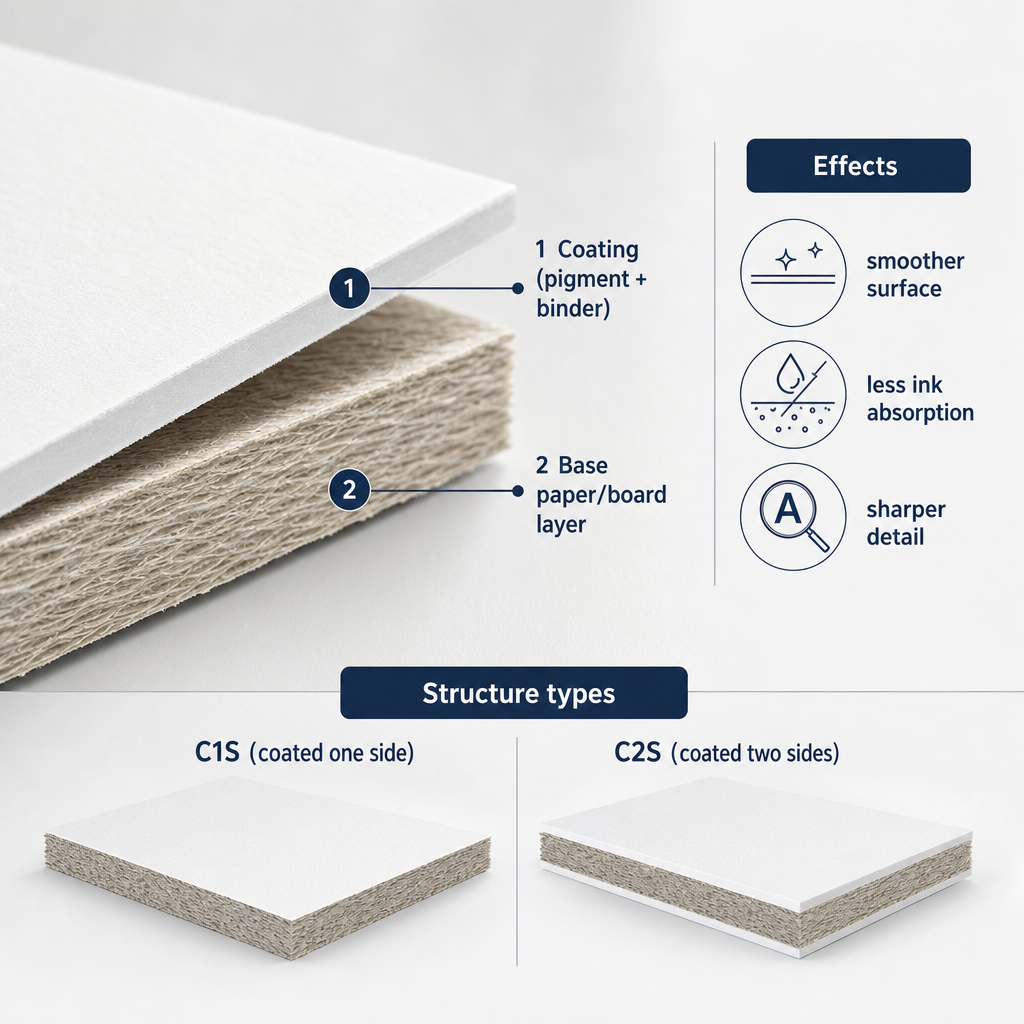
What do C1S and C2S mean?
The two most frequently encountered terms in coated paper selection are C1S and C2S. The difference between them is how many sides are coated and therefore which sides are suitable for printing.
| Structure | Description | Typical use |
|---|---|---|
| C1S | Coated on one side | Label, packaging paper, single-sided printed wrap, bag and belly band |
| C2S | Coated on two sides | Folding box, outer wrapping, paper bag, products printed on both sides |
In a C1S structure, one side is prioritized for printing and visual presentation. It can be preferred in applications where the other side comes into contact with the product, adhesive or carrier cardboard. In a C2S structure, both sides are smoother and suitable for printing; it makes more sense if high visual quality is desired on both the outer and inner surfaces of the box. On our rigid cardboard box product page, we offer bleached white bristol cardboard coated on both sides as SBS C2S and consider it as a base for printing and surface treatments.
The difference between coated paper and coated cardboard
Although "coated paper" and "coated cardboard" are used interchangeably in everyday conversation, in terms of packaging they are not the same structure. Skipping this distinction leads to incorrect material expectations at the quotation stage.
- Coated paper: It is thinner and more flexible. It is used in label, wrap, card, inner print and lightweight packaging applications.
- Coated cardboard: It has a higher grammage and is more rigid. It is found in folding boxes, paper bags and the load-bearing surfaces of packaging.
- Coated wrapping sheet: It is the decorative and printed surface wrapped specifically around the outside of a rigid cardboard box. The main carrier of the box is not the coated wrapping sheet but the underlying cardboard.
This distinction matters in practice because simply choosing a high grammage does not automatically produce a durable box. The strength of the box is determined together with the thickness of the cardboard, the box form, the folding lines, the gluing areas, the internal supports and the usage scenario. If you want to see the balance of structure and material more broadly, you can review our cardboard box selection guide.
Where is coated paper used in packaging?
Coated surface does not play the same role in every packaging component. Four main areas of use clarify where it is a carrier and where it is a coating.
Folding carton boxes
In cosmetics, candles, chocolate, jewelry accessories, electronic accessories and retail products, coated cardboard is a common choice for carrying the brand's printed surface. Suitability for full-color printing, clarity of the product name and content information, matte or glossy surface options, suitability for die-cutting and folding, and a controlled shelf appearance are the main advantages in this application.
Rigid cardboard boxes
In a rigid cardboard box, coated paper is mostly used not as a load-bearing material but as an outer coating surface. While the rigid cardboard body gives the box volume and rigidity, the coated wrapping sheet carries the brand colors, product images, logo and text, surface effects and premium touches. This combination can be used in magnetic-lid, drawer, lidded and gift boxes. If foil stamping, embossing, spot UV or film lamination is to be applied over the coating, the surface compatibility should be checked on a sample.
Paper bags
Coated cardboard bags give a brighter, more corporate and color-controlled effect than the natural kraft look. They are preferred by cosmetics, fashion, jewelry and corporate gift brands. Here, you should look not only at the paper's appearance but also at the total weight of the product, the type of handle and its attachment point, the base gusset, the carrying time, the risk of moisture and friction, and whether the bag is shipped flat or upright.
Labels
Coated label paper is useful in products that require high print clarity in a small area; a smooth surface provides an advantage for logo, barcode, content text and fine lines. However, whether the label adheres to a glass, plastic, metal or cardboard surface, whether it works in cold or moisture, whether it is exposed to friction, and whether it comes into direct contact with food must be evaluated separately. If necessary, a varnish, lamination or a different label surface is chosen.
Surface options and printing methods
The feel that coated paper gives comes largely from the choice of surface and the printing method applied on it. Planning the two together ensures that the on-screen design matches the printed result.
On the surface side, glossy coating reflects more light; it gives a vivid appearance in photographs, colored illustrations and high-contrast designs. On the other hand, fingerprints may be more visible, it may reflect under strong light, and readability may decrease for some small texts. Matte coating creates a calmer, more refined and premium perception; texts are generally read more comfortably and reflection is low, but scratch and fingerprint performance varies according to the coating used. Silky or satin surface, on the other hand, falls between glossy and matte; it preserves colors while offering a softer tactile effect.
On the printing side, offset printing is strong for high color accuracy and fine details; it becomes economical in medium and high-volume jobs, and when Pantone colors are managed together with a proof print, it helps the consistent reproduction of the brand color. Digital printing provides an advantage in low and medium volumes, in different designs or in personalized series; the fact that it does not require a die provides flexibility for sampling and short runs. UV printing can be used for high contrast and special effects on certain surfaces, but the compatibility between the coated surface, ink and drying system should be tested before production.
In rigid cardboard box production, we use offset, digital and UV printing options depending on quantity and design; before mass production, we proceed with an unprinted, printed or 3D digital sample. The main finishings that can be applied to a coated surface are matte/gloss film lamination, spot UV, hot foil stamping, embossing, debossing and varnish. Because not every process gives the same result on every coated surface, especially very small text, fine lines and graphics near folding lines should be checked with a physical sample.
Is grammage enough when choosing coated paper?
No. Grammage expresses the mass of one square meter of paper and is measured by the grammage determination method defined in the ISO 536 standard; however, it does not by itself indicate thickness or strength. For this reason, writing only "300 gram coated" in a quotation or technical brief falls short for most projects.
| Decision area | Why is it important? |
|---|---|
| Grammage | Gives an idea about material consumption and basic load-bearing capacity |
| Thickness | Affects folding, cutting and the box's sense of volume |
| C1S/C2S | Determines the print performance of one or two sides |
| Box structure | The same grammage shows different strength in different forms |
| Printing technique | Affects the decision on color, detail, quantity and personalization |
| Surface treatment | Changes friction, appearance and tactile effect |
| Product weight | Determines the box's load-bearing capacity |
| Logistics | Affects the risk of crushing, moisture, stacking and shipping |
For example, producing the shelf box of a lightweight cosmetic product and a gift box carrying a glass jar with the same coated cardboard specification may not be correct. Grammage is a starting data point, not the entire decision.
The limits and risks of coated paper
The visual strength of a coated surface does not make it the right material for every scenario. Four limits are risks that should be noticed early when planning a project.
It does not provide automatic protection against moisture. The surface being smooth does not mean the packaging is resistant to water or heavy moisture. In scenarios such as a humid bathroom environment, cold chain, refrigerator or outdoor shipping, an additional barrier may be required.
Friction and scratching may be visible. Scuff marks can be noticeable especially on dark-colored, matte or heavily printed surfaces. The channel and stacking conditions under which the box will be transported together with the product should be evaluated in advance.
Standard coated paper is not sufficient for direct food contact. Not every coated paper used in food packaging can be considered suitable for food contact. In Turkey, there are special rules for paper-based materials that come into contact with food; the Turkish Food Codex regulation on materials and articles in contact with food states that there should be no transfer of coloring matter to food and that printed papers not produced for the purpose of food contact cannot be used for this purpose. For products such as chocolate, cookies or confectionery, the inner surface in direct contact, the food-safe inner packaging and the printed box used only externally should be planned separately; a declaration of compliance, technical data sheet and migration information should be requested from the supplier.
Recyclability depends on surface treatments. The recycling performance of a paper-based packaging depends not only on the coated paper. Film lamination, plastic lamination, metalized surface or heavy adhesive can affect the separation process. Since packaging waste in Turkey is evaluated within a legislative framework covering different material groups, including paper and cardboard, all layers of the finished packaging should be examined instead of the generalization "because it is paper, it is definitely easy to recycle."
Which brand should prefer coated paper?
The decision framework below clarifies whether coated paper is suitable for your packaging project. Prioritizing the need and matching the material accordingly is safer than hasty choices made based on grammage.
| Need | More suitable approach |
|---|---|
| Vividly colored shelf packaging | Matte or glossy coated cardboard |
| Simple and luxurious look | Matte or satin coated surface |
| Outer coating of a rigid cardboard box | C1S or C2S coated wrapping sheet depending on box structure |
| Box printed on both sides | C2S cardboard |
| Low-volume personalization | Surface suitable for digital printing |
| High volume and color sensitivity | Coated cardboard suitable for offset printing |
| Direct food contact | Special material with documented compliance |
| Humid or friction-prone use | Testing with barrier, varnish or lamination |
| Heavy product or shipping use | Rigid/corrugated structure and inner protection alongside the coating |
Coated paper is a strong starting material in projects that prioritize print and brand visibility. If impact resistance in a shipping box, load-bearing capacity for a heavy product or regulatory compliance in direct food contact is a priority, it may not be sufficient on its own. On the cosmetics side, if you want to plan the surface and box decision together, our cosmetic box selection tips provide an additional framework.
Coated paper or kraft paper?
These two materials serve different brand goals; "which one is higher quality?" is not the right question. The real question is whether the brand is seeking color accuracy and a premium surface, or a natural look and material character.
| Criterion | Coated paper | Kraft paper |
|---|---|---|
| Appearance | Clean, controlled, matte or glossy | Natural, fibrous, warm |
| Color printing | Vivid and high-contrast | Can be affected by the paper color |
| Premium perception | Luxurious and corporate | Natural, sustainability-focused |
| Photo printing | Generally more suitable | May be limited depending on the design |
| Tactile effect | Even and smooth | More characterful and fibrous |
| Typical use | Cosmetics, jewelry, retail box | Coffee, natural product, boutique brand |
If color accuracy and photographic printing are your priority, coated stock stands out; if natural texture and a fibrous brand perception are your priority, kraft stands out. The two surfaces can also be used together in different packaging parts.
What should be in a coated-surface packaging brief?
Sharing the following information in a quotation or sample request speeds up the material and price decision. An incomplete brief increases both the time and the risk of the wrong material.
- Product name and the intended use of the packaging
- Exact dimensions and weight of the inner product
- Exterior dimensions of the box or bag
- Preference for folding box, rigid cardboard box, bag or label
- C1S or C2S expectation
- Estimated grammage, surface appearance and glossy/matte/satin preference
- Printing method and color references
- Need for foil stamping, embossing, UV or varnish
- Whether the product comes into direct contact with food
- Moisture, friction, shipping and stacking conditions
- First order quantity and continuous production estimate
- Physical sample need, delivery date and shipping address
Before mass production, we check the lid mechanism, color and surface treatments with an unprinted, printed or 3D digital design sample. This approach is valuable in that color and finishing decisions on a coated surface are not left solely to the on-screen design. In our rigid cardboard box portfolio, we evaluate coated paper, kraft paper and different print-finishing options together; we manage the process under one roof, from product and channel analysis to the material decision, from design and sampling to mass production and logistics. If you want to see the factors that determine the price in advance, our guide on the factors determining box profile prices explains the items.
For a coated-surface box, it is particularly useful to request three outputs: the material and surface specification, a physical sample including color and finishing approval, and a production example checked against the product's real usage conditions. For cosmetics, jewelry, candle, chocolate, fashion and e-commerce brands, coated surface combines print quality and premium brand perception in the same packaging. The best result comes from not thinking of coated paper separately from box structure, printing method, surface treatment, inner protection and sales channel.
Frequently asked questions
What is coated paper?
Coated paper is paper or cardboard made smoother, more even and more suitable for printing by applying a coating to one or both of its sides.
Is coated paper durable?
Its print surface can be even and visually high-quality; however, durability does not depend solely on being coated. Grammage, thickness, box structure, coating, product weight and usage conditions must be evaluated together.
Is coated paper waterproof?
Coated paper is not automatically waterproof. In humid environments, varnish, lamination or a suitable barrier may be required.
Is coated paper recyclable?
Paper-based coated packaging can enter recycling systems when all layers of the finished product are suitable. However, plastic film, metalized surface and some special coatings can affect recycling performance.
Can coated paper come into contact with food?
Not every coated paper is suitable for food contact. For direct contact, the compliance documents and regulatory requirements regarding the product's intended use must be checked; printed papers not produced for the purpose of food contact should not be used for this purpose.
Is coated paper used in rigid cardboard boxes?
Yes. In rigid cardboard boxes, coated paper is mostly used as an outer coating. While the rigid cardboard body gives the box rigidity, the coated layer forms the printed and decorative surface.