
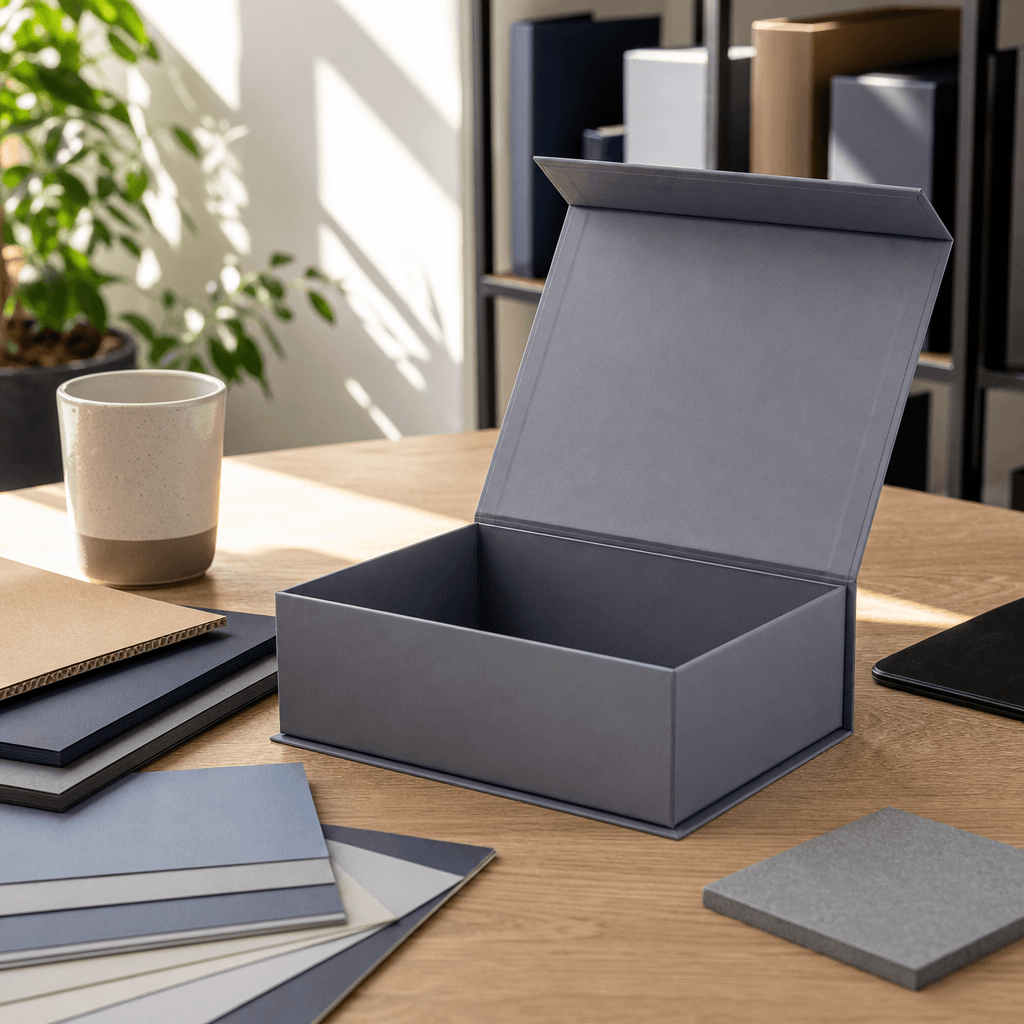
The short answer to the question of what a magnetic closure box is: it is a premium packaging solution, mostly cardboard-based, that closes with hidden magnets placed inside the lid and in the corresponding part of the box body. Since the magnets are not visible from the outside, the box gains a clean and cohesive appearance; when the lid closes, it aligns with a controlled pull and gives a soft "click" feel. This structure is not merely a decorative closure: it simultaneously affects the product's presentation, reusability, unboxing experience, logistics cost, and brand perception. That's why the decision is made less on the question "does it look luxurious?" and more on the balance between the product, use case, shipping conditions, and budget.
In this guide, we address together how the mechanism works, which box varieties exist, which products it works for, and which risks you should test before moving to mass production. As the starting point of our Premium Box Forms content, from here you can move on to product- and channel-specific sub-decisions.
Contents
How does a magnetic closure box work?
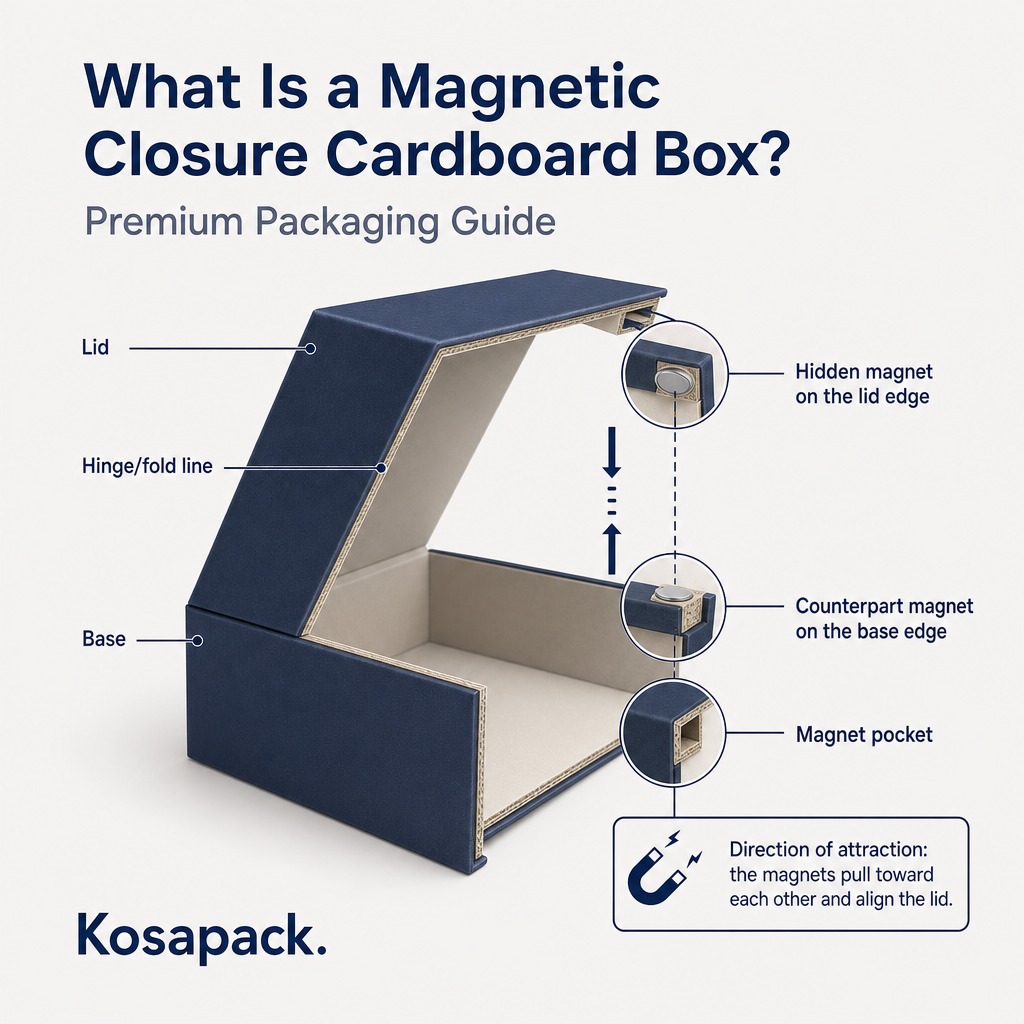
In a magnetic closure box, the lid and body are connected by a hinge or fold line. The magnets are usually hidden at the edges where these two parts meet. When the lid is closed, the opposing magnets attract each other and ensure the lid seats in the correct position.
For the mechanism to work reliably, four elements must work together in harmony:
- Sufficiently strong body: The box body and lid must not bend under the magnets' attractive force.
- Correct magnet position: The opposing parts must meet on the same axis.
- Suitable lid geometry: The lid must seat without catching on the edges of the box as it closes.
- Secure fastening: The magnets must be firmly embedded within or behind the cardboard layers.
Misalignment of the magnets causes the lid not to close fully, the corners to lift, or the box to open on its own during use. Therefore, in design it is not only the strength of the magnet but the total structure of the box that is decisive.
Basic structure and layers
Although the outer surface looks like a single piece, most magnetic boxes consist of several layers. Each layer performs a separate task, and the quality difference usually emerges in the harmony of these layers.
- Structural cardboard: Provides the box's form and durability. Grey board, duplex board, and different paper surfaces are among the options.
- Wrapping paper: The brand's color, texture, and print are applied over this surface.
- Magnet slots: Ensure the magnets are placed invisibly and remain fixed.
- Lid and hinge area: Makes it possible to open and close the box repeatedly.
- Interior layout: A divider, cardboard insert, foam, molded pulp, or another support is used to secure the product.
The interior layout plays a critical role especially in cosmetics, jewelry, electronics, candles, and gift sets. If the product moves inside the box, even a strong lid mechanism cannot prevent transport-related damage on its own.
Types of magnetic closure boxes
There is no single "magnetic box"; the opening style and body structure vary by product. Choosing the right form directly affects both the presentation and the shipping volume.
Magnetic flip-top box
The lid opens with a top or front hinge. It is frequently preferred for perfume, watches, jewelry, accessories, and premium cosmetics. When the product is opened, it is visible at a glance and creates a controlled unboxing experience.
Book-style magnetic box
It opens like a book cover and is suitable for displaying the product inside the box. It is used for press kits, brand launches, corporate gift sets, and curated collections.
Double-lid magnetic box
This is a design where two panels meet at the center. It creates a more theatrical opening effect for jewelry, watches, bottles, and special gift sets.
Windowed magnetic box
There is a window in the lid, showing the product without opening the box. On the other hand, the window material, bonding method, and recycling scenario should be evaluated together.
Foldable magnetic box
This is the model that can be shipped flat; because it takes up less volume in storage and transport, it can provide a logistics advantage. On the other hand, the assembly points, corner strength, and fold marks should be tested on a sample.
Rigid-body magnetic box
It comes ready to maintain its form after production. It gives a fuller and sturdier premium feel; however, it may require more volume in storage and shipping.
Which products is it used for?
A magnetic closure box gains value in scenarios where the product is not only protected but also presented. The table below summarizes which use highlights this form and why.
| Use case | Why is it preferred? |
|---|---|
| Cosmetics and perfume | Provides a premium shelf perception and an impactful unboxing experience. |
| Jewelry and watches | Supports the perception of value, used together with an interior slot. |
| Candles and chocolate | Strengthens the gift presentation; a separator or fixer is added. |
| Electronics and accessories | Presents the product neatly; magnet-electronics compatibility should be checked. |
| Corporate gift sets | Combines multiple products in a single branded presentation. |
| Press and launch kits | Turns the moment of opening into part of the communication experience. |
| Loyalty and subscription boxes | Creates the effect of reusable, storable packaging. |
Our Kosapack collection includes examples of magnetic boxes for different scenarios such as cosmetics, jewelry, watches, coffee, tea, candles, wine, electronics, headphones, press kits, and promotions.
Where do its advantages become evident?
The benefit of the magnetic lid turns into concrete business results in the right project. Four headings show where this form makes a difference.
Premium perception: The hidden closure offers a clean appearance without visible clips or complex fastenings. The controlled closing of the lid supports the perception of price and quality.
Unboxing experience: When the lid is opened, the product can be presented gradually with a message card, tissue paper, or interior separator. This approach, especially for direct-to-consumer brands, turns the box into more than a delivery package.
Reusability: Since the magnetic lid opens and closes easily, the consumer can use the box for storage, organizing, or re-gifting. However, this claim must be supported by durability, coating quality, and hinge performance.
Broad branding surface: The outer lid, inner lid, base, and inner cardboard surfaces can be used for a logo, campaign message, usage instructions, or brand story. Different surface options such as grey, duplex, kraft, coated, metallic, holographic, and textured paper support this area.
Limitations and risks
A magnetic closure box is not automatically the right choice for every product and channel. The headings below are points that should be clarified before starting the project.
Magnet-electronics compatibility: Packaging containing magnets should be tested before being used with card magnetic strips, some sensors, compasses, or sensitive electronic components. For an electronic product, the product's technical sensitivities should be shared with the manufacturer.
Child safety: The magnet inside the box must not become accessible. Swallowing small magnets poses a serious health risk; the European Commission has mandated visible safety warnings on packaging for toys containing magnets (European Commission decision 2008/329/EC). This does not mean toy legislation will be applied to every magnetic package; however, it shows that a safety assessment is required for products accessible to children.
Food and direct contact: For a food product such as chocolate, confectionery, or any other, the magnet, print, coating, adhesive, and interior lining should be evaluated according to the direct or indirect contact scenario. If the product is in direct contact with the box, a suitable interior packaging or barrier should be designed.
Weight and shipping cost: The cardboard body, coating, magnet, and interior slot increase weight and volume compared to a simple cardboard box. In e-commerce, the shipping volumetric weight, outer carton layout, and impact resistance should be calculated together.
Recycling and separation: Recyclability cannot be determined just by looking at paper or cardboard. The magnet, lamination, window, foam, plastic part, and adhesive affect separation. The European Union's packaging framework requires that the weight and volume of packaging be kept at an appropriate minimum while preserving the necessary safety and function (packaging waste directive); the new PPWR regulation also makes the topics of resource efficiency, safe use, and recyclability more visible. Therefore, the phrase "paper-based" alone is not sufficient proof of sustainability; the material composition, surface treatment, separability of the magnet, and the recovery infrastructure in the target market should be questioned together.
Decision criteria when choosing
The right magnetic box emerges when several decisions are made together. The headings below list what you need to clarify before quotation.
Size and weight: The box dimension is not determined solely by the product's outer dimensions. The protective interior slot, opening allowance, hand-grip area, and lid movement should also be taken into account.
Usage channel: In retail presentation, rigid-body showy models stand out. In e-commerce, the foldable structure, outer shipping box, and interior protection are examined together. In corporate distribution, stackability, shipping volume, and quick assembly become important. For subscriptions or repeat shipments, the durable hinge and re-closing performance should be tested.
Closing force: The magnet should be strong enough to hold the lid but controlled enough not to strain the user. A too-weak magnet reduces the sense of security; a too-strong magnet can make opening the lid difficult or apply unnecessary pressure to the interior product.
Interior layout: If the product moves inside the box, the magnetic lid alone does not provide sufficient protection. Depending on the product's shape, a cardboard separator, cardboard slot, foam, or molded pulp should be chosen.
Print and surface treatment: Matte/gloss lamination, textured paper, foil stamping, embossing, spot UV, and interior printing change brand perception. Each surface treatment should also be examined in terms of cost, recycling, and scratch resistance.
Storage and shipping: A rigid body may be bulkier; a foldable body offers a shipping advantage while creating assembly sensitivity. In the quote, not only the unit price but also storage, outer carton, and transport cost should be taken into account.
Before mass production, perform the following checks on a physical sample: does the lid align fully, do the magnets leave visible marks under the layer, does the product shift when the box is opened, does the hinge withstand repeated use, is the print sufficiently resistant to scratches, does corner damage occur inside the outer shipping box, and are all small parts fixed in an inaccessible manner.
Magnetic or classic lidded cardboard box?
The magnetic model is suitable for brands that want a fast, impressive, and reusable unboxing experience. The classic two-piece lidded box, on the other hand, may be more appropriate for projects that want a simpler structure, adaptation to different product sizes, or more controlled cost.
You can clarify the decision with these questions: Does the packaging hold a high share of the brand value in the unboxing experience? Is the product positioned as a gift or premium collection? Is the box expected to be reused? Can the magnet-electronics and safety checks be completed? Are the box, shipping, and storage volumes within budget? Is there enough space for interior layout and product protection?
To separately examine the basic differences between cardboard and corrugated boxes, you can look at the Cardboard Box and Corrugated Box: Which Is Right? guide. For interior separator and food contact decisions for food products such as chocolate, the Chocolate Box Production: A Guide for Brands page helps. For the role of tissue paper inside the box, you can also review the What Is Tissue Paper? Its Use and Advantages in Packaging content.
Magnetic closure box with Kosapack
Our magnetic closure cardboard box solution offers custom size and surface options for cosmetics, jewelry, luxury gifts, and different product sets. We handle production with your choice of foldable or rigid body; different box designs, coating materials, and divider options are planned according to brand applications.
In the order process, the box type is chosen, a quote is submitted, and technical and cost decisions are clarified with expert advice; afterward, the production and shipping process is managed by us. For a clear quote, it is enough to share with us the product dimension, quantity, target usage channel, interior layout, print, surface treatment, delivery address, and your physical sample expectation. For electronic products or products accessible to children, when you add the relevant safety information to the brief as well, we design the suitable structure and interior protection together.
Frequently Asked Questions
What is a magnetic closure box?
It is a branded box, mostly produced from premium cardboard, that closes with magnets hidden inside the lid and body.
Which products is a magnetic closure box suitable for?
It is suitable for cosmetics, perfume, jewelry, watches, candles, chocolate, electronic accessories, gift sets, and corporate kits. The product's sensitivity, weight, and usage channel should also be evaluated.
Is a magnetic box suitable for e-commerce?
It can be suitable; however, the box itself is not shipping packaging. The outer shipping box, interior protection, stacking, and volumetric cost should be designed together. Foldable models can reduce storage and shipping volume.
Is a magnetic closure box recyclable?
This depends on the materials across the entire box and the local recovery system. The cardboard, coating, magnet, lamination, window, and interior slot should be evaluated together.
Are the magnets visible on the outside of the box?
In a correct design, the magnets are hidden within the lid and body layers; there are no visible metal parts or clips on the outer surface.
What is the minimum order quantity?
The starting quantity is generally stated as 100; however, the exact minimum may vary depending on options such as foldable structure, dividers, and foil stamping. It is best to get a quote for your current project.