
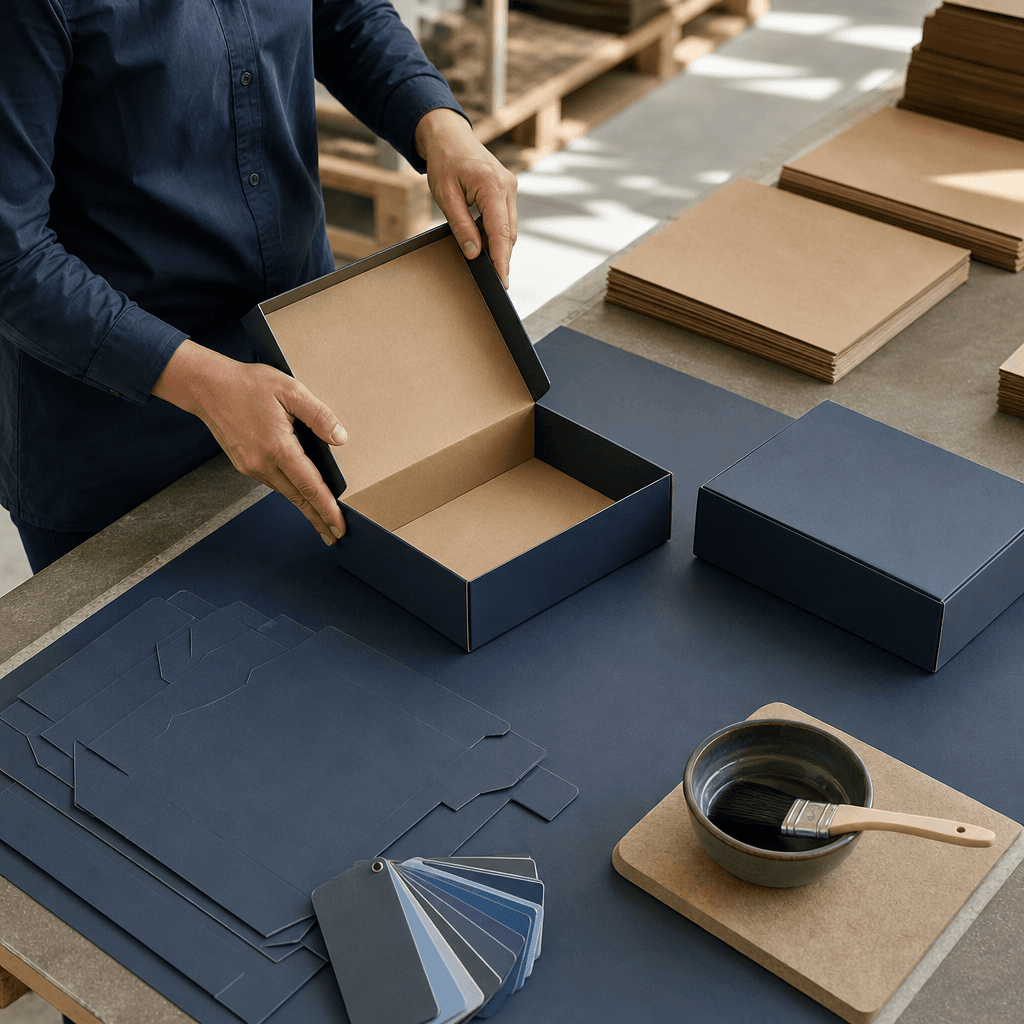
The short answer to the question "what is ceramic coating" is this: it is a method of enhancing the barrier, durability, or appearance properties of a surface by applying a very thin, mineral- or ceramic-based layer to it. In packaging, this term mostly refers to transparent, oxide-based barrier layers applied to paper, cardboard, or film surfaces. However, "ceramic coating" does not guarantee a single chemical structure or a fixed level of performance; the right decision cannot be reached without jointly evaluating the material to be used, the coating thickness, the application method, and the targeted barrier. In premium packaging, this coating comes into play to limit the transfer of water vapor, oxygen, grease, and odor, to protect the printed surface, or to create a special surface effect — but it is not necessary for every product.
At Kosapack, we prepared this guide to go beyond general promises such as "more durable" or "more sustainable" and to clarify the decision together with the product's usage conditions and the packaging's recycling system. Below, we address how the coating works, which surface treatments it is confused with, where it makes sense, and which criteria you should consider when making a choice.
Table of Contents
How does ceramic coating work in packaging?
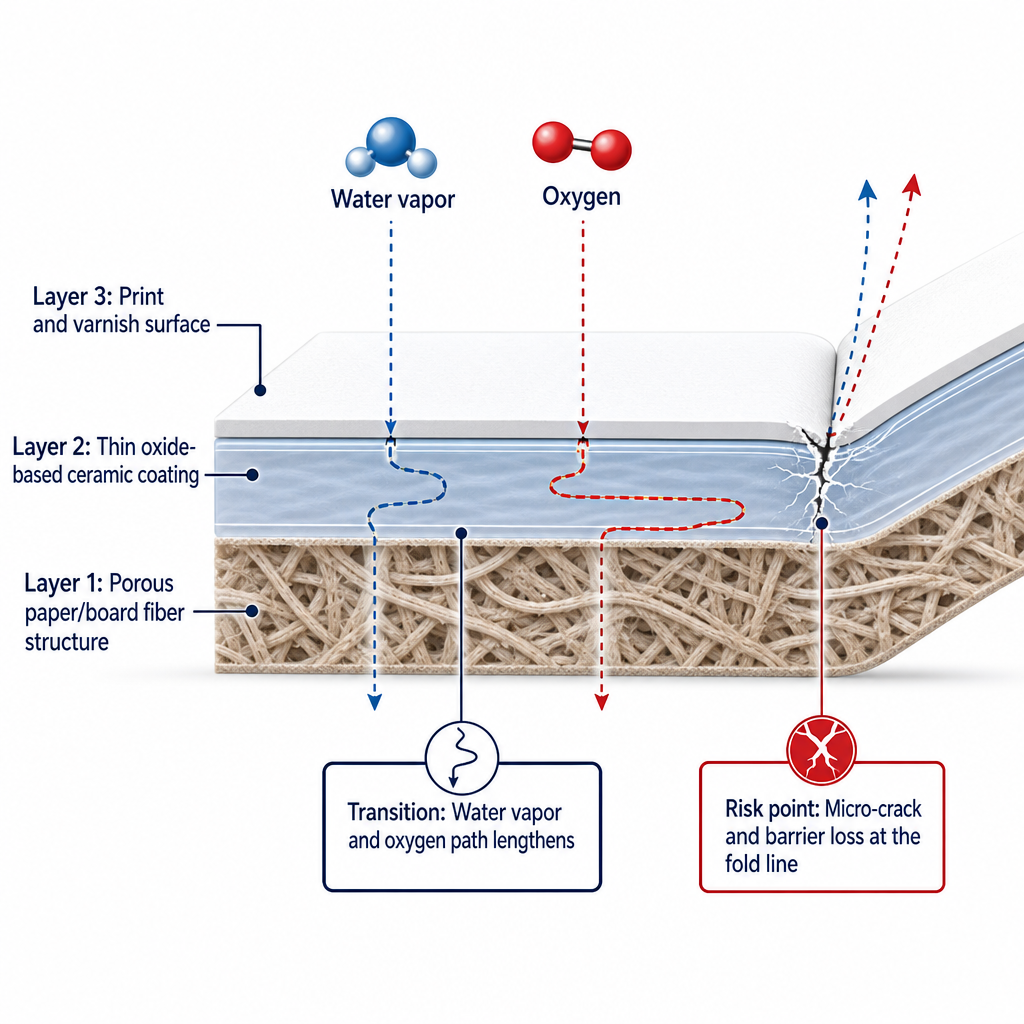
Paper and cardboard are naturally porous materials. These pores can allow water vapor, oxygen, grease, or odor to travel through the material. Coating reduces this transfer by partially closing the pores on the surface or by lengthening the path that gas molecules must follow.
Ceramic-based thin films, especially oxide layers such as aluminum oxide, can improve the gas barrier even at very low thicknesses. It has been examined in research that aluminum oxide layers can reduce water vapor and oxygen permeability in paper-based packaging, and that among the different application techniques, the atomic layer deposition method offers high barrier performance.
That said, the ceramic layer alone does not determine the entire packaging performance. Other factors affecting the outcome include: the fiber structure and surface smoothness of the paper or cardboard; the thickness and uniformity of the coating; cracks that form during folding, cutting, and gluing; printing ink, primer, and other surface treatments; the moisture, grease, alcohol, or aroma properties of the product inside the packaging; storage temperature and transport conditions.
In particular, micro-cracks that form at fold lines or sharp bends can cause the barrier performance measured in the laboratory to decline in real use. For this reason, the coating must be evaluated not only on a flat sheet but, where possible, on a finished packaging sample.
Which applications should not be confused with "ceramic coating"?
In the packaging industry, surface treatments serve different purposes. Assuming ceramic coating is the same as the applications below leads to the wrong technique and unnecessary cost decisions.
Varnish
Varnish is a surface treatment used to protect the printed surface, provide gloss or matte finish, and increase abrasion resistance. Depending on its formulation, it can provide limited resistance to water, grease, or oxygen; however, it does not promise the same performance as a ceramic barrier.
Lamination
Lamination is the bonding of paper or cardboard with a film layer. It creates a more pronounced film layer and can improve mechanical strength and barrier performance. The film type, adhesive, and layer structure are decisive in recycling evaluation.
Mounting (Casing)
Mounting is the gluing of a printed paper onto a thicker rigid board surface. It gives the packaging thickness, rigidity, and a premium feel; it does not directly mean a ceramic barrier coating. For structural packaging options, you can review our content What Is a Mounted (Rigid) Box? Premium Packaging Guide.
Ceramic-look print or effect
Some surfaces can be designed with printing and special effects to resemble ceramic, stone, or porcelain. This application is for aesthetic purposes; it should not be assumed to provide a water, grease, or oxygen barrier on its own.
Where can ceramic coating be used in packaging?
Ceramic or oxide-based barrier coatings are considered in applications that require high performance but where a layer as thin and transparent as possible is desired.
Food packaging
For dry foods, coffee, tea, chocolate, and products whose aroma must be preserved, the transfer of oxygen, moisture, grease, and odor can be critical. In our product and industry approach, there are scenarios for preserving aroma for coffee and tea, and premium solutions with internal inserts for chocolate. However, we are not saying that a specific ceramic coating is a standard product feature for these products; this can only be clarified through the relevant testing.
If food contact is involved, the name of the coating alone is not enough. The suitability of the finished packaging for the usage conditions, its migration behavior, and its evaluation together with the inks and adhesives must be considered. In Turkey, materials in contact with food must not transfer components in amounts harmful to human health and must not change the composition or the taste and odor of the food in an unacceptable way (regulatory summary).
Cosmetics and personal care packaging
In cosmetic boxes, ceramic coating can be evaluated as much for surface durability and premium perception as for direct product safety. For products such as perfume, cream, serum, and soap, the transfer of moisture, grease, alcohol, or odor can influence design decisions. Here, what stands out is that the outer surface does not scratch easily, the print does not deteriorate with friction, and the box maintains its appearance under shelf and shipping conditions. In most cosmetic boxes, ceramic coating is not mandatory; the right combination of cardboard or rigid board, printing, varnish, and internal layout is often sufficient.
Coffee, tea, and aromatic products
If loss of aroma or the transfer of external odors into the product is critical, barrier coating options can be explored. However, the barrier role of the outer box and the protective function of the product's actual inner packaging should not be confused. While a rigid board box often handles transport and presentation, the inner pouch or inner packaging provides the main barrier for food safety and shelf life.
Premium gift and rigid board box
Ceramic coating can be considered as a special option in premium boxes where the visual and tactile surface effect is important. That said, a rigid board box being in the premium class does not necessarily mean it is ceramic-coated. Box structure, mounting, printing, varnish, foiling, magnet, and internal cavity are separate technical decisions. We coordinate solutions such as rigid board box, cardboard box, corrugated cardboard box, label, tissue paper, and box separator within the same packaging program; we manage the design, prototype, production, and logistics processes together.
Advantages and limitations of ceramic coating
The value of ceramic coating lies in its ability to meet a specific performance need with a thin layer when the right material and application are chosen. But the term "ceramic" alone promises neither waterproofing, nor food suitability, nor full recyclability. For this reason, its advantages and risks must be read together.
The main advantages: ceramic oxide layers can especially help reduce oxygen and water vapor transfer; some oxide-based coatings are transparent, so a barrier can be achieved without the opaque appearance of metallized films; the coating adds function with a thin layer without replacing the main carrier material; depending on the application system, it can be combined with a glossy, matte, or tactile surface effect. Still, both the aesthetic effect and the technical barrier must be verified separately.
The limitations fall under the following headings:
- Recycling complexity: While paper and cardboard coatings provide resistance to water or grease, they can also make the process of separating the fibers with water and repulping them more difficult (paper-cardboard coatings summary). From the supplier, you should request not just the statement "recyclable" but the chemical structure of the coating, its weight, its separability from the fiber, its suitability for local infrastructure, food contact documents, and finished packaging test results.
- Folding and cracking risk: Brittle or hard ceramic-based layers can crack at the fold lines of the box; this means visible breakage or barrier loss. For folding boxes, window boxes, or multi-layer structures, finished sample testing is essential.
- Cost and supply complexity: Ceramic-based coating may require more specialized equipment, suppliers, and testing compared to standard varnish, water-based barrier coating, or common lamination. In low-volume projects, tooling, proofing, testing, and production setup significantly affect the total cost.
- Risk of false expectations: The term "ceramic" does not guarantee waterproofing, food suitability, full recyclability, unlimited scratch resistance, or an automatic extension of shelf life. These claims can only be supported by relevant testing and compliance documents.
In our sustainability approach, we talk about recyclable papers, options that reduce plastic use, and carbon footprint reporting; however, we do not present a product-specific recycling test result for a particular ceramic-coated product as a general promise. Such performance is clarified through project-specific testing.
Which criteria should be considered when choosing ceramic coating?
Before surface appearance, product and channel needs should determine the coating decision. The table below gathers in one place the questions that need to be answered when preparing a brief.
| Decision criterion | Question to ask |
|---|---|
| Product sensitivity | Is the transfer of moisture, oxygen, grease, alcohol, or aroma truly critical? |
| Contact condition | Will the coating be in direct contact with food or the product? |
| Barrier target | Which barrier is needed: water vapor, oxygen, grease, odor, or light? |
| Packaging structure | Rigid board box, folding carton, corrugated box, or flexible film? |
| Folding | Does the coating maintain its performance after cutting and folding? |
| Printing | How will color accuracy and abrasion resistance be maintained? |
| Recycling | How will the packaging be processed in the local collection and recycling system? |
| Testing | Will testing be done on the finished box instead of a flat surface? |
| Cost | Do the coating, sample, testing, and production setup fit the total budget? |
For example, if only print protection is needed on the outer box of a dry, low-risk cosmetic product, a standard surface treatment may be sufficient. In contrast, for a product with high moisture or aroma sensitivity, barrier performance should be measured, and the coating should be considered together with the inner packaging.
Ceramic coating or standard surface treatment?
To clarify the decision, defining your priority in a single sentence is often sufficient. The framework below shows a sensible starting direction for different needs:
- If only gloss or matte finish is desired: Varnish options can be reviewed.
- If high rigidity and premium presentation are desired: A suitable rigid board box and mounting structure can be considered.
- If a strong film barrier is required: Lamination or multi-layer film structures can be compared.
- If a transparent oxygen or moisture barrier is targeted: Ceramic oxide-based coating can be explored.
- If shipping and impact resistance are a priority: A corrugated cardboard box, internal protection, and separator may be more effective.
- If sustainability is a priority: The balance between an uncoated or low-coating solution and the required performance should be tested.
Packaging must be read as a whole system. An expensive coating applied to the outer surface does not compensate for the wrong box size, insufficient internal protection, or faulty logistics design.
Why are samples and quality control important?
In special surface treatments such as ceramic coating, the pre-production sample is the most reliable stage of the decision. In the sample, not only color and appearance but also whether the performance is maintained in real use should be checked.
In a sample inspection, looking at the following largely prevents the surprises encountered in the field: whether the coating is uniform on the surface; whether there is cracking at the fold and corner areas; whether the print changes color after coating; abrasion and scratch resistance; the suitability of the surface in contact with the product; the behavior against moisture or grease; whether the surface deteriorates when the box is opened and closed; the appearance after transport and stacking.
Before production starts, we offer high color-accuracy proofing and approval processes; after the requirement is shared, we aim for a quote within 24 hours and a physical sample within 7–15 business days. These timelines are targets that become clear according to the project scope and may require additional testing steps in complex surface treatments.
To separately evaluate the options on the printing side, you can check out our content What Is Digital Printing? A Guide to Its Use in Packaging, and to expand on product and box selection, you can look at our guide Types of Jewelry Packaging: Options for Brands.
Frequently Asked Questions
What is ceramic coating?
Ceramic coating is enhancing the barrier, durability, or surface properties of a surface by applying a thin, mineral- or ceramic-based layer to it. In packaging, this term is mostly used for oxide-based transparent barrier layers.
Does ceramic coating make paper packaging waterproof?
Not always. The type and thickness of the coating, the continuity of the surface, and the way the packaging folds determine the outcome. A "waterproof" claim requires testing on the finished packaging.
Can ceramic coating be used in food packaging?
Its usability depends on the chemical structure of the coating and the usage conditions of the finished packaging. For food-contact applications, a decision should not be made without verifying suitability, migration, and production conditions.
Is ceramic coating recyclable?
The recyclability of coated packaging depends on the type of coating, its quantity, its separability from the fiber, and the local recycling system. Ceramic coating should not be automatically considered recyclable or non-recyclable.
What is the difference between ceramic coating and lamination?
Ceramic coating generally refers to a thin mineral- or oxide-based barrier layer. Lamination, on the other hand, is the bonding of paper or cardboard with a film layer. The barrier, folding, cost, and recycling outcomes of the two applications can differ.
Does every rigid board box require ceramic coating?
No. The choice of a rigid board box is mostly about rigidity, premium presentation, product protection, and brand experience. Ceramic coating should only be considered when a specific barrier or surface performance is required.