
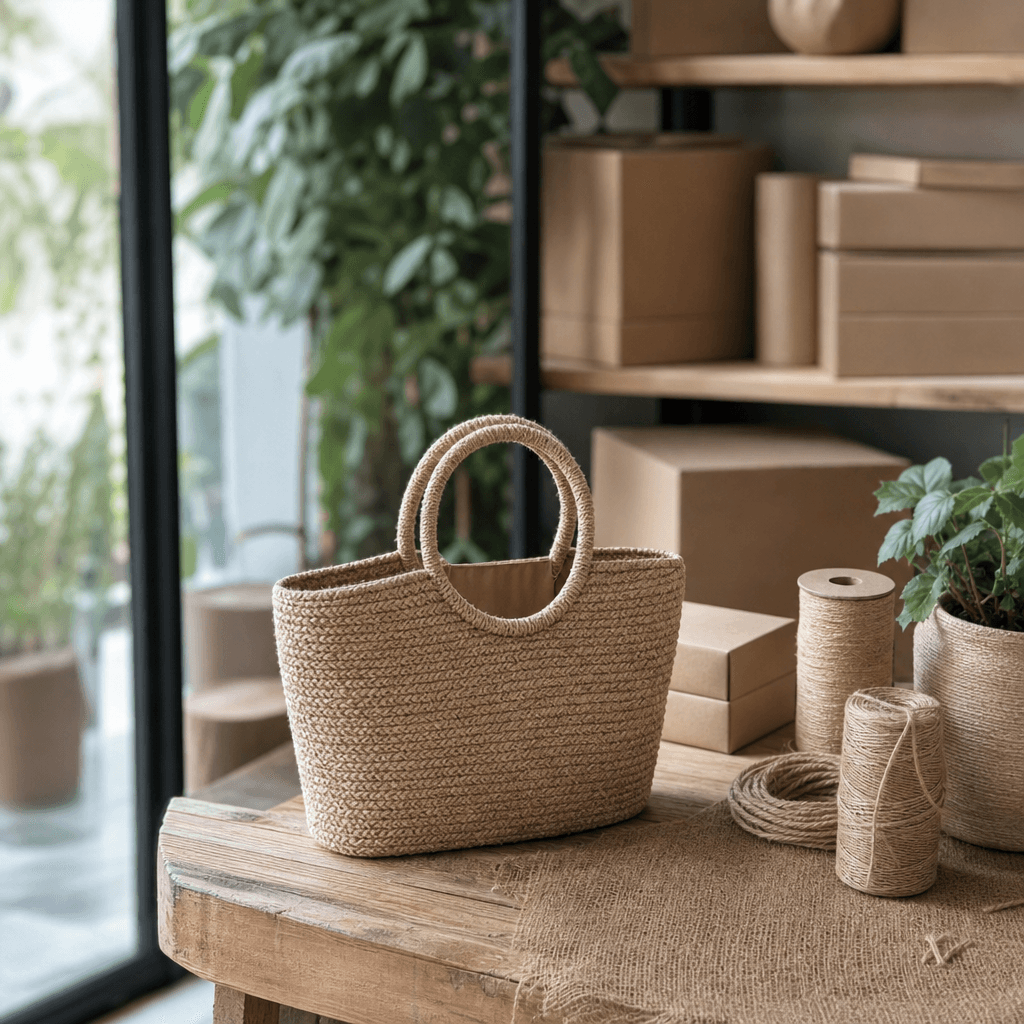
Making paper rope bags isn't limited to simply weaving the rope and adding handles, as most brands assume. The right outcome emerges from planning product dimensions, carrying capacity, weave density, handle attachment, logo application, and sample inspection together. This guide explains how a paper rope bag comes to life, which items make up the cost, which risks recur in production, and what information you should have on hand before requesting a quote—all as a decision framework. The goal is not to provide a price list, but to help you define your project accurately and receive the right quote.
Table of Contents
What exactly is a paper rope bag?
A paper rope bag is a carrier packaging product made by weaving paper rope—obtained by twisting thin paper strips—or shaping it into body and handle forms using weaving-like techniques. The thickness of the rope, weave density, and fiber structure directly determine both the appearance and the carrying capacity of the bag. In this respect, it differs from flat-surface printed cardboard bags: texture, tactility, and a handcrafted look come to the fore.
The most concrete result of this difference is seen on the logo side. While in classic paper bags the logo is applied by printing on a flat surface, the woven surface does not offer a homogeneous printing base. For this reason, brand application in most projects is solved with a different method:
- Woven or printed label
- Leather or faux leather logo label
- Metal badge
- Small cardboard tag
- Printed inner label
- A thank-you card or packaging set matching the bag
If the carrying requirement is high, this bag should not be considered a standalone solution. In scenarios involving heavy glass bottles, dense electronic products, or cargo requiring durability, the product itself is protected by a corrugated box or corrugated shipping box; the paper rope bag is designed as the outer presentation layer. For material and production fundamentals, you can find a detailed introduction in our article What Is a Paper Rope Bag and How Is It Produced?
Design decisions that determine cost
The design decisions made before production determine both the unit cost of the bag and its usage performance. The three most influential topics are dimensions, the rope-weave balance, and handle attachment.
When determining dimensions, not only the external size of the product but also the packaged weight, the size of the product box, the items to be added to the bag, the use of paper filling or tissue, handle length, and whether the bag will be carried by hand or over the shoulder should be considered together. Using thin rope and sparse weave at very large dimensions weakens the form and carrying performance; overly thick rope and dense weave increase weight and cost.
Rope thickness and weave density are not merely visual preferences; they establish the balance between durability and cost. This balance should be tested on a sample.
| Design choice | Potential advantage | Potential risk |
|---|---|---|
| Thin rope | Elegant and lightweight appearance | Low carrying capacity |
| Thick rope | Stronger and sturdier body | Higher material cost |
| Sparse weave | Low weight, natural texture | Loss of form and deformation |
| Dense weave | More durable structure | Longer production time |
| Lining use | Form and inner surface quality | Additional material and labor |
| Base reinforcement | Better carrying performance | Additional part and assembly cost |
The handle is one of the most critical durability points of the bag, and how it is attached to the body matters as much as its appearance. Options such as woven paper rope, fabric or textile, leather or faux leather, rope type, wood or metal detailing, short hand handles, and long shoulder straps are used. When attachment points are left unreinforced, the risk of breakage or the body splitting open increases as the product gets heavier. That's why, in sample testing, the carrying performance should be checked not with the bag empty but with the actual product weight.
Around which decisions does the production process proceed?
In paper rope bag production, the process varies according to the level of craftsmanship and the desired scope of customization. Rather than a fixed assembly line, it operates as a chain of technical decisions that determine one another.
The first stage is clarifying the use scenario: store checkout, gift set, seasonal collection, or event distribution require different dimensions, rope, and handles. At this point, the product type, product and packaging weight, target dimensions, sales channel, season, target quantity, desired brand perception, and the need for lining-pocket-closure are defined.
In preparing the rope, color and thickness determine the character of the bag. The critical point here is color selection: since batch-dependent tone variations can occur in natural and recycled fibers, a physical sample should be requested rather than relying on the catalog color.
The base and body weave is the section where carrying capacity is determined. The base form allows the bag to stand upright, distribute weight, and reduce deformation. In projects with intensive handcrafting, an approved sample is taken as reference to maintain the same dimensions and weave appearance. In the mouth and handle application, symmetry, attachment strength, and carrying comfort are checked. Typical problems that undermine premium perception are:
- The right and left handles being of different lengths
- The mouth edge appearing wavy
- Looseness at the handle attachment
- Irregularity in stitching or fixing marks
- The bag failing to hold its form when empty
Details such as lining, inner pocket, zipper, or button can transform the bag from a single-use carrier into a reusable product; however, each additional part increases cost and time. Avoiding details added solely for appearance is more sensible in terms of overall benefit. Logo application should also be chosen according to the woven surface and tested on a sample: a woven label stands out for natural perception, a metal or leather logo for a premium look, and a printed cardboard tag for an economical solution. If you are planning the bag, box, label, and unboxing experience together, the product–packaging compatibility approach in our Jewelry Packaging Types: Options for Brands guide will help.
How to read cost and compare quotes?
It is not correct to give a single standard unit price for a paper rope bag; cost depends on many variables ranging from dimensions to technique, from quantity to brand application. Reading the total cost as follows makes the items visible:
Total cost = material + production labor + handles and accessories + logo application + sample + packaging + logistics
On the material side, the type, thickness, color, and amount used of the paper rope are decisive; larger dimensions or denser weave consume more rope. Weaving and craftsmanship is a significant item in itself, and the time varies according to body dimensions, weave pattern, handle model, and the desired craftsmanship standard. For handles, not only the purchase price but also the attachment method is taken into account. Lining, pockets, closures, and base reinforcement improve usage quality but require additional cutting and sewing. The logo method may also affect the minimum order quantity. A sample is necessary to verify dimensions, weave density, handle attachment, and logo placement before production, and it may be calculated separately from the mass production price. As quantity increases, fixed costs such as design and preparation spread over a larger volume; in low-quantity custom production, the unit cost rises. In logistics, the volume of the bag, packaging, and delivery destination are influential.
When comparing quotes, looking only at the unit price is misleading, because two seemingly identical prices may cover different scopes. Make sure the following items are stated in writing in the quotes:
- Bag dimensions, rope type and thickness
- Weave density and handle model
- Lining and base reinforcement
- Logo application
- Is the sample included?
- Are packaging, VAT, and shipping included?
- Production time
- Acceptable craftsmanship tolerance and defective product policy
We do not publish publicly available fixed unit prices or quantity-based tables for paper rope bags; this is because the real cost can only be accurately determined based on a brief that shares dimensions, quantity, material, and customization scope. For packaging projects, we provide an expert response within 24 hours, so we can clarify the scope and prepare a comparable quote.
What factors extend production time?
Production time varies according to whether the product is based on a ready-made model or a brand-specific design. Receiving a quick quote does not mean production will be completed at the same speed; the quote turnaround and the mass production delivery date should be planned separately.
The main factors that extend the time are custom dimensions, a new weave pattern, custom-colored rope, intensive craftsmanship, lining and inner pockets, custom handles, metal or leather logos, multiple sample revisions, low-quantity custom production, and the preparation of additional packaging such as boxes and labels along with the bag. For this reason, the following stages should be kept as separate time periods in the procurement plan:
- Preparation of the brief and technical requirements
- Quote and design evaluation
- Sample production and revision
- Mass production
- Final quality control and shipment
Which risks repeatedly cause problems?
The paper fiber structure is sensitive to heavy water and moisture. In bags that will be used for long periods in wet environments or outdoors, softening, deformation, and loss of form may occur. If the bag will be exposed to rain, the outer packaging scenario should be considered separately; a bag designed for dry use will struggle with heavy and wet products.
Miscalculating the carrying capacity is the second common mistake. Evaluation done on an empty bag is misleading; especially with glass, metal, or dense products, the handle attachment and base reinforcement should be tested with the actual product weight at the sample stage. In productions involving manual labor, small differences in weave density, dimensions, handle symmetry, and stitching appearance are natural; in premium projects, defining these tolerances before ordering aligns expectations. A print design prepared for a flat surface may also not yield the expected result on a woven base, so the logo method should be approved on an actual sample.
Finally, using sustainability claims without documentation carries risk for the brand. Being paper-based does not automatically mean the product is sustainable in terms of its entire life cycle; the source of the fiber, the proportion of recycled content, the dyes and accessories, and the service life should be evaluated together. Packaging and packaging waste placed on the market in Turkey fall under the scope of the Regulation on the Control of Packaging Waste; the regulation covers the design, production, placing on the market, and waste management of packaging. The Ministry of Environment, Urbanization and Climate Change also considers paper or plastic shopping bags as packaging within this scope. For this reason, before using expressions such as "eco-friendly," material and supply chain information should be verified.
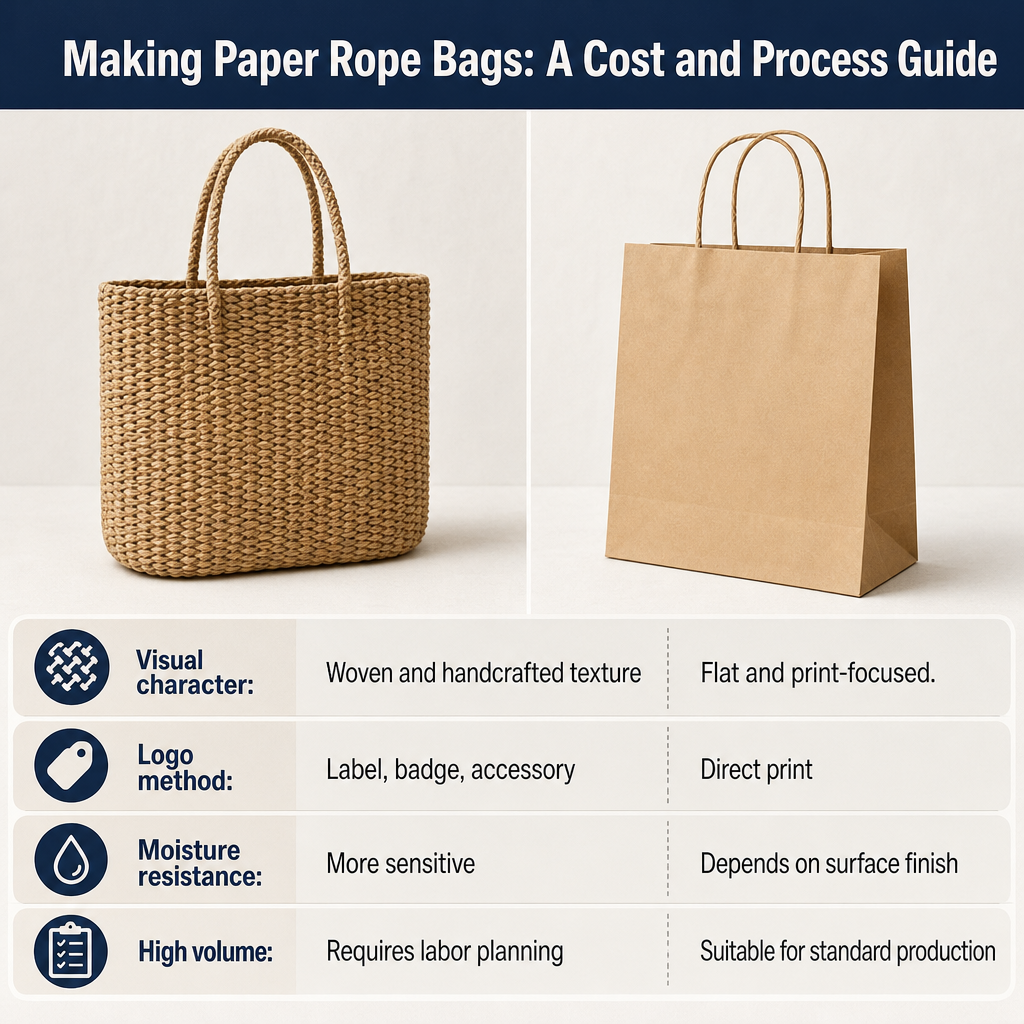
Paper rope bag or cardboard bag?
The decision is made according to the product's intended use. The comparison below allows you to read the two products according to the same criteria.
| Decision criterion | Paper rope bag | Cardboard bag |
|---|---|---|
| Visual character | Woven, natural, handcrafted texture | Printed, flat, graphics-focused |
| Logo application | Label, badge, or accessory | Direct printing is easier |
| Usage perception | Reusable accessory feel | Store and gift carrying |
| Moisture resistance | More sensitive | Depends on surface treatment |
| High-volume production | Requires a labor plan | Suitable for standard production |
| Heavy product carrying | Requires sample testing | Predictable with appropriate weight and handles |
If the brand is seeking a natural, boutique, and tactile identity, the paper rope bag stands out; if it wants a printed, scalable, and more standard carrier, the cardboard bag comes to the fore. The two products can also be designed together: the paper rope bag serves as the outer presentation layer, while the cardboard box takes on inner protection and premium product presentation. If you want to strengthen the premium perception with surface treatment, our article What Is Soft Touch Lamination? A Premium Touch Guide clarifies the options on the box side.
The brief you should prepare before requesting a quote
If you want to receive quick and comparable quotes, share the following information in a single file. An incomplete brief both extends the quote time and makes prices incomparable due to differences in scope.
- Brand name and sector
- Product photo or technical dimensions and product weight
- Internal dimensions of the bag
- Estimated order quantity and target delivery date
- Usage channel and, if any, season/campaign
- Desired rope color
- Handle type and length
- Need for lining or closure
- Logo application and sample expectation
- Delivery address and, if available, existing brand guidelines
Our service model handles the stages of consultancy, structural and graphic design, prototyping, verified production, and consolidated logistics together. When we plan components such as the paper rope bag, label, tissue, thank-you card, and cardboard box as a single packaging experience, we reduce the risk of incompatibility between different suppliers and control the unboxing moment from start to finish. When evaluating printing options for brand application, our article What Is Digital Printing? A Guide to Its Use in Packaging provides direction for labels and complementary products.
Following this order during the decision stage protects you from costly mistakes: determine the product weight realistically, choose the dimensions based on carrying needs, test the rope thickness and weave density on a sample, check the handle attachments with the actual load, evaluate the logo method together with the woven surface, and do not proceed to mass production without sample approval. When you share a brief with a clear scope, we can work out the material and production combination suited to your project together.
Frequently asked questions
Is a paper rope bag made entirely of paper?
It is possible to produce the body and handles from paper rope. However, additional parts such as lining, metal accessories, labels, closures, and base reinforcement may be made of different materials. For this reason, it is necessary to ask separately about all components of the bag.
Is a paper rope bag waterproof?
The paper fiber structure is sensitive to heavy water and moisture. Whether the bag will be designed for dry use or for outdoor and seasonal use should be determined before production.
Can a paper rope bag carry heavy products?
Depending on the rope thickness, weave density, base structure, and handle attachment, it can carry certain weights. For heavy products, mass production should not begin without conducting a physical carrying test with the actual product.
How is a logo applied to a paper rope bag?
Due to the woven surface, woven label, cardboard tag, leather, or metal logo applications are more suitable than direct printing in most projects. The most appropriate method is determined on a sample.
How is the price of a paper rope bag calculated?
The price is calculated according to the items of dimensions, rope type, weave density, quantity, handles, lining, logo, sample, packaging, and logistics. Rather than a fixed price, a quote should be obtained based on the project brief.