

A poorly chosen box creates an invisible bill that most brands pay without noticing: products broken in transit, rising return rates, a lackluster unboxing experience, and a quiet drift away from sustainability goals. The right packaging materials do the opposite; they protect the product, elevate the brand's perception on the shelf and in shipping, and make costs predictable. Making this decision alone means balancing dozens of interacting variables at the same time. As a premium custom packaging company headquartered in Zeytinburnu, Istanbul, Kosapack takes on the task of striking this balance under one roof—from consultancy to production and logistics—for more than 500 brands across over 25 verticals.
Our aim in this article is not to give you a handbook for solving packaging selection on your own. On the contrary, it is to show you which criteria determine the right decision and to explain how you can solve these criteria together with Kosapack's end-to-end service model and product portfolio. That way, when you come to a meeting, you'll already know what we're discussing and why.
Table of Contents
- Key factors that determine packaging material selection
- Right material matches by industry and the Kosapack portfolio
- Sustainable packaging materials and Kosapack's commitments
- The material selection process with Kosapack: from brief to shipment
- The impact of working with the right partner on total cost
- Frequently Asked Questions
Key factors that determine packaging material selection
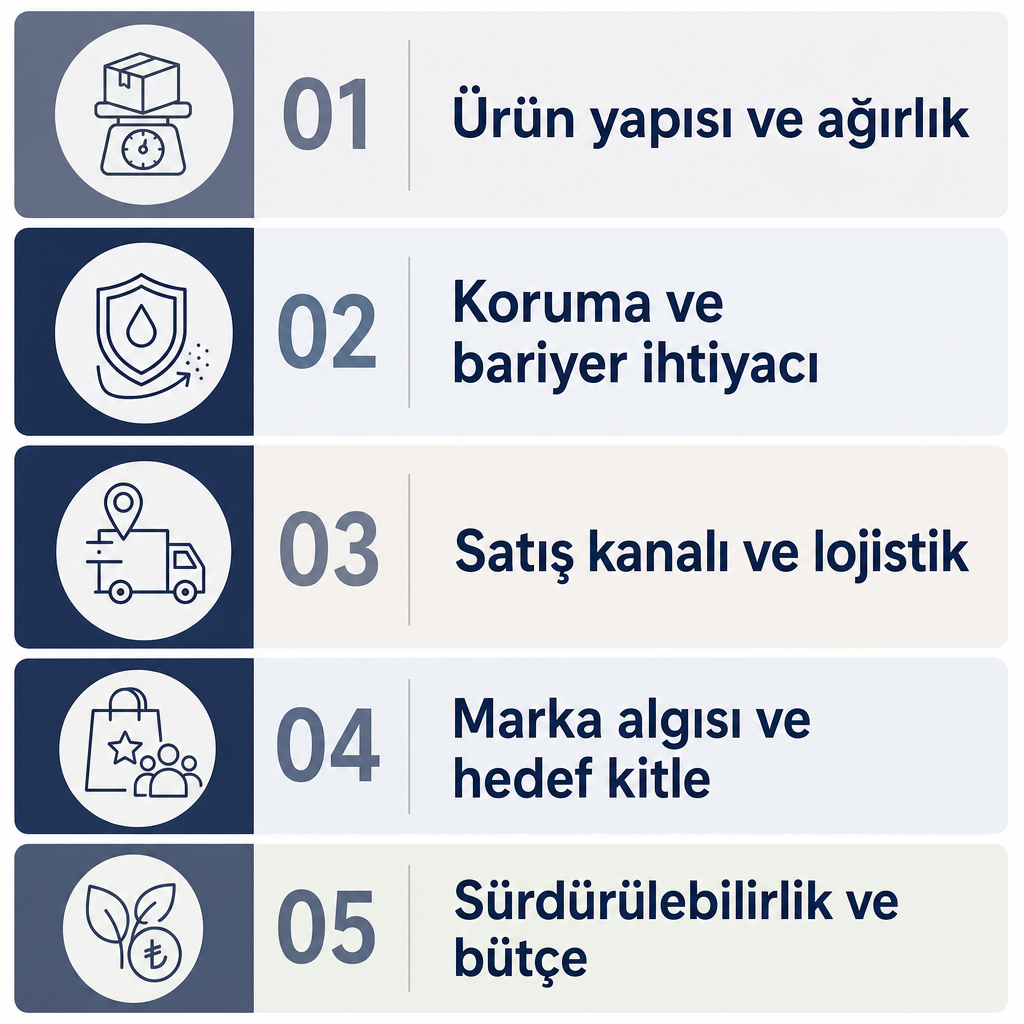
The decision about the right packaging materials cannot be reduced to a single criterion. Expert content addresses this choice across several interconnected axes and recommends, as a first step, understanding the physical structure of the product: weight, fragility, form, and whether the content is liquid, solid, or powder. It is emphasized that the starting point in packaging selection is to clarify how the product will be protected, transported, and what impression it will leave on the customer, after which the material, form, and print structure should be determined (Eposet packaging material selection guide).
Alongside product analysis comes the barrier requirement. It is noted that protection against oxygen, moisture, and light directly affects shelf life; therefore, the product structure, barrier requirement, brand goals, sustainability goals, and budget constraints should be evaluated together (MTD Pack flexible packaging guide). This is exactly where Kosapack's consultancy step begins: product analysis and risk mapping. We do not recommend materials without discussing what will be shipped, under what conditions, and over what distance.
The balance of weight, strength, and protection
The thickness and strength of the material are directly proportional to the product weight. Sources report that the first criterion in selection is often product weight; lighter products require lower thickness, while heavier products require higher thickness. For example, ranges of 40–50 microns are given for light textile products and at least 100 microns for heavy industrial parts, while it is noted that 60 microns can provide sufficient protection for standard products under 1 kilogram. These values are not an exact prescription for your product; what matters is verifying them by testing under the product's real conditions. Kosapack's structural design team likewise designs the form of a box or bag and its transport and protection architecture with this logic. The right thickness decision is often about capturing the minimum strength that will protect the product without creating unnecessary cost; excess strength is just as inefficient as insufficient strength.
Channel, target audience, and brand perception
How the product will be transported and sold determines not only the material but also the form. An e-commerce shipment and a product on a store shelf create entirely different need profiles. Expert content emphasizes that packaging should be aligned with the target audience's preferences, brand image, and marketing strategy; and that packaging is a tool carrying the message you want to convey. In a premium brand, details such as color consistency, logo application, and textured paper cannot be left to chance. Kosapack's graphic design and color-accurate proofing processes ensure that these details are approved before printing. Another criterion determined by the channel is the strength profile: for the same product, aesthetics come to the fore in store display, while burst and moisture resistance take precedence in cargo shipping.
If you are looking for a more detailed, component-by-component framework on packaging materials, you can review the right-selection approach in our packaging materials guide. The underlying logic here is the same: need first, material second.
Right material matches by industry and the Kosapack portfolio
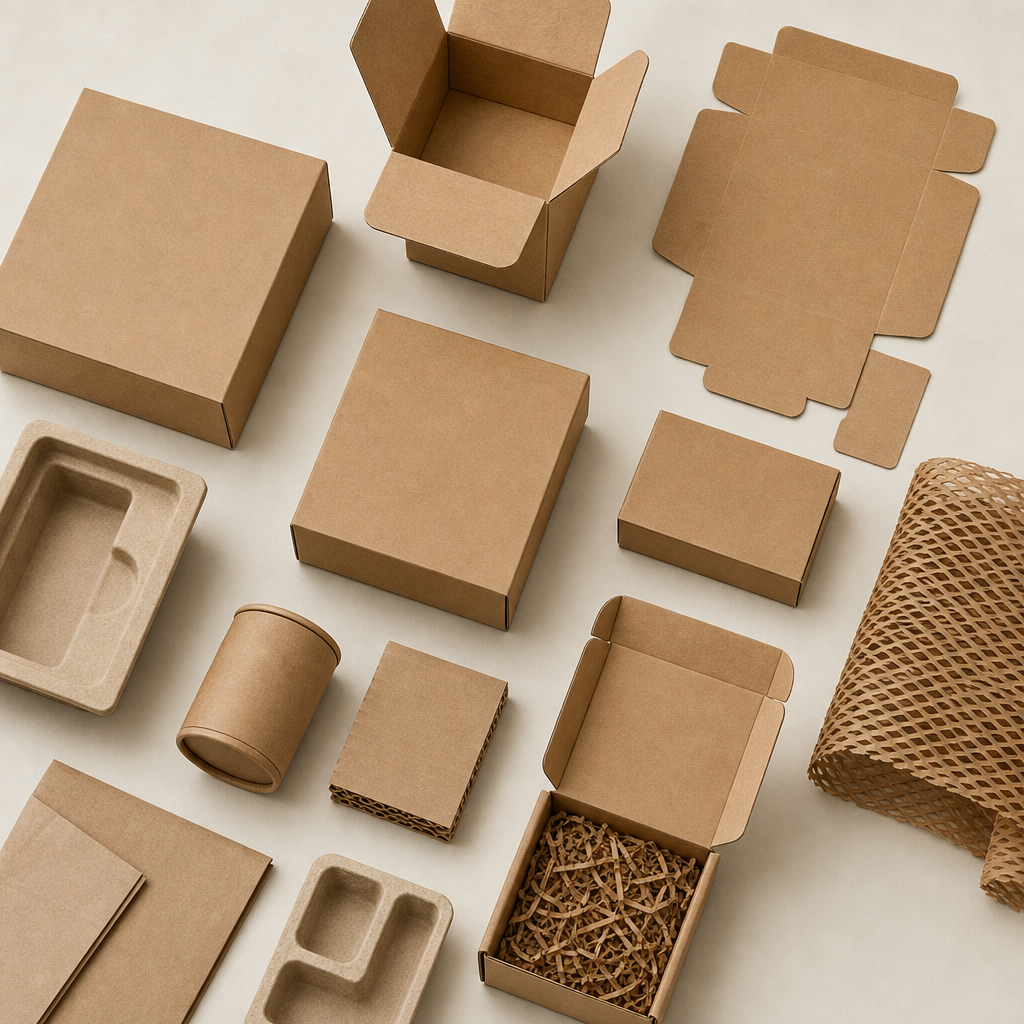
The right material varies according to the industry and the sales channel. Because Kosapack's portfolio is broad, ranging from rigid boxes to complementary components, we can design scenario-based combinations rather than gathering products one by one. The matches below summarize the needs we frequently encounter across different verticals.
| Industry / channel | Priority need | Kosapack combination |
|---|---|---|
| Cosmetics and jewelry | Protection and premium perception | Rigid box + internal separator + fabric pouch + label |
| E-commerce and DTC | Cargo durability and unboxing | Corrugated box + printed kraft paper + tissue paper + thank-you card |
| Fashion and retail | Store and gift presentation | Paper bag + folding box + label |
In categories such as cosmetics, perfume, premium chocolate, and jewelry, rigid boxes come to the fore. This structure, where cardboard and coating paper come together, offers both high print quality and an internal architecture that secures the product, with options such as a magnetic lid, ribbon, and separator. In-box separators lower the risk of damage in multi-product packs by preventing products from touching one another. In these categories, the decision criterion is not only visual; product securing, the first impression at the moment of opening, and gift-worthiness are weighed together.
For e-commerce and DTC brands, the priority is to protect the product under the tough conditions of shipping while also turning the unboxing moment into a brand touchpoint. Corrugated cardboard boxes strike the balance between durability and cost; the brand print applied to the outer surface, tissue paper, and the thank-you card added to the package complete the experience. The natural texture and durability of kraft-based solutions can be both an aesthetic and functional choice in this segment; you can find details about the properties of kraft paper in our article on what kraft paper is. Here, the decision comes down to how you will manage the gap between the internal volume of the box and the product—using fillers and internal accessories—without generating unnecessary freight costs.
On the fashion and retail side, store checkout, boutique shopping, and gift wrapping come to the fore. Paper bags, folding boxes, and labels are the basic components here. If you are curious about how the grammage, carrying capacity, and brand use vary on the bag side, our guide on paper bag types and use cases is a good starting point. In the retail scenario, the grammage of the bag is selected according to the weight of the product the customer will carry and the brand's expectation of reuse.
What these combinations have in common is that Kosapack supplies all components under one roof. Managing the rigid box, folding carton, corrugated box, paper bag, fabric bag, label, tissue paper, thank-you card, mailer, and separator as a single project—rather than gathering them from separate suppliers—preserves both color and quality consistency and shipping order.
Sustainable packaging materials and Kosapack's commitments
Sustainability is no longer an aesthetic preference but a decision parameter. Expert content emphasizes that when choosing materials, the environmental impact (recyclability, reusability, compostability) and the material's life cycle should be taken into account (Yucai Printing material selection guide). On the flexible packaging side, it is recommended to evaluate sustainability goals together with usability features such as barrier layer selection and resealability.
Within this framework, Kosapack works with a commitment to using recyclable materials and reporting the carbon footprint. Kraft and recyclable cardboard solutions can help reduce the environmental burden while offering a premium look with their natural texture. The fact that complementary components such as tissue paper can mostly be chosen from recyclable paper ensures that the unboxing experience does not conflict with your sustainability goal.
It is worth drawing an important line here: sustainability cannot be considered independently of the material doing its job properly. Packaging that fails to protect adequately, gets crushed in transit, and sends the product back as a return cannot be considered sustainable in terms of its net impact, no matter how recyclable it is. The total environmental burden of a product that is returned, re-produced, and re-shipped is far greater than that of packaging that protects correctly the first time. Choosing the right material means striking a balance that considers protection, brand perception, and environmental impact all at once. Kosapack's consultancy role lies in establishing this balance according to your product.
Legal requirements specific to your industry, such as labeling, warning statements, or recycling marks, may vary according to the market and product category. It would not be right to provide a single definitive list for these conditions; requirements specific to your industry must be verified from current and official sources. The Kosapack team helps you carry out this verification together within the scope of the project.
The material selection process with Kosapack: from brief to shipment
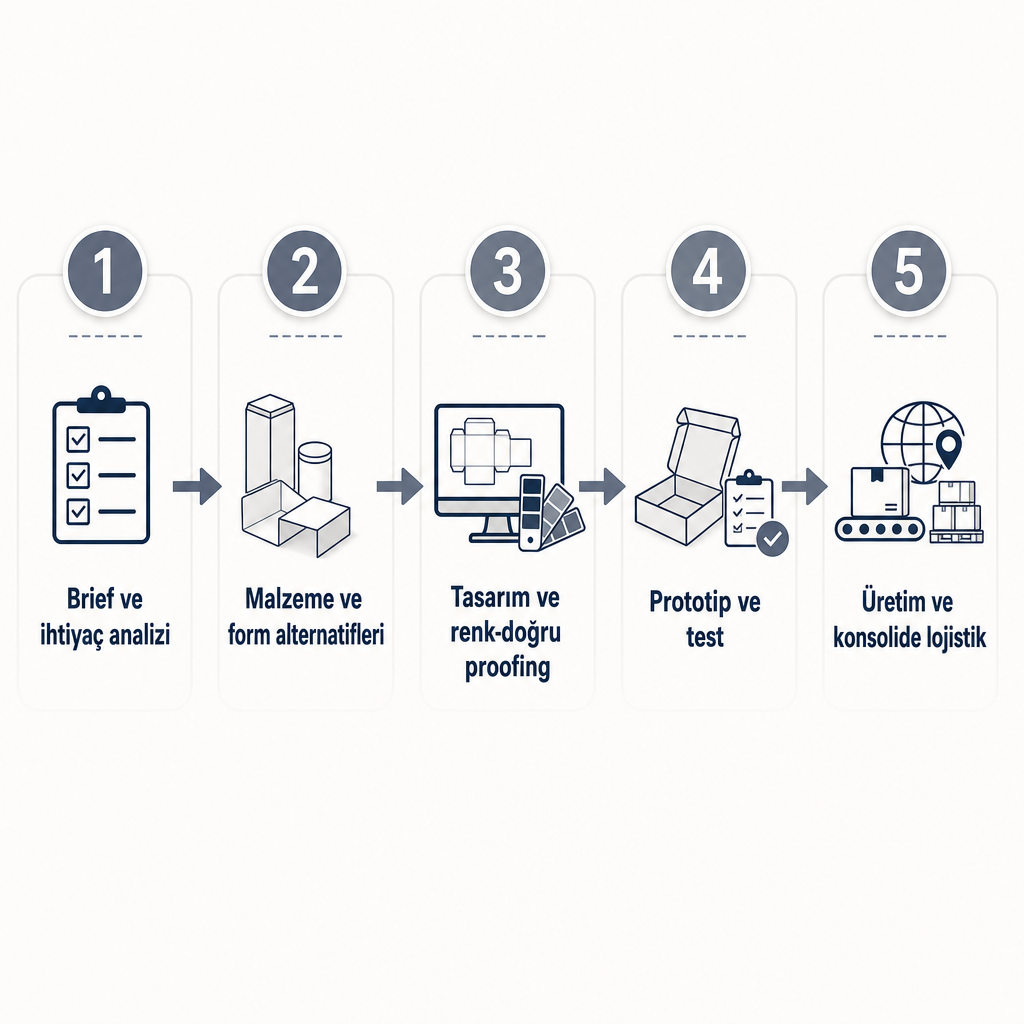
The right packaging decision matures not in a single meeting but through steps that feed into one another. Expert sources define this ideal process in distinct stages; Kosapack's service model is also designed to carry out these stages under one roof.
Defining needs and goals. The first step is clarifying the product, channel, target audience, sustainability goals, and budget. The first brief meeting with Kosapack does exactly this. We do not recommend materials without discussing what we are protecting, which channel you sell through, and what perception your brand aims for.
Determining material and form alternatives. Once the need is clarified, scenario-based recommendations emerge from the portfolio. Rigid box or folding carton, kraft or coated cardboard, which separator structure produces less damage for your product? At this stage, Kosapack compares the alternatives in terms of protection, cost, and brand impact, and transparently lays out the pros and cons of each option.
Design and print decisions. Brand elements, printing techniques, and color are determined at this step. Kosapack's graphic design team and color-accurate proofing process aim to ensure that the color you see on screen finds its equivalent in print. In premium brands, color deviation is a risk that can overshadow the entire investment.
Prototype and testing. Verifying samples before moving to large-scale production is strongly recommended. Sources advise testing indicators such as burst strength, adhesive strength, and moisture resistance through small-scale tests; and even simulating transport by dropping or shaking the samples (CRD Box material selection). Kosapack makes this verification possible before production by providing a physical sample within 7–15 business days; it delivers the initial pricing within 24 hours.
Production, logistics, and maintaining the standard. The approved design moves into production managed through verified factory partners. Different items are consolidated under a single shipment with consolidated logistics, and the quality standard is preserved through systematic control in ongoing orders. Considering that supply shortages in niche materials can cause production delays, supply stability is also monitored at this stage.
Managing each of these five steps with separate suppliers and teams creates both a time and a consistency cost. Kosapack's approach is to reduce this cost by channeling the process through a single partner.
The impact of working with the right partner on total cost
Calculating packaging cost by looking only at the unit price is misleading. Expert content emphasizes that a correct calculation must include product loss, return rate, storage efficiency, cargo volume, and brand impact together (Eposet packaging material selection guide). A box with a low unit price but weak protection can end up much more expensive due to rising returns and damaged products.
When thinking about total cost of ownership, several items are evaluated together. The returns and re-shipments caused by products damaged in transit; the effect of box size on cargo volume and thus on freight cost; the space it takes up in the warehouse; and perhaps the most easily overlooked, the perceptual value that lackluster packaging takes away from the brand. These are extensions of the unit price that do not appear on the invoice.
Kosapack's advisory role is precisely to simplify this complex calculation. To recommend, from among alternative materials and box structures, not merely the cheapest but the one that optimizes total cost; to reduce the return risk before production by verifying protection performance at the prototype stage; and to reduce operational complexity by consolidating all components. Thanks to custom sizing, a structure that fits your product exactly can reduce both the need for void fill and unnecessary volume.
The meaning of this approach is: the decision about the right packaging materials is not an expense line but an investment decision that affects protection, brand, and operations all at once. Making this decision with a partner who balances the criteria on your behalf reduces both aesthetic and operational risks from the start.
Frequently Asked Questions
For which products should I choose a rigid box?
Rigid boxes come to the fore in categories where premium perception and protection matter together. For products such as cosmetics, perfume, jewelry, premium chocolate, and corporate gifts, the structure where cardboard and coating paper come together offers high print quality while securing the product with options such as a magnetic lid, ribbon, and separator. The weight and fragility of your product and your brand positioning are evaluated together in a Kosapack meeting to determine the most suitable structure.
Which material is more advantageous for e-commerce shipments?
In e-commerce and DTC shipments, the priority is to protect the product under the tough conditions of shipping while also turning the unboxing moment into a brand touchpoint. Corrugated cardboard boxes strike the balance between durability and cost; the brand print applied to the outer surface, kraft paper, tissue paper, and the thank-you card complete the experience. The right combination varies according to the weight, fragility, and shipping volume of your product; that is why it is recommended to simulate transport conditions at the prototype stage.
Is sustainable packaging more expensive?
Measuring sustainability solely by unit price is misleading. Recyclable materials may sometimes come with a higher initial cost, but when chosen correctly, they balance the total cost through their effects on protection performance and brand perception. The returns and product loss caused by poorly protecting packaging leave no net gain from an environmental standpoint either. Kosapack evaluates recyclable material options together with the real protection needs of your product.
How long does the sampling and quotation process take?
Kosapack delivers the initial pricing within 24 hours and provides a physical sample for the approved design within 7–15 business days. A physical sample allows you to verify material and print decisions before moving to large-scale production; you can see the color, texture, and structural strength by holding it in your hands.
Can I get different packaging items from a single source?
Yes. The Kosapack portfolio covers rigid box, folding carton, corrugated box, paper bag, fabric bag, label, tissue paper, thank-you card, mailer, and separator. Supplying all components under one roof preserves color and quality consistency and makes it possible to combine different items in a single shipment through consolidated logistics.
How do I comply with packaging regulations specific to my industry?
Requirements such as labeling, warning statements, and recycling marks may vary according to the market and product category. For this reason, it would not be right to provide a single list for every industry; requirements specific to your industry must be verified from current and official sources. The Kosapack team helps you review these requirements together within the scope of your project.