
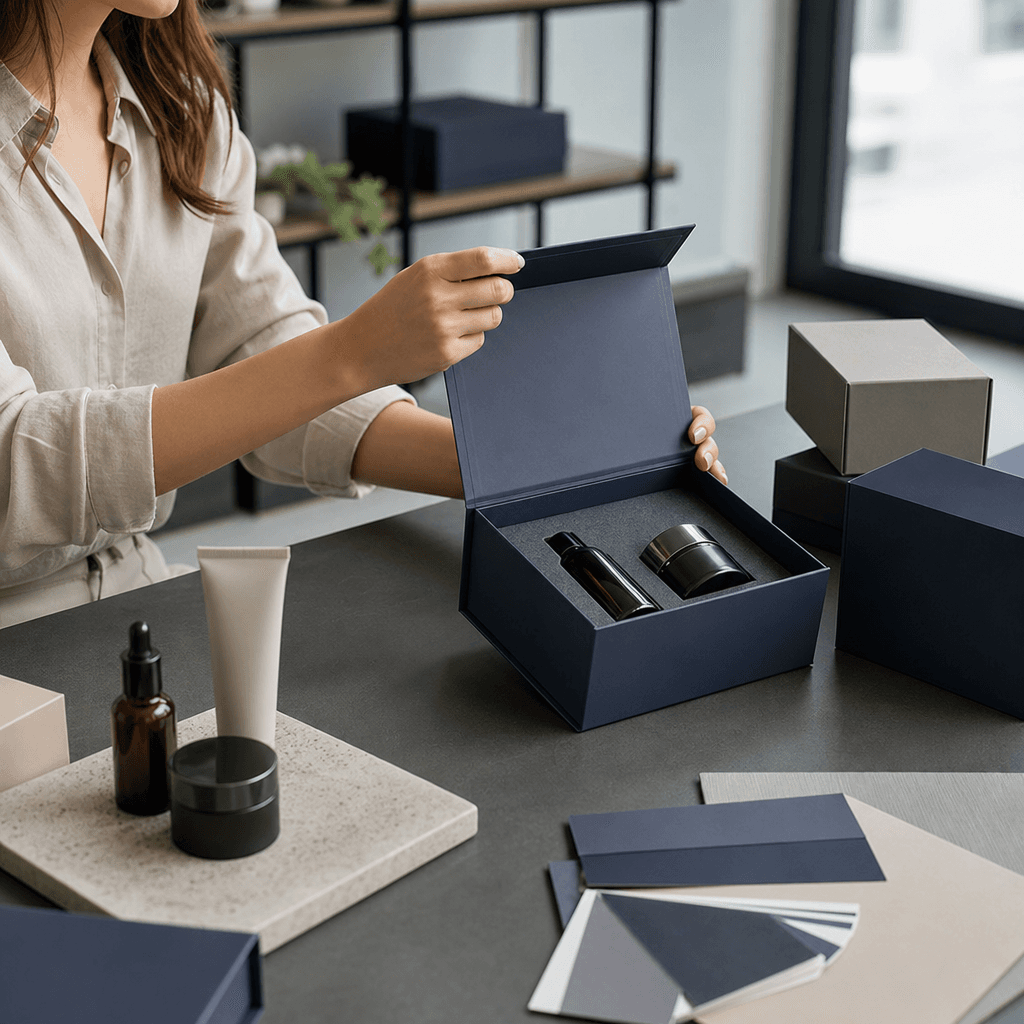
The box decision for cosmetic products requires balancing more variables at once than most brands assume. A box that looks beautiful is considered to have failed its job if the product moves around inside, if mandatory information cannot be read, or if it takes impact during shipping. The correct answer to the question of how to choose a cosmetic box is not a single box type but a decision sequence: first the product's dimensions, weight, fragility, sales channel, and brand positioning become clear; then cardboard box, rigid board box, or corrugated box options are evaluated together with internal fit, printing, surface application, regulations, sustainability, and total cost.
We prepared this guide as a practical decision framework for brands that will choose the outer box of their cosmetic products. Here, rather than defining each box type one by one, we address which product leans toward which box with which logic, and the points most often overlooked during selection.
Contents
What is the fundamental decision in choosing a cosmetic box?
In cosmetic packaging, two separate box decisions must not be confused. The primary packaging is the container that directly touches the cream jar, serum bottle, perfume, or makeup product. The secondary packaging is the outer box that protects the product, carries information, and provides shelf visibility and an unboxing experience. This guide deals with the secondary box, that is, the layer that most affects the brand's perception.
The job of the outer box is not merely to contain the product. At the same time, it stabilizes the product, lowers the risk of impact and friction, makes the information required by regulations visible, and establishes the correct quality perception in the consumer. When any one of these four functions is missing, the box has technically been chosen incorrectly. If you want to see the general structure of cosmetic packaging in a broader frame, our cosmetic box design guide offers a complementary read on the design side.
How is the box type determined by product?
Not every cosmetic product needs the same level of protection. Box selection first narrows according to the product's physical properties and sales scenario, then is refined by brand preferences. The table below shows this narrowing through product types.
| Product or sales scenario | Suitable box approach | What to watch for |
|---|---|---|
| Cream jar | Folding cardboard box or rigid board box | Diameter, weight, cap height, internal fixing |
| Serum and dropper bottle | Folding cardboard box or solution with separator | Glass breakage, neck area, vertical handling |
| Perfume | Rigid board box or heavy-weight cardboard | Bottle weight, impact resistance, premium presentation |
| Lipstick and mascara | Compact folding box | Small size, print legibility, opening |
| Multi-product set | Rigid board box, inner tray or separator | Layout that prevents products from hitting each other |
| E-commerce order | Product box + corrugated outer shipping box | Shipping impact, void filling, dimensional weight |
| Gift or launch set | Rigid board box, magnetic or lidded structure | Unboxing experience, surface quality, reuse |
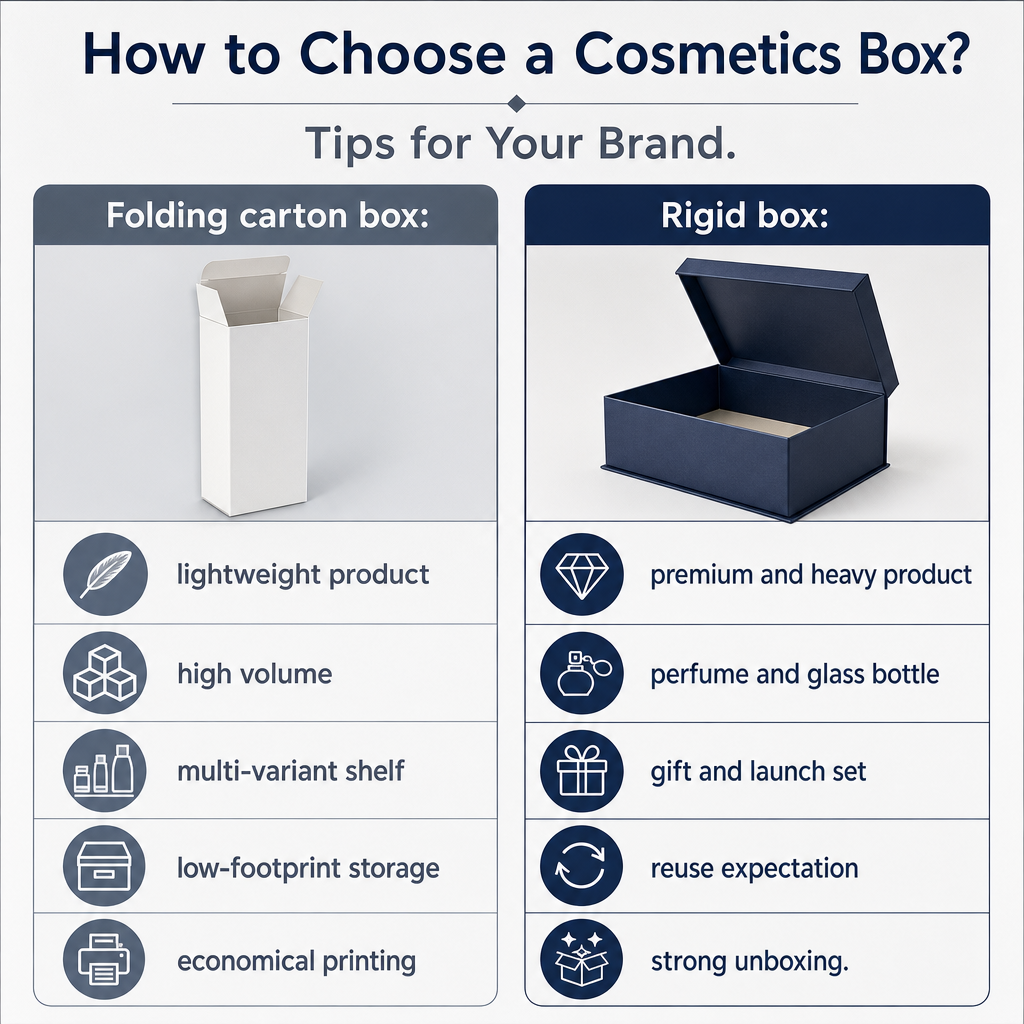
In practice, a two-way tendency is seen: folding cardboard boxes stand out for small and light products, while rigid board boxes come to the fore where high perceived value or set presentation is needed. For products that will go into shipping, instead of relying on the product box alone, a corrugated shipping box that provides outer protection should additionally be considered. To clarify whether a ready-made size or a fully custom structure is needed, our ready-made box vs custom box comparison details the decision criteria.
Cardboard box or rigid board box?
The decision between these two options is most often resolved not by budget but by the product's weight and the brand's shelf target.
The folding cardboard box is efficient for high-volume cosmetic products thanks to its lightness, flat-stackable structure, and wide print area. It is a strong choice for brands with mass production, multi-variant shelf lines, lightweight products, and low-volume storage needs. Its limit appears in weight: for heavy glass bottles or products carrying high impact risk, it may not suffice on its own. Here, the weight, surface coating, and box structure must be calculated together with the product weight.
The rigid board box, with its thicker and more durable structure, comes into play for premium cosmetics, perfume, gift sets, and launch products. The box's solid feel, the way the lid opens, and the internal fit directly convey the quality perception. E-commerce sales where there is an expectation of reusable packaging and where the unboxing experience matters also lean toward this side. However, the rigid board box's strong appearance does not mean it is automatically the better choice in every scenario; if the product is light, the shipment is high-volume, or storage space is limited, the folding cardboard box remains more economical and practical.
Dimensions and internal fit: protection starts here
The internal dimension of the cosmetic box should be slightly larger than the product's outer dimension, but an oversized box is not a solution either. Excess space causes the product to move inside the box, increases the risk of impact, requires more filling, raises the volumetric cost of shipping, and makes the box look disproportionate on the shelf. In dimensioning work, besides the product's width, length, and height, cap, pump, or pipette protrusions; single or multi-product presentation; the need for an inner tray or separator; box unfolding and gluing allowances; the outer shipping box to be used; and whether the product can be easily removed by hand must all be considered together. Especially for glass bottles, the box must not squeeze the product but should also limit its range of movement; this balance is verified not by on-screen design but by a physical sample.
Internal structure determines protection as much as the outer surface does. If the bottle or jar moves inside the box, even the highest-quality printing will not solve the protection problem. Depending on the product, a cardboard inner tray, a box separator, a snap-fit cradle that grips the product, folding inner support, paper filling, or a compartmented layout for multiple products can be considered. For glass packaging such as serum and perfume, the neck and cap area in particular must not take impact; in multi-product sets, if the products touch one another, the risk of scratching or breakage persists even if the outer box is sturdy. For this reason, when requesting a quote, not only the box dimensions and printing but also how the product will be fixed inside the box should be described.
Printing, surface application, and regulatory space
Print selection is made according to brand color, box material, print quantity, and the desired surface effect. In the decision, the accurate appearance of brand colors, legibility on dark backgrounds and at small point sizes, the print tolerance of logos and fine lines, the preference for matte or glossy surface, and applications such as cellophane, varnish, foil, or embossing are all considered together. A matte surface gives a natural and sophisticated look; a glossy surface makes colors vivid but light reflections can make small text harder to read. Foil and embossing are strong for highlighting a logo or product name, but when spread across the entire surface they increase both cost and visual density. To understand how which printing technique behaves on which surface, our what is screen printing and how is it applied content provides a technical foundation.
The regulatory side is as binding as the aesthetic one. In Türkiye, cosmetic products can be placed on the market provided that the information on their inner and outer packaging is indelible, easily readable, and visible. The relevant article of the Cosmetic Products Regulation covers information such as the name or trade name and address of the responsible person, nominal content, expiry date or period after opening, special warnings, batch or serial number, the product's function, and the ingredient list. Therefore, in box design, sufficient and legible space for these texts must be reserved from the outset; mandatory information should not be printed too small or with low contrast for the sake of a logo or decorative pattern. Before design approval, it should be checked that the information required to be given in Turkish is in Turkish, that the ingredient list appears on the outer packaging, that the batch number and date area are left legible, that warning texts are not covered by surface application, and that the information area is planned in advance for small boxes.
There is a clear separation of responsibility here: we provide the structural and printing solution; the accuracy of the product information and its regulatory compliance are confirmed by the responsible person of the cosmetic product and the brand. To verify the texts against a current and complete official source, the Cosmetic Products Regulation text should be taken as the basis.
Selection by sales channel and sustainability
The same product requires a different box priority depending on the channel it is sold through. In shelf sales, the front face of the box must be read quickly from a short distance; the product name, main benefit, volume, and brand hierarchy should be easily distinguished visually. In multi-variant lines, color codes and a product family system noticeably increase shelf readability. In the store and gift scenario, the feel the box gives in hand, the way it opens, and the surface quality come to the fore; a rigid board box, a special lid structure, or internal fit raises the product's gift value.
In e-commerce, the box takes on two tasks at once: making the product look good to the consumer and protecting it during transport. The product box may be premium, but for shipping impact an outer corrugated box, suitable filling, or a separator is most often essential. Instead of making the product box heavier solely for shipping durability, a two-layer packaging system is a more controlled and, in most cases, more economical solution.
Sustainability, on the other hand, is not just about using paper. The box's total material usage, print and coating choice, transport volume, service life, and recycling process must be evaluated together. For a more balanced choice, one should avoid unnecessarily large boxes, aim for the lowest material usage that will protect the product, ask about recyclable paper and cardboard options, use mixed materials such as plastic windows or heavy lamination only if needed, pay attention to whether box parts can be easily separated, and verify every environmental claim together with which material and process it belongs to. As Kosapack, we offer topics such as recyclable materials, plastic-reducing solutions, certified materials, and carbon footprint reporting within the scope of our service; however, we do not assume any box is automatically recyclable, and we verify the selected material, coating, and additional parts on a project-specific basis.
Sample, quote, and how to proceed with us
A design that looks right on screen may not give the same result on the physical product. The color of the cardboard or rigid board surface, the difference between matte and glossy, the mismatch between screen color and print color, the overlap of fold lines with graphics, lid tolerance, and small text losing legibility in print are the most common deviations. For this reason, before mass production, the following checks should be done on a physical sample: does the product go in and out of the box easily, do the lid and gluing points work properly, does the print color meet the brand expectation, is the mandatory information readable, does the box keep its form during handling and shelf placement, does the inner support fix the product without scratching it, and does the box fit into the outer shipping packaging without leaving unnecessary space.
For a quote to be comparable, quantity information alone is not enough. We recommend you convey the following information to us as far as possible: product name and type, net dimensions, product weight, packaging material (glass, plastic, metal), single or multi-product presentation, the need for an inner tray or separator, box type expectation, print colors, surface application, estimated order quantity, initial and reorder plan, sales channel, target delivery date, sustainability or certification expectation, whether the product will be shipped by cargo, and whether the regulatory texts are ready. In our service model, consultancy, structural and graphic design, prototype, production, quality control, and logistics come together in a single program; with custom dimensioning, approved production partners, and consolidated logistics options, we simplify the process for brands whose product dimension or internal fit is not yet clear. After the needs are shared, we proceed with a quote within 24 hours and a physical sample in 7–15 business days; these timeframes are confirmed according to the project scope.
For the right choice, having the following sentence clear in your brief notably eases decisions about box type, material, and printing:
Our product will be sold in these dimensions and through this channel; our priority is protection, premium appearance, low volume, or sustainability.
Common mistakes
A few recurring mistakes in cosmetic box selection raise both cost and the risk of re-production. Deciding based on appearance alone tops the list: even if the box looks beautiful, the choice has failed if the product is not fixed or the information is not readable. Using a box too large for the product causes both the product to move and the transport cost to rise. Leaving the regulatory space to the end of the design forces rework at the final stage when there is no room left for the ingredient list, warnings, and batch number. Going to mass production without seeing a sample means noticing deviations in dimension, color, folding, lid, and internal fit too late. Trying to solve both shipping and shelf needs with a single box often weakens both functions; when needed, two-layer packaging is safer. Finally, using a sustainability claim without documentation is risky, because recyclability depends not only on the main material but also on additional parts such as coating, adhesive, magnet, and window.
Frequently asked questions
How is a cosmetic box chosen?
It is chosen by evaluating together the product dimension, weight, fragility, sales channel, brand positioning, and regulatory information. For light and high-volume products, the folding cardboard box; for premium, heavy, or gift sets, the rigid board box may come to the fore.
Which is the best box for cosmetic products?
There is no single best box. For cream and makeup products the folding cardboard box, for perfume and gift sets with glass bottles the rigid board box, and for the shipping process an additional corrugated outer box may be suitable.
Is an inner separator necessary in a cosmetic box?
If the product moves inside the box, if more than one product is in the same box, or if glass packaging is used, a separator or inner tray may be needed.
What information should be on a cosmetic box?
In Türkiye, the responsible person's information, nominal content, expiry date or period after opening, special warnings, batch or serial number, the product's function, and the ingredient list are important. The information must be indelible, easily readable, and visible.
Should a physical sample be obtained for a cosmetic box?
Yes. Dimension, color, printing, folding, lid, internal fit, and text legibility should be checked with a physical sample before mass production.