
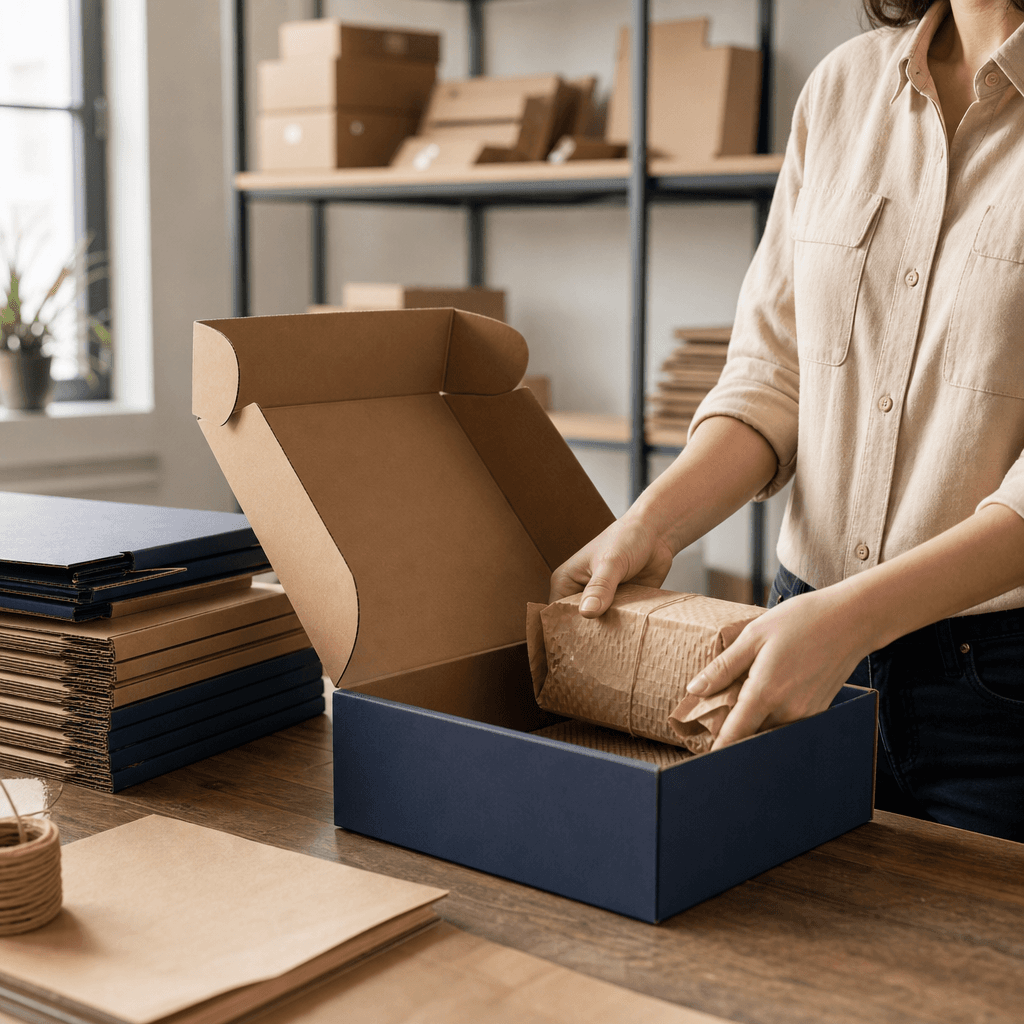
The short answer to the question of why branded packaging matters is this: packaging is more than an outer layer that carries the product. As one of the first physical points where the brand touches the customer, it directly influences perceived quality, trust, the purchase decision, and the opening experience. Well-designed packaging takes on a role at different stages of the sales journey, from being noticed on the shelf to delivering a shareable unboxing in e-commerce. But what makes packaging branded is not simply printing a logo on it. When the right dimensions for the product, the correct material, the brand's visual language, a structure that protects the product, regulation-compliant information, and a responsible waste profile all work together, packaging turns into a genuine brand investment. Our aim in this guide is not to make you choose a good-looking box; it is to clarify which commercial and functional problem packaging needs to solve for your brand.
Table of contents
What branded packaging is and what it covers
Branded packaging is the deliberate use of a brand's logo, colors, typography, graphic language, message, material, form, and opening experience on a product's packaging. In other words, it describes a far broader system than just printing a logo on an outer box.
This system may include the following components:
- Printed cardboard box
- Rigid box
- Branded corrugated shipping box
- Paper bag
- Label
- Tissue paper
- Thank-you card
- Shipping envelope
- Fabric bag
- In-box insert or separator
Branded packaging consists of more than just the outer box. It covers all the touchpoints that extend from the product reaching the customer to its opening, storage, and re-sharing. This wholeness also explains why the functions discussed in the next section depend not on a single piece but on the harmony of the components.
Why branded packaging matters: six functions
It would be incomplete to explain the value of packaging through a single benefit. Branded packaging takes on multiple jobs at once, and these functions reinforce one another.
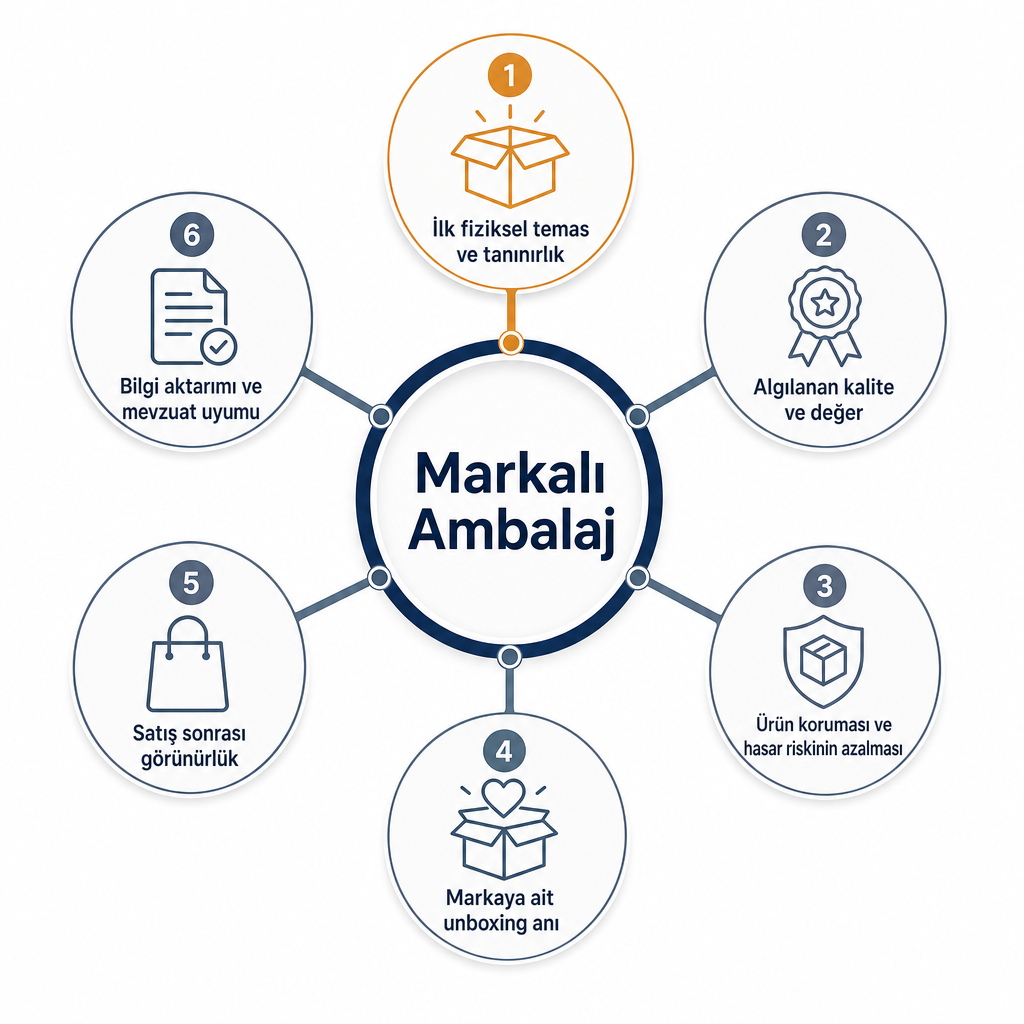
Visibility at the first physical touchpoint. In the digital space, the customer's first contact with the brand may be the website, social media, or an ad; with a physical product, this contact often begins with the packaging. When the brand name, colors, typefaces, and visual language are used consistently, packaging makes recognition easier, sets the product apart from similar ones, and turns positioning into a tangible object. For a jewelry brand, a rigid box with a velvet lining; for a natural soap brand, a plain kraft-surfaced cardboard box; for an e-commerce brand, a corrugated shipping box with interior printing—each answers different expectations. The goal is not for every brand to use the same packaging, but for the packaging to align with the brand promise.
Perceived quality and value. Packaging design can shape the consumer's expectation of the product before purchase. An academic study shows that the attitude toward packaging design is positively related to perceived quality, and perceived quality to perceived value; it also reveals that visual design alone does not determine brand preference (Pertanika JSSH study). This distinction is important: packaging can support the quality perception, but it cannot by itself compensate for a poor product experience. Premium packaging is also not merely more decoration; material quality, print accuracy, the way the box opens, and the interior layout should be evaluated together.
Product protection and damage risk. Branded packaging is as much a protective engineering solution as it is an aesthetic tool. If the product moves too much inside the box, the risk of scratching, breakage, crushing, or deformation increases. The need for protection varies by category: molded internal support or an anti-static lining for electronics, separators that hold placement in place and suitable contact materials for chocolate and food, an internal structure that secures the product for jewelry, keeping the bottle or jar from moving for cosmetics, and an outer box suitable for stacking and handling impacts for e-commerce stand out. Beyond the product's dimensions and weight, we recommend evaluating the distribution channel at the start of the design and establishing dimensions and structure compatible with the product. Box separator options for protection and premium placement are also part of this decision.
A brand-owned unboxing moment. In e-commerce, packaging partly takes over the role of the in-store advisor. When the customer receives the product, they may encounter the brand physically for the first time. A box size suitable for the product, a tidy interior layout, branded tissue paper, a thank-you card, a personalized message, a separator that secures the product, and an easy-to-open structure strengthen this moment. But a strong opening does not always have to be showy; a plain, fast, waste-reducing opening can also reflect brand values. The basic question is clear: does the packaging make opening harder, or does it make reaching the product safer and more meaningful? You can look at our How to Create an Unboxing Experience? guide, where we address in detail how this moment is designed.
Post-sale visibility. Packaging may not become useless after the product is opened. A sturdy rigid box can be used for storage, gift-giving, or collection purposes; a paper bag can keep the brand visible in different settings after leaving the store. Thus packaging serves as a kind of media. For this to happen, the packaging needs to be durable, useful, easy to store, visually consistent, and suited to the usage scenario.
Information transfer and regulatory compliance. Packaging can carry mandatory information such as the product's usage, contents, quantity, warnings, and manufacturer information. In food in particular, packaging and labeling are subject to regulations. The Ministry of Agriculture and Forestry sets out mandatory information, general labeling rules, and business responsibilities under the Turkish Food Codex Regulation on Food Labeling and Informing Consumers (Ministry of Agriculture and Forestry announcement). For this reason, aesthetics and regulation should be handled together; the space reserved for a logo or campaign message should not hinder the readability of mandatory information. In non-food categories too, product claims, usage instructions, and sustainability statements should be prepared in a clear, verifiable, and non-misleading manner. On the sustainability side, the European Union Packaging and Packaging Waste Regulation aims for packaging placed on the EU market to be economically viable to recycle by 2030 (European Commission packaging waste page); in Turkey, the Regulation on the Control of Packaging Waste sets out the framework for waste reduction and recovery. These increase the importance of two decisions: not enlarging packaging unnecessarily and supporting sustainability claims with provable information.
Not every brand needs the same kind of branded packaging
In the branded packaging decision, product category, sales channel, and brand positioning should be evaluated together. The matching below is for comparing the priorities of different scenarios; it is not a fixed recipe.
| Use scenario | Priority need | Suitable solution examples |
|---|---|---|
| Premium cosmetics | Shelf impact, tactile quality, product protection | Printed cardboard box, rigid box, interior insert |
| Jewelry and goldsmithing | Secure placement, gift perception, lasting use | Rigid box, velvet lining, custom separator |
| E-commerce and DTC | Shipping durability, unboxing experience, volumetric weight control | Printed corrugated shipping box, tissue, thank-you card |
| Fashion and apparel | Carrying, gift presentation, visibility | Cardboard box, paper bag, tissue |
| Chocolate and confectionery | Product placement, hygiene, presentation | Cardboard box, rigid box, molded insert |
| Corporate gift | Set layout, representational power, personalization | Rigid box, paper bag, message card |
| Electronics | Protection from impact and static electricity | Corrugated box, molded internal support, anti-static lining |
Two brands in the same category may differ in product weight, sales channel, budget, and positioning. That is why the table is a starting framework, while the final decision depends on the product scenario.
Decision criteria for choosing branded packaging
To make a sound packaging decision, it is necessary to address, one by one, the headings that appear independent but affect one another.
Brand alignment. The color, material, printing technique, and opening style must align with the brand's promise. For a natural and plain brand, an overly glossy and heavy design may be incompatible; for a luxury brand, low print quality or overly thin material can create a loss of trust; for a young and digital brand, interior printing, a message card, and shareable details can be more effective.
Product fit. The box should be evaluated not by the product's external dimensions but by the product's actual movement within the packaging. Too much empty space negatively affects protection and logistics cost; too tight a fit makes removing the product difficult. For a more detailed framework on how custom-size decisions are handled, you can refer to the How to Design a Custom-Size Box? guide.
Sales and distribution channel. Shelf, shipping, corporate gift, and event distribution do not create the same need. Visibility and information hierarchy on the shelf, impact resistance and size optimization in shipping, tidy presentation of the set and personalization in corporate gifts, and ease of carrying in the store come to the fore.
Print and color accuracy. Because packaging carries the brand's colors into the physical world, there should be no difference between the digital design and the printed result. For brands whose corporate colors are critical, color references should be clarified, the print surface should be taken into account, a sample or color-accurate proof should be seen, and written approval should be obtained before production. We run the color-accurate proof and approval process before production; and we carry out structural and graphic design support together with production and logistics coordination.
Total cost. Unit price is not the only indicator. The box type and structure, dimensions, material and grammage, print surfaces, special coatings or finishes, interior inserts and supports, order quantity, samples, storage, shipping, and the risk of damaged product affect the total cost. A packaging that appears cheaper may be more expensive overall if it increases product damage or shipping volume. To review cost items in detail, you can look at the Box Prices 2026: Current Cost Guide page.
Supplier reliability. The following questions should be answered in the evaluation: Is structural and graphic design support provided? Is a physical sample offered? How is color approval done? Is quality control applied during production, and how is production audited? Is logistics and consolidation support available? Are sustainability claims backed by documents or data? Are MOQ and delivery time clearly stated according to the specification? We coordinate consulting, structural and graphic design, prototyping, managed production, and logistics under a single program. When a brief is shared, we offer a quote within 24 hours, and a range of 7–15 business days for a physical sample; MOQ varies according to structure, material, and finishes.
Common mistakes in branded packaging
Focusing only on the logo. Adding a logo does not automatically make packaging branded. If the material, form, color, information layout, and opening experience are not aligned with the brand strategy, the result looks disorganized.
Choosing a box much larger than the product. A large box does not look more premium; unnecessary empty space negatively affects product movement, the need for protection, storage space, and shipping cost.
Going into mass production without seeing a sample. A digital file does not always show the real surface and structural feel of the printed product. Color, folding, lid fit, interior layout, and product-box compatibility should be checked on a physical sample.
Using a sustainability claim without proof. Claims such as eco-friendly or one hundred percent recyclable should be evaluated together with the material, ink, coating, and local waste infrastructure. Unprovable claims create both a trust and a regulatory risk.
Designing packaging only for the moment of purchase. How the packaging will be stacked in the warehouse, how it will be carried in shipping, how it will be displayed in the store, and what will happen after it is opened are also part of the design decision.
What information an effective brief should include
For the quote and sample process to proceed correctly, having the following information in the brief speeds up the work:
- Product name and category
- The product's external dimensions and weight
- How the product will sit inside the packaging
- Sales channel
- Estimated monthly or annual quantity
- Target delivery date
- Brand colors and logo files
- Desired box or packaging type
- Interior insert need
- Print and finishing expectations
- Sustainability goals
- Target unit cost
- Relevant regulations or labeling information
This information enables aesthetic expectations to turn into a producible and measurable solution. The best packaging is not the most expensive or the most showy; it is packaging that properly protects the product, reflects the brand's positioning, suits the sales channel, does not use unnecessary volume, carries regulation-compliant information, is verified with a physical sample, and bases its sustainability claims on provable foundations. If you would like to manage the packaging components under a single program rather than through separate suppliers, we can clarify the right solution for you together when you share your brief.
Frequently asked questions
Is branded packaging necessary for every brand?
It is not necessary to the same extent for every brand. However, for brands that present their product through a shelf, store, shipping, or gift experience, packaging is an important touchpoint in terms of visibility, protection, and brand communication.
Are branded packaging and custom packaging the same thing?
They largely overlap but are not the same concept. Custom packaging refers to designing production features such as dimensions and structure according to the brand; branded packaging covers the addition of the brand name, color, graphic language, and communication elements to this structure.
Should a rigid box or a cardboard box be preferred?
The decision should be made according to the product's weight, protection need, premium perception, sales channel, quantity, and budget. A rigid box may be suitable for premium gifts and lasting use; a cardboard box for lightness, high quantity, and practical logistics. The final decision should be verified with a physical sample and the product scenario.
Can branded packaging be sustainable?
Yes; but using only paper or cardboard is not enough. The packaging's dimensions, unnecessary material use, coating and printing choices, separability, and the post-use waste system should be evaluated together.
Can you go into production without taking a sample?
You can; but this approach is risky, especially for packaging involving color, custom dimensions, interior layout, lid structure, or a premium surface finish. A physical sample helps you see the production outcome of the design and catch errors before mass production.