

The short answer to the question of what a folding carton is: it is a type of packaging made from thin cardboard, shipped flat after printing and die-cutting, and taking on a three-dimensional form at the moment of filling. In English it is referred to as a folding carton. Beneath this simple definition lies a real decision for brands: with which box, in which channel, and with what balance of cost and protection will you present the same product? The folding carton works across a wide range of fields—from food to cosmetics, pharmaceuticals to e-commerce—thanks to its low storage volume, large printing area, and suitability for high-volume production; however, it is not always the right choice on its own for every product. In this guide, we clarify together how the box works, where it differs from a rigid box, which products it works for, and which criteria you should consider when making your choice.
Table of Contents
How does a folding carton work?
The performance of a folding carton depends not only on the cardboard used, but also on the box's dieline and folding geometry. The box leaves the production line not assembled but packed flat; it takes on its form at the actual point of need, namely during filling or packaging. This operating logic directly affects both the box's logistics and production planning.
Several fundamental elements define the structure. The cardboard sheet forms the body; the logo, colors, product information, and visual communication are applied directly to the printing surface. Die-cutting opens the box's outer contour, its flaps, and locking points. Score or fold lines allow the cardboard to bend in a controlled manner. Gluing or locking points help maintain the form after setup. The closure system can be designed as a tuck-end flap, an auto-lock bottom, or in various locking flap forms.
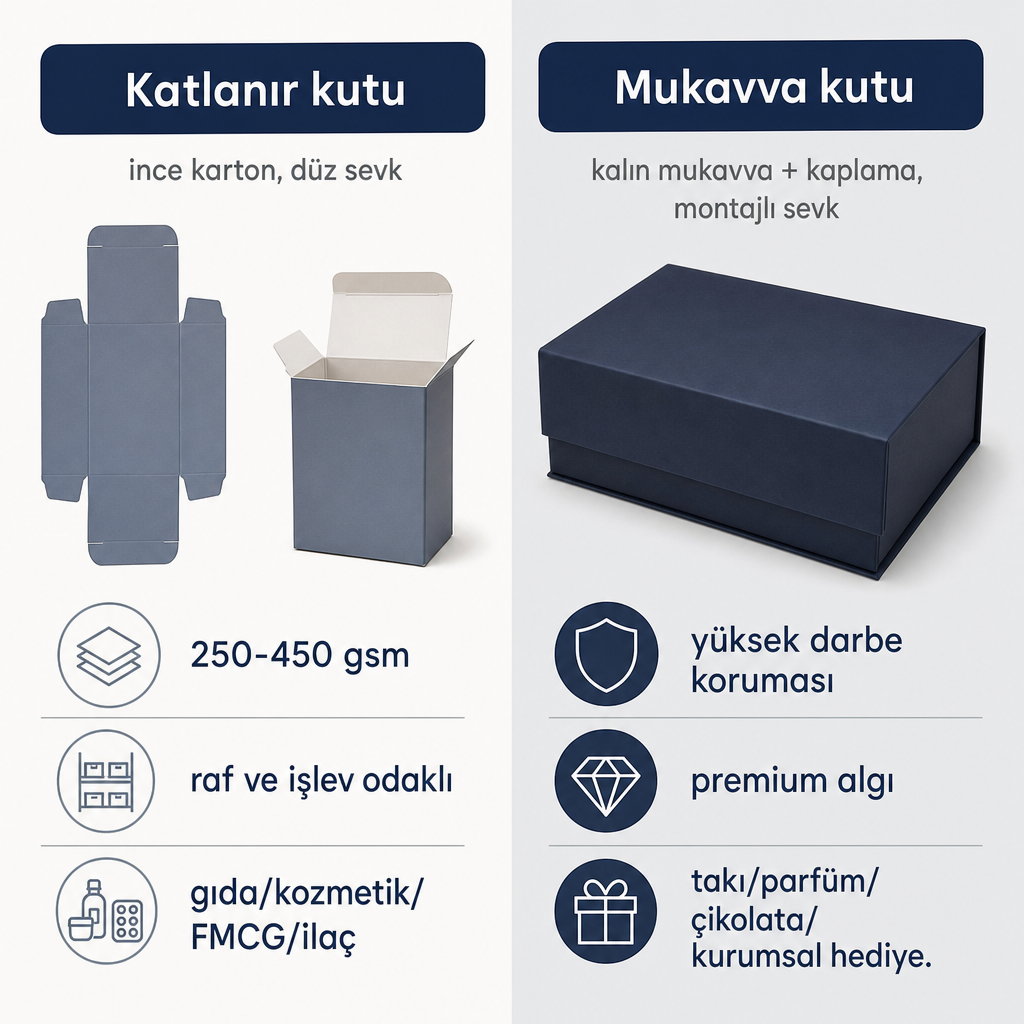
Thanks to this layout, the box stays flat throughout shipping and is quickly set up at the point of filling. It can be designed for machine assembly on automatic filling lines, or for manual setup in low- or medium-volume operations. Folding cartons generally use cardboard in the 250–450 gsm range; the choice of weight determines both the ease of setup and the weight of the product the box carries.
The difference between a folding carton and a rigid box
A folding carton and a rigid box do not always give the same answer to the same packaging need. The main distinction comes down to four points: material thickness, shipping form, level of protection, and use case. A folding carton is made from thin cardboard and takes form by folding, while a rigid box is created by applying a wrap over thick chipboard and is mostly shipped in its ready-made form.
| Feature | Folding carton | Rigid box |
|---|---|---|
| Structure | Set up by folding from thin cardboard | Wrap over thick chipboard |
| Shipping form | Shipped flat | Generally shipped three-dimensional |
| Storage | Requires less space | Requires more warehouse volume |
| Protection | Suitable for light and medium products | Stronger against impact and crushing |
| Perceived value | Shelf- and function-oriented | Gift- and premium-experience-oriented |
| Typical use | Food, cosmetics, FMCG, pharmaceuticals | Jewelry, perfume, chocolate, corporate gifts |
In short, if low storage volume and high production quantity are your priorities, a folding carton is more suitable; if high impact protection and a premium unboxing experience are your priorities, a rigid box is a better fit. The two boxes are not alternatives to one another, but can be thought of as complements to the same brand family across different channels. To see a more detailed comparison of material and structure, you can check out our Rigid Box or Folding Carton? Comparison content.
For which products is a folding carton used?
The folding carton does its job wherever the presentation of light and compact products meets high-volume operations. Breaking down its use cases with concrete scenarios makes it easier to see whether your own product fits within this framework.
In cosmetics and personal care, it increases shelf visibility for products such as creams, serums, soaps, and outer perfume boxes; since the product is light, it provides sufficient protection with the right weight and inner dimensions. The large printing area for ingredient descriptions, usage instructions, and legal markings is also critical in this category. We detailed design, material, and regulatory decisions specific to cosmetics in our How to Design a Cosmetic Box? guide.
In food and chocolate, it serves as both a presentation and a brand communication tool for shelf-type products such as dragées, coffee, tea, and dry goods. Here, visual design alone is not enough; the suitability of the cardboard, printing ink, varnish, adhesive, and any inner barrier for the contact scenario must be evaluated. In pharmaceuticals and supplements, its light and mass-production-friendly structure, combined with readability and information-layout requirements, makes it a practical option.
For e-commerce and DTC brands, the folding carton most often takes on the role of inner packaging or a branded presentation box. On its own, it may not provide shipping protection for every product; for fragile or heavy products, a corrugated shipping box is added on the outside. This way, the folding carton carries the brand experience while the outer box takes on the protective role. We covered e-commerce packaging architecture in detail in our What Is a Mailer Box? A Guide for E-commerce content. In fashion accessories, it reduces storage volume for flat-lying products such as socks, underwear, wallets, and belts; in candles and lifestyle products, it gains a premium look with printing and surface finishes, but for heavy contents like glass jars or ceramics, inner placement and impact management come to the fore. In corporate and promotional products, it offers a high-volume, easy-to-store solution for pens, card holders, and small accessories; the inner and outer surfaces can be used together for a QR code, campaign message, and thank-you note.
Where do its advantages really pay off?
The strengths of the folding carton are not abstract; each one solves a specific operational problem. The most obvious gain appears in storage and shipping efficiency. Boxes shipped flat take up far less volume than assembled boxes; this creates an advantage in palletizing and shipping planning for high-volume brands with limited warehouse space. However, the real savings are calculated according to production quantity, case layout, product dimensions, and shipping channel; promising a percentage up front would not be realistic.
The large surface area brings the second major advantage: an effective communication space for brand colors, product images, and campaign messages. Different visual results are achieved with applications such as CMYK printing, lamination, and varnish; in surface selection, color accuracy, scratch resistance, recycling goals, and cost must be weighed together. With standardized products and high-volume production, when the dieline and print file are prepared correctly, consistent results are achieved in repeat runs; printing and die costs are distributed more efficiently per unit.
The thin cardboard structure limits the packaging weight per product and, especially for light products, contributes to controlling the total shipping weight. Although a folding carton is not as voluminous as a rigid box, it can create a branded unboxing experience through color, typography, inner printing, flap structure, and message areas. If you're curious about the role of branded packaging in perception, our Why Is Branded Packaging Important? content deepens this context.
Limitations and pre-production risks
A folding carton is not automatically the right choice for every product, and this is also the most money-saving section of this guide: seeing the risks at the quotation and design stage prevents surprises that would otherwise arise after production.
The most commonly encountered problems fall under these headings:
- Insufficient impact protection: It may be inadequate on its own for heavy, fragile, or high-value products.
- Crushing and deformation: Low weight, wrong dimensions, or excessive inner void weaken the box's form.
- Wrong inner dimensions: If the product moves inside the box, scratching, breakage, or print marks can occur.
- Folding errors: An incorrect dieline, a wrong score line, or print-cut misregistration can cause the box not to set up properly.
- Print and color variation: There can be a color difference between the on-screen view and the printed sample; this is why a physical proof is important.
- Effect of moisture and grease: In food, cosmetics, or cold-chain applications, the cardboard's environmental resistance must also be examined.
- Effect of finishing on recycling: Plastic lamination, heavy varnish, or a composite structure can complicate the recycling process.
- Automation incompatibility: For boxes to be set up by machine, tolerances, gluing points, and the dieline must be prepared according to machine requirements.
Most of these risks are directly related to material and dieline decisions; therefore, they must be verified with a physical sample before going into production. At the sampling stage, the product's easy placement in the box, the correct closing of the flaps, the functioning of the fold lines, color quality, the rigidity of the material, and the box's compatibility with the outer shipping packaging are all checked together.
Which criteria should you consider when choosing a folding carton?
Deciding on the right box is possible by evaluating a few criteria in the right order. The first question is the product's weight and fragility: while a folding carton is sufficient on its own for light and durable products, for glass, ceramic, heavy metal, or delicate products, an inner divider, support piece, or outer corrugated box comes into play.
The sales channel is the second determining factor. In retail sales, front-face visibility, readability, and conformity to shelf dimensions come to the fore; in e-commerce, how it works together with the outer packaging, the risk of crushing in shipping, and the dimensional weight effect become important. Production quantity establishes the cost balance: at high quantities, printing and die costs are distributed efficiently per unit, while for low-volume products or those with frequently changing designs, the die, sample, and setup costs must be examined separately.
Product dimensions should not be determined based on the outer size alone; the orientation of placement, flap allowance, inner supports, filling, and production tolerances must all be taken into account. In print and surface appearance, the whiteness of the cardboard, surface texture, color management, and finishes are evaluated together; if a premium result is targeted, the design's true counterpart on the cardboard surface should be checked with a physical sample. The final criterion is the sustainability goal, and it is not explained merely by the box being paper-based; the cardboard type, recycled content, lamination, ink, varnish, adhesive, and packaging weight are considered as a whole. In Turkey, it is required that packaging design take into account suitability for reuse, recycling, and recovery, and that packaging not be used in more volume and weight than necessary; paper and cardboard packaging waste is evaluated as a separate material category.
Making the folding carton decision with Kosapack
In folding carton production, we address product dimensions, cardboard type, print combination, and fold lines together as parts of a single decision. In the process, we particularly check print-cut compatibility, fold lines, and the box's suitability for the use case; after the analysis, we work within a range of 7–15 business days for the physical sample. At the sampling stage, we recommend evaluating the material, color accuracy, and mechanical durability together, because these three aspects are invisible in a computer drawing.
The decision is often not limited to a single "folding carton or rigid box?" question. Within the same product family, a folding carton can be used for standard sales, and a rigid box for gift, PR, or collection sets; this way, your brand language is preserved while the packaging level changes according to channel and budget. The folding carton is especially suitable for brands that package light or medium-weight products, reach high production quantities, want to reduce warehouse and shipping volume, seek strong print visibility on the shelf, create a branded presentation with an outer shipping box in e-commerce, use automatic filling, and evaluate single-material, recycling-friendly options. For heavy, fragile products, or those requiring a high premium perception, it is more appropriate to plan the folding carton together with a rigid box, an inner divider, or a corrugated outer box.
Frequently Asked Questions
Are a folding carton and a cardboard box the same thing?
A folding carton is a specific type of cardboard box. It is made from thin cardboard, shipped flat, and folded during use. "Cardboard box," on the other hand, is a broader term covering different cardboard structures.
Is a folding carton shipped flat?
Yes. Folding cartons are mostly shipped flat, i.e., as a flat-pack, and are folded into box form at the point of filling or packaging.
Is a folding carton durable?
When the right cardboard weight, dimensions, dieline, and inner placement are chosen, it offers sufficient durability for light and medium-weight products. For heavy or fragile products, additional inner or outer protection may be needed.
Is a folding carton recyclable?
Paper- and cardboard-based folding cartons can be more compatible with recycling systems with suitable material and design choices. However, lamination, plastic components, and composite structure affect the process; recycling suitability should be checked together with the material composition before production.
Should I choose a folding carton or a rigid box?
If storage, shipping volume, and high quantity are your priorities, a folding carton is more suitable; if impact protection, gift presentation, and premium perception are your priorities, a rigid box is a better fit. The product's weight, sales channel, and unboxing experience should be evaluated together.