
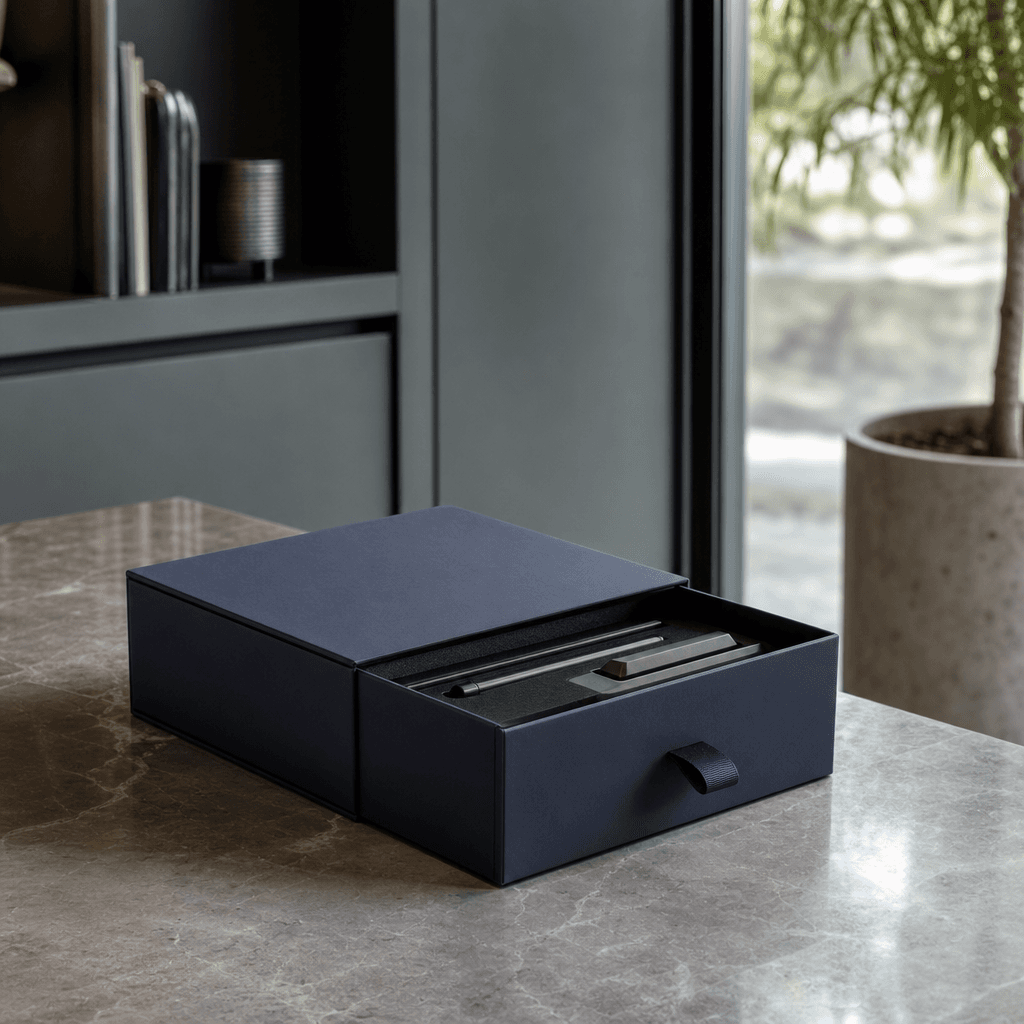
Drawer box production is the design and manufacture of generally cardboard-based premium packaging that places the product in an inner drawer which slides horizontally out of an outer sleeve. What sets it apart from lidded models is that it turns the opening action into a pulling experience; the product emerges from the box in a controlled manner, just as it sits on the shelf. This structure stands out in projects where you want to not only protect the product but also strengthen the brand's perception of quality and the box-opening moment. At Kosapack, we produce drawer-style cardboard boxes across a variety of scenarios—from jewelry, watches, cosmetics, perfume, candles, chocolate, and corporate gift sets to launch kits—managing consulting, structural and graphic design, prototyping, production, and logistics all under one roof.
This guide approaches the drawer box not as an aesthetic whim but as an engineering and brand decision: it explains, in order, how the mechanism works, which material and printing options make sense, which brands it suits, what determines cost, and what you need to prepare before requesting a quote.
Table of Contents
How does the structure of a drawer box work?
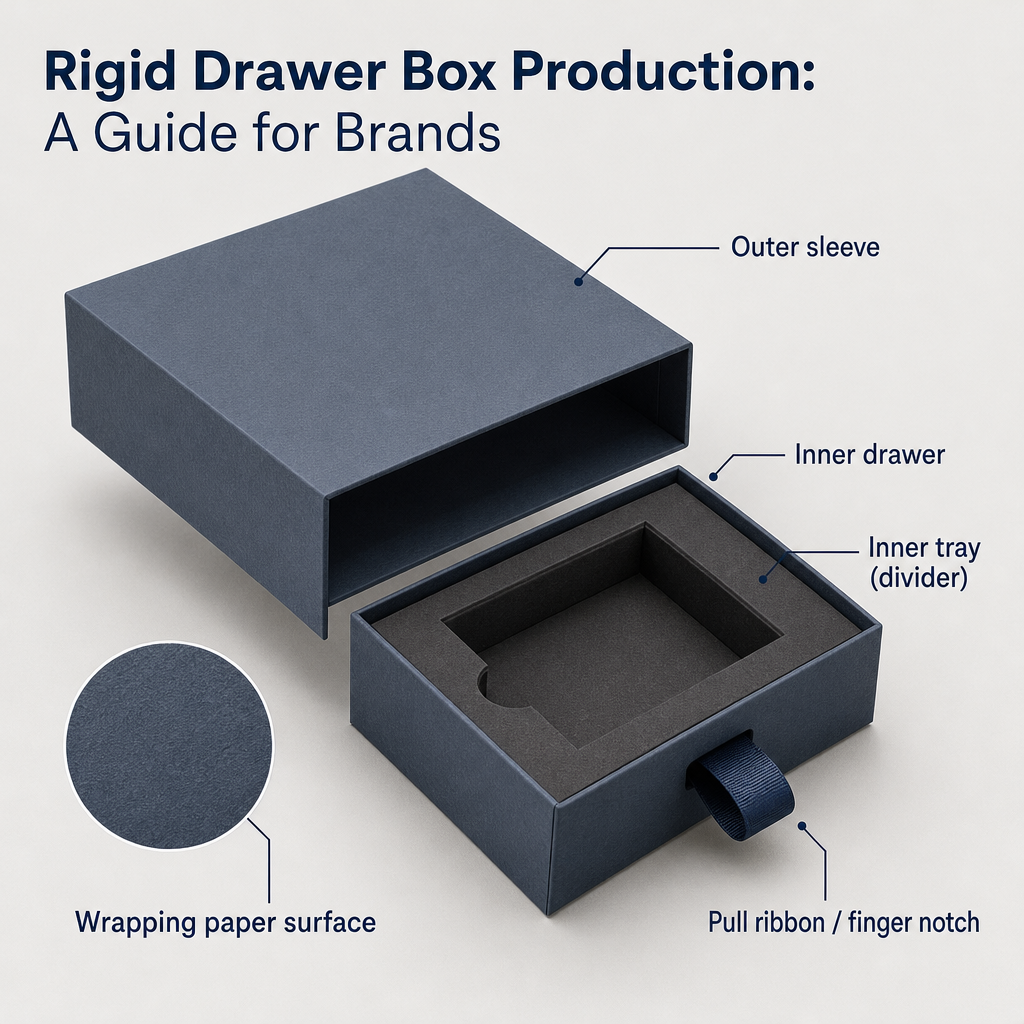
At the foundation of a drawer box are two main parts: the inner drawer that carries the product and is pulled out via a grip point on its front face, and the outer sleeve within which this drawer moves. The key is that these two are not dimensioned independently of each other.
If the gap between the inner drawer and the outer sleeve is too narrow, the box sticks and the coated surfaces get damaged by friction. If the gap is too large, the drawer loosens inside the box, shifts during transport, and may even open on its own. The correct tolerance is found when the product's actual dimensions, the cardboard thickness, the thickness added by the coating paper and lamination, and the drawer's travel distance are all calculated together.
For this reason, structural design is not merely about drawing the box's outer contours. The elements that must be planned simultaneously are:
- The product's actual dimensions and tolerances
- The inner drawer's travel distance and the outer sleeve's inner dimensions
- The cardboard thickness and the extra thickness created by coating and lamination
- The design of the drawer's front face and the inner cradle holding the product
- The ribbon, button, handle, or finger notch to be used at the moment of opening
A cardboard-based structure helps the drawer model retain its form. Cardboard boxes are non-folding premium packaging produced by coating thick grey board with printed or colored paper; this rigidity ensures the form is not distorted in a mechanism where the drawer is opened and closed repeatedly.
Which materials are used in production?
Material selection in a drawer box is a three-layered decision: the skeleton, the coating, and the inner carrier. Each serves a distinct function.
Grey board forms the structural skeleton of the box. It is usually produced from recycled paper pulp and gives the box rigidity. The thickness is chosen according to the product's weight and the box's dimensions. Using thin board in a large box causes the sleeve or drawer to flex over time; board thicker than necessary, on the other hand, makes the box heavier and raises the cost. White-surfaced duplex board is considered when direct printing or a cleaner inner surface is needed, especially in designs where both the inner and outer surfaces are visible.
The outer surface of the cardboard body is coated with various papers. In drawer-style cardboard box production, we work with coated paper, white and natural brown kraft, black kraft, metallic, holographic, and textured paper options. The coating paper is not just a visual surface; its abrasion resistance matters as much as its weight, texture, and print compatibility. The front face and the inside of the sleeve that come into contact during the drawer's movement must also be taken into account in surface selection.
The product should not be left loose inside the drawer. Depending on its form, a sponge or foam cradle, a cardboard insert, a paper-based molded carrier, a ribbon lifting system, or a custom-cut product bed can be used. The inner cradle not only secures the product; it also determines the presentation at the moment of opening. While separate compartments can be designed for rings, necklaces, and bracelets in a jewelry box, dividers that prevent bottles and tubes from touching each other are used in cosmetic sets.
Printing and surface finishing decisions
The brand identity of a drawer box becomes visible through the printing and surface finishing applied to the coating paper. The printing technique is determined by quantity, color sensitivity, personalization needs, and the level of detail in the design.
For drawer-style cardboard boxes, we offer offset, digital, and UV printing, as well as Pantone and metallic Pantone options. Offset printing comes into play in high-volume projects where color consistency is critical; digital printing in low-volume, variable, or personalized production runs; UV printing for specific surface and graphic details; and Pantone matching to keep corporate colors controlled. You can find a more detailed comparison of printing techniques in our guide explaining how screen printing is applied.
Color approval should not be given based on the on-screen design alone. The whiteness of the paper, the natural tone of the kraft surface, lamination, and lighting conditions all change color perception; this is why a physical sample or an approved proof before mass production is important.
To enhance perceived value, hot or cold foil stamping, embossing, debossing, spot UV, soft touch lamination, and scratch-resistant lamination can be used. A gold foil logo on a matte soft touch background creates a strong premium effect in perfume and corporate gift boxes. However, every process increases both the cost and the production control requirements. Finishing should be chosen not merely to add more detail, but in line with the message the brand wants to convey.
Which brands is a drawer box suitable for?
A drawer box is the right choice if the product's price level and brand positioning make the opening experience important. A few typical scenarios make this concrete:
- Jewelry and watch brands: The pulling motion allows small, high-value products to be presented in a controlled manner; the inner cradle is customized to the form of a ring, necklace, bracelet, or watch.
- Cosmetics and perfume brands: Perfume bottles, skincare sets, and makeup collections are presented neatly in a single box; inner dividers reduce glass bottles knocking into each other.
- Candle and home fragrance brands: In sets where a jar candle, incense, and accessories are presented together, the drawer structure—combined with the inner design—prevents the product from shifting around inside the box.
- Chocolate and gourmet product brands: In premium chocolate, coffee, or tea sets, the reusability of the box strengthens the brand experience. For the inner surface in contact with food, a material and regulatory check appropriate to the product's nature must also be carried out.
- E-commerce and DTC brands: A drawer box on its own is not always the most efficient solution as a shipping box. For sensitive premium products, the drawer box is used protected by an outer corrugated shipping box; the inner packaging delivers the brand experience while the outer packaging bears the transport risk.
A drawer box or another model?
When choosing a drawer box, the question to ask should not be "Which box is the most impressive?" but rather "Which opening mechanism is right for my product and my sales channel?" The table below summarizes which approach is more suitable depending on the need.
| Need | More suitable approach |
|---|---|
| Premium and controlled opening experience | Drawer-style cardboard box |
| Quick visibility of the product on the shelf | Lidded or window model |
| Frequent shipping and high impact risk | Corrugated outer shipping box + inner premium box |
| Low weight and high volume | Folding box |
| Reusable, sturdy gift packaging | Thick cardboard box |
| Compartmentalizing the product inside the box | Drawer box + custom inner divider |
A drawer box can be bulkier and heavier than a folding box; this raises storage and shipping costs. In return, it offers advantages in terms of sturdiness, reuse, and perceived value. To see the differences between material types in a broader context, you can refer to our guide explaining the features and uses of cardboard boxes.
Factors that determine cost
The price of a drawer box is not determined by a single measure. When preparing a quote, the following items are evaluated together:
- Box dimensions and the inner drawer and outer sleeve structure
- Cardboard thickness and coating paper
- Printing technique, number of colors, and surface finishes
- Inner cradle or divider; accessories such as ribbon, button, or handle
- The need for samples and prototypes
- Order quantity, packaging, dispatch, and delivery schedule
As the quantity increases, the die, setup, and production costs are spread across a larger number of units. In low-volume projects, digital printing and more limited surface finishes keep the total cost under control. The minimum order quantity for drawer-style cardboard boxes is 100; for a quote, we ask that you share the product dimensions, the estimated quantity, and the preferred model. You can also examine the relationship between dimensions and cost in our content explaining how custom box production cost is calculated.
Why is a pre-production sample critical?
With a drawer box, a physical sample provides far more than visual approval; because you can only tell whether the mechanism works correctly when you have an example in your hands. Before mass production, the following risks can be spotted:
- The drawer opening with difficulty or the sleeve remaining too loose
- The ribbon or button being impractical
- The product moving around in its cradle
- Wrinkling or peeling in the coating paper
- The print color appearing different from the screen, or the embossing or foil not being sufficiently prominent
- The box creating more bulk than necessary during shipping
Before mass production, an unprinted, printed, or 3D digital design sample can be obtained; in these samples, the mechanism, color, and surface finishes are checked. In the assessment, it is not enough to look only at the closed appearance; it is also necessary to test the box being opened and closed repeatedly and the product being placed and removed.
Sustainability and regulations
Sustainability in a drawer box does not just mean using kraft paper. The box's total material structure, coating, lamination, adhesive, inner cradle, and service life must all be evaluated together. In Turkey, packaging regulations cover all packaging placed on the market and its waste; they are based on preventing waste, supporting reuse and recycling, separate collection at source, and designing packaging to be recyclable.
It is useful to translate this framework into concrete questions at the design stage:
- Is the box made of a single material, or does it have a multi-layered structure that is difficult to separate?
- Does the lamination or special coating affect the recycling process?
- Can the inner cradle be easily separated from the box?
- Is more cardboard, paper, or plastic used than necessary, and is the box reusable?
The regulations require packaging producers to design packaging, starting from the design stage, in a way that generates less waste and facilitates recovery. The symbol to be applied, the material code, or the notification obligation must be checked separately according to the project's supply chain, the party placing it on the market, and the product category.
What criteria should you look for in a supplier?
In drawer box production, it is not enough to look only at print quality; the mechanism, sampling discipline, and logistics planning are at least as decisive as the printing. Ask the supplier for clear information on the following points:
- Structural design competence: Instead of offering ready-made dimensions, they should be able to design the inner and outer parts to fit your product; the pull tolerance, cardboard thickness, and inner cradle should be addressed together.
- Sampling process: A physical sample should be obtainable before mass production; the mechanism, color, coating, and accessories should be testable in the sample.
- Printing and color control: They should explain by which method corporate colors are matched, how the proofing process is carried out, and how color consistency is maintained in production.
- Production and quality control: It should be clear which stages of production are managed, where quality control is performed, and the procedure to be followed in case of defective products.
- Logistics planning: Due to the bulky structure, the in-carton layout, storage, and shipping plan should be part of the quote.
For drawer-style cardboard boxes, we offer consulting, structural and graphic design, prototyping, production, and logistics together. After design approval, our standard production time is 10–25 business days, and domestic shipping within Turkey takes 2–5 business days. The exact time is finalized at the quoting stage based on quantity, model, sample, printing, and surface finishes.
Information to prepare for a quote
For a clear and comparable quote, sharing the following information provides a good start:
- The product's length, width, height dimensions and weight
- The number of products in the box and the estimated order quantity
- The desired box model and the need for an inner cradle or divider
- The print file or brand colors; the desired paper and surface finish
- The target delivery date, delivery address, and whether the box will be used in e-commerce or in a store
The clearer the initial brief, the easier it becomes to compare alternative materials, printing, and surface finishes. When you share the product dimensions, estimated quantity, and model information, we will work out the drawer box model that suits you and the pricing options together.
Frequently Asked Questions
What material is a drawer box made from?
It is mostly produced from a grey board skeleton and printed or colored coating paper. Depending on the project, duplex board, kraft, coated paper, metallic, or textured papers can also be used.
Are a drawer-style cardboard box and a carton box the same?
No. A drawer-style cardboard box is a premium box with a thick, rigid skeleton that generally does not fold. Carton or folding boxes can be lighter and suitable for flat shipping; the structure and user experience are different.
Can an inner cradle be added to a drawer box?
Yes. Depending on the product's form, sponge, foam, cardboard dividers, or custom-cut carriers can be added. The inner cradle is designed for both protection and presentation.
Is a drawer box suitable for e-commerce?
It is suitable for premium products; however, using it on its own as shipping packaging may not always be appropriate. The box can be shipped protected by corrugated outer shipping packaging.
How long does drawer box production take?
Our standard schedule is 10–25 business days for production after design approval and 2–5 business days for domestic shipping within Turkey. Samples, special materials, high quantities, or complex surface finishes can change the timeline.
What is the minimum order quantity?
The minimum order quantity for drawer-style cardboard boxes is 100. A definitive quote is prepared once the dimensions, quantity, printing, and surface finishes have been shared.