

Two boxes that look the same size are often not produced at the same price. The production cost of a custom box is a total that emerges when material, grammage, printing technique, lid mechanism, order quantity, and delivery method come together. That's why accurate calculation doesn't start with the question "how much per box?" but by reading the project's total cost and intended use together.
Let's give the short answer upfront: custom box production cost = material + production labor + printing and finishing + die/setup + sample and quality control + logistics + design and additional services, if any. The unit price is found by dividing this total by the production quantity. At Kosapack, we don't base pricing on a fixed catalog; we prepare it on a project basis according to box type, dimensions, material, printing, quantity, and logistics requirements. Below, we explain how each of these items changes the cost and what you should look at to compare quotes soundly.
Contents
What items make up the cost?
The price of a custom box project comes not from a single item but from several interconnected headings. Which item takes precedence also varies by project: while the die and handcraft are decisive for a small-batch premium cardboard box, material, production efficiency, and dimensional weight weigh more heavily for a high-volume e-commerce box.
| Cost item | How does it affect the price? |
|---|---|
| Box type | Folding carton, corrugated, and rigid boxes require different production processes. |
| Dimensions | As the box grows, material, unfolded area, and logistics volume increase. |
| Material and grammage | Thicker, more durable, or premium material raises the unit cost. |
| Printing and finishing | Number of colors, surface, lamination, varnish, foil, and embossing create additional stages. |
| Structural feature | Magnetic lid, drawer, hinge, or inner divider requires additional labor. |
| Production quantity | As the die and setup are spread over more boxes, the unit price drops. |
| Sample and logistics | Physical prototype, dimensional weight, palletizing, and delivery method change the total cost. |
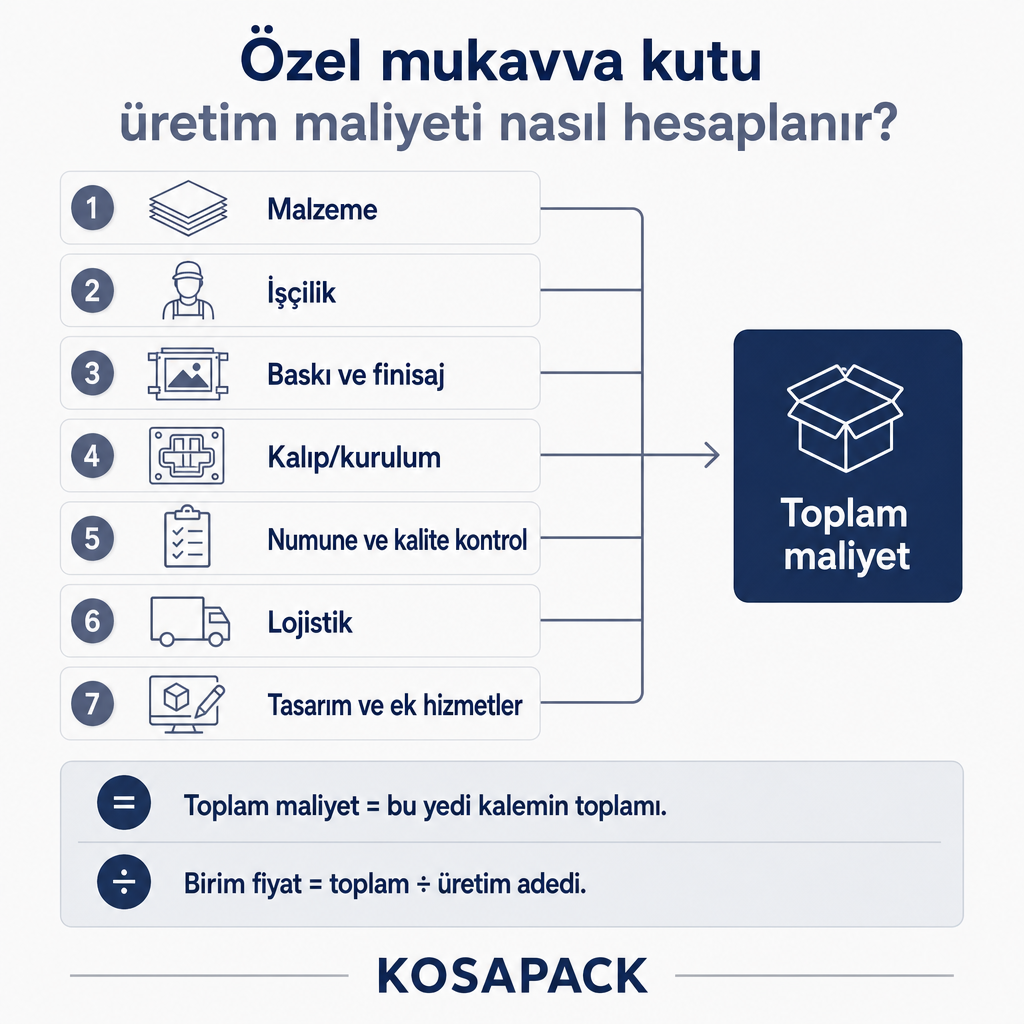
Basic cost formula and material calculation
The general calculation can be expressed as follows: total packaging cost = material + labor + printing/finishing + die and setup + sample + quality control + logistics + additional services. The unit box cost is found by dividing the total project cost by the production quantity.
The subtlety of this division is this: some items such as die, design, sample, or shipping are independent of production quantity. In other words, even if the quantity increases, these expenses remain the same—they are simply spread over more boxes. That's why, when comparing quotes, asking for fixed and variable costs to be shown separately is necessary for a sound reading.
For the material item, the basic approach is: material cost = box unfolded area × grammage × raw material price per kilogram. The critical point here is not the box's closed dimension, but the unfolded box area required for production. The unfolded area includes allowances for cutting, folding, gluing, and bleed, so it shows the actual amount of material used. You can find more detailed information on how the unfolded layout and production-ready design are set up in our guide explaining box graphics and unfolded layout concepts.
As dimensions grow, more cardboard or rigid board is used, the cutting area widens, waste may increase in sheet layout, and the volume covered in shipping and dimensional weight rise. For this reason, adding not just the box's closed length-width-height values but also the unfolded dimension and delivery method to the quote brief makes a difference for a realistic price.
The effect of box type on cost
Box type is one of the biggest drivers of cost because it directly changes the production method and labor level. The same product can come before you with three different cost tables in three different structures.
Folding carton box generally offers lower material and storage costs; since it can be shipped flat, it takes up less volume in logistics. Here, the cost is determined by carton grammage, printing surface, cutting-folding die, window application, lamination or varnish, and special lid form. In products where shelf appearance matters, such as cosmetics, food, and retail, printing and surface treatments stand out within the total.
Corrugated box is preferred particularly in e-commerce and shipping processes for protection purposes. Its cost is determined by wave type, layer structure, printing, dimensions, and load resistance. With these boxes, you need to look not only at the production price but also at the volume the product will occupy in shipping; a box larger than necessary means more filler per product and a higher shipping dimensional weight.
Rigid box is a high-perceived-value solution preferred in premium gift, cosmetic, jewelry, electronic, and corporate gift packaging. Its price is determined particularly by the thickness and density of the board, the type of wrapping paper, dimensions, magnetic/drawer/hinged structure, inner divider, printing and surface applications, and handcraft. On our rigid box product page, we also specify dimensions, order quantity, box model, lid mechanism, wrapping paper, printing, finishing, and inner insert needs as the main price determinants; depending on the model and customization level, the minimum order can generally range between 100–500 units.
How decisive are dimensions, grammage, and finishing?
Dimensions don't just determine whether the product fits in the box; they also affect material consumption, transport volume, and production efficiency. As unnecessary space around the product increases, the box dimensions grow, the unfolded area widens, and the shipping dimensional weight rises. Conversely, very tight tolerances make it difficult to fit the product. The right dimension is one where the product fits comfortably but without leaving unnecessary space; product dimensions, lid movement, protective filler, and user experience should be evaluated together.
There is a similar balance with grammage: higher grammage provides a more durable but more expensive structure. Material thicker than necessary increases cost, and moreover doesn't always offer better protection. The point is to hit the right level of protection.
On the printing side, cost is not determined by the number of colors alone. Which surfaces the printing will be applied to, whether inner printing will be done, the offset-flexo-digital choice, special brand colors, and color accuracy expectation change the price. Finishing, on the other hand, adds a new die, machine setup, labor, or quality control stage with each application:
- Matte or glossy lamination, spot varnish
- Foil printing, hot stamping
- Deboss or emboss
- Inner surface coating, special textured paper
- Window application
For this reason, the phrase "printing included" is not enough in a quote. The printing technique, number of colors, surfaces to be applied, and finishing scope must be clearly written; otherwise two quotes may be pricing very different work under the same heading.
How does production quantity change the unit price?
The main reason the unit cost decreases as production quantity increases is that the fixed preparation expenses are spread over more boxes. The cutting die, printing preparation, machine setup, color adjustment, sample, and pre-production technical work are among these fixed or semi-fixed items.
With a concrete example: in an order of 200 boxes, the die and setup cost is divided among a small number of products, which drives the unit price up. When the same preparation expense is spread over 2,000 boxes, the cost per box can drop noticeably. However, a high quantity is not automatically more advantageous. Storage, cash flow, product demand, and stock risk must also be taken into account; boxes that won't be sold or will be stored for a long time can completely eliminate the low unit price advantage.
That's why evaluating two scenarios together is more balanced in quantity planning: a controlled low quantity for the initial launch, and bulk production once a steady sales volume settles in. Sharing the reorder plan with the manufacturer in advance allows more efficient management of preparation costs on the second round. You can examine how quantity and scope reflect on current price bands with sample values in our box prices and current cost guide.
Overlooked items: die, waste, sample, and logistics
The items most frequently skipped in quotes are the preparation expenses that arise before production begins. For custom-sized boxes, a cutting die is prepared, machine setup is done, proofs are needed for printing colors, waste occurs in sheet layout, and manual assembly may be required depending on the box structure. When these items are not shown separately, a unit price that appears low can later rise with additional costs.
When getting a quote, it's useful to clarify the following questions: is the die fee included in the price, with what assumption was the waste rate calculated, are installation and setup written separately, are the printing proof and physical sample included, will there be an additional fee in case of revision?
A physical sample, meanwhile, is as much a risk control as it is a cost item. It allows you to test the box's actual dimensions, material, printing, and user experience before mass production; it makes errors such as the product not fitting, the lid not closing properly, the colors coming out different from the screen, or the printing and cutting lines not matching visible in advance. Although a sample raises the total budget, it is a valuable investment especially in premium packaging because it prevents costly errors that could occur in mass production. We generally specify a range of 7–15 business days for a physical sample.
On the logistics side, focusing on the ex-works price can be misleading. For bulky, assembled, or high-volume boxes, shipping is a significant item. The commonly used dimensional weight formula is: dimensional weight = width × length × height ÷ 3000. Box dimensions, quantity, flat or assembled delivery, palletizing, delivery address, and storage duration directly affect this item. For e-commerce brands, designing the box to a dimension compatible with the product lowers both material and shipping costs; a box larger than necessary, on the other hand, increases the need for filler and the transport volume.
The sustainability decision also enters this picture. "Cheapest material" is not the right criterion on its own; the material's source, recyclability, production waste, and waste management should be read together. In Turkey, for packaging manufacturers and those placing packaged products on the market, extended producer responsibility, the minimum requirements for packaging, and marking-labeling issues are regulated under the Regulation on the Control of Packaging Waste. For this reason, sustainability claims should be evaluated not just as a marketing preference, but in compliance with product and packaging legislation.
Compare quotes on the same technical scope
The most frequently made mistake in comparing two quotes is looking only at the unit price even though the technical scope is different. The quote that appears lower can turn into a higher total cost at the end of the project if it doesn't cover the sample, die, shipping, or quality control. Before comparing quotes, make sure the following headings are given with the same definition on both sides.
| Topic to compare | Information to check |
|---|---|
| Box type and dimensions | Same structure, same lid mechanism; are the inner/outer dimensions and unfolded layout the same? |
| Material and grammage | Same carton/rigid board/corrugated structure, equivalent thickness and durability? |
| Printing and finishing | Same number of colors and surface; are lamination, varnish, foil, embossing included? |
| Die and sample | Are the die, setup, physical sample, and revision scope included in the price? |
| Quality control | How is post-production control carried out? |
| Logistics and tax | Ex-works or delivery included; are VAT and other expenses included? |
| Delivery | Are the products shipped flat or assembled? |
Sound ways to reduce costs
The sound way to reduce costs is not to cut quality randomly, but to eliminate decisions that create unnecessary cost. A few decisions directly affect this balance.
Design the dimensions compatible with the product. Don't leave unnecessary space, but keep the tolerance needed for the product to fit easily and be protected. Every unnecessary centimeter in dimensions reflects on both material and dimensional weight.
Choose the structure according to the usage scenario. A premium rigid box is not always the most efficient solution for an e-commerce shipment; conversely, a low-cost shipping box weakens the brand experience for a jewelry or gift product. The right match preserves both the budget and the perceived value.
Prioritize finishes. Instead of applying special treatment to all surfaces, focus on the most visible point of contact. Using foil or spot varnish only on the logo limits the total number of processes while preserving the premium effect.
Match the quantity plan with demand forecasting. Producing more than necessary to lower the unit price increases storage, cash flow, and stock risk. Keeping the first order controlled and sharing the reorder plan in advance is a more balanced path.
View the sample as risk control, not a cost. Removing the sample fee may ease the budget in the short term; however, a mass production error creates a much greater loss.
What information is needed for a clear quote?
A realistic quote begins with a clear brief. When you prepare the following information, the pricing work becomes both faster and more accurate:
- The product name, area of use, and inner dimension or product dimension
- Box type, material preference, and grammage/durability expectation
- Target box quantity and whether it's one-time or recurring
- Printing colors, inner/outer printing request, and finishing options
- Inner divider or product slot need
- Sample need and revision expectation
- Delivery city, warehouse information, flat/assembled delivery preference
- Sustainability and certification expectations, and target budget if any
If the dimensions are not yet final, sharing the product's physical dimensions, weight, and usage scenario is also sufficient for a starting quote. You can examine the more comprehensive design approach in our step-by-step getting-started guide to custom box design.
We approach custom box projects not just through the production price; we evaluate consultancy, structural and graphic design, sample, production, quality control, and logistics together. After the brief, we prepare a project-based quote according to box type, dimensions, material, printing, quantity, and logistics requirements; we clearly show whether the die, sample, and additional services are included in the quote. This way, the figure you compare becomes a total cost that does not contain surprise additional items.
Frequently Asked Questions
Is there a fixed price for custom box production cost?
No. Instead of a fixed per-box price, calculation is done on a project basis according to box type, dimensions, material, printing, quantity, die, and logistics information.
Does the unit price drop as the quantity increases?
Generally, yes. Since the die and machine setup costs are spread over more boxes, the unit price can drop. However, storage and stock costs should also be evaluated together.
Why can a rigid box be more expensive?
Rigid boxes may use denser material, wrapping paper, handcraft, special lid mechanisms, inner inserts, and premium finishes. These elements increase production time and material cost.
Is it necessary to make a sample?
A physical sample is recommended especially for custom-sized, printed, or mechanized boxes. The sample allows you to see dimension, color, lid, inner layout, and durability errors before mass production.
Are VAT and shipping included in the quote?
This depends on the supplier's quote scope. When requesting a quote, ask for VAT, sample, die, shipping, storage, and delivery conditions to be specified separately.