
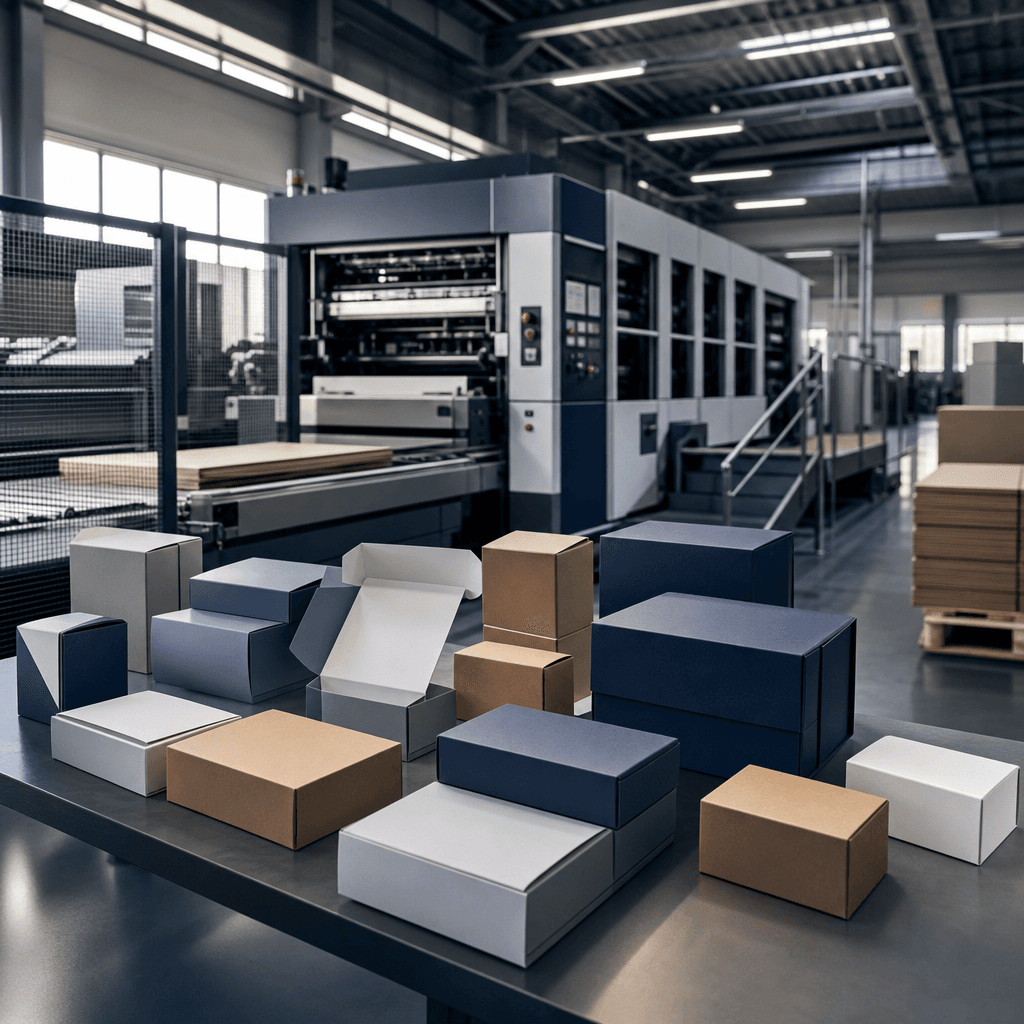
Printed cardboard box manufacturing is a strategic investment that protects your product while telling your brand's story through the shelf and shipping experience; when set up correctly, it takes on both protection and presentation at the same time. For premium and growth-stage brands, the box is not a packaging expense but a tool that directly feeds perceived value and the desire to repurchase. In this guide, we explain what a folding cardboard box does, when it is the right choice, the mechanisms behind its production, and the criteria premium brands should base their decisions on; we also share how we at Kosapack manage the process end to end.
Table of Contents
What is a printed cardboard box and what does it do?
A printed cardboard box is a cardboard-based folding box that protects the product, delivers it to the consumer under hygienic and safe conditions, facilitates transport and storage, and also carries brand messages on the surface of the packaging. Folding cardboard is lightweight, easy to shape, and visually eye-catching, which is why it is widely used in cosmetics, food, FMCG, and shelf boxes.
The most notable advantage of a cardboard surface is that, compared to corrugated board, it offers a more suitable base for high print quality, color accuracy, and fine-detail graphic applications. This allows the brand's typography, color, and finishing decisions to be carried onto the shelf surface without degradation in the premium segment.
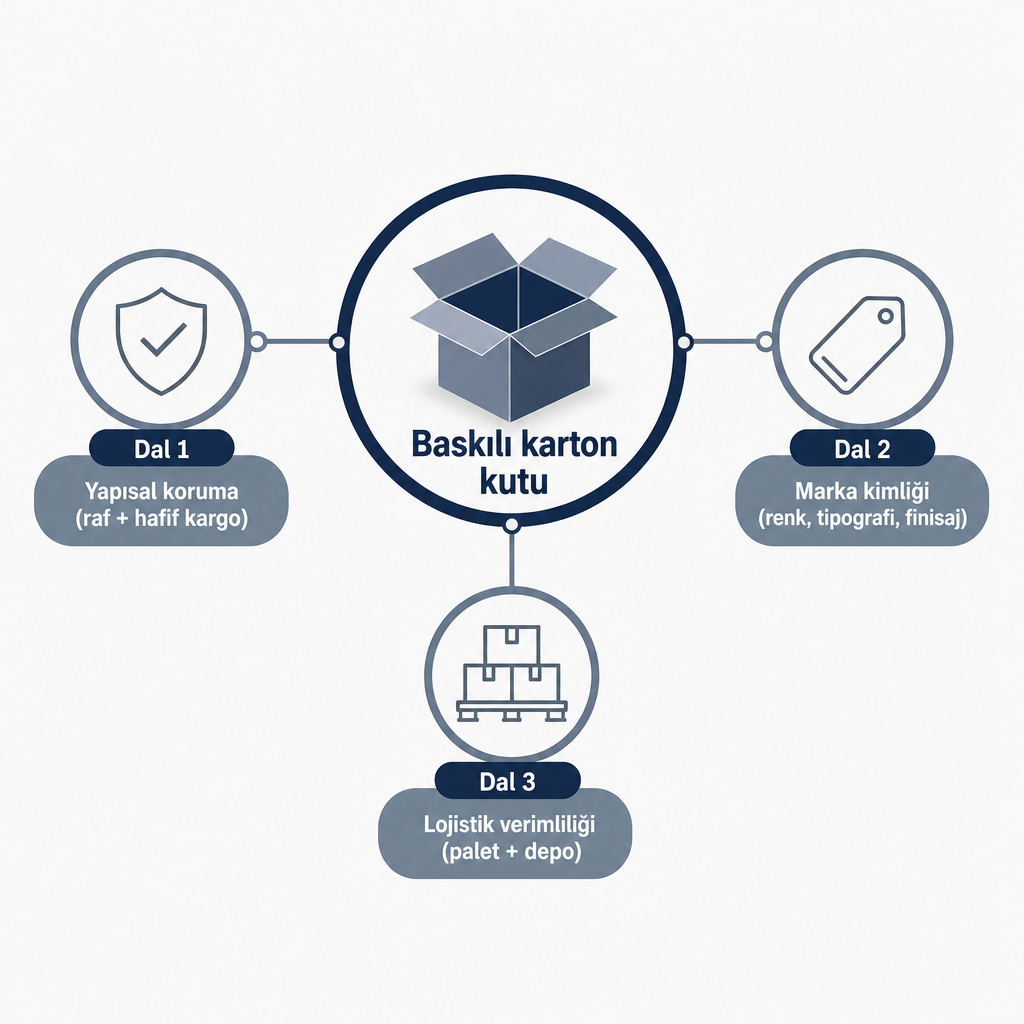
In practice, this box type does three jobs together: it provides structural strength for transport and shelf protection, reflects brand identity through color, typography, and finishing, and directly affects logistics and storage costs through pallet efficiency. At Kosapack, our approach is based on designing the box dimensions to fit the product's measurements exactly, optimizing both protection and shipping economics together.
When should a printed cardboard box be preferred?
The decision to use a printed cardboard box requires a deeper framework than the simple question of "box or pouch?" The decision is determined by four variables, and these must be clarified before going into production.
The first is product type and weight. For light and medium-weight products with a relatively stable form (perfume, skincare, candles, chocolate, jewelry, premium food), a printed cardboard box is the ideal solution for both protection and shelf presentation. For heavier or very bulky products, an additional corrugated shipper outside the cardboard box may be necessary.
The second is the sales and distribution channel. In physical store, boutique, and chain shelf sales, the cardboard box is the main tool for managing shelf visibility, compliance with category codes, and consumer perception. Compared to products shipped only in a cargo pouch, boxed shipments increase customer satisfaction by reducing the risk of breakage and crushing.
The third is brand positioning. In the premium and luxury segment, the print quality of cardboard, finishing options (matte, glossy, soft-touch, metallic), and detailed graphic design support the brand's pricing power and perceived value. Our Kosapack portfolio focuses on such premium boxes in categories like cosmetics, fashion, jewelry, chocolate, and candles.
The fourth is logistics and cost pressure. Packaging size changes the number of units per pallet, creating a significant difference in annual shipping costs; even a few millimeters of optimization can produce meaningful savings. Choosing a cargo pouch only makes sense to reduce transport costs for lightweight products with low breakage risk; for fragile products or those whose form can be deformed, using a box becomes mandatory. These four topics form the "problem definition" you need to solve together before going into production; when choosing between different packaging types, our guide comparing whether to use a rigid box or a folding box also helps you clarify this definition.
The core mechanisms of printed cardboard box manufacturing
Printed cardboard box manufacturing is an integrated process consisting of analytical planning, structural and graphic design, material selection, sampling, and mass production stages. The order matters because each stage determines the margin of error of the next.
The process begins with analysis and strategy. Product dimensions, weight, distribution channels, shelf targets, quantities, and budget are considered together. At this stage, shipping and storage scenarios (e-commerce, wholesale, export) are modeled; the total cost of ownership covering setup, unit, logistics, and warehouse space is evaluated; and the brand's short-term campaign need is separated from its long-term core packaging strategy.
Structural design determines the box's opening-closing mechanism, side flaps, locking system, and internal supports. At Kosapack, we focus on optimizing both the level of protection and pallet efficiency by designing dimensions and structure that fit your product exactly. Packaging size directly affects transport cost; large boxes with unnecessary empty space lead to higher fees due to cargo companies' volumetric weight calculations. That is why a few millimeters of optimization can create meaningful advantages on an annual basis; you can find this logic in the article where we explain in detail how custom-sized box production works.
Material and weight (gsm) selection is a critical locking point. In folding cardboard boxes, the 250–400 gsm range is standard; 300 gsm is a common benchmark for most FMCG boxes, while 350 gsm is common for premium and shelf-top boxes. Going outside this range creates either excessive cost or the risk of insufficient strength. Material selection should be considered together with cardboard type (chromo, coated, natural, cream), weight, and surface color. Instead of vague expressions like "premium cardboard," locking down the specific cardboard type and weight in writing is a critical step in the process.
In the printing, color management, and finishing stage, the infrastructure includes CMYK offset, special Pantone spot colors, varnish, and foil applications. Color management is especially decisive for the consistency of brand colors in the premium segment; incorrectly profiled files can produce faded or broken colors in printing. The finish and coating is chosen as matte, glossy, soft-touch, metallic, or uncoated surface, and each offers a different feel, cost, and durability profile. For example, soft-touch coating provides a luxurious tactile experience but requires proper use in terms of abrasion resistance. Additionally, failure to follow prepress rules such as bleed, safe area, resolution, and submitting CMYK files instead of RGB leads to printing errors; compliance with these rules is mandatory for print quality and legibility.
Sampling and physical tests are the insurance of mass production. For complex printed boxes, a physical sample prepared with actual production materials is important. Sample preparation time is generally 7–15 business days, followed by a mass production lead time projected at 3–6 weeks. During the sampling stage, durability tests such as drop test (1 m), stacking test, folding test, and closing cycle are recommended; keeping the pass criteria in writing is critical for quality assurance, especially in magnetic or complex closing mechanisms.
Mass production, quality control, and logistics are the final link. A quality control regime is needed where the correct material is used and print and cutting tolerances are maintained. Our managed production model consolidates this quality chain through verified factory partners and combines it with consolidated logistics to offer brands a single-source service. Invisible but decisive items such as the palletizing plan, three-month inventory space, and warehouse square meter cost also become part of the packaging decision at this stage.
Differences between cardboard box, corrugated, and rigid box
Folding cardboard is mostly used in printed cardboard box manufacturing; however, in some scenarios, a corrugated box or rigid board box comes into play. The table below summarizes which structure does which job better when making a decision.
| Feature | Cardboard box (folding) | Corrugated box |
|---|---|---|
| Product weight | Light and medium-weight products; cosmetics, food, small electronics | Heavier and bulky products; long-distance transport |
| Print quality | High print quality and shelf presentation on a flat surface | Printable but with more limited visual detail |
| Protection | Sufficient for shelf and light cargo; can be reinforced with internal supports | High protection against impact and crushing |
| Cost | Cost-effective with premium presentation when well optimized | Higher due to material and volume, mandatory for critical protection |
In the premium segment, we often design combinations of a rigid box placed inside a cardboard box or a corrugated shipper added outside the cardboard, balancing both presentation and protection goals. In other words, these three structures are often not competitors but complementary layers within the same shipment.
How to choose the right box for premium brands?
In the premium and luxury segment, the decision cannot be made based on unit price alone; five criteria must be balanced.
Product weight and sensitivity. Cardboard is effective for lighter or smaller items; for heavy or highly breakage-sensitive products, it should be used together with a corrugated box or internal supports. A cargo pouch offers sufficient protection only for products that are impact-resistant and do not lose their form.
Logistics scenarios. In complex and long-distance transport, transport conditions and the packaging standards of cargo companies are an integral part of the decision. Boxes with unnecessary empty space increase costs due to volumetric weight, while boxes that are too small and tight can cause product damage.
Brand positioning and unboxing experience. For premium brands, the box is part of the product's psychological value; matte/soft-touch finishes, custom internal printing, and shelf-front design directly affect consumer perception. For e-commerce and DTC brands, we plan brand-specific unboxing scenarios (internal printing, thank-you cards, dividers, tissue paper combinations) under one roof.
Sustainability goals. Folding cardboard boxes can offer an eco-friendly solution with the right cardboard selection and recyclable finishes. We aim to integrate brands' ESG goals into the packaging decision through sustainable material options and carbon footprint reporting.
Total cost of ownership. Instead of unit price alone, the sum of setup cost, unit cost, logistics, and inventory space should be evaluated together. The warehouse square meter fee and the effect of oversized boxes on pallet efficiency are often overlooked but decisive items in the decision.
Risks and common mistakes
Mistakes in the packaging and printing process can turn directly into revenue and image loss for premium brands. The five most common mistakes are, in fact, ones that can be prevented with the right questions from the start.
Vague material definition is the first risk. Ambiguous descriptions like "thick cardboard" or "premium cardboard" are open to supplier interpretation and can lead to unexpected results at the end of the project; the material type and weight must always be clarified in writing.
Wrong weight (gsm) selection is the second risk. A lower-than-necessary weight increases the risk of deformation and product damage during the shelf and cargo process; a higher-than-necessary weight creates unnecessary cost and logistics weight.
Sizing errors are the third risk. Boxes designed too large increase cargo costs and the need for filler material; boxes that are too tight increase assembly difficulty and the risk of product damage.
Not following prepress rules is the fourth risk. Incorrectly setting the bleed and safe area, submitting low-resolution or RGB files, and barcode size errors can lead to cut graphics, blurriness, and unreadable barcodes.
Skipping the sampling stage is the fifth risk. Deciding only based on a PDF or 3D render, without seeing a physical sample with actual production material and printing, increases the likelihood of encountering surprise errors in mass production. Our end-to-end service model aims to reduce these risks with systematic checkpoints at the analysis, design, prototype, and managed production stages.
The Kosapack approach: a strategic partner in printed cardboard boxes
Kosapack is a premium packaging company based in Zeytinburnu, Istanbul, offering personalized printed packaging solutions to 500+ brands. We position ourselves along four axes in printed cardboard box manufacturing.
On the consulting and packaging strategy side, we prepare a brand-specific packaging plan by listening to your product, your marketing goals, and your logistics constraints. You can find the steps of brand-specific work in more detail in our guide on how to have brand-specific packaging made.
On the structural and graphic design side, we plan the custom-sized box design to fit your product exactly, and on the graphic side we set up color, typography, and finishing decisions in harmony with your brand identity.
On the prototyping and color accuracy side, we verify print quality and structural performance before mass production through physical sampling and color proofing processes.
On the managed production and consolidated logistics side, we manage mass production through verified production partners and deliver your boxes in a single shipment together with other components such as labels, bags, cards, and dividers. Our fast quote and sampling times, along with our sustainability commitments, aim to transform printed cardboard box manufacturing from a supplier relationship into a strategic partnership for growth-focused brands.
Frequently Asked Questions
How is the minimum quantity for printed cardboard box production determined?
The minimum quantity is related to print setup cost, cutting die, and logistics optimization. At very low quantities, die and setup costs that raise the unit cost come into play. We determine the optimal quantity range together according to your brand's size and campaign plan.
How should I choose the weight (gsm)?
In folding cardboard boxes, the 250–400 gsm range is standard; 300 gsm is a common reference for everyday consumption products, while 350 gsm is common for premium shelf boxes. The weight decision should be made by evaluating product weight together with the shelf and cargo scenario.
Does box size really affect my logistics cost?
Yes. Packaging size directly affects the number of units per pallet and the volumetric weight calculation of cargo companies; even a few millimeters of optimization can create a meaningful difference in annual transport costs.
What should I pay attention to when preparing the print file?
Correctly defining the bleed and safe area, using the CMYK color space, sufficient resolution, and having barcodes legible at print size are critical. If your design does not comply with these rules, you may experience shifting, cutting, and readability problems in printing.
What sets Kosapack apart from other manufacturers?
We combine end-to-end service components such as custom sizing, professional design, managed production, sustainable material options, and consolidated logistics under one roof. This integration makes us not a single supplier but a strategic packaging partner for premium and growth-stage brands.