
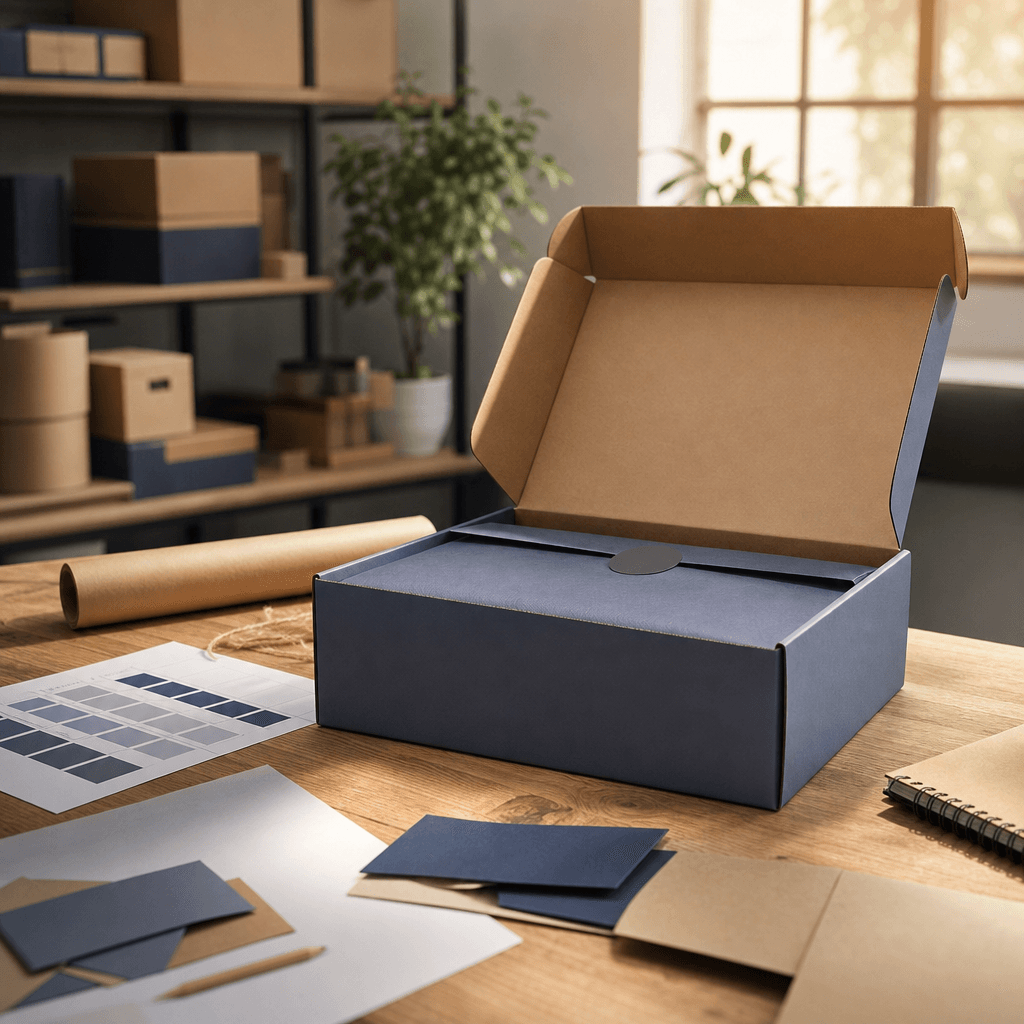
The most tangible physical contact with your brand happens the moment your online order reaches the customer's door; custom-printed e-commerce shipping boxes let you manage precisely this moment. A shipping box is a corrugated cardboard-based transport packaging that protects the product from external impacts, stacking, and transport risks from the warehouse all the way to the customer. Custom printing is the design and production process that transforms this functional box into a communication channel with logos, brand colors, visual language, and messages. For premium and growth-stage brands, this decision requires optimizing product safety, shipping cost, and the unboxing experience all at once. At Kosapack, we combine durable industrial boxes with premium printing and design services, treating the shipping box as a core component of your brand's customer experience strategy.
Table of Contents
This guide explains the concrete ways to turn packaging from a cost item into a marketing tool by transforming your packaging into a marketing tool, the connection between box structure and printing technique, and the decision points of premium brands.
Defining the decision: which custom printing for which box?
"Custom-printed e-commerce shipping box" is not a single choice but a set of interrelated sub-decisions. Trying to make these decisions in isolation most often results in either unnecessary cost or an inconsistent brand experience.
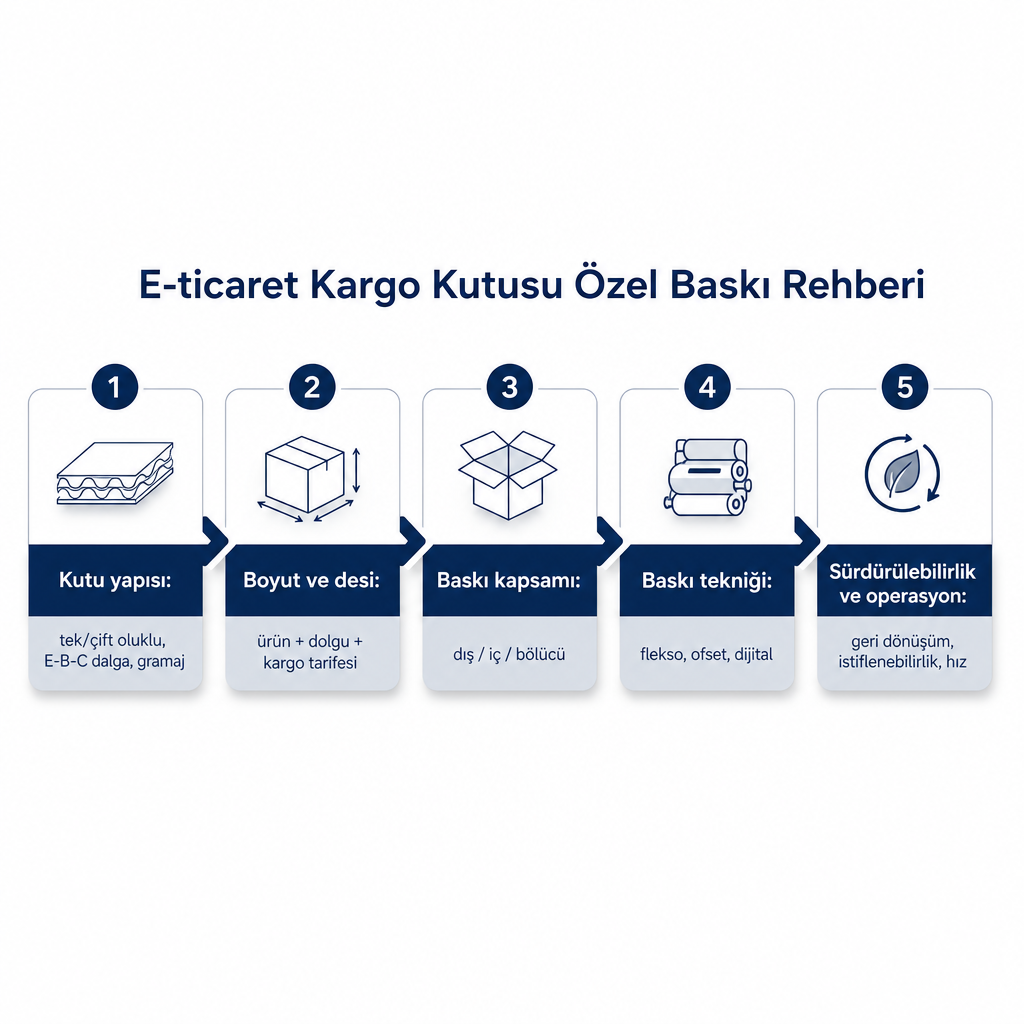
The first layer is the box structure: single or double-wall corrugated cardboard, flute type (E, B, C), and weight selection are determined by the product's weight and fragility. The second layer is size and volumetric weight (desi); the alignment of product dimensions, filler material, and the carrier's volumetric weight tariffs directly affects shipping cost. The third layer is the print scope: do you want only the exterior surface, or a design that continues on the interior surface and on dividers/inserts? The fourth layer is the printing technique; flexo, offset, or digital printing is chosen based on print run, color expectations, and graphic detail density.
To these are added the level of sustainability (recyclable material, certified sourcing, carbon footprint targets) and operational requirements (stackability in the warehouse, compatibility with automation lines, packaging speed). Making this decision holistically both reduces return rates and damage risk and increases brand touchpoint value per customer. If you want to evaluate box type in depth, our e-commerce shipping box selection guide details the structural options.
Material, printing, and logistics mechanisms
To make the right decision, you need to see the physical connection between box structure, printing, and transport. Each one determines the outcome of the other.
Material and box structure
The flute type and number of layers of corrugated cardboard directly affect both the box's carrying capacity and print quality. For light and small products, thin-flute (E, B) single-wall boxes provide sufficient protection and low volumetric weight. For medium-weight products, standard B or C flute offers higher impact resistance. For very delicate or heavy products, double-wall boxes and reinforced corner structures are recommended. Material quality also determines print sharpness; smooth-surfaced, homogeneous cardboard delivers cleaner color and a sharper logo in premium printing.
Printing techniques and brand impact
Three fundamental printing mechanisms serve different needs. Flexo printing is a cost-effective solution for simpler graphics and brand logos in large print runs. Offset printing supported by coating is ideal for work requiring high visual detail and premium perception, close to photographic quality. Digital printing, on the other hand, offers flexibility for low-to-medium print runs, frequent campaign changes, and personalized designs. When the wrong system is chosen, color deviations, blurry logos, and an inconsistent brand experience can result. That is why obtaining a color-matched proof before production and defining color tolerances in writing is critically important.
Size, volumetric weight, and shipping cost
Box dimensions should always be planned together with the product and filler material. Overly large boxes bring unnecessary volumetric weight cost and breakage risk due to movement inside; overly small boxes create compression and damage risk. The product's length-width-height values should be measured together with the filler, and for fragile products a safe gap of a few centimeters should be left on every side. Correct sizing keeps shipping costs under control, uses warehouse volume efficiently, and delivers a "perfectly fitted," full, and aesthetic unboxing experience.
Protection and test standards
In reducing damage, internal placement and filling are as decisive as box structure. It is recommended to secure the product so that it does not move inside the box and to leave a protective gap of at least a few centimeters. For heavy products, double-layered filling at the bottom and reinforced corner structures, and for set products interior-partitioned boxes, reduce the risk of collision and scratching. In the field of packaging safety, drop test standards such as ASTM D5276 and e-commerce-focused ISTA 6 series test protocols are used as references in validating boxes against real transport conditions. Designs compliant with these protocols reduce the damage and return risk for premium brands.
Decision criteria for premium brands
Once you understand the mechanisms, the question becomes clear: by what criteria will you choose the right combination for your own brand? Four criteria axes make it easier to manage this decision.
Brand positioning and unboxing goal. For premium cosmetics, jewelry, chocolate, and fashion brands, the shipping box is a touchpoint as important as the product box. These brands typically build a sense of luxury with a matte or soft-touch appearance, brand-specific colors, and clean typography; they enrich the experience with storytelling, care recommendations, or collection information in interior printing; and they aim for organic reach with details suitable for sharing on social media. The print design must be consistent with the target customer profile and the brand's price segment.
Product type and category requirements. The degree of fragility, weight, and category rules determine the box structure. Cosmetics and perfumes in glass bottles may require higher impact resistance, interior dividers, and warning icons. In textured fabrics and premium ready-to-wear, a soft touch on the interior surface, dust protection, and elegant presentation stand out. In the food category (chocolate, gourmet products), food-safe filling, protection against moisture and heat, and a reassuring design language should be considered together. We cover category-specific details for cosmetics brands in detail in our cosmetics packaging production brand guide. Regulations and user expectations determine the balance between mandatory information on the print and experiential content.
Operations, print run, and flexibility. Box and printing decisions must be aligned with warehouse and shipping operations. For brands with high SKU diversity, modular size sets and shared print design simplify inventory management. Digital printing that can be quickly updated during campaign periods provides an advantage for seasonal messages. Print run size, in turn, determines the cost advantage of the printing technique: flexo or offset in large runs, digital printing in small and personalized sets. A mismatched print run–printing system either creates unnecessary cost or lowers print quality.
Sustainability and quality assurance. Sustainability claims are becoming increasingly critical, and these claims need to be backed by materials and certifications. Recyclable sourcing, forest management certifications such as FSC, and random quality control sampling during production are prominent practices. In the premium segment, obtaining written quality assurance for color consistency, print tolerance, and structural defect rates reduces brand risk; requesting a physical or color-matched proof before full production prevents surprises in mass production.
Custom-printed shipping box solutions with Kosapack
At Kosapack, we are a premium packaging company based in Zeytinburnu; we offer custom-printed boxes and complementary packaging solutions to more than 500 brands across over 25 sectors, including e-commerce, cosmetics, fashion, food, jewelry, and electronics. We work with an end-to-end service model spanning from consulting to design and prototyping, to mass production managed through verified production partners, and to consolidated logistics.
The highlights we emphasize in custom-printed e-commerce shipping box projects are as follows:
- Brand-specific sizing: Box design optimized according to volumetric weight and product dimensions, suited to shipping and warehouse operations.
- Structural and graphic design: A design approach that combines product protection, transport requirements, and your brand story in a single packaging structure.
- Prototype and color-matched proof: Reducing print risks with a physical sample and color accuracy control before mass production.
- Integrated portfolio: The ability to manage all touchpoints under one roof, such as the shipping box, the inner product box, dividers, thank-you cards, and paper bags.
- Sustainability focus: A production approach that supports the environmental goals of premium brands with a focus on recyclable materials and carbon footprint.
- Fast quotes and samples: Rapid quoting and physical sampling processes for short launch timelines; a decisive advantage especially for e-commerce and DTC brands.
Within this framework, we treat the shipping box not merely as a means of transport but as a core component of your brand's integrated customer experience strategy. We determine the right combination together based on the technical details of your project; when you share product dimensions, target print run, category requirements, and your delivery timeline, we clarify the box structure, printing technique, and sampling plan best suited to you.
Frequently asked questions
Do custom-printed e-commerce shipping boxes increase sales?
Custom-printed shipping boxes can increase customer satisfaction and brand recall thanks to a brand-specific unboxing experience and shareable designs; this effect can positively reflect on repeat purchase behavior. The outcome should be evaluated together with design consistency and product experience.
For which products should double-wall boxes be preferred, and for which single-wall?
For light and small products, single-wall thin-flute boxes are usually sufficient. For medium-to-heavy and fragile products, standard or double-wall structures used together with interior filling and dividers are recommended.
Is there a mandatory minimum quantity for custom printing?
Traditional techniques such as flexo and offset require certain print run levels to be economical; digital printing, on the other hand, offers flexibility for lower quantities and frequent campaign changes. The exact minimum quantity is determined based on the project's technical details.
What is the advantage of having interior printing done?
Interior printing creates a surprise and storytelling effect the moment the customer opens the box. Using a thank-you message, care instructions, or brand story inside strengthens the unboxing experience and can support loyalty.
Is a sustainable custom-printed shipping box possible?
With recyclable sourcing, certified cardboard, and controlled printing processes, it is possible to produce shipping boxes that preserve a premium appearance while aligning with sustainability goals. The right material selection is decisive here.