
When a brand asks us, we always open our answer with the same sentence: custom box production prices are too project-specific to be expressed with a single "per-unit" figure. The cost of two boxes of the same size diverges significantly when the paper weight, board thickness, printing technique, number of colors, and effects change. In this guide, we clearly explain the cost drivers, scope boundaries, and the information you need to share at the quote stage so that premium and growth-stage brands can make a realistic budget plan. We also share, for reference, the example price levels seen in the 2026 Turkish market.
Table of Contents
Why giving a single "custom box price" range is not sound
From cardboard boxes to luxury rigid board boxes, from paper bags to labels and complementary printed materials, we produce a wide range entirely with brand-specific dimensions and designs. With so many different product types and levels of personalization together, quoting everyone a single unit price would be misleading for most brands.
In the premium segment, packaging is not merely a means of protecting the product; it is an experiential product that carries the brand's perception. Professional service links such as structural design, graphic design, sampling, and quality control also become part of the total cost. That is why, instead of a public fixed price list, we work with a project-based quote model tailored to the product, quantity, and expectations.
Whether you prefer a rigid box or a folding cardboard box is the first major budget decision; the cost logic of the two structures is fundamentally different. If you would like to explore this distinction in depth, our rigid box versus folding box comparison clarifies the selection process. Even so, to help you plan, in this guide we openly share the factors that determine cost and the example levels seen in the market.
The main cost drivers that determine the price
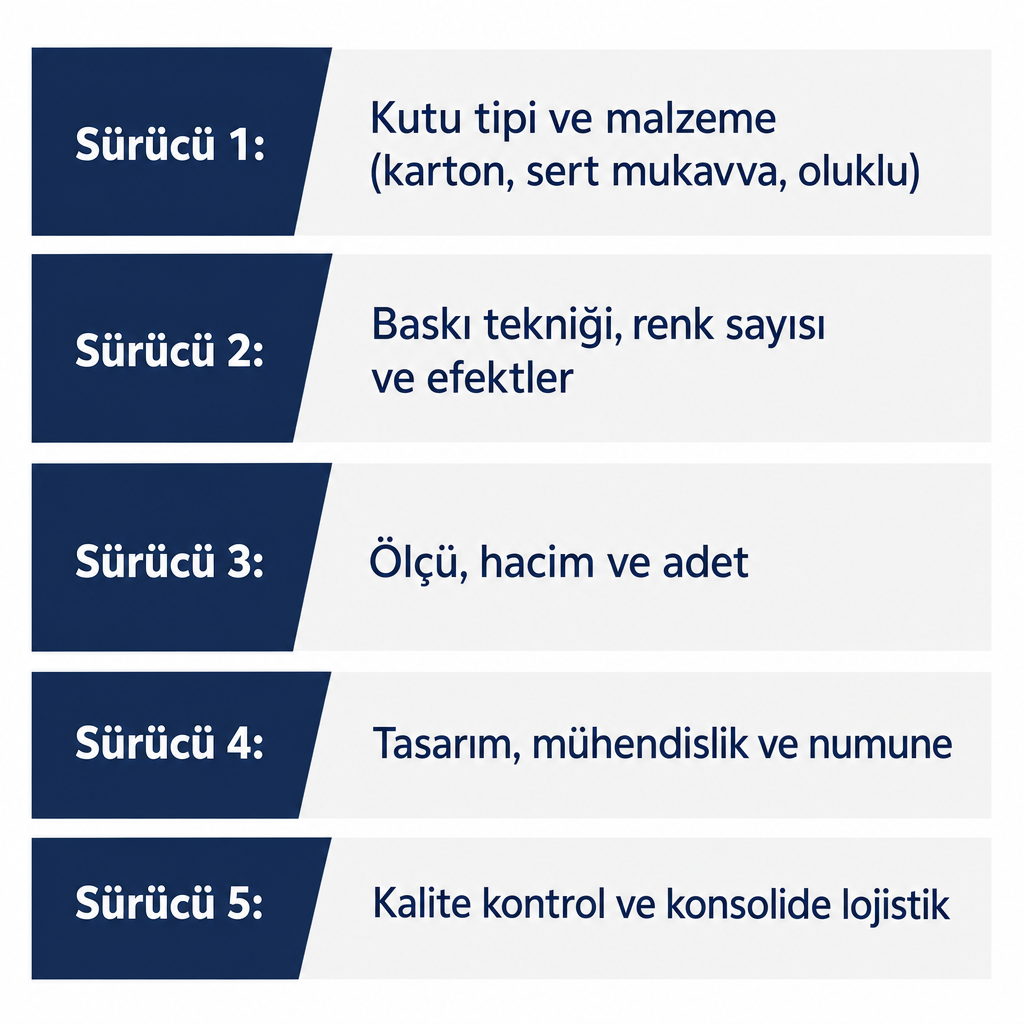
The price is shaped not by abstract but by concrete variables. To understand why a quote goes up or down, you need to read the five main items separately.
Box type and material structure
Folding cartons are a versatile option for cosmetics, chocolate, candles, and lightweight products; weight, coating (cellophane, varnish), and interior reinforcement determine the cost. Rigid boxes are produced with a board body and special papers wrapped over it; due to intensive handwork and material consumption, their unit cost is markedly higher than cardboard boxes. Corrugated boxes are used for e-commerce and shipping; as thickness and carrying capacity increase, so does the cost. Complementary pieces such as paper bags, labels, and cards take on part of the budget when worked as a set; their unit prices are generally lower than the main box.
Printing technique, color, and effects
We use offset and digital printing systems together with hot foil stamping and embossing lines. Offset printing lowers the unit cost at medium-to-high quantities; at very low quantities, digital printing can be more economical. On the color side, there is a significant difference in plates, ink, and machine time between 1–2 color printing and 4-color plus special Pantone combinations. Premium applications such as hot foil, embossing, spot varnish, and debossing each require a separate die and labor, and therefore raise the unit price.
Size, volume, and quantity
As the size grows, the amount of cardboard or board used per box increases; material cost rises in parallel. As quantity increases, the unit price drops because setup and preparation costs are spread across more pieces; this economy of scale is especially pronounced in offset printing. Very low-quantity, highly personalized projects — for example VIP or corporate gift sets — are positioned higher on a per-unit basis, because the fixed setup cost is distributed over few units.
Design, engineering, and the sampling process
As an end-to-end packaging partner, we offer product and brand analysis, structural and graphic design, digital proofing, physical sampling, production, and logistics within a single service chain. Product analysis, size optimization, and planning the shelf/online experience make up the initial cost of design. Structural design and graphic design carry professional service fees that vary according to project complexity. While digital proofing and 3D mockups lower pre-print revision costs, physical sampling requires a separate production run for material and form validation. All of these links do not necessarily have to be reflected in the unit price; however, within the total project budget, design and sampling are an important area of investment for premium brands. You can see step by step how the process is set up in our guide explaining the scope of packaging design service.
Quality control and logistics
While managing production through verified factory partners, we also include our own quality control processes and consolidated logistics in the service model. Multi-level quality control reduces the risk of defective production but requires additional time and labor. Consolidated logistics optimizes total shipping cost by combining different product types into a single shipment, while creating planning and coordination work on the project side.
Example cost levels for the 2026 Turkish market
The figures below are example prices compiled as of 2026 from suppliers selling custom-printed boxes in the Turkish and European markets. These are not our price list; we share them only to give an idea of the general level in the market. We have also added the calculation input next to each figure.
| Example product | Size and quantity | Total price | Per-unit estimate |
|---|---|---|---|
| Custom-printed cardboard box | 20×20×9 cm, 25 units | 955.00 TL (2026) | ~38.20 TL + VAT (955 ÷ 25) |
| E-commerce shipping box | 11×11×8 cm, 50 units | ~1,100.00 TL (2026) | ~22.00 TL + VAT (1,100 ÷ 50) |
| Europe-focused custom packaging | Depending on product and quantity | — | 0.25–2.00 € and 2.00–4.47 € (2026) |
The per-unit values are estimated calculations made by us; they were found by dividing the total price by the number of units and exclude VAT. These levels show that in premium printed boxes, the unit cost can quickly rise to the 20–40 TL + VAT (Turkey) or a few Euro (Europe) band depending on the combination of size, quantity, printing, and material. Since we raise the bar on design and service in the premium segment, the final unit cost in your actual projects may be positioned below or above these general levels. The exact price is determined through engineering calculations based on your brand's goals and technical requirements.
Scope in the Kosapack model: what's included, what's extra
In our end-to-end packaging partnership model, we bring together the following service links under one roof:
- Product and brand analysis, clarification of goals, and a detailed packaging brief
- Structural design and packaging engineering: the right box type, size, weight, and carrying strength
- Graphic design: a consistent visual language for the box, bag, label, and other printed materials
- Digital proofing, 3D mockup, and physical sampling process
- Production, quality control, and consolidated logistics management through verified factory partners
When preparing a project-based quote, we structure production cost (material, printing, labor, quality control), design and engineering service fees if needed, sample production, and logistics components as a single total project fee. Which items are included in the quote becomes clear according to your brand's existing design infrastructure — for example a ready drawing or corporate identity guide — and the level of service you need. You can find the technical details of the process on the printed cardboard box side in our printed cardboard box production guide.
How to compare quotes on equal terms
A brand wanting to have a custom box made in Turkey generally encounters two different approaches. In the production-only supplier model, the brand is expected to provide the existing design and box construction; the supplier prints the drawing that comes in, and design or engineering support is limited. The unit price may look lower on paper; however, poor optimization — excessive material consumption, insufficient strength, incorrect colors — can create additional cost in the long run.
In the end-to-end model, analysis, design, sampling, production, and logistics are structured as a single chain. Structural engineering and graphic design are optimized for both durability and brand perception; the box becomes not just a carrier but a part of the experience design. Quality control and consolidated logistics reduce total cost risks as scale grows.
For a similar size and quantity, placing a quote that includes only printing plus material price side by side with a project price that includes design, sampling, production, and logistics does not give a fair comparison. To compare on equal terms, tick off the service links within the scope of each quote one by one, and compare price only over the shared items. Otherwise, a figure that appears lower may actually be hiding a missing scope.
Information needed to get an accurate price quote
We work with the goal of providing a price quote within 24 hours and a physical sample within 7–15 business days (2026, Turkey). For this process to run smoothly, you need to provide the following information in your quote request as clearly as possible:
- Product information: the type of product (cosmetics, candle, chocolate, jewelry, textile, etc.), its net dimensions and weight, fragility and handling sensitivity (glass, ceramic, liquid, food, etc.)
- Box type and usage scenario: rigid box, cardboard box, corrugated e-commerce box, or paper bag; single-use or reusable; usage channel (store shelf, online order, corporate gift set, event)
- Quantity and order plan: target quantity for the first production (for example 500, 2,000, 10,000), annual or seasonal volume forecast, one-time or regular repeat order
- Printing and design status: whether you have a ready graphic design or want a design service; the file format of the logo, color codes, and brand visuals; expected effects (hot foil, embossing, spot varnish, special Pantone)
- Budget and timing: your unit or total budget band, target delivery dates for sampling and mass production, your storage and consolidated shipping needs (single/multiple locations, export)
A brief that comes with this information allows our design and engineering team to develop a solution that is both technically sound and budget-optimized and to price it quickly. The clearer the brief, the lower the chance of surprise costs arising later.
Frequently Asked Questions
What is the minimum quantity in custom box production?
The minimum quantity varies according to the box type (rigid, cardboard, corrugated) and the printing technique. Even in very low-quantity, highly personalized premium projects, we make a project-based assessment; the exact limit is determined according to the balance of technical feasibility and total cost.
Is an unprinted box or a printed box more economical?
Generally, unprinted boxes or those with a single-color logo application are lower cost than multi-color offset-printed boxes. However, in the premium segment, printed solutions can create higher value in the long run for brand perception.
Why is a rigid box more expensive than a cardboard box?
Rigid boxes require a thick board body, special paper wrapped over it, intensive handwork, and often extra effects. Since this increases both material and labor cost, the unit price is positioned higher than a cardboard box.
In design, do you start from the graphics or from the box form first?
We handle structural design and graphic design together. First the product and goals are analyzed, then the form and visual language are developed in parallel; this way technical strength and brand perception are optimized at the same time.
What is included in the quote, and do surprise costs come up later?
In our project-based quotes, we combine production, printing, quality control, and logistics in a single model; we clearly state items such as design, sampling, and special effects within the scope. In projects where the brief is clear, the risk of surprise costs later is low.