

Giving a single fixed figure for paper cup prices would be misleading, because even two cups of the same volume end up at a completely different unit cost when their weight, inner lining, print, and case quantity differ. For a coffee brand, a corporate event team, or a restaurant running takeaway service, the right question isn't "how much is a paper cup?" but "with which technical specifications, in what quantity, and for which use scenario will the cup I need be produced?" In this guide we break down the factors that determine price one by one and clarify what you should look at when comparing quotes.
At Kosapack, in custom packaging projects we treat price as a whole formed together by volume, weight, coating, printing, quantity, lid, regulations, and logistics. We designed this article as the entry point to our cost and pricing cluster; if you're curious about the pricing logic of different packaging types, our Box Prices 2026: Up-to-Date Cost Guide article completes the general framework.
Table of contents
What cost items make up the price of a paper cup?
The unit price of a paper cup is not just the cost of the paper. A quote is formed by evaluating together several interrelated cost groups. When one item changes, often not only the material but also the print preparation, production line setup, packaging method, and shipment volume change.
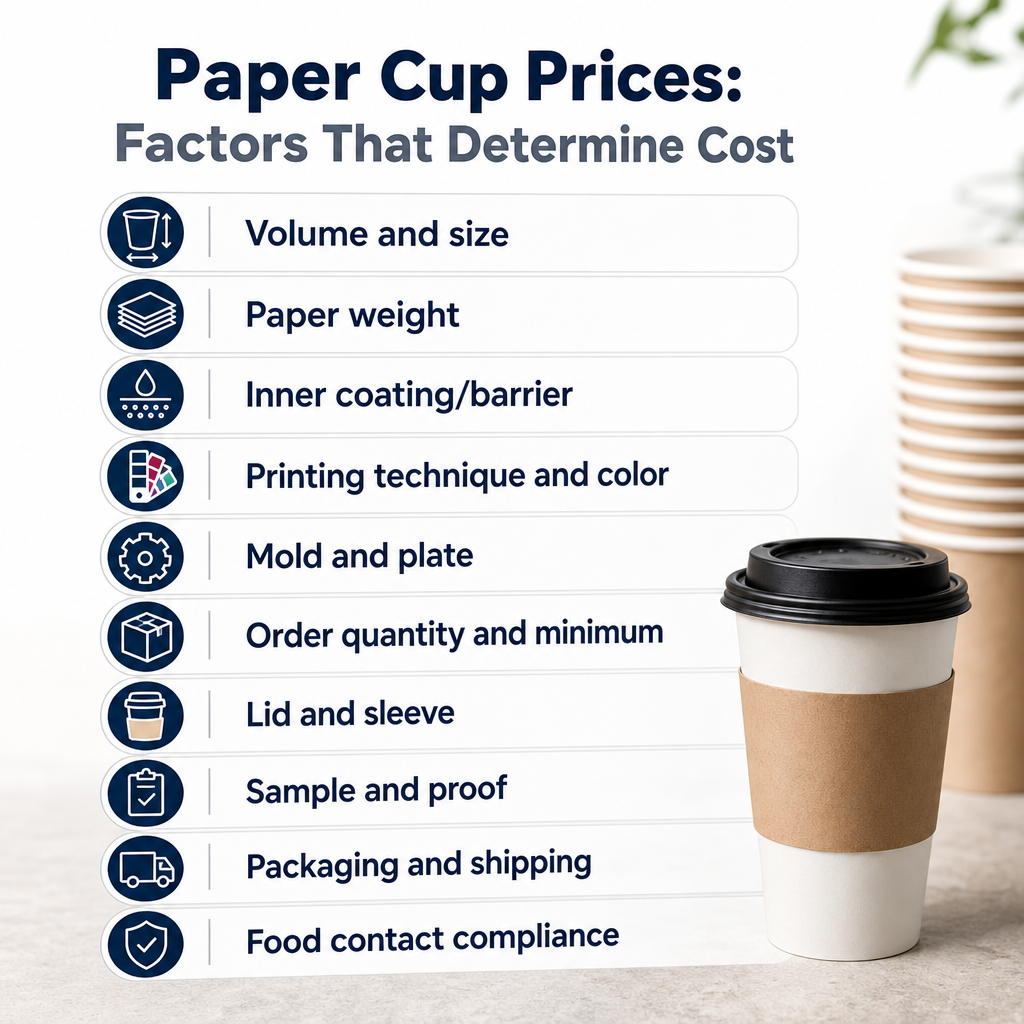
In practice, the main items that make up a quote are as follows:
- Cup volume and size
- Paper or cardboard weight
- Inner surface coating or barrier layer
- Printing technique and number of colors
- Die and plate expenses
- Order quantity and minimum production quantity
- Complementary items such as lid, sleeve, and carrier
- Sample and color proof work
- Packaging, palletizing, and shipping
- Food-contact compliance and related documentation
This list should be read not as a single purchase line but as the components that make up the product's total cost of ownership. When two suppliers give very different prices for the same volume, the difference almost always stems from a scope difference in one of these items.
How do volume, weight, and inner coating change the cost?
In paper cups, volumes such as 4 oz, 7 oz, 8 oz, 9 oz, and 12 oz are common. As volume increases, more paper is used, the body and base size grow, and the case volume and the shipping cost tied to it increase; in most scenarios a higher weight or a stronger structure is required. While small volumes are suitable for tasting and short treats, 8 oz and above is more often preferred for hot coffee, tea, and cold beverage service. Looking only at the oz value is not enough; the cup must be suited to the beverage's temperature, the fill amount, and how long it stays in the hand.
Weight is the paper's weight per unit area and is directly related to the cup's sturdiness, how it feels in the hand, heat insulation, and durability. A common mistake here is the assumption that "the higher the weight, the better." While very low weight creates risks such as softening in hot beverages and an increased heat sensation in the hand, unnecessarily high weight raises both the unit price and the transport cost. The aim is not to choose the highest possible weight, but to find sufficient structural durability suited to the use scenario. The weight decision should be made together with these points: whether the beverage is hot or cold, how long the cup stays in the hand, service duration, diameter and height, the risk of crushing during transport, and the brand's perceived quality target.
The inner surface coating is the barrier layer needed so that the cup does not directly absorb the liquid. It prevents leakage, preserves the form, and reduces the interaction between the beverage and the cardboard. The coating choice affects both the price and sustainability as well as food-contact compliance. Alternatives that are more easily recyclable or reduce plastic use do not always lower the initial purchase price; however, they may be more aligned with the brand's environmental goals and regulatory requirements. For this reason, the coating decision is not only a cost decision but also a use and reputation decision.
How do printing, quantity, and variants affect the unit price?
On a branded paper cup, printing is the most visible component of the cost. The main elements affecting the price are: the extent of the print surface, a single-color or multi-color design, the use of Pantone or CMYK, whether full coverage around the cup is required, the need for plates or dies, print tolerance, and how many different sizes the same design will be applied to. The preparation and production cost of a simple logo print and a photographic design wrapping the entire cup are not the same. Too many colors, thin lines, small text, or layouts incompatible with the cup's taper increase the print risk.
The printing technique should be chosen according to need: if short runs and variable designs stand out, digital printing; if repeated production and a unit cost advantage at higher quantities are targeted, other methods can be considered. You can find more detail on the effect of printing technique on packaging decisions in our article What Is Digital Printing? A Guide to Its Use in Packaging.
Order quantity is one of the most decisive levers of the unit price. Fixed expenses such as die, plate, print preparation, sample, and machine setup raise the unit cost in low-quantity production; as the quantity increases, these expenses are spread over more products and the unit price drops. However, high quantity is not automatically advantageous for every brand. Excess stock requires storage space, creates the risk of unused product if the design or messaging changes, strains cash flow, and increases the risk of moisture, crushing, and deformation. The optimal quantity is determined by considering monthly consumption, campaign calendar, the design's usage period, and storage conditions together.
Variant count is often an overlooked cost item. High-quantity production of a single design versus the same total quantity across three different designs, or separate printing for each size, does not produce the same unit price. As variants increase, print preparation, planning, quality control, and stock management become more complex. For this reason, when requesting a quote, clearly stating the quantity per design as much as the total quantity reduces revisions and surprises.
Why does food-contact compliance affect the price?
Since a paper cup is in direct contact with the beverage, it cannot be evaluated merely as a visual packaging product. The paper, coating, dye, ink, and production process used must be suitable for the intended use; because this compliance affects both material choice and the documentation burden, it is reflected in the price.
In Türkiye, the Regulation on Materials and Articles in Contact with Food requires the preparation of a written declaration of compliance for substances and materials produced according to certain rules; it also stipulates that the relevant documents be presented upon request and that traceability be ensured. Since scope and conditions may vary by product, it is appropriate to confirm compliance specifically for your project for your own use.
The information a brand purchasing within a corporate or food service scope will request at the quote stage is as follows: declaration of compliance, information on the material and coating used, the scope of food-contact compliance, batch or production traceability, migration or analysis documents if needed, and the suitability of the print ink for the use scenario. The absence of these documents can affect not only purchasing risk but also product safety, the audit process, and brand reputation. For this reason, clarifying the scope of compliance at the quote stage rather than leaving it to the end of the order is the safest path.
Ready-made cup or brand-specific printed cup?
The two paths serve different needs and their cost logics differ as well. A ready-made paper cup may be suitable for low-quantity purchases, needs for fast delivery, situations where brand visibility is not critical, scenarios where standard volume and design are sufficient, and trial or temporary services. The limitation of this path is the narrow range of color, size, weight, and design options.
A brand-specific printed cup, on the other hand, makes more sense in scenarios where a café, restaurant, or hotel brand wants visibility; where events and corporate organizations are held; where the takeaway experience is important in brand communication; where a special design will be used for a campaign or launch; and where the cup will be part of the social media and unboxing moment. Here, besides the unit price, the minimum quantity, sample lead time, and design change cost should also factor into the decision. In custom printed production, the physical sample and color proof are the most important checkpoint before mass production: catching risks such as misplacement of the logo, colors coming out different from the screen, small texts being unreadable, the print distorting at the seam line, the lid not seating fully, or the cup feeling softer than expected at the sample stage is far cheaper than catching them in mass production.
In custom packaging projects, we share a quote within 24 hours based on the brief and a physical sample lead time within 7–15 business days; we determine the minimum order quantity according to structure, material, and surface treatments. Whether the sample cost will be shown separately in the quote or offset against the production order is a condition that should be discussed from the outset.
Are you comparing quotes on the same scope?
The lowest unit price is often not the most advantageous quote. When comparing figures from different suppliers, you need to make sure you are measuring the same scope. The table below summarizes what information should be asked to make an "apples-to-apples" comparison of quotes easier.
| Comparison criterion | What to ask |
|---|---|
| Size | How many oz or how many ml is the cup? |
| Weight | What is the paper weight and structure? |
| Coating | What barrier is used on the inner surface? |
| Printing | How many colors, how many faces, and which technique? |
| Quantity | What is the total quantity and the quantity per design? |
| Sample | Are the physical sample and proof included? |
| Lid | Is the lid included in the price or separate? |
| Shipping | Are delivery and shipment charges included? |
| Regulations | Are a declaration of compliance and documents provided? |
| VAT | Is the price VAT-inclusive or exclusive? |
Clarifying the brief before requesting a quote fills in most of the gaps in this table from the start. For a clear quote, it is useful to convey in one go the cup volume (oz or ml), hot or cold use, the estimated monthly or campaign quantity, the design and logo file, the print surface and color expectation, the need for a lid or sleeve, the delivery city and target date, the food-contact document expectation, the sample request, and the target unit cost or total budget. The clearer this information is, the less uncertainty there will be before revisions and production.
Common cost mistakes
Repeating the same mistakes is the factor that inflates the budget most in paper cup purchasing. The most frequently encountered are as follows:
- Evaluating only the unit price: Even if the figure looks low, the lid, shipping, die, and VAT may be added separately. Always calculate the total project cost separately.
- Choosing the volume independently of the use scenario: A cup that is too large creates unnecessary material and beverage cost; a cup that is too small spoils the service experience. Choose the volume according to the beverage and service.
- Moving to mass production without taking a sample: The design on the screen may not look the same as the actual print on the conical cup surface. Verify color, logo position, and readability with a physical sample.
- Requesting food-contact documents afterward: When the documents are left to the end of the order, there is a risk of encountering an unsuitable material or print component. Clarify the scope of compliance at the quote stage.
- Not specifying design variants: Even if the total quantity is high, a large number of variants changes the production plan and the unit price. Add the quantity per design to the brief.
Plan your total packaging cost with Kosapack
In a paper cup project, the right cost emerges not only from the product purchase price but together with the scope of design, sample, production, quality control, and logistics. In custom packaging projects, we manage structural and graphic design, prototyping, production coordination, quality control, and logistics under a single program. For brands, we create a more predictable quote scope by evaluating size, material, target cost, and delivery date together.
If, along with the paper cup, products such as a coffee box, paper bag, label, tissue paper, or shipping box will also be used, planning the entire packaging system together reduces from the start the size, color, and delivery mismatches that can arise between different sources. If you are considering a carrying solution to complement the cup, our article Paper Rope Bag Making: A Cost and Process Guide explains the cost items with the same logic. This way, the decision is made based on the whole of use safety, brand appearance, delivery time, and total cost of ownership rather than a single unit price.
Frequently Asked Questions
Why do paper cup prices vary at the same volume?
Cups of the same volume can differ in weight, inner coating, print quality, pack quantity, and production amount. For this reason, comparing prices based only on the oz value does not give the right result.
Is a printed paper cup or a ready-made cup more economical?
For low quantities and short-term use, a ready-made cup may be more economical. For regular consumption, brand visibility, and high-quantity production, the total benefit of custom printed cups may be higher.
What does weight change in a paper cup?
Weight affects the cup's rigidity, feel in the hand, heat insulation, durability, and material consumption. Instead of the highest weight, a weight suited to the beverage and usage period should be chosen.
Is the lid included in the paper cup price?
It may not be included in every quote. You should separately ask whether lids, sleeves, and carriers are included in the price.
What information is needed to get a clear paper cup price?
The cup volume, hot or cold use, weight expectation, print design, quantity, lid need, delivery location, and target date should be shared. If a physical sample is requested, this request should also be added to the brief.