

There is no single right answer to the question of "the best packaging material"; the right choice varies depending on your product, sales channel, and brand goal. For a cosmetics brand, shelf visibility and print quality come to the fore, while for an e-commerce shipment, impact protection and volumetric weight cost are decisive; for jewelry or gift products, the presentation experience and internal layout change the decision. Read the list of packaging materials in this article not as a ranking, but as a decision guide built around the balance of product-channel-protection-perception-sustainability. We approach the options based on the real-world use cases we've seen while working with more than 500 brands.
The materials on the list are not arranged from "best" to "weakest." Each one does a different job well; even the highest-quality material fails when chosen for the wrong job. That's why we first clarify the selection criteria, then the distinctive aspect of each material, who it suits, and where it falls short.
Table of Contents
Which criteria are evaluated together when choosing packaging material?
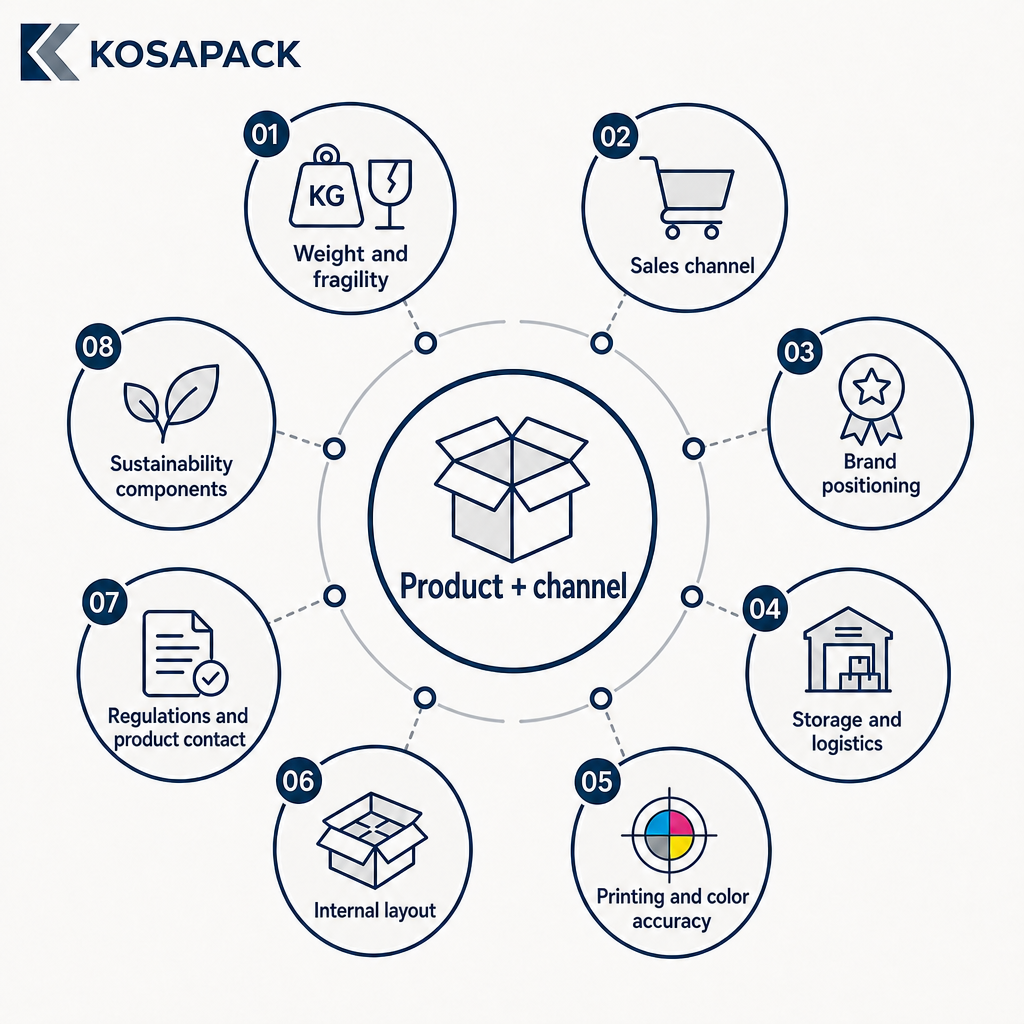
Choosing a material on its own because it's "pretty" or "quality" is the source of most failed packaging decisions. The right choice emerges from weighing the following criteria simultaneously:
- Product weight and fragility: The packaging should not get crushed or torn during transport, and should not allow the product to move inside the box.
- Sales channel: Shelf, store, e-commerce, corporate gifting, and event uses create different needs.
- Brand positioning: For premium products, material texture, print quality, and the unboxing experience come to the fore.
- Storage and logistics: Flat-shipped solutions reduce storage space; bulky packaging increases shipping cost.
- Print and color accuracy: Kraft and textured surfaces alter colors; a physical proof before mass production is essential.
- Internal layout: Tissue paper, filler, separator, or an inner box change the overall dimensions and protection level.
- Regulation and product contact: For packaging that will come into direct contact with food, the suitability of paper, ink, varnish, and adhesive must be documented.
On the sustainability side, being merely paper-based is not enough; lamination, varnish, handle, adhesive, and recycling infrastructure must be examined together. In Turkey, designing packaging to be suitable for reuse, recycling, and recovery is one of the core approaches in the legislation (Regulation on the Control of Packaging Waste). You can also take a look at our sustainable packaging guide, where we cover this topic in greater depth.
Rigid box: for a premium and gift experience
Brands looking for the material that most boosts perceived value usually start here. A rigid box is made by covering thick board with paper or a printed surface, giving a firm, substantial feel.
Its distinctive aspect is presentation power: it can be customized with lid, drawer, magnetic, or foldable structures and can turn into a box that can be kept with the product for a long time. For jewelry, perfume, candles, chocolate, and corporate gift sets, it creates a branded unboxing moment.
Who it's suitable for: jewelry and fine jewelry brands, premium cosmetics and perfume, candles and lifestyle products, chocolate and special gift sets, corporate gift projects.
Its limitation: Rigid boxes generally require more storage space than flat-shipped folding cartons; their heavy and bulky structures can increase shipping cost. If it is to be used alone in e-commerce, the product must additionally be tested against impact and shipping conditions, and it often needs to be planned together with an outer corrugated box.
Folding carton: for shelf visibility and high volume
When high-volume production and storage efficiency are the priority, the weight of rigid board starts to become a burden. A folding carton is a thin cardboard packaging that is flat-shipped after printing and die-cutting, and folds into shape during filling. Although the grammage is usually chosen in the 250–450 gsm range, the correct value is determined based on the product weight and design.
Its advantage is clear: because it is flat-shipped, it reduces storage volume, offers a wide printing surface, and can be designed for automatic filling lines. Cream, serum, and soap; tea, coffee, dragees, and dry food; lightweight supplement products and fashion accessories work well with this structure.
Its limitation: For heavy, fragile, or high-value products, it may not provide sufficient protection on its own. Glass jars, ceramics, or sensitive products require an inner separator, support piece, or outer corrugated box. Print-cut alignment, fold lines, and a physical sample must be checked before mass production. The What Is a Folding Carton? Use Cases article, where we examine the structure and uses of this material in more detail, helps during the decision stage.
Corrugated box: for e-commerce and shipping protection
If the product needs to arrive intact before presentation, the corrugated box takes on the protection job. The corrugated layer in its structure contributes to crush and impact resistance; it supports the product against shipping and stacking risks.
When designed to custom dimensions, it reduces the empty space inside the box and also serves as a branded outer box in e-commerce shipments. When used together with a folding carton or rigid box, it provides both protection and presentation. It is suitable for brands using glass bottles and jars, electronic accessory sellers, cosmetic sets, and businesses sending corporate gifts by courier.
Its limitation: A corrugated box alone does not offer a premium unboxing experience for every product. To strengthen the inner presentation, it should be planned together with a rigid box, folding carton, tissue paper, or separator. An oversized outer box, on the other hand, increases the need for filler and the volumetric weight cost.
Paper rope bag: for in-store handover and visible brand communication
If you want the brand to remain visible as the product leaves the store in the customer's hand, the job falls to the bag. A paper rope bag is prepared by determining size, paper type, print, handle, and reinforcement structure together, and it increases brand visibility at store exit.
It can be customized with kraft, white, colored, or textured paper options; the color, length, and thickness of the handle are chosen to suit the brand. When used as a set together with a rigid box, tissue paper, and a thank-you card, a cohesive experience is created. It is a strong option for fashion and accessory, cosmetics stores, jewelry brands, and corporate gift projects.
Its limitation: A paper rope bag is not automatically shipping packaging. The paper's color affects the print result; light-colored logos on a kraft surface may not look as bright as on white paper. For heavy, sharp, or fragile products, the base and handle connection must be tested with the actual product weight. To prepare the right brief step by step, you can review the How to Customize a Paper Rope Bag? guide.
Complementary materials: label, tissue paper, thank-you card, and separator
The packaging experience often distinguishes itself not by the box, but by the small pieces inside it. These four materials don't carry a product on their own; they change the perception and protection of the system they're used in together.
A label carries the brand name, product information, contents, usage instructions, barcode, or legal information on the packaging. On small or plain packaging, it increases visibility, makes it easier to distinguish variants, and allows a product update without changing the packaging. Its limitation is surface compatibility: if the material is chosen incorrectly, peeling, wrinkling, or print distortion occurs; on glass, kraft paper, and textured surfaces, adhesion and color must be tested separately. On the suitability of a printing technique to the surface, the What Is Screen Printing? How Is It Applied? article explains the limits of different methods.
Tissue paper layers the inside of the box and enriches the unboxing experience; it supports the product surface against scratches and can be customized with a logo or pattern. It does not provide impact protection on its own; for fragile products, it should be supported with a box, filler, and separator.
A thank-you card adds a personal message to the order or gift experience; by carrying usage instructions, care tips, or a QR code, it turns the packaging into customer communication. Its function is communication, not protection; too much text makes the card illegible.
A box separator separates multiple products inside the box and limits movement during transport. In glass bottles, jars, candles, or multi-cosmetic sets, it organizes the internal layout. It is only effective when the product dimensions are determined correctly: loose compartments do not prevent movement, while overly tight compartments make placement difficult. Since the thickness of the separator reduces the inner dimensions, it must be taken into account at the very beginning of the design.
Options for lightweight shipments: mailer envelope and fabric bag
Not every shipment needs a box; in some cases, a box means extra volume and cost. Two materials fill this gap for different purposes.
A mailer envelope is a low-volume outer packaging used for e-commerce shipments of textiles, documents, small accessories, and lightweight products. For flat or flexible products, it reduces volume, creates a lighter shipment than a box, and makes the outer shipment visible with brand printing. Its limitation is protection: for glass, ceramic, electronic, or crush-sensitive products, it is not sufficient on its own; for products with sharp edges, the risk of puncture and the gap between the contents and the envelope must additionally be tested.
A fabric bag aims for the customer to reuse the packaging and keeps the brand logo visible for a long time; it works in store, event, corporate gift, and campaign projects. Its sustainability impact depends not only on the type of fabric: usage frequency, production material, printing method, wash resistance, and actual usage duration must be evaluated together. It does not replace an inner box or separator for fragile products.
Which packaging material should be chosen based on the use case?
Not a single material, but the right combination delivers the result. The matching below is a practical starting point for the scenarios we frequently encounter; the definitive decision is clarified with the product dimensions and a sample.
| Need | Recommended packaging combination |
|---|---|
| Premium jewelry or fine jewelry | Rigid box + tissue paper + thank-you card + paper rope bag |
| Cosmetic product | Folding carton or rigid box + label + paper bag |
| E-commerce cosmetic set | Folding carton/rigid box + separator + tissue paper + outer corrugated box |
| Glass jar or candle | Rigid/folding carton + separator or support + corrugated box |
| Lightweight textile product | Mailer envelope or folding carton |
| In-store handover | Rigid box + paper rope bag |
| Corporate gift | Rigid box + tissue paper + thank-you card + fabric/paper bag |
| High-volume shelf product | Folding carton + label |
| Multi-product set | Rigid or corrugated box + separator + tissue paper |
For food products, the compliance certificate is as critical as the combination: the suitability of the paper, ink, varnish, and adhesive that will come into direct contact with the relevant requirements must additionally be verified.
The most common mistakes when choosing packaging material
The same mistakes recur across different brands, and most are problems that can be caught during the sampling stage.
Deciding based on appearance alone. A nice-looking box or bag may not carry the product's weight. Material strength and internal structure must be tested as much as the visual design.
Using only the product's outer dimensions. If a box, tissue paper, filler, card, or inner separator will be used, the packaging dimensions must be determined according to all components; otherwise, the product either won't fit or will shift inside.
Mistaking a screenshot for a print proof. Kraft, white, and textured papers display the same color differently. A physical proof before mass production reduces color deviations.
Using the term "sustainable" without documentation. Not all components of a paper-based product automatically fall under the same recycling scope; paper, ink, varnish, handle, adhesive, and lamination must be examined together.
Confusing shipping packaging with presentation packaging. A rigid box, folding carton, or paper bag strengthens the brand experience; however, for shipping protection, an outer corrugated box and inner support are often needed.
For the right start, the product's exact dimensions and weight, the dimensions of all components to be used together, the sales channel, the targeted protection level, and the material and print surface should be determined in advance; color, size, lid, handle, folding, and durability should be tested with a physical sample; tolerances, compliance certificates, and sustainability scope should be put in writing in the quote. Especially for paper bags, looking at the grammage is not enough; a 10–15 minute carry with the actual product, the handle connection, the base, and the print's behavior at the fold areas should be checked.
At Kosapack, we plan the dimensioning, structural design, graphic design, sampling, production, quality control, and logistics steps of a packaging project in a single flow. A clear brief prepared with the product dimensions, weight, sales channel, target quantity, print expectations, and delivery date is the step that clarifies the right material combination the fastest.
Frequently Asked Questions
Which is the best packaging material?
There is no single best packaging material. For premium presentation, the rigid box; for high-volume shelf products, the folding carton; for shipping, the corrugated box; for in-store handover, the paper rope bag; and for multi-product protection, the box separator stand out in different jobs.
What should be looked at first when choosing packaging material?
First, the product's weight, fragility, dimensions, and sales channel should be determined. Material and print decisions are made after this information.
Which is better, a folding carton or a rigid box?
If storage volume, high quantity, and shelf visibility are the priority, a folding carton; if premium presentation, durability, and gift experience are the priority, a rigid box is more suitable. The two can also be used together within the same product family.
Can a paper rope bag be used for shipping?
It cannot be used alone for every product. For heavy, fragile, or long-distance shipments, an inner cardboard box, outer corrugated box, base reinforcement, and handle durability must be evaluated together.
Why is a physical sample important for packaging materials?
A physical sample shows color accuracy, material stiffness, folding and lid performance, handle connection, and shipping compatibility much more realistically than a computer design. This way, surprises in mass production are caught early.
Can any paper packaging be used for food products?
No. Compliance certificates must be checked for the paper, ink, varnish, and adhesive that will come into direct contact with the product. A standard printed paper bag is not automatically considered suitable for food contact.