
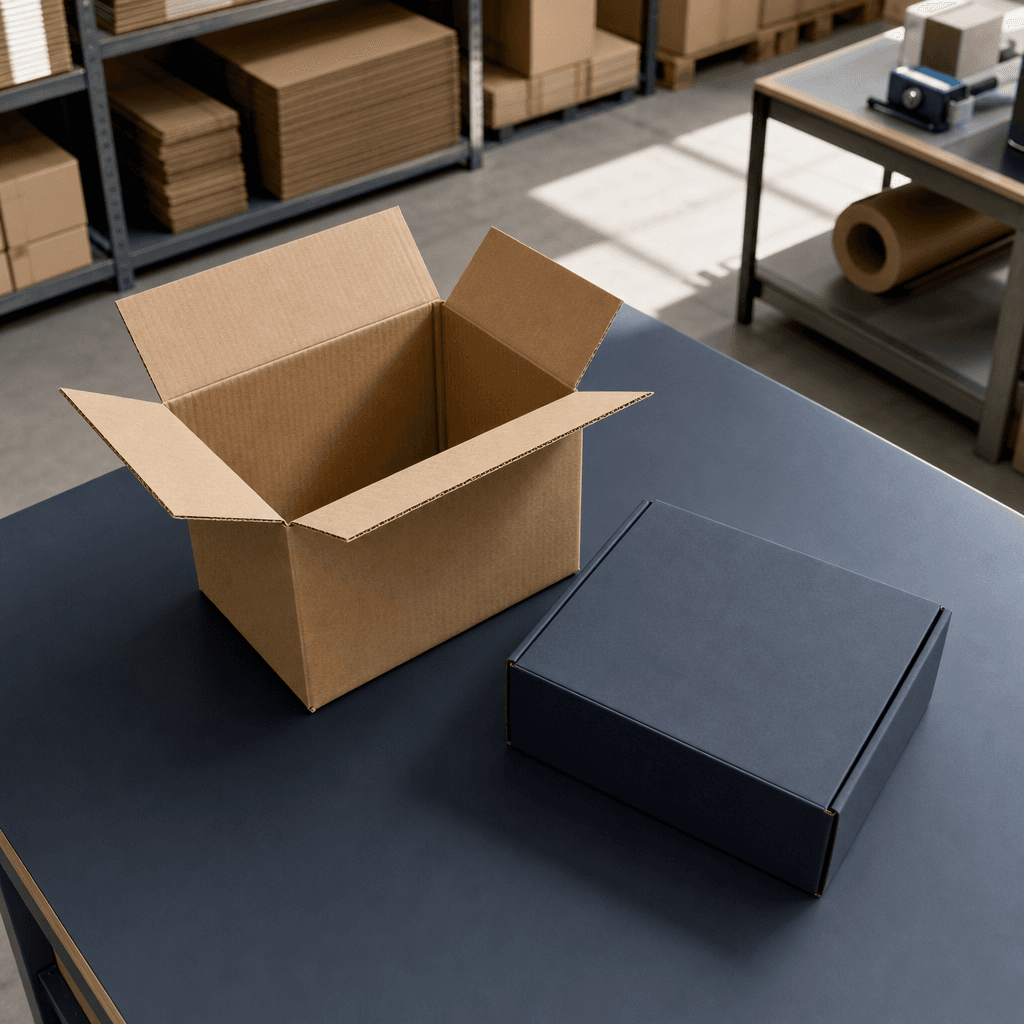
There is no single correct answer to the question of ready-made box or custom box; the right choice depends on your product's dimensions, protection needs, sales channel, order quantity, budget, and the brand impact you expect from the packaging. If you're looking for a quick, operational solution in small quantities, a ready-made box may be more practical. If your product doesn't fit standard dimensions, requires a premium presentation, or you want to use the packaging as part of your brand experience, a custom box is the better choice. Below, we compare these two paths in terms of cost, protection, logistics, design, sustainability, and production risk, clarifying the criteria by which you should make your decision.
Table of Contents
What do ready-made box and custom box mean?
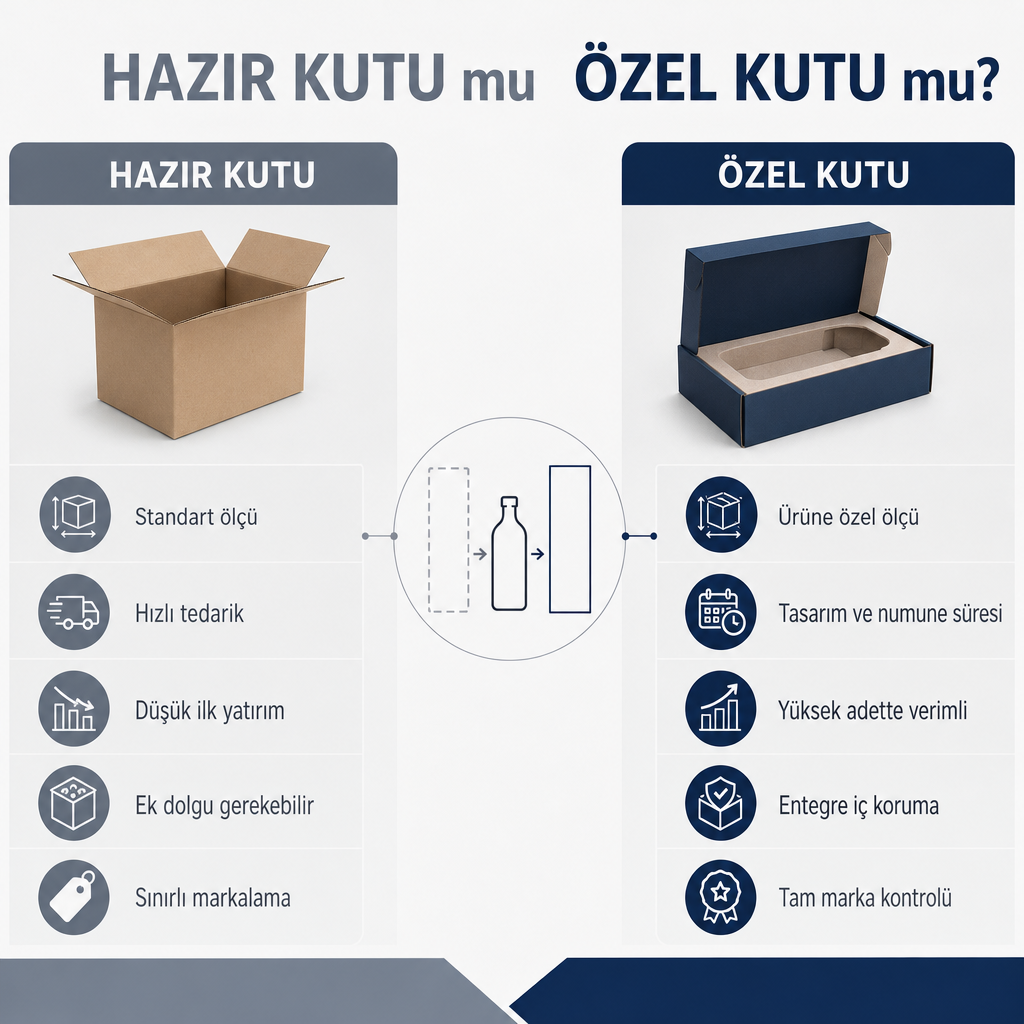
A ready-made box is one chosen from the standard sizes, forms, and material options predetermined by the manufacturer. The closest available option is selected based on the product's dimensions. These boxes typically come with predefined length-width-height options, a limited number of models, standard weights, ready-made closure mechanisms, and a limited branding area such as a label or sticker. Because it reduces design and production preparation, it offers an advantage when you need samples, seasonal campaigns, small stock, or quick shipping.
The main challenge of this model appears in fit. If the box's internal volume doesn't exactly match the product, there will be empty space inside; this means additional filling material and the product moving during transport. When the box is too small, the product may be damaged or the lid-lock system may fail to perform its function.
A custom box, on the other hand, is designed according to the product's dimensions, weight, usage scenario, sales channel, and brand identity. The size, form, interior layout, print, coating, and opening style are determined specifically for the project. The box size and form, closure mechanism, interior compartments or foam inserts, print and color system, paper or cardboard choice, and finishing applications such as foil stamping, embossing, and spot lacquer, along with accessories like ribbons, magnets, windows, and drawers, can all be designed together. As in our custom-size box design guide, we address product dimensions, box structure, interior layout, printing, and sample decisions together. This approach transforms the custom box from merely "a box of a different size" into part of the product and brand experience.
A side-by-side comparison of the two options
Seeing the two paths side by side at the decision point quickly reveals which criterion weighs most heavily for you.
| Criterion | Ready-made box | Custom box |
|---|---|---|
| Size | Selected from standard sizes | Designed according to the product |
| Supply speed | Usually faster | Requires design and sample time |
| Initial investment | Usually lower | May involve mold and design costs |
| Unit cost | Can be advantageous in small quantities | Becomes efficient at high quantities |
| Product fit | Limited to the nearest size | Perfect fit achievable |
| Interior protection | May require additional filling | Insert integrated into the box |
| Brand visibility | Limited customization | Form, surface, and print tailored to the brand |
| Error control | Fit tested afterward | Verified in advance with a sample |
Strengths and weaknesses of the ready-made box
The most obvious advantage of the ready-made box is speed. As a product launch, campaign, or short-term sales plan approaches, the production process is shorter because design and mold preparation are limited. This advantage is especially decisive for small e-commerce brands, test sales, seasonal gift sets, and quick sample orders. Since the need for structural design and custom molds is limited, the initial order cost also remains low.
However, looking only at the unit price of the box is misleading. If the product doesn't fit the box perfectly, you may need filling, extra tape, a second outer carton, or a higher shipping volume. Therefore, the true cost should be evaluated together with the box price, filling material, additional protective packaging, storage space, shipping volume, and the risk of product damage and returns.
The second limitation is product fit. If a standard-size box doesn't perfectly match the product's shape, the product moves inside the box and extra material is used to fill the gap. For glass bottles, cosmetics, jewelry, electronic accessories, and fragile products, this increases transport risk. The third is brand differentiation: although a label or limited print can be applied to a ready-made box, the form, opening style, and interior layout remain standard. As we discussed in why branded packaging matters, for premium brands the issue isn't just whether the logo is visible; color accuracy, surface feel, the way the lid opens, and the product's presentation inside the box also affect perceived value.
If the product is small and the box is large, unnecessary volume is created; this means more filling, storage space, shipping volume, and packaging waste. In Turkey, packaging regulations cover packaging placed on the market and the waste from this packaging; one of the fundamental principles is not using packaging with more volume and weight than necessary.
The value and disadvantages of the custom box
Custom sizing makes the box's internal volume compatible with the product. This reduces the product's range of movement and provides the necessary protection with less additional material. This fit gains particular value for glass bottles and perfumes, cosmetic sets, jewelry and watches, candles, chocolates and gourmet products, electronic accessories, and sets consisting of multiple parts.
In terms of protection, the difference the custom box makes doesn't come only from the rigidity of the outer body; the product's position inside the box is also designed. Foam or sponge inserts, cardboard separators, slots that fix the product, and layered interior layouts can be used together. For this reason, the statement "a custom box is more durable" is not sufficient on its own; a proper assessment considers product weight, fragility, transport orientation, and in-box fixation together.
On the brand experience side, rigid cardboard boxes stand out. Structures such as magnetic lids, drawers, book-style openings, and hinges make it possible to design the way the lid opens, the order in which the product is revealed, and the feel the box leaves in hand as a whole. When graphic design is prepared according to the box's dieline, color, logo placement, typography, and finishing are evaluated together. Depending on the project, offset or digital printing, Pantone color matching, foil stamping, blind embossing, spot UV, soft touch coating, and textured, kraft, or metallic paper can be used. The goal isn't to use as many applications as possible; it's to choose the right combination that serves the brand's positioning and budget.
By contrast, the custom box has two notable disadvantages. The first is the initial cost: the quote is determined together by box size, structural design, order quantity, material and weight, printing method, mold, lid mechanism, finishing, interior insert, sample, and logistics. In low-quantity orders, the unit cost appears high because preparation and mold costs are divided among a small number of boxes; as quantity increases, these costs are spread across more products. The second is time: a custom box isn't a product that can go straight into mass production. It requires structural design, graphic design, and sample control. During the sample stage, it must be verified whether the product fits the box, whether the lid works smoothly, whether the insert secures the product, and whether the print colors come out in the expected tone. Going into high-volume production without this control increases the risk of re-production due to incorrect dimensions or color.
The seven criteria that determine the decision
To make a sound choice between a ready-made box and a custom box, evaluate the following seven criteria in order.
1. Product dimensions. Determine the product's net width, length, and height; include the lid, pump, handle, and protrusions in the measurement. Before asking "does the product fit," ask whether the product moves inside the box, whether there is enough space for closure, and whether any room remains for interior protection material.
2. Protection need. For fragile, heavy, or high-value products, the box isn't chosen based on appearance alone. The box should be evaluated according to the transport conditions the product will go through from production to the customer.
3. Sales channel. A store shelf, e-commerce shipping, and corporate gift delivery do not have the same requirements. Shelf visibility matters in store, shipping durability and volume matter in e-commerce, premium appearance and personalization matter in corporate gifting, and repeated production and packaging speed matter in subscription models.
4. Order quantity and repeat frequency. A one-time order of 100 units is not evaluated the same way as a monthly recurring order of 10,000 units. For regular, high-volume orders, the initial investment in a custom box makes sense; for low and uncertain demand, a ready-made box carries lower risk.
5. Brand positioning. If the product is sold at a premium price, given as a gift, or designed as an experience to be shared on social media, the box's texture, weight, opening feel, color accuracy, and interior layout should reflect the same quality level as the product.
6. Sustainability. A sustainable choice isn't just about using kraft paper. Unnecessarily large boxes, excessive filling, hard-to-separate multilayer structures, and unused stock must also be taken into account. When a custom-size box is designed correctly, it reduces empty space and the need for additional filling. In Turkey, obligations regarding packaging waste should be evaluated according to the type of packaging placed on the market; the relevant regulations and competent authorities should be checked for current responsibilities. If products are shipped from Turkey to the European Union market, EU rules regarding the recyclability, reuse, and life cycle of packaging should also be taken into account.
7. Sample and quality control. The safest decision isn't made based on visual design or a price quote alone. The product, lid, print, color, and interior layout should be tested on a physical sample. In our rigid cardboard box solution, we offer verification options such as an unprinted sample, printed sample, and digital mockup.
If you'd like to look directly at the relevant regulatory texts, you can consult the Packaging Waste Control Regulation and the summary of EU packaging regulations.
When does switching from ready-made to custom box make sense?
A brand should consider switching if it sees the following signals: if the product frequently moves inside the box, if filling material costs are rising, if shipping damage or return rates are increasing, if brand visibility lags behind competitors, if customers highlight the packaging experience in their reviews, if it's necessary to stock a large number of standard boxes for different products, or if the packaging falls short of the product's price and positioning.
The goal in this transition isn't to produce the most showy box for every product. It's to build a packaging system suited to the product's value, channel, and order volume. For premium and growth-stage brands, the value of a custom box isn't purely aesthetic; product protection, shipping efficiency, brand recall, and customer experience all benefit together.
Information needed when planning a custom box with Kosapack
For a precise quote, it's enough to share the product's net dimensions, weight, images or technical drawing, estimated order quantity and frequency, sales channel, preferred box model, need for an interior insert or separator, print and brand files, desired delivery date, and target budget range. We can also start without these details in hand; we'll clarify any missing points together.
We handle complementary packaging such as rigid cardboard boxes in particular, along with carton boxes, corrugated boxes, paper bags, labels, tissue paper, thank-you cards, fabric bags, and box separators within the same project. This way, not just a box but an entire packaging system suited to the product's sales and shipping scenario is designed.
If speed, low initial cost, and small quantities are your priority, go with a ready-made box; if product fit, protection, a premium brand experience, and long-term scalability are your priority, move toward a custom box. Don't make the decision based solely on the box's unit price; empty space inside the box, additional filling, shipping volume, product damage, inventory management, and brand experience determine the total cost. For premium cosmetics, jewelry, candles, chocolate, fashion, electronics, and corporate gift brands, in most cases the soundest approach is to analyze the product dimensions and usage scenario and verify a custom-size box through a sample.
Frequently Asked Questions
Is a ready-made box cheaper than a custom box?
Not always. A ready-made box may have a low initial cost; however, if the box doesn't fit the product, filling, an extra carton, high shipping volume, and damage costs can raise the total cost.
Can a custom box be made for a small-quantity order?
It can; however, the unit price rises because design, preparation, mold, and sample costs are divided among fewer boxes. For small quantities, a simple structure, limited finishing, or a knockdown model can be considered.
How long does custom box production take?
The time varies according to the box model, quantity, material, print, sample, and production plan. On our rigid cardboard box product page, we state a standard production time of 10–25 business days after design approval, and a domestic shipping time of 2–5 business days within Turkey.
Can an interior separator be used in a custom box?
Yes. Depending on the product's form, a sponge, foam, cardboard insert, or custom interior divider can be designed. These options improve both protection and presentation, especially for set products and fragile products.
Are a rigid cardboard box and a carton box the same?
No. A rigid cardboard box is a premium type of packaging with a thicker, firmer body; it holds its own form and is usually produced with a wrap paper. A carton box, on the other hand, mostly has a thinner, foldable structure that can be transported in a lower volume.