
Chocolate box production is not merely about preparing a decorative sleeve that wraps the product for brands; it is a decision that protects the chocolate during transport and storage while also defining the brand's quality perception, gift experience, and position in the sales channel. The right choice is not the same for every brand: a high-volume shelf product, a limited-edition premium gift set, corporate shipping, and an e-commerce order create different box requirements. That is why box type, interior layout, food contact conditions, printing, quantity, logistics, and brand experience must be evaluated together rather than separately. This guide was prepared to clarify which decisions should be made in which order in chocolate packaging and where physical verification should be carried out.
Table of Contents
The fundamental decision: Carton box or rigid board box?
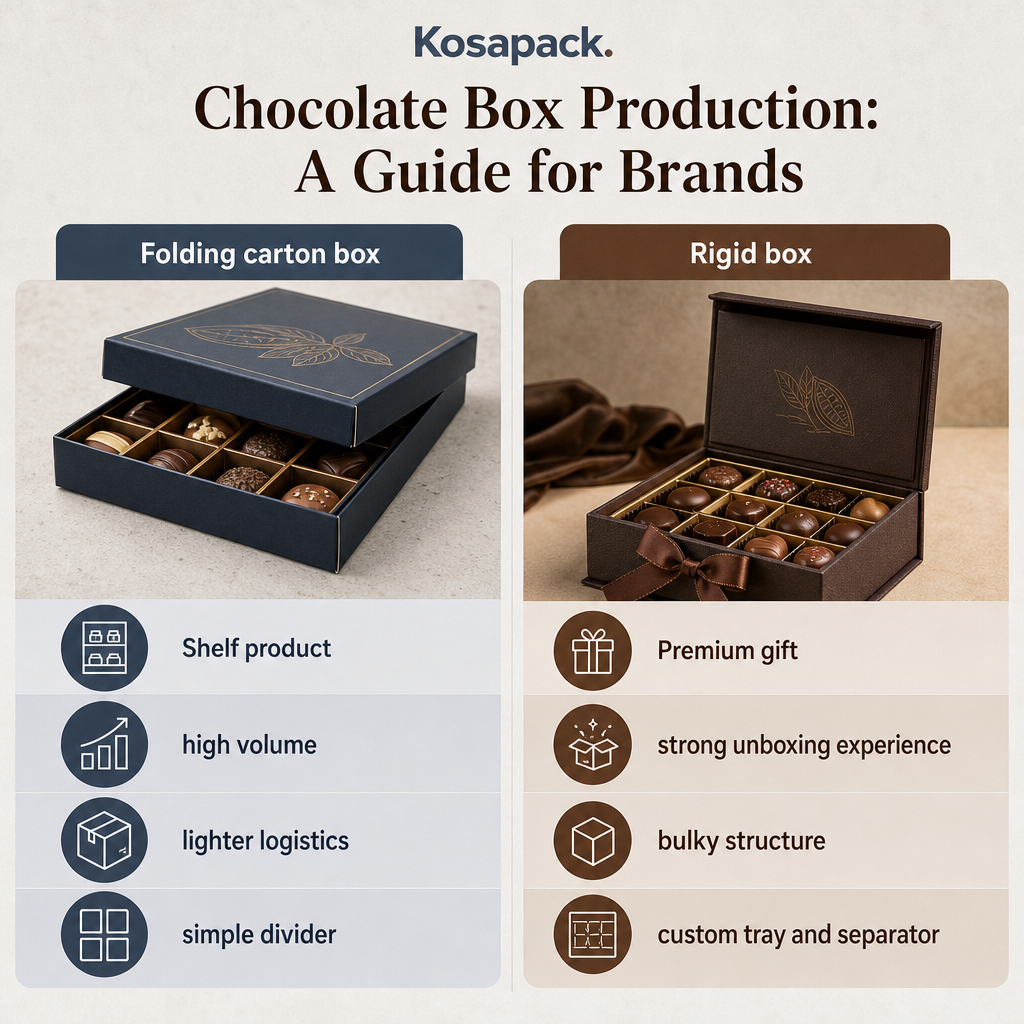
The two most frequently considered options in chocolate packaging are the folding carton box and the rigid board box. The difference between them lies not only in appearance; it also emerges in perceived value, logistics volume, and interior layout flexibility.
| Criterion | Folding carton box | Rigid board box |
|---|---|---|
| Use case | Shelf product, high volume, mass sales | Premium chocolate, gift set, corporate shipping |
| Structure | Printed carton that takes form by folding | Covering paper over a thick rigid board body |
| Cost approach | Lighter and scalable | Higher perceived value and presentation impact |
| Logistics | Less volume and weight | Bulkier and more durable structure |
| Interior layout | With a simple divider or tray | Expandable with custom tray, compartments and separators |
The folding carton box offers advantages for lightweight products, high-volume production, and projects where shelf visibility is a priority. The rigid board box, on the other hand, is better suited to premium chocolate brands where the feeling of sturdiness it conveys in the hand and the moment of opening stand out. In our published guide, we define the rigid board box as a form used for chocolate, luxury gift sets, candles, and premium product groups, with decorative covering paper applied over thick rigid board or chipboard; and we position the carton box as a lighter, print-friendly, and cost-accessible option.
To delve deeper into this distinction, you can review our content What Is a Rigid Board Box? Features and Uses and What Is a Folding Box? Uses.
Why is the interior layout decisive in a chocolate box?
The interior arrangement is as much a part of the production decision as the box's exterior appearance. Chocolates moving inside the box, rubbing against each other, or tipping over during transport leads to both physical damage and a spoiled impression at the moment of opening. The main solutions you can consider for the interior layout are as follows:
- In-box separator: Keeps pralines, tablets, or different pieces in separate compartments.
- Carton inner tray: Ensures the products are arranged in a specific order.
- Custom-sized slot: Secures single products in place.
- Layered interior arrangement: Presents different chocolate varieties in the same box.
- Tissue paper or paper filling: Reduces empty space and supports the sense of presentation.
The size of the separator cannot be determined solely by the product's width, length, and height. Whether the chocolate is presented wrapped or unwrapped, the gap between pieces, the carrying orientation of the box, and the way it opens must all factor into the design. For example, in a 12-piece praline box, having each compartment the same size is often not enough; the shape of the product, the decoration on it, the use of separate wrapping, and the distance the box will be carried as a gift must be tested in the prototype. When selecting material for in-box filling, our guide What Is Tissue Paper? Its Use and Advantages in Packaging helps you strike a balance between the sense of presentation and recyclability.
Regulations for chocolate packaging in contact with food
If the chocolate is placed directly inside the box, or if a material in the box comes into contact with the product, the suitability of the packaging components in terms of food contact must be evaluated. The Ministry of Agriculture and Forestry defines materials and articles in contact with food as packaging materials that protect food against external influences and enable its transport and storage, along with materials that come into or are expected to come into contact with food.
For this reason, looking only at the exterior print is not enough. The following components must be considered together:
- Box body and covering paper
- Inner tray and separator
- Paper or film that the chocolate comes into direct contact with
- Printing ink, varnish, cellophane, and other surface treatments
- Adhesives
- The duration the product will remain in the packaging and storage conditions
According to the Ministry's statements, food packaging, while protecting the product from external factors, must also provide conditions that prevent harmful components from migrating from the packaging material into the food. The first question you need to clarify is whether the box comes into direct contact with the food or indirectly as secondary packaging. If the chocolate is wrapped in an inner packaging suitable for food contact, the role of the outer rigid board box changes; however, if the inner tray, separator, or paper touches the product directly, the compliance documents and production conditions must be checked separately. In businesses that produce food-contact packaging, managing hygiene, traceability, and batch information is also important; the packaging is expected to be protected from contamination throughout transport, storage, and distribution.
Practical note: In a chocolate box quotation, explicitly state the question "Is there any part that will come into contact with food?" For every component that comes into direct contact, the compliance documents and, if necessary, the scope of testing must be confirmed with the manufacturer.
Since regulatory requirements may vary depending on the target market and current regulations, we recommend verifying the obligations specific to the market where your product will be sold with your own manufacturer and, when necessary, a regulatory consultant.
Premium perception through printing and surface treatments
Chocolate packaging, especially in the shelf and gift category, is one of the main touchpoints carrying the brand's visual identity. The printing method must be chosen together with the material. Offset printing is a strong option for color consistency, fine lines, and the controlled application of corporate colors in high-volume production. Digital printing, on the other hand, offers advantages in low quantities, in the use of different designs within the same project, and in personalized boxes; it is suitable for seasonal series, named corporate gifts, and limited editions. When choosing a method, look not only at the unit price but also at quantity, number of designs, delivery schedule, color expectation, and the possibility of reordering together. For the details of the decision framework, make use of our guide Offset Printing vs Digital Printing: Which Is Right for You?.
Surface treatments carry the brand's positioning onto the box:
- Matte or glossy cellophane: Changes the appearance and texture of the surface.
- Varnish: Highlights the logo, pattern, or specific areas.
- Foil: Creates gold, silver, or metallic effects.
- Embossing: Gives the logo or pattern a tactile relief.
- Soft-touch: Provides a soft, velvety surface feel.
- Specially textured paper: Strengthens the perception of a handmade or boutique brand.
For a premium perception, there is no need to use all treatments at once. Excessive gloss, heavy foil, or too many effects can conflict with the brand's positioning. Often, a minimal logo, textured covering paper, and a single metallic detail deliver a stronger result. When choosing covering paper, our content What Is Coated Paper? A Guide to Its Use in Packaging helps you match your surface and printing expectations with the right weight.
Why should the sample never be up for negotiation?
Digital design does not show all the features of the final product. Especially in rigid board boxes, the material thickness, the direction of the covering paper, the lid movement, the magnet or mechanism, the inner separator, and the product placement can only be seen in a physical sample. At the sampling stage, you can examine the following:
- Whether the chocolate fits comfortably in the box
- Whether the products move inside the box
- Whether the lid opens and closes easily
- Whether the separator secures the products sufficiently
- Whether the print color matches the brand expectation
- Whether the foil, varnish, or embossing is in the correct position
- Whether there are opening or adhesion problems at the box edges
- Whether the products look orderly and appetizing at the moment of opening
In brand-specific box projects, we test the printing and surface treatments with a physical prototype, and after approval we proceed to mass production; we carry it out with production-verified factory partners and quality control coordination. Proceeding to mass production without the sample being approved amplifies risks such as wrong dimensions, incorrect color, the product shifting inside the box, or the lid mechanism working differently than expected.
Factors that determine cost
It is not correct to give a single standard price for a chocolate box; the cost is formed from a combination of the following variables:
- Box type: folding carton, rigid board box, or corrugated outer box
- Box size and volume
- Rigid board or carton weight
- Inner separator and tray structure
- Printing technique and number of colors
- Surface treatments such as cellophane, varnish, foil, embossing
- Magnet, ribbon, or special lid mechanism
- Order quantity along with sample and die requirements
- Food contact conditions, storage, and shipping method
For a high-volume shelf product, a simple folding carton box keeps the unit cost and logistics volume under control. For a limited-edition premium gift set, on the other hand, a rigid board box, inner separator, and special surface treatments can turn a higher budget into a meaningful brand investment. When comparing quotes, check the scope as well as the per-box price: if the sample, interior layout, printing proof, quality control, packing, and delivery are not included, a quote that appears low may rise at the end of production.
Outer packaging for e-commerce and corporate gifting
A chocolate box can be the product's presentation packaging; however, in shipping consignments a second outer packaging is often needed. In this scenario, three layers are planned together: the product packaging that carries the chocolate and the brand presentation, the protective interior layout that reduces the box's movement during shipping, and the corrugated outer shipping box that provides protection against impact and pressure. If the outer box is chosen larger than necessary, empty space, the need for filling, and volumetric cost increase; if it is chosen smaller than necessary, the premium box may be squeezed or its surface may be damaged.
Our product range includes, alongside rigid board and carton boxes, complementary packaging such as corrugated boxes, labels, tissue paper, thank-you cards, paper bags, and in-box separators. Planning these products together reduces the risk of color, size, and delivery mismatches between different suppliers.
What to look for in a sustainable chocolate box?
A sustainability claim should not be reduced to the message "we use paper." For a more robust assessment, examine the following topics together:
- The material structure and recyclability of the box and inner parts
- The separability of different materials from one another
- The use of unnecessary plastic or composite layers
- The suitability of the box size to the product and excessive empty space
- The effect of printing and surface treatments on the recycling process
- The supplier's ability to provide certificates, technical documentation, and a carbon impact report
For brands offering products to the EU market, extended producer responsibility regarding the collection, sorting, reuse, and recycling of packaging waste is also important. For brands selling in Turkey as well, we recommend confirming your packaging choice with regulatory consultants in line with the target market and the relevant current obligations.
Chocolate box production with Kosapack
For chocolate brands, we can plan folding carton and rigid board box alternatives together with inner separators, custom sizing, printing, and surface treatments. Depending on the scope of the project, we can evaluate the product packaging, outer shipping box, label, tissue paper, thank-you card, and other complementary products within the same packaging system. In our custom box projects, we handle consultancy, structural design, graphic application, sampling, mass production quality control, and consolidated logistics together. We aim for 24 hours for a quote and 7–15 business days for a physical sample; we clarify the exact timeline together according to the scope of the project.
To speed up the quote, it is enough to share the following information:
- The dimensions and total weight of the chocolate
- Format: single product, tablet, praline, or gift set
- The number of products inside the box and whether the product comes into direct contact with the packaging
- The preferred box type or the dimensions of an existing box
- Target order quantity and sales channel: shelf, store, e-commerce, or corporate shipping
- Brand colors, existing design files, and desired surface treatments
- Sample and target delivery date
Frequently Asked Questions
Is a rigid board box or a carton box better for a chocolate box?
There is no single right answer. For high-volume, lightweight, shelf-focused products, a folding carton is more suitable; for premium gift sets, corporate presentations, and projects where a strong opening experience is desired, a rigid board box is more appropriate.
Is a rigid board box suitable for food contact with chocolate?
Suitability depends on which part of the box comes into contact with the chocolate and on all the components used. If the chocolate touches the box, the inner tray, or the separator directly, the suitability of the material, ink, varnish, and adhesive must be verified with the manufacturer.
Is an inner separator necessary in a chocolate box?
In multi-piece boxes, a separator or custom inner tray is often useful because it prevents the products from moving and tipping over. The necessity is determined by the product's shape, quantity, and transport conditions.
Should a sample be taken in chocolate box production?
Yes. A sample lets you verify the dimensions, lid movement, interior layout, print color, surface treatment, and product protection before mass production.
What affects the price most in chocolate box production?
Box type, size, quantity, inner separator, printing, surface treatments, lid mechanism, sample, food contact conditions, and logistics are the main factors.