

Cosmetic box design is far more than placing a logo on a box: it is a holistic decision-making process that protects the product, strengthens the brand's perceived value, stands out on the shelf and in e-commerce visuals, and delivers the right information to the consumer. The right result emerges when the product's form, fragility, sales channel, brand language, printing expectations, and regulatory requirements are evaluated together. Our goal is not to impose a single box model; it is to help your brand make a clear, production-ready design decision.
Table of contents
What is cosmetic box design and which decisions does it cover?
Cosmetic box design is the planning, as a single whole, of a box's structural form, dimensions, material, internal layout, graphic design, printing and surface finishes, and product information in order to protect and present a product. Successful design solves both aesthetic appearance and function at the same time.
To make this concrete, consider a serum bottle. A good box decision is not only concerned with color and logo; it also covers preventing the bottle from moving inside the box, protecting the glass surface against impacts, and placing product information in a legible manner. When these three layers are considered separately from one another, the resulting box is often either fragile or communicates poorly.
Design also has a legal framework. In Turkey, cosmetic products are evaluated under Cosmetic Law No. 5324 and the Cosmetic Products Regulation dated May 8, 2023, and compliance with the legislation is the manufacturer's responsibility. In addition, a special conformity mark on the box is not mandatory for cosmetic regulatory compliance (Ministry of Trade sectoral guide). This framework shows from the outset that information areas cannot be left until the very end of the design.
The starting point is not the product, but the usage scenario
The same brand cannot use the same box approach for serum, perfume, lipstick, and a care set; because each product has different physical and commercial needs. For this reason, design should begin not by choosing a material or printing technique, but by defining the scenario.
Before a proper brief, the following questions should be clarified:
- Is the product in the form of a glass bottle, plastic tube, jar, or palette?
- Will a single product or a set be offered?
- Will the box be used on a store shelf, inside a shipping package, or as a gift?
- Is the product heavy, fragile, or does it carry a risk of leakage?
- Is the box single-use, or can it be reused for storage?
- Does the brand have an accessible, natural, clinical, premium, or luxury positioning?
- Will the product be sold in different sizes or variants?
If a material or printing method is chosen before this information is clarified, it may lead to the design being redrawn in later stages. If you want a broader view of why packaging is a decision variable for your brand, our guide explaining the functions of branded packaging complements this scenario-based thinking.
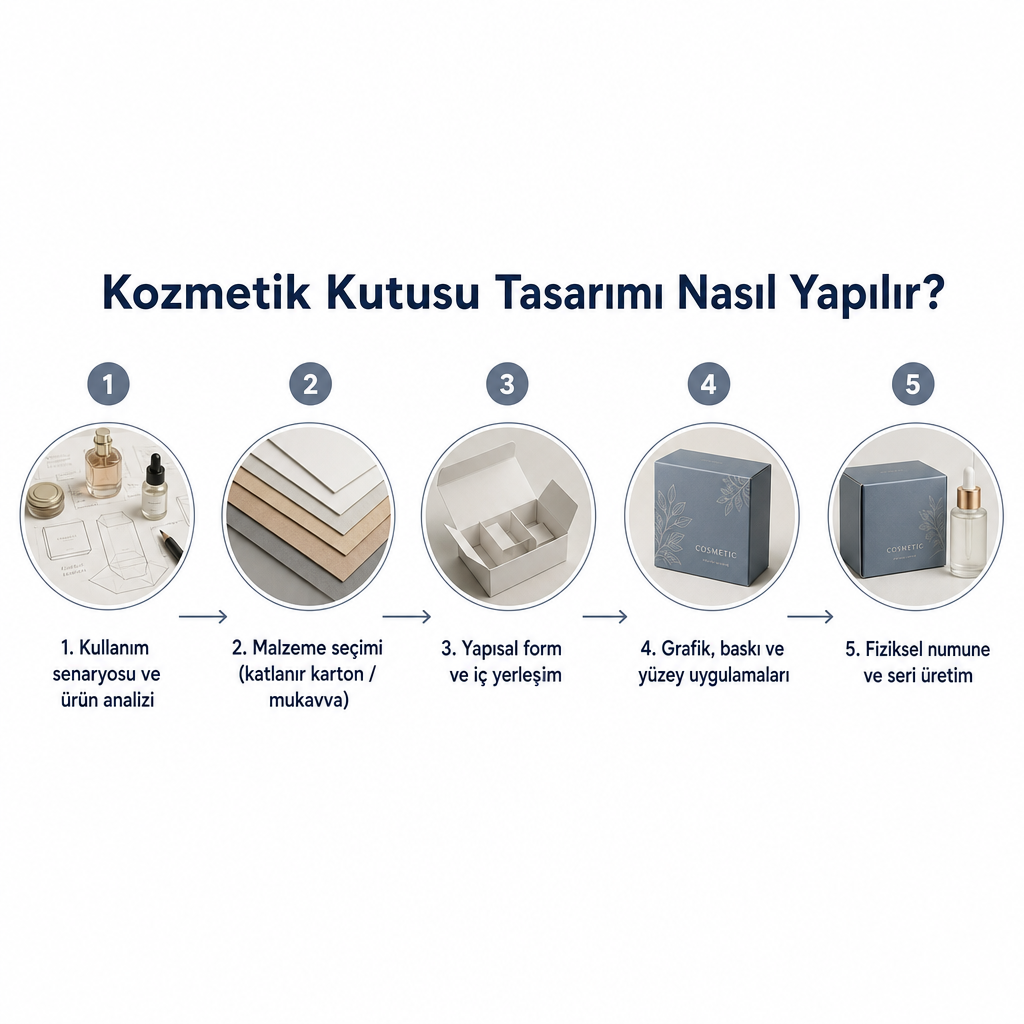
Folding carton or rigid board? The logic behind the material decision
Material selection is determined by the relationship between the product's weight and the brand's presentation goal. Two main approaches stand out for cosmetic products: folding carton boxes and rigid board boxes. The right question is not "which one is higher quality?" but through which channel the product will be sold, how it will be transported, and what perception it will create in the consumer.
Folding carton boxes are frequently used for products such as creams, serums, soaps, tubes, and mascara. They are a strong choice when high-volume production, a compact structure suitable for shelf sales, low storage volume, a wide printing area, and the differentiation of variants by color are needed. Here, the carton weight, box dimensions, and product weight should be evaluated together: very thin carton cannot maintain its form, especially with heavy glass bottles, while carton that is thicker than necessary increases cost and folding difficulty.
Rigid board boxes, on the other hand, are preferred for premium perfumes, skincare sets, gift boxes, and products where high perceived value is expected. A sturdier box feel, high protection, a premium opening experience, special lid and internal layout options, the ability to present product sets in a single structure, and reusability potential are the advantages of this structure. In a rigid board box, the body, lid mechanism, wrapping paper, internal separator, and surface finishes are designed together. In our rigid board box service, in addition to structural design, dimensions, and internal arrangement, we offer unprinted, printed, or 3D digital mockup sample options. We cover in detail how this structure is designed for brands in our premium rigid board box production guide.
Through which channel will the product be sold, how will it be transported, and what brand perception will it create in the consumer?
Structural decisions: form, internal layout, and dimensions
Structural design determines how the box will work before how it will look. Form selection depends directly on the product type: a classic top-opening folding box, a tuck-lock carton box, a lidded or magnetic rigid board box, a drawer box, a two-piece lid-and-body structure, a set box, a window box, and a box with an internal tray are solutions for different scenarios. While a compact folding box is sufficient for a single serum; for a care set consisting of serum, cream, and cleanser, a rigid board box with an internal tray or separators may be more appropriate.
The empty space inside the box is a critical risk in cosmetic packaging. If the product moves inside the box, the glass bottle may be damaged, the lid or pump may be harmed, the product's orientation may be disrupted, and the opening experience is weakened. Internal separators, carton dividers, die-cut slots, carton trays, or special internal supports reduce this risk. The dimensions of bottles and tubes should be determined not only according to the outer packaging dimensions but also taking production tolerances into account.
Dimension optimization, on the other hand, is a two-way balance. An overly large box increases material consumption and shipping volume, causes the product to move inside, and creates the perception that "the product is small, the box is big." An overly small box, however, makes it difficult to place the product and limits the printing area. The right box does not squeeze the product, but it also does not leave unnecessary empty space.
How does graphic design turn a box into a brand?
The graphics of a cosmetic box are one of the first points of contact a product has on the shelf or on screen; however, visual richness should not take precedence over legibility. The color palette should be consistent with the product category and brand positioning. White, off-white, and pastel tones establish a sense of simplicity and gentle care; black, dark green, or navy support a premium and expertise-focused positioning; vivid colors create differentiation for makeup and a younger target audience; metallic tones strengthen the perception of luxury and gifting. Color is also a system: serum types, skin types, or fragrance options should be easily distinguishable by color.
Typography and information hierarchy are also part of the decision. On the front of the box, the brand name, product type, and key distinguishing information should be understandable at first glance; on the back and sides, usage, contents, warnings, and manufacturer information should be arranged in an orderly manner. Very small point sizes, low contrast, thin text on a glossy background, using too many typefaces together, and the product name getting lost within the logo are risks to be avoided.
The visual language can be built on illustration, photography, pattern, typographic layout, or plain white space. What matters is that the language used does not conflict with the product's actual positioning. On a product claiming natural ingredients, overly glossy, plastic-looking graphics weaken the brand message; on a product positioned as clinical, overly decorative patterns reduce the perception of trust.
Printing, surface finishes, and the regulatory area
Printing and finish decisions directly affect the perceived quality of the box, but not every surface finish produces the same result on every material or in every quantity. Offset and digital printing, matte or glossy lamination, spot UV varnish, hot foil stamping, embossing, textured wrapping paper, and special color applications are options that can be evaluated. A matte surface gives a simple and premium look; however, on dark-colored matte surfaces, the risk of fingerprints and scratches should be checked on a sample. Spot varnish highlights a logo or a specific area in a distinguished way on a matte background. Gold, silver, or metallic foils create a strong accent on perfume and gift boxes, but the suitability of line thickness and logo details for production should be tested beforehand. Embossing adds a tactile feature; because the expected result may not be achieved with finely detailed logos, a physical sample is decisive.
Regulation and product information, on the other hand, should not be "squeezed" onto the box after the graphics are completed, but should be reserved as space in the initial brief stage. In Turkey, the safety of cosmetic products is addressed through obligations such as the product information file and the product safety assessment report; the manufacturer has the responsibility to ensure compliance with the legislation, and the company must have a responsible technical staff member (Ministry of Trade sectoral guide). For this reason, items such as the product name, nominal content quantity, intended use and instructions, warnings, ingredient information, responsible person or manufacturer information, batch/traceability information, durability period or post-opening usage information, and origin should be checked in a manner consistent with the legislation and the product file. The final texts are verified by the brand and the responsible technical team; we support design and production compliance, but the ultimate responsibility for product regulation lies with the brand's authorized team.
Design differences by sales channel
The same product requires different box decisions in different channels. In shelf sales, the front of the box should be readable within a few seconds; the brand, product type, and key benefit message should stand out in the visual hierarchy. Variant differentiation among products standing side by side, legibility from shelf distance, upright stance, surface scratch resistance, and keeping the product stable inside the box are decisive in this scenario.
In e-commerce, the box is often visible in product page visuals and at the moment of delivery. For this reason, the box should be easy to distinguish in photos, protected during the shipping process, support the opening experience, and stand out from the outer shipping packaging. The retail box prepared for a cosmetic product is often not a standalone shipping box: for glass bottles or delicate products, a corrugated shipping box on the outside and a branded cosmetic box on the inside can be used together.
In gift and set sales, the internal arrangement and opening sequence come to the fore. Having the products visible one by one, arranging accessories in an orderly manner, and the controlled opening of the lid strengthen the experience. In this scenario, the rigid board box, internal tray, separators, and complementary packaging such as tissue paper are evaluated together.
Sustainability is also a design layer independent of the channel, and it is not limited to simply choosing recyclable material. Choosing a box size proportional to the product, avoiding unnecessary volume, reducing material layers, making it easier to separate different materials, evaluating reuse potential, and taking shipping and storage volume into account yield a more balanced result. Sustainability claims should be supported not by marketing messages, but by material, sourcing, production, and usage scenarios.
Information that should be ready in the brief
The most common mistakes are actually the result of an incomplete brief: starting the design without measuring the product, focusing only on appearance, neglecting the information area, moving to mass production without taking a sample, leaving the shipping scenario out, and forcing the same box structure on every product even though the forms differ. To prevent these, starting the quotation and design process with the following information saves time.
| Brief area | Information to be provided |
|---|---|
| Product | Product name, type, net quantity |
| Physical dimensions | Width, length, height, weight |
| Packaging | Bottle, tube, jar, palette, or set |
| Fragility | Glass, pump, lid, and leakage risk |
| Sales channel | Store, e-commerce, salon, gift, or mixed |
| Quantity | Initial production and estimated reorder |
| Brand language | Premium, natural, clinical, minimal, colorful, luxury |
| Printing and finish | Logo file, color expectation, matte/varnish/foil/embossing |
| Internal layout | Separator, tray, insert, or fixation |
| Regulation and logistics | Approved product information, shipping and outer freight conditions |
Sample approval is especially critical in projects using dark colors, foil, embossing, magnets, and internal separators: the color on screen, the surface texture, and the feel of the box in hand may not look the same as the physical sample. For material selection in complementary packaging alongside the rigid board structure, our guide explaining the properties of kraft paper makes decision-making easier.
Cosmetic box design with Kosapack
For cosmetic brands, we handle the box project not merely as a printing service; but within the integrity of consulting, structural design, graphic design, prototyping, managed production, and logistics. Planning folding carton boxes, rigid board boxes, outer shipping boxes, paper bags, labels, and complementary packaging together reduces the risk of mismatch between different suppliers. We design different box and complementary packaging scenarios for perfumes, skincare sets, creams, serums, tubes, and e-commerce shipments within the same project.
Within the scope of the project, we clarify the following outputs: the box type suitable for the product and sales channel, custom dimensions and internal layout, graphic application consistent with the brand identity, printing and surface options, a physical sample, mass production quality control, and a consolidated logistics plan. In our rigid board box service, in addition to addressing the box model, dimensions, and internal arrangement during the design process, physical sample and pre-production mockup options are also offered.
A simple decision framework is useful when choosing the right box: if the product is fragile, increase internal fixation and protection; if it is sold in high volumes, consider folding carton and efficient dimensions; if it is premium or gift-oriented, examine rigid board boxes, special lids, and tactile surfaces; if it is sold through e-commerce, plan the inner box together with the outer shipping protection; if the product family is broad, establish a common brand language and a color system that distinguishes variants; if there is a regulatory risk, verify the product information with the authorized team at the beginning of the design. The first step is always to prepare a clear brief that includes the product dimensions and the usage scenario.
Frequently Asked Questions
How long does cosmetic box design take?
The duration depends on the box type, the scope of the design, the number of samples, and the printing and finish options. In addition to design approval, time for a physical sample and revisions should also be planned. After the brief, we generally estimate a range of 7–15 business days for a physical sample.
Is a folding carton box or a rigid board box better for cosmetic products?
There is no single right answer. A folding carton box may be more suitable for high-volume, shelf-focused products; while a rigid board box may be more suitable for premium, gift, and high-protection products.
Is a separator necessary in a cosmetic box?
If there is a glass bottle, multiple products, or a risk of the product moving inside the box, a separator or special internal support may be needed. The decision is made by examining the product dimensions and transport conditions.
Does a cosmetic box need to carry a special conformity mark?
According to the Turkey Product Rules Database, a special conformity mark is not mandatory for cosmetic regulatory compliance. However, the product and packaging information must comply with the relevant legislation.
Should a sample be taken before sending the box design to production?
Yes. A sample allows you to check the box dimensions, the product's stance inside it, the lid mechanism, the colors, the surface finishes, and the print legibility.