
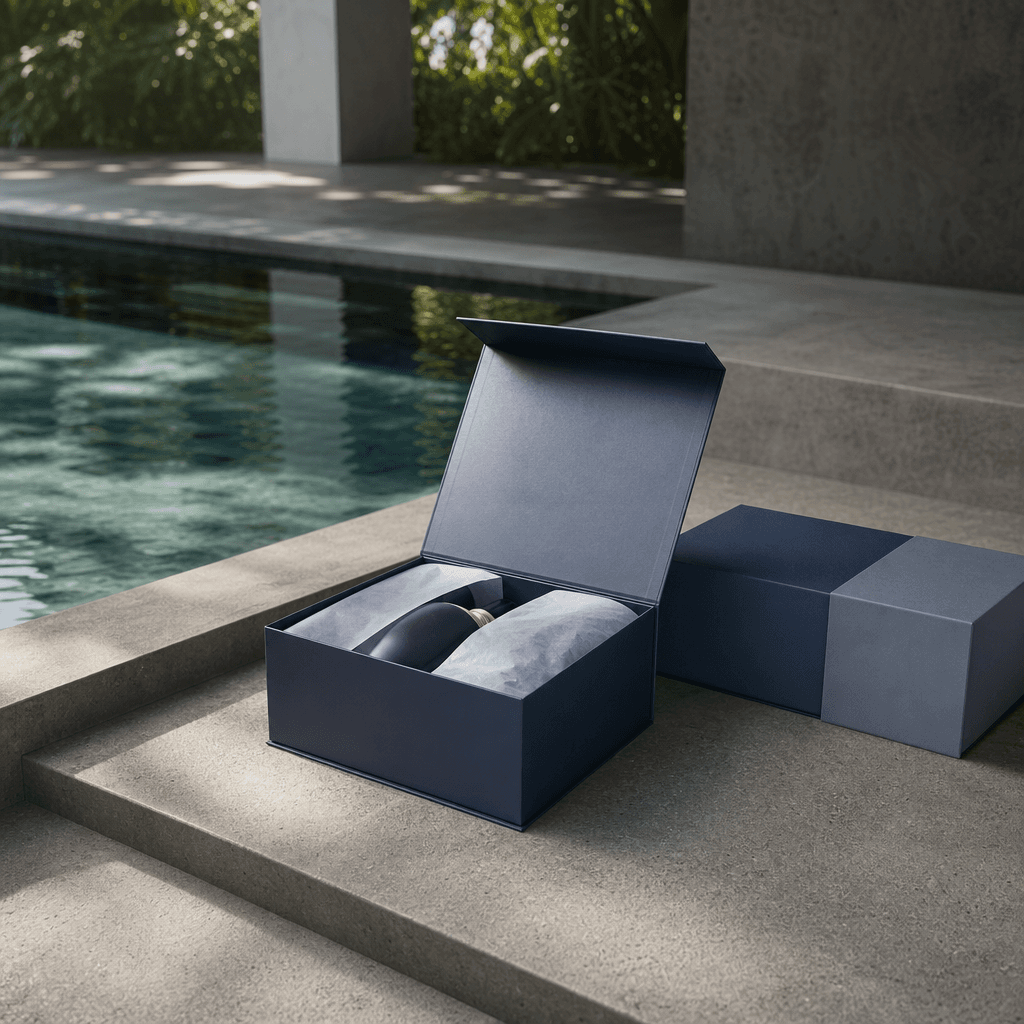
Premium rigid cardboard box production is a packaging decision that goes far beyond protecting the product—it elevates your brand's perceived value, transforms the unboxing moment into a marketing tool, and leaves a lasting impression on the shelf. In premium segments such as cosmetics, jewelry, candles, chocolate, and corporate gifts, a well-designed rigid cardboard box becomes as much a part of the brand as the product itself. In this guide, we explain what a rigid cardboard box is, when it's the right choice for your brand, how the production mechanism works, the technical options that create premium perception, the decision criteria, and common risks. At Kosapack, we manage this entire process under one roof—from consultancy to consolidated logistics.
Table of Contents
What is premium rigid cardboard box production?
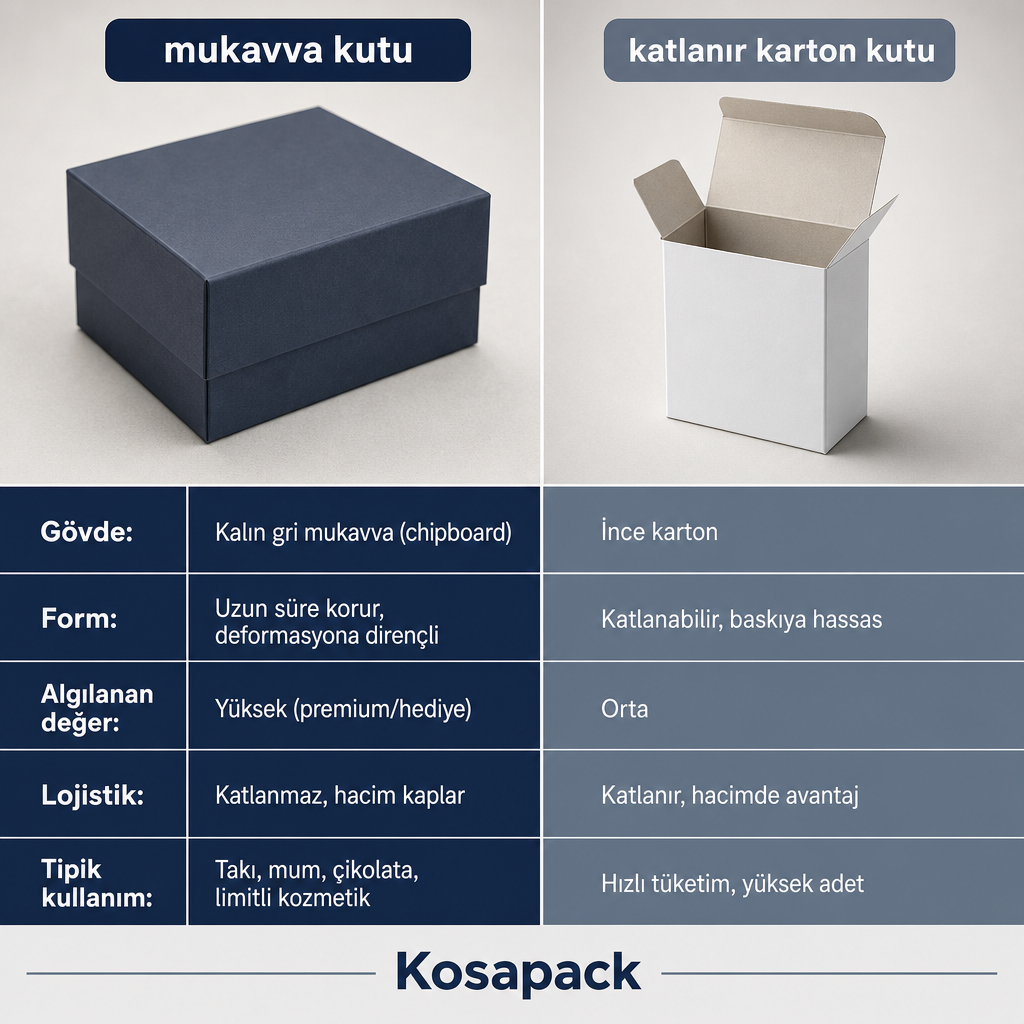
A rigid cardboard box is a hard box type produced by wrapping specialty covering paper around a thick gray chipboard body, and it never loses its shape. There are three key points that distinguish it from thin, foldable carton boxes. Thanks to its body thickness and rigidity, it retains its shape for a long time and withstands being opened and closed repeatedly. The covering paper carries brand identity in a far more refined language through finishes such as lamination, foil stamping, and embossing. And when the consumer holds the product, they directly feel the price segment, the gift positioning, and the brand's attention to detail; perceived value is the decisive factor here.
Instead of letting you pick these boxes from a ready-made catalog, we design and produce them as fully brand-specific projects that unite dimensions, construction, material, and print around a single brand objective. If you're curious about the broader custom production context of rigid cardboard boxes, you can take a look at our comprehensive guide explaining what brand-specific box production is.
The decision for your brand: when should you choose a rigid cardboard box?
A rigid cardboard box is not the right solution for every product, but it is the best solution for certain strategic scenarios. If your product carries gifting and collector value (jewelry, watches, candles, chocolate, limited-edition cosmetics), a rigid cardboard box meaningfully increases perceived value. If you're preparing corporate or VIP gift sets, you achieve a far more professional presentation than with carton—through interior layouts, logo applications, and finishes.
On the e-commerce and DTC side, if you want to use the unboxing moment as a marketing tool, a rigid cardboard box becomes an object that can be photographed, kept, and reused. And for high-priced products that will remain on the shelf in-store for a long time, where the packaging's deformation resistance and color stability are critical, a rigid cardboard box is the right choice.
We don't expect you to make this decision alone. We work with a consultancy-driven model that analyzes your brand's needs and clarifies together whether you need a rigid cardboard box, a carton box, or a different solution. The goal here is not a visual preference, but making a brand decision supported by product, channel, and budget data.
The mechanism: how does premium rigid cardboard box production work?
Premium rigid cardboard box production is a more comprehensive, end-to-end process than a simple "box order." Its workflow can be summarized in five stages.
Consultancy and decision framework. The process begins with a discussion about your products' dimensions, weight, sales channel, and brand objectives. At this stage, the box form (lidded, magnetic, drawer-style, two-piece), dimensions, and material set (cardboard thickness, covering paper type, interior layout materials) are determined. After receiving your brief, we get back to you within 24 hours to determine the right packaging type and scope together.
Structural and graphic design. After the decision, the structural design—including the box body, lid mechanism, and interior separator/foam layout—is prepared; then, in the graphic stage, the logo, typography, and colors are worked into alignment with your brand guidelines.
Sample and prototype. Before mass production, the lid feel, colors, and finishes are tested with an unprinted or printed physical sample or a 3D digital mockup. Depending on the scope of the brief, we provide a physical sample within approximately 7–15 business days, enabling you to make your decision based on an actual box.
Managed production and quality control. After approval, the cardboard is cut, the covering paper is printed, and the finishes are applied; the paper is glued to the cardboard body and shaped into the box. Mass production is carried out through our verified factory partners; print, cut, gluing, and strength checks are systematically monitored throughout the project. This minimizes risks such as color inconsistency, faulty lid operation, or a body that easily falls apart.
Logistics and delivery. After design approval, the standard production time is approximately 10–25 business days; domestic shipping within Turkey ranges from 2–5 business days depending on demand. We also reduce logistical complexity by consolidating your different packaging types (rigid cardboard box, carton box, bag, label, tissue paper) under one roof. If you're thinking of designing the unboxing moment with tissue paper, a thank-you card, and a label, you can benefit from our guide explaining how to create an unboxing experience.
The technical options that make a premium rigid cardboard box premium
What elevates a rigid cardboard box to a "premium" level is a few critical technical choices. Combining them correctly aligns your packaging with your brand's price segment.
Material and body structure. Thick gray cardboard enables the box to retain its shape and conveys a high-quality feel. Cardboard thickness is determined based on the product's weight and dimensions; a higher-strength body is preferred for heavy jewelry sets or cosmetics in glass bottles.
Covering paper and print. Matte, semi-matte, or glossy coatings; textured specialty papers, kraft looks, or metallic surfaces are chosen according to your brand tone. Offset printing delivers high-resolution, color-consistent results in CMYK and Pantone colors. While a single-color logo on a simple coating may be enough for a minimalist brand, compositions enriched with special effects can be built for the luxury segment.
Finishing (surface effects). Processes such as lamination, spot UV, embossing, debossing, and hot foil stamping are the main tools that support premium perception. In particular, embossing or foil stamping used on the logo positions the box as a luxury object, both on the shelf and during unboxing.
Box form and lid mechanism. Magnetic lids, drawer-style boxes, two-piece lid-and-body structures, or book-cover forms are chosen according to product type and frequency of use. For products that will be opened and closed frequently, a more ergonomic form and extra strength stand out; for collection boxes, more striking, sculptural structures come to the fore.
Interior layout and protection. EVA or foam inserts, cardboard separators, and custom-cut interior beds provide both protection and aesthetic presentation for premium candles, jewelry, or bottled products. When the interior composition is completed with tissue paper, a thank-you card, and branded labels, the unboxing moment turns into a brand experience.
Decision criteria: choosing the right box for your brand
We treat premium rigid cardboard box production not as a visual preference, but as a brand decision based on concrete criteria. The following six headings clarify the decision.
| Criterion | What to look at | When a rigid cardboard box is right |
|---|---|---|
| Product protection | Fragility, weight, number of parts | Glass bottles, fragile jewelry, multi-part sets |
| Brand positioning | Price segment, perceived value | Premium/luxury price segment |
| Unboxing | Shareability, DTC experience | If video/photo sharing is targeted |
| Logistics and quantity | Storage, unit cost, dimensional weight | If the volume and cost are acceptable |
| Sustainability | Recycling, certified paper | If a controlled finishing set is possible |
| Ecosystem consistency | Harmony with other packaging | If a cohesive brand language is desired |
On the product protection side, a rigid body and the right interior layout reduce the risk of breakage and return rates. In brand positioning, while a thin carton box often doesn't support a luxury perception, a rigid cardboard box fills that gap. If there is an unboxing and shareability goal, your design language, interior arrangement, and box form should be shaped around this experience.
The logistics side should not be neglected: rigid cardboard boxes don't fold, take up volume in storage, and have a higher unit cost than carton; therefore, quantity, storage capacity, and logistics costs should be evaluated together. For sustainability, recyclable materials, responsibly sourced paper, and keeping heavy lamination/plastic components limited are important; we also take on this side with recyclable material sets and carbon footprint reporting. Finally, your rigid cardboard box needs to work in the same design language as carton boxes, paper bags, labels, and tissue paper; by producing all these products under one roof, we simplify brand consistency and supplier management.
Common risks and how we prevent them
A premium box, in a poorly managed process, can harm a brand more than it helps. Here are the most common risks and our approach to them.
- Low-quality cardboard. Thin or flexible cardboard causes the box to deform in a short time. In our projects, we guarantee form stability by using high-quality gray cardboard.
- Color inconsistency and print errors. Color drift or faded printing in mass production damages premium perception. We take the sample and proof stages seriously, verifying color and print quality before mass production.
- Lid and magnet problems. Poor engineering causes the lid not to close fully or the magnet strength to be insufficient. We intensively test the lid mechanism during the structural design and prototype stages.
- Incorrect dimensions and logistics surprises. Boxes that are larger or smaller than necessary ruin both product protection and shipping/dimensional weight costs. We make the dimension decision by evaluating product and logistics data together.
- Finishes that contradict sustainability claims. Excessively plastic-based or non-recyclable combinations weaken sustainability communication. The right material combinations and a reportable carbon footprint eliminate this contradiction.
Before starting your premium rigid cardboard box project, preparing a short brief that includes your dimensions, quantity, sales channel, and brand objectives significantly improves both timing and quote clarity. To see the broader steps of your project, our guide explaining the custom printed carton box production process step by step is also a useful resource.
Frequently Asked Questions
What is the main difference between a premium rigid cardboard box and a carton box?
A rigid cardboard box is a hard-structured box produced with a thick gray cardboard body and covering paper; it retains its shape, elevates perceived value, and withstands frequent opening and closing. A carton box, with its thinner and foldable structure, offers an advantage in volume and cost, but its premium perception level is generally lower.
Which brands benefit most from a premium rigid cardboard box?
Cosmetics, jewelry, candle, chocolate, fashion, and corporate gift brands can meaningfully increase perceived value and the unboxing experience by using rigid cardboard boxes for their high-priced or gifting-oriented products.
How long is the production time and when is the sample ready?
After the brief and design approval, production time is typically 10–25 business days; domestic shipping within Turkey takes 2–5 business days. A physical sample is prepared within approximately 7–15 business days depending on the project scope.
What is the minimum quantity and how are prices determined?
The minimum quantity varies depending on the box type and printing technique. Instead of a fixed list, we do project-based pricing; a clear quote is created by evaluating the box type, dimensions, material, print and finishes, order quantity, and logistics requirements together.
Is it possible to produce a sustainable premium rigid cardboard box?
Yes. With recyclable covering papers, responsibly sourced cardboard, and a controlled finishing set, you can limit environmental impact while maintaining your premium stance. We support this process with sustainable material options and carbon footprint reporting.