
Having custom printed cardboard boxes made is a process that, when carried out with a proper brief and a clear workflow, is completed within 2–6 weeks for most projects, including a physical sample. For premium printed cardboard boxes in Turkey, the per-unit cost typically ranges between 20–40 TL + VAT depending on the combination of dimensions, weight (gsm), printing technique, and quantity; it can exceed this range in small-quantity, effect-heavy projects. In this guide, we build the process step by step through Kosapack's end-to-end service model: from preparation to quotation, design to sample, mass production to delivery, we share concretely what awaits you at each stage and where mistakes are made.
Table of Contents
Before You Start: Prerequisites Checklist
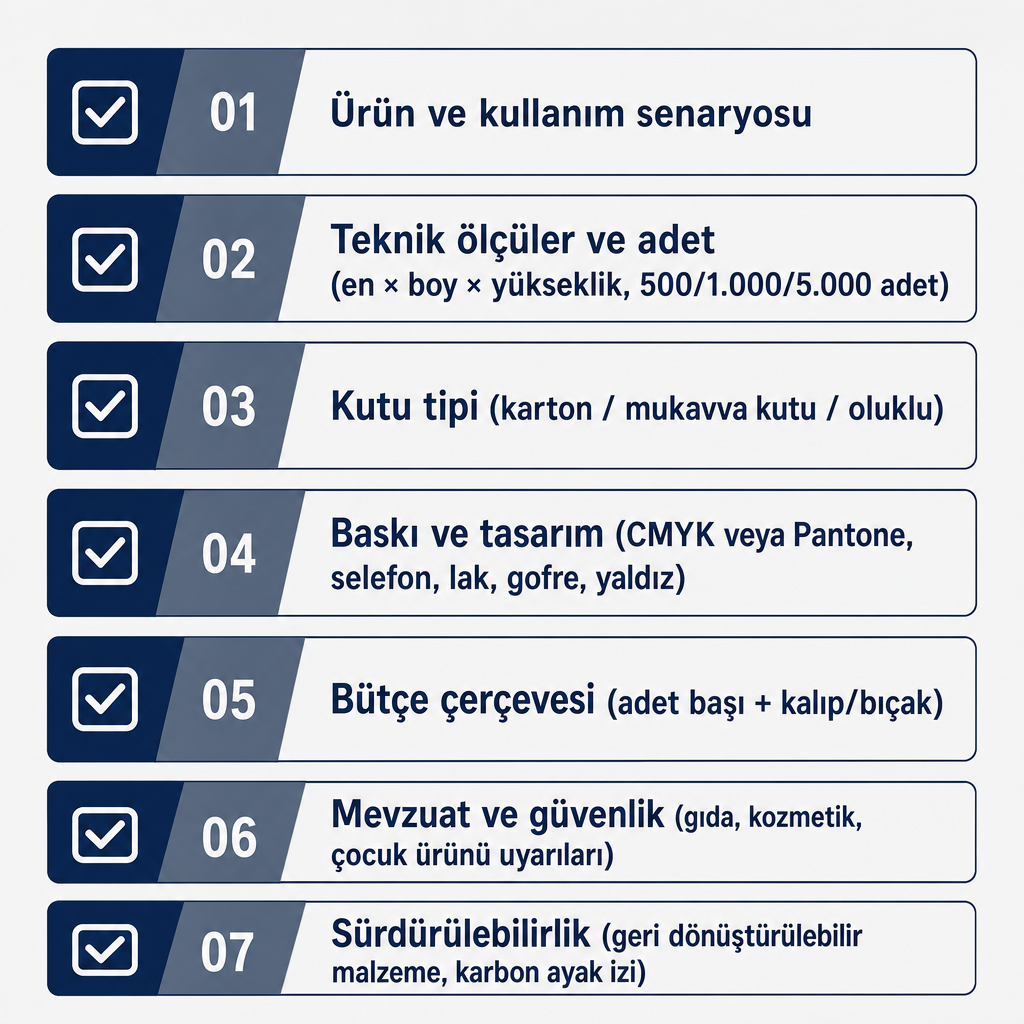
What speeds up the quotation process and reduces surprise costs is coming to the meeting prepared. When you clarify the topics below, you reach both the right box type and a realistic cost much faster.
- Product and use scenario: Product type (cosmetics, jewelry, chocolate, textiles, corporate gift), sales channel (e-commerce, boutique store, chain store, corporate distribution), and the function of the box — is it only protection, or do unboxing and gift perception also matter?
- Technical dimensions and quantity: The product's net dimensions (width × length × height) and weight; internal placement needs for set products; the target quantity of the first order (e.g., 500, 1,000, 5,000) and reorder frequency.
- Box type: Folding cardboard boxes are lighter and advantageous in logistics, generally preferred for high-volume production. Rigid board boxes are thicker and firmer in structure, intended for premium gifts and permanent storage boxes. For e-commerce and heavy products, corrugated or laminated boxes are needed for transport protection.
- Printing and design expectations: Logo, brand colors (CMYK or Pantone codes), typography set; print area (full-surface pattern, minimal logo, interior print) and surface treatments (matte/gloss lamination, spot varnish, embossing, hot foil stamping).
- Budget framework: Target per-unit cost and the total budget range including one-time items such as design, die, and cutting.
- Regulations and safety: Appropriate cardboard type and certification for products in direct contact with food; mandatory labels and warning areas in cosmetics (INCI, warning icons); statements such as choking hazard warnings for children's products.
- Sustainability preferences: Recyclable material, expectation of certified forest sourcing, carbon footprint tracking, and a target ratio of recycled content.
Once this preparation is complete, our fast quotation and sampling process works far more predictably. If you are undecided between box types, you can review our guide to premium box production in Istanbul, where we explore the technical criteria in more depth, before the brief.
Step by Step: Having Custom Printed Cardboard Boxes Made with Kosapack
The process proceeds in seven stages. Knowing when the decision is made at each stage and what is expected of you noticeably lowers the risk of returns and reprints.
1. Needs analysis and choosing the right box type together
Our portfolio brings cardboard boxes, rigid board gift boxes, corrugated e-commerce boxes, labels, paper bags, and complementary packaging together under one roof. This way, you can design a thin-gsm cardboard box for the shelf, a rigid board box for premium gifts, a corrugated or laminated box for shipping, and the tissue paper, label, and thank-you card that enrich the unboxing in a single project. In the needs analysis meeting, by discussing product quantities, sales channels, and the targeted unboxing experience, it is clarified whether "a cardboard box alone," a "cardboard + rigid board combination," or a "cardboard box + paper rope bag" is needed. If you are considering the bag component, we explained how paper rope bags are produced in a separate guide.
2. Clarifying the technical brief and dimensions
To speed up the quotation, we work with a brief format that includes dimensions and technical information. The brief typically includes: box type (cardboard, rigid board, corrugated, or combination); net internal dimensions and tolerance expectations; cardboard type and gsm (e.g., 300–350 gsm cardboard, laminated rigid board); printing technique (offset, digital) and number of colors (4 colors + custom Pantone); surface treatments (lamination, varnish, embossing, foil); quantity and shipping destinations; product, channel, and regulatory notes. This stage is critical for a sound cost calculation, the right choice of die and cutting, and to avoid surprises at the sample. The most common mistake here is confusing internal dimensions with external dimensions; always emphasize the internal dimensions in the brief.
3. Getting a fast price quote
For custom printed cardboard box projects, we aim to provide a fast price quote within 24 hours. The quote is prepared based on box dimensions and volume, cardboard/rigid board type and gsm, the printing and effect combination, and the quantity/logistics model. In our cost guide, for a sample premium printed cardboard box (20×20×9 cm, 25 units), a total of 955 TL (2026) and a per-unit cost of approximately 38.20 TL + VAT was shared. This example shows that in small-quantity, effect-heavy projects the per-unit cost rises rapidly, and that higher quantities are generally preferred for an economical unit cost.
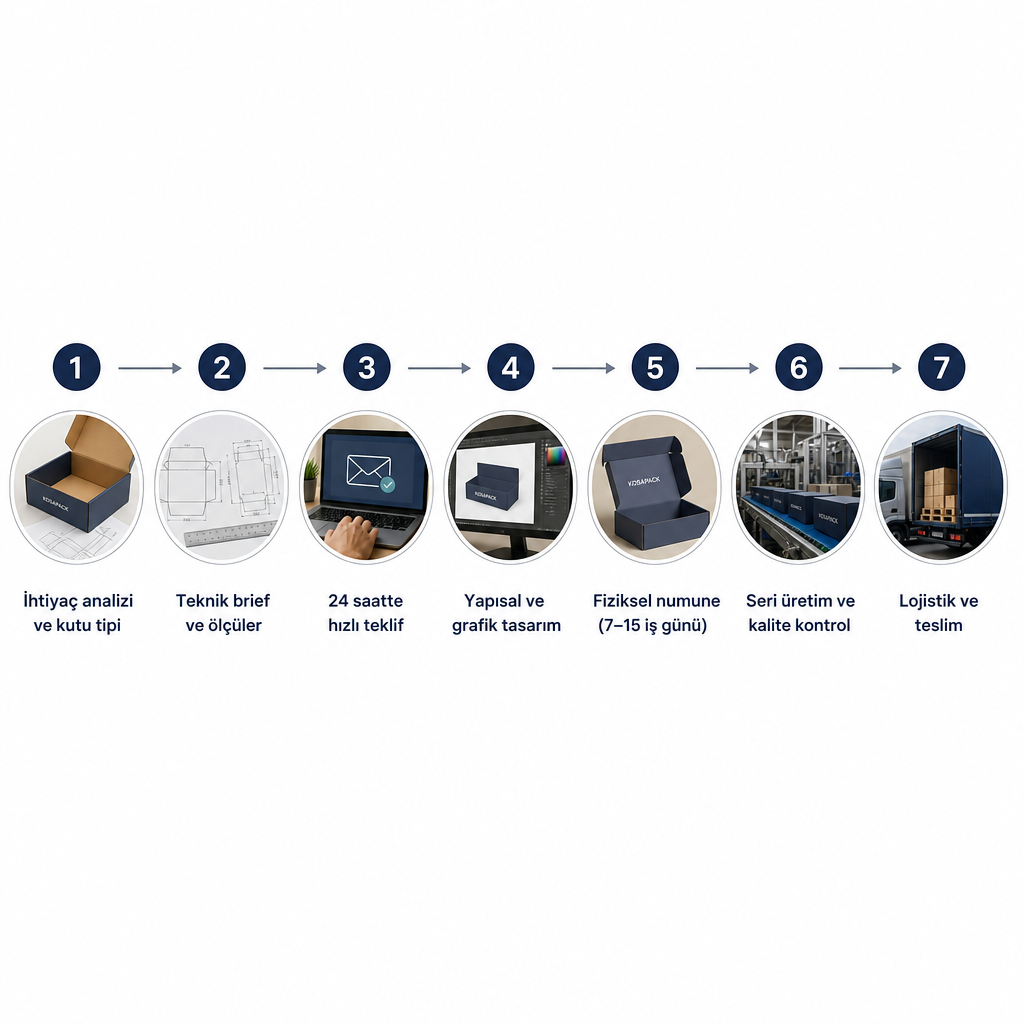
4. Structural and graphic design process
We treat packaging as a service that covers not only production but also structural and graphic design. In structural design, a product-specific die-cut is devised; locking, drawer-style, or windowed form alternatives for cardboard boxes, and lid-base types (magnetic, telescopic, hinged) and internal separators for rigid board boxes are planned. In graphic design, brand colors are converted to CMYK/Pantone, a print-ready file is prepared, product information and regulatory requirements are placed into the visual hierarchy, and a mockup (3D mockup or digital drawing) is submitted for approval. Reserving space for text and icons required by regulations already at the design stage prevents last-minute additions that disrupt the layout.
5. Prototype and physical sample
After the designs are approved, a physical sample (prototype box) is produced; preparation time is typically 7–15 business days. In this process, a structural sample is prepared with real cardboard/rigid board material, a printed sample or color/proof work is carried out especially for Pantone and effect-heavy projects, and the sample is sent to you to test together with your product. At the sample stage, risks such as the product rattling inside the box, the feel of the lid closing, and print colors deviating from the screen are checked, and necessary revisions are clarified.
6. Mass production: printing, cutting, gluing, and quality control
After sample approval, mass production begins. Premium printed cardboard box production generally runs on offset printing, cutting, and automatic folding/gluing lines. Cardboard sheets are printed on offset machines with CMYK and spot colors, and matte, gloss, or soft-touch lamination is applied if needed. In rigid board box projects, the printed cardboard is laminated onto rigid board sheets to form firm panels; the panels are cut, scored, and shaped into the box form. In folding cardboard boxes, automatic folding and side gluing are performed. In quality control, color consistency, cutting precision, adhesion strength, logo alignments, and effect zones are inspected visually and by measurement. Production time can extend from a few days to several weeks depending on quantity and complexity; it is useful to add a safety margin to the timeline for busy campaign periods or projects requiring multiple dies.
7. Logistics, consolidation, and delivery
We don't just produce packaging; we also consolidate different product and box types and manage the logistics. For the same brand, cardboard boxes, rigid board boxes, labels, and bags can be combined into a single shipment. Boxes are delivered flat or assembled depending on your storage method; for domestic shipments in Turkey, palletizing, boxing, and labeling are planned according to your needs. This model reduces the confusion created by working with multiple suppliers and increases color/quality consistency.
Common Mistakes and Solutions
Recurring mistakes in the process usually originate at the brief stage and are noticed in the sample. The table below summarizes the most common problems and their practical solutions.
| Mistake | Result | Solution |
|---|---|---|
| Confusing internal and external dimensions | Box ends up too tight or too loose for the product | Emphasize internal dimensions in the brief and request a dimension simulation if needed |
| Heavy effects on small quantities | Per-unit cost rises many times over | Simplify effects in the first project or increase the quantity |
| Using a screenshot for color | Color difference in printing | Provide the Pantone/CMYK code with the file and request a proof |
| Skipping regulatory areas | Additions that disrupt the design at the final stage | List mandatory text and icons before the design |
| Box type–scenario mismatch | Deformation and breakage during transport | Choose corrugated or laminated for heavy/fragile products, and rigid board boxes for premium gifts |
Each of these items can be caught early by testing at the sample stage; the most expensive scenario is noticing mistakes after mass production.
DIY or Professional Production? The Decision Point
The critical threshold is the value and risk level of the project. A DIY approach like a ready-made box plus a sticker makes sense only for specific, low-risk scenarios.
Scenarios closer to DIY: micro trial productions of 50–100 units; trying only a logo label or a kraft box + label combination on a limited budget; low-value products with low regulatory and durability risk. In these cases, proceeding with a label or sleeve on a ready-made kraft cardboard box can be a temporary solution for testing the brand concept.
Scenarios that require professional production are as follows:
- Premium and luxury brand positioning
- High quantities (e.g., 500+) and regular reorders
- Regulated sectors such as food, cosmetics, and electronics
- The goal of creating a marketing impact through the unboxing experience
- The need for color consistency, mass production quality, and sustainability reporting
Once this threshold is crossed, working with a manufacturer that manages design, sampling, production, and logistics end to end both reduces risks and optimizes the cost/efficiency balance in the long run. At Kosapack, we handle cardboard box and rigid board box solutions with this integrity.
Frequently Asked Questions
What should the minimum quantity be for a custom printed cardboard box?
Due to design, die, and print preparation costs, an economical unit cost is most often achieved with orders of 500–1,000 units and above. Smaller quantities are also possible, but the per-unit cost increases.
Which factors most affect the per-unit price?
Box dimensions, cardboard/rigid board thickness, gsm, printing technique, number of colors, special effects (foil, embossing, spot varnish), and total quantity are the main factors that determine the per-unit cost.
Should I choose a cardboard box or a rigid board box?
Cardboard boxes are preferred for shelf- and e-commerce-oriented, lightweight or mid-range products; rigid board boxes are preferred for premium gifts, jewelry, cosmetic sets, and permanent storage scenarios. Our premium box guide, where we break down the decision with technical criteria, clarifies this choice.
Does it make sense to go straight to production without a sample?
For premium projects where color, dimension, and structural risks are high, production without a sample is generally not recommended. Testing by placing the product in the box with a physical sample seriously reduces the risk of returns, reprints, and reputational loss.
Can I manage multiple packaging items in a single project?
Yes. It is possible to plan cardboard boxes, rigid board boxes, paper bags, labels, tissue paper, and thank-you cards in a single project and consolidate production and logistics. This approach provides an advantage in terms of both cost and brand consistency.