
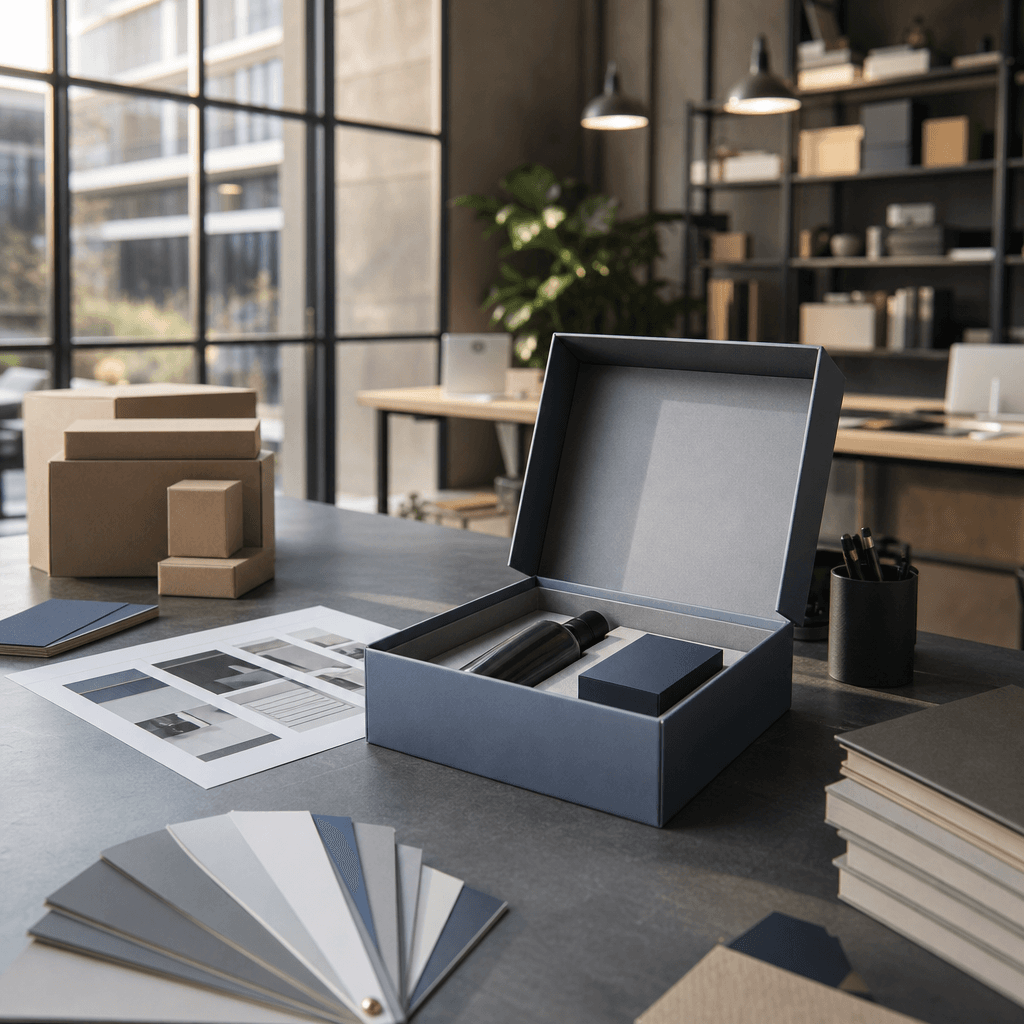
The shortest answer to the question of what brand-specific box production is: it is a box production model designed from scratch according to your product's dimensions, weight, sales channel, and brand identity; a model whose material, printing, and finishing belong entirely to you. Instead of standard catalog dimensions, it brings together decisions about size, construction, material, printing language, and internal layout around a single brand goal. In this article, we gather the definition, the mechanism, the box options, and how to make the right decision for your brand within a single framework; and when you want to go deeper, we direct you to our relevant specialized guides.
Table of Contents
What exactly does brand-specific box production define?
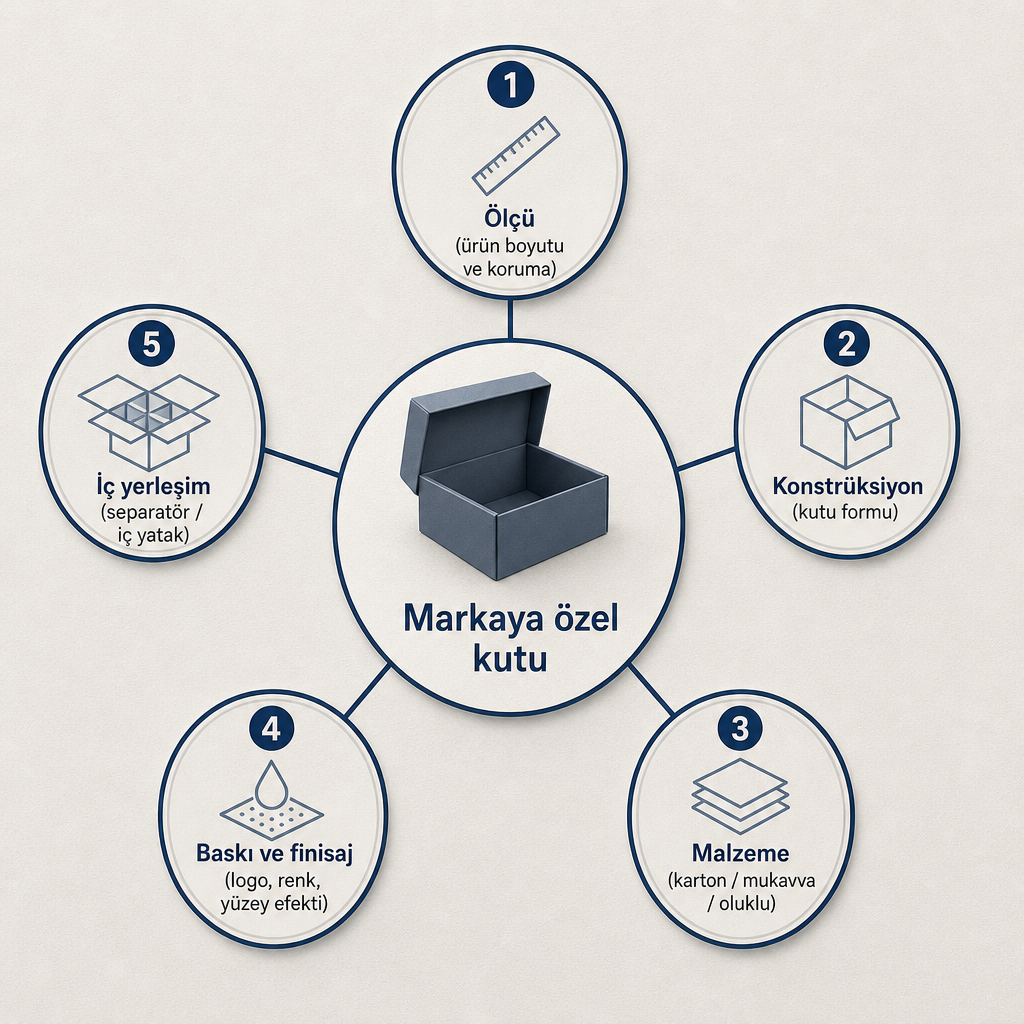
In the classic sense, custom box production means designing the box from scratch according to your product's actual dimensions and protection needs, instead of using standard catalog sizes. Brand-specific box production goes one step further: size, construction (box form), material, printing language, finishing, and internal layout (such as dividers and inner beds) are brought together around a single brand strategy.
The practical meaning of this approach becomes clear in three points. The box wraps your product completely; gaps, movement, and deformation are minimized. The box form — hinged, drawer-style, magnetic, or two-piece — is chosen according to the experience your brand promises. The material, on the other hand, is determined among carton, rigid board, or corrugated so that it aligns with the product weight and price segment. On the graphic design side, logo placement, color palette, typography, and surface effects carry both your brand's shelf and unboxing impact.
When size, construction, material, and printing decisions are made together for a single brand goal, packaging does not merely serve a protective function; it also becomes a marketing and experience tool. And it is precisely this holistic decision that distinguishes brand-specific box production from an ordinary box order.
The brand's real decision: what do you want to solve?
The decision for brand-specific box production is, in fact, a strategy decision made across three axes. How protected and transport-ready do you want to make the product? What level of brand and unboxing experience do you want to deliver to the customer? Within what range do you need to keep logistics, quantity, and budget? These three questions constantly balance one another.
The box is both protection and a brand touchpoint at the same time. On the e-commerce side, the branded shipping box is often the first physical contact you establish with your customer; on the shelf and in-store side, the box is the primary carrier of premium perception. Therefore, when answering the question "what is brand-specific box production?", it is also necessary to clarify a parallel question: for my brand, what problem am I positioning the packaging to solve?
In practice, this problem falls under a few headings: purely product protection, elevating brand perception, making the unboxing moment memorable, or leaving a lasting impression in corporate gifts and gift sets. Determining this priority upfront is a prerequisite for choosing the right box type and production mechanism. For brands that place the unboxing moment at the center, our guide explaining how the unboxing experience is crafted makes this decision concrete.
How the mechanism works: from brief to logistics
Brand-specific box production is not a single box order but an end-to-end managed packaging project. The process consists of sequential stages that feed into one another.
First comes consultancy and needs analysis. Based on the brand's category, target audience, distribution channel, and product range, we clarify together the appropriate packaging type — carton box, rigid board box, corrugated shipping box, paper bag. Then structural design comes into play: the box form, the opening method, the lid type, and mechanical details such as magnets or ribbon pulls are designed with transport and protection functions in mind. Especially in rigid board boxes, by applying a wrapping paper over a thick board base, both high durability and a premium appearance are achieved.
The next stage is graphic design and print preparation. Logo placement, brand colors, printing technique (offset or digital), and surface treatments (varnish, foil, embossing, soft-touch, kraft look) are finalized; the print files are made production-ready. In the sample and proof stage, a physical prototype is produced; color tones, material feel, open-close ergonomics, and internal layout are tested together and revised if necessary.
After approval, mass production is carried out under our quality control and coordination through verified factory partners. At the end of the process, when complementary items such as carton boxes, rigid board boxes, paper bags, labels, and tissue paper are consolidated into a single shipment through consolidated logistics, the brand's supply and warehousing operation is simplified. For those who want to see the operational steps of this process in more detail, we explain how custom-brand packaging is produced step by step in a separate guide.
Box families: folding carton, rigid board, and corrugated
When it comes to brand-specific box production, three main box families stand out in practice for premium brands. Each is strong in a different context.
Folding carton box. Folding carton boxes are lightweight, print-friendly, and cost-accessible solutions for cosmetics, food, small electronics, and shelf products. With custom printing, different weights, and functional folding shapes, they offer a wide design space tailored to the brand.
Rigid board box. The rigid board box is a premium box form produced by applying a decorative wrapping paper over thick board or fiberboard. It is preferred for creating a lasting impression in jewelry, fine jewelry, luxury cosmetics, chocolate, candles, and corporate gift sets. Thanks to its high durability, pronounced sense of weight, and multi-layered finishing options (foil, embossing, textured paper), it is one of the box types that delivers brand-specific perception most powerfully.
Corrugated shipping box (shipper). Corrugated board shipping boxes are indispensable for e-commerce shipments to protect the product and optimize volumetric weight costs. The branded shipping box both keeps the product safe and carries your brand's first physical contact with the customer; that is why printing and structural decisions are made together with a brand-specific unboxing strategy.
In real projects, these three types often work together: a folding carton box on the product shelf, a rigid board box in the gift set, and a branded corrugated shipping box in transit. Supported by paper bags, tissue paper, and labels, a consistent packaging ecosystem is built.
Decision criteria: which box for which brand?
The right box decision rests on a few core criteria. We have gathered the prominent headings and their practical thresholds for premium and growth-stage brands in the table below.
| Criterion | Points toward a folding carton box | Points toward a rigid board box | Points toward a corrugated shipping box |
|---|---|---|---|
| Product and segment | Lightweight, high-volume shelf product | Heavy, high-value, gift-oriented | Shipment with high transport difficulty |
| Sales channel | Shelf and store | Boutique, gifting, luxury presentation | E-commerce / DTC |
| Unboxing goal | Simple premium experience | Lasting, weighty impression | Protected but branded opening |
| Cost logic | Economical unit price | Marketing investment | Balance of volumetric weight and protection |
Perceived value and unboxing goal. Packaging is the first link in the emotional bond established with the customer and an experience that triggers repeat purchases. In premium gifts, influencer deliveries, or corporate gifting projects, a rigid board box leaves a more lasting impression; a folding carton box, on the other hand, is suitable for lighter and simpler premium experiences.
Quantity, cost, and investment perspective. Price is determined by box type, size, material, printing, surface treatments, order quantity, and logistics requirements. Because production is carried out with brand-specific sizes and designs across a wide range from the folding carton box to the luxury rigid board box, each project requires a separate cost structure. The critical question here is: do you see the box merely as a cost item, or as an investment in customer acquisition and brand perception? Premium brands generally view the rigid board box and the branded shipping box as a marketing investment; for this reason, quantity and budget are evaluated together with the medium-term brand strategy.
Sustainability and regulations. Whether the packaging is recyclable, the certification of the paper and inks used, and carbon footprint reporting are increasingly becoming a fundamental decision criterion, especially for cosmetics, food, and corporate brands. We recommend considering material selection together across the axes of product, channel, and sustainability. For brands that want to closely see Istanbul-based production and sampling processes, our premium box production guide brings these decisions down to the local level.
Risks and common mistakes
In brand-specific box projects, the most expensive mistakes are often made not in production but in the decision stage. For a premium brand, the most frequently encountered ones are as follows.
Wrong size and construction decision. Providing product dimensions incompletely or incorrectly causes the box to be too large (risk of gaps and impact) or too tight (damage and production problems). If the construction is not tested sufficiently, problems arise in opening-closing and shelf placement in the field.
Unnecessary weight and cost inflation. The weight and material decision directly affects cost; "the thickest" or "the most luxurious" is not always the right choice. A board or carton weight that does not match the product, channel, and quantity creates unnecessary cost.
Design that does not match the brand identity. Logo placement being illegible, brand colors not being accurately reproduced in print, or finishings being incompatible with the product damages the premium perception. That is why moving to mass production without color and finishing proofs is risky.
Fragmented structure in supply and logistics. Purchasing the box, bag, label, and tissue paper from different suppliers gives rise to color inconsistency, delivery time clashes, and stock management problems. Our consolidated logistics approach aims to reduce this risk by gathering different packaging items into a single shipment.
Price-focused short-term choice. When a decision is made solely on unit price, material quality, print accuracy, quality control, and sustainability criteria may be overlooked. In the long run, the costs of returns, damage, and brand reputation can far exceed the initial saving.
Our approach to brand-specific box production with Kosapack
As a premium packaging partner based in Zeytinburnu, Istanbul, we run brand-focused box projects with an end-to-end service model spanning from consultancy to design, from prototype to production management and consolidated logistics. Our ability to manage carton boxes, rigid board boxes, corrugated shipping boxes, paper bags, labels, tissue paper, thank-you cards, textile pouches, and box dividers under one roof provides an operational advantage, especially for growth-stage e-commerce and DTC brands.
Instead of a fixed, catalog-focused list, we work on a project-based quote for each brand. As the need becomes clear, our expert team gets in touch within 24 hours; the quote is prepared according to box type, size, material, printing, quantity, and logistics requirements. In addition, we offer brand-specific rigid board box expertise in the premium and luxury segment with proof and sample processes that guarantee color consistency, sustainable material options, and recyclable packaging-focused design.
For brands that see the box not merely as a cost item but as a strategic marketing and experience tool for their brand, we become a natural packaging partner. A short brief containing your product information, quantity ranges, and brand goals is a sufficient starting point for us to determine the right box type together.
Frequently Asked Questions
What is brand-specific box production?
It is a box production model in which decisions about size, construction, material, printing, and finishing are made specifically for a single brand goal, according to your product's dimensions, protection needs, and brand identity.
Who should have brand-specific box production done?
Premium and luxury consumer brands (cosmetics, jewelry, chocolate, candles), e-commerce and DTC brands, fashion and corporate gifting projects benefit from this model when they want to present their products with brand-specific packaging instead of a standard box.
How should I decide between a folding carton box and a rigid board box?
Product weight, price segment, sales channel, and the unboxing experience you aim for are determining factors. For lightweight and high-volume shelf products, a folding carton box; for heavy, high-value, and gift-oriented projects, a rigid board box is generally more suitable.
What does the cost of brand-specific box production depend on?
Box type (carton, rigid board, corrugated), dimensions, material and weight, printing and surface treatments, order quantity, and logistics requirements directly affect the unit price. We prepare a project-based quote according to these inputs.
How do I start a brand-specific box project?
It is enough to share a short brief containing your product information, quantity ranges, and brand goals. We respond within 24 hours with a needs analysis and a packaging type recommendation, and craft the design and sample process together.