
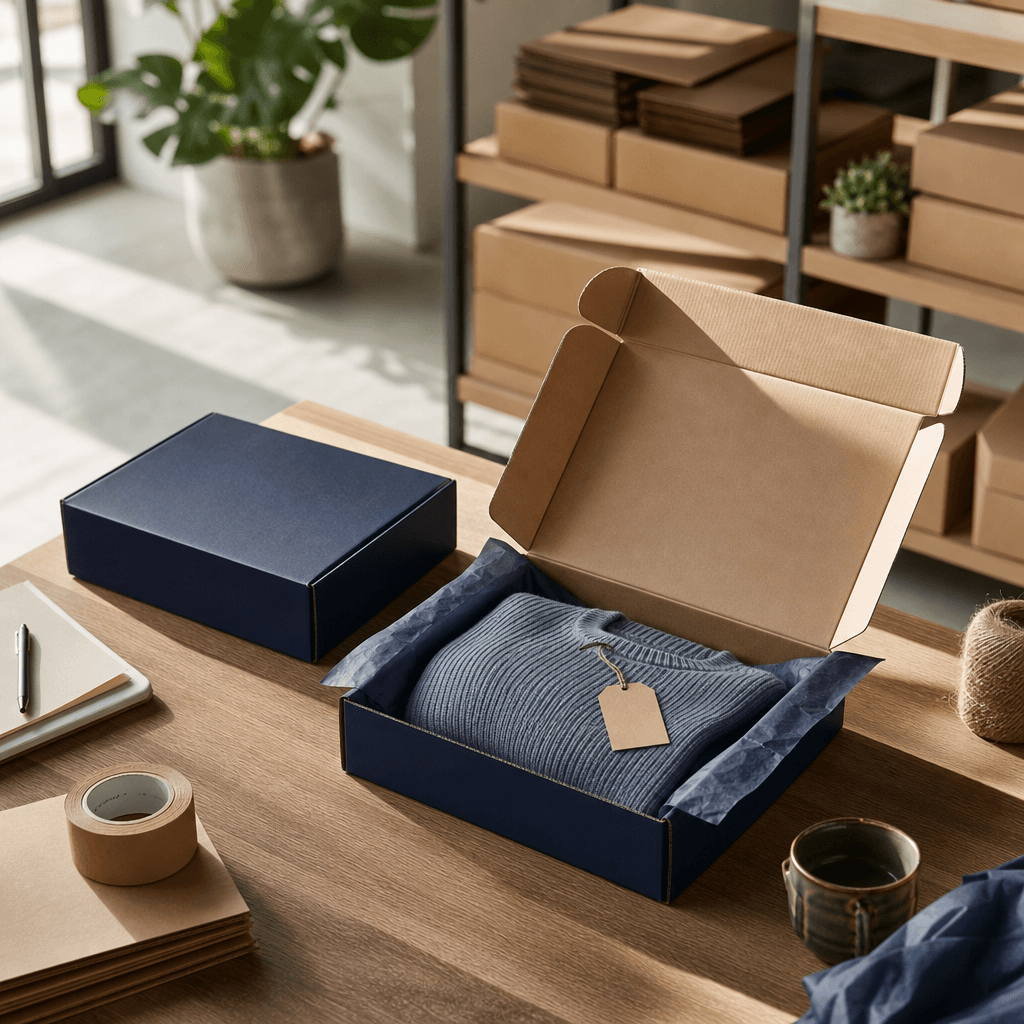
In e-commerce, delivering the product safely to the customer matters, but so does the first moment the box is opened reflecting the brand, which shapes the post-purchase experience. When discussing the packaging type that combines these two needs in a single structure, the most common question is: what is a mailer box? Simply put, a mailer box is a special shipping box usually made from corrugated cardboard, with its lid and locking flaps integrated into the body, and in most cases able to close without the need for additional packing tape. It carries the product directly to the customer, protects it during shipping, and turns the unboxing moment into a branded touchpoint.
This guide explains how a mailer box works, where it differs from a shipping carton, which products it suits, and which criteria are decisive when choosing one for e-commerce. The goal is to clarify the technical foundation so you can make the right decision before moving into samples and cost analysis.
Contents
How does a mailer box work?
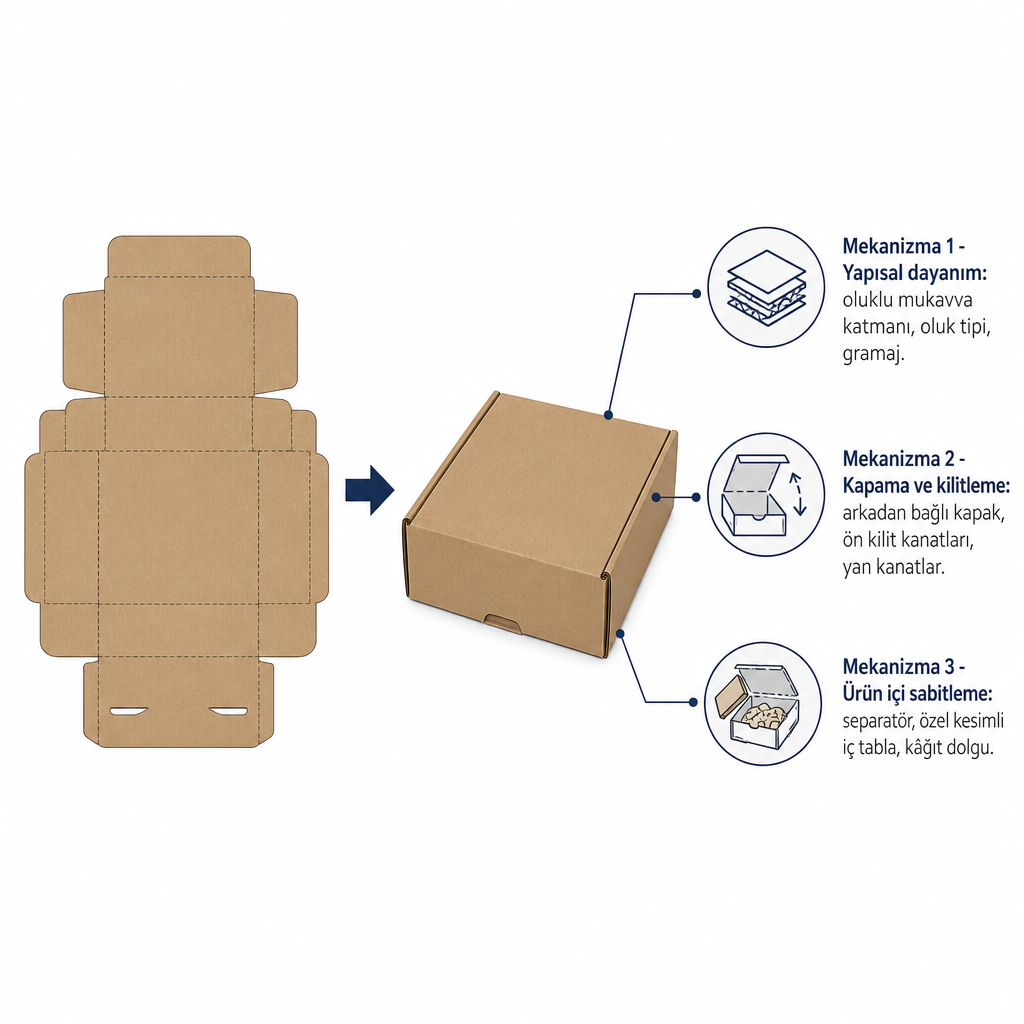
A mailer box is formed by cutting and folding a single-piece cardboard or corrugated board blank. The body, lid, side flaps, and lock details are all part of the same structure; that is why, unlike a classic carton, a separate lid and heavy tape usage are not needed in most scenarios. Its function relies on three mechanisms: structural strength, closure mechanism, and internal product fixing.
On the structural strength side, corrugated board is a layered material where flat paper surfaces work together with a fluted paper layer in between. The fluted structure provides a certain resistance against impact and pressure. However, "being corrugated" alone does not mean sufficient protection for every product. Flute type and height, paper weight, single or multi-layer structure, box dimensions, product weight, cargo stacking conditions, and internal filling usage are all evaluated together. A large, hollow box allows the product to move around inside even if its material is strong; therefore, how much the product moves inside the box is as important as the box's strength.
On the closure and locking side, the lid is mostly attached to the rear part of the box. When the front lock, insert flaps, or side lids are closed, the box retains its form. Some designs include a tear strip for easy opening and a second adhesive strip for reclosing. This mechanism can shorten packing time, reduce tape usage, and offer the customer a tidier opening. Still, a locked structure does not mean the box will never open under any condition; for heavy products, long-distance transport, or high-vibration shipping, the lock detail must be tested on a sample.
The third mechanism is internal product fixing. The outer structure alone does not always provide sufficient protection. If there is a gap between the product and the box wall, a cardboard divider, product-specific die-cut insert tray, paper filling, honeycomb paper, crinkled kraft, tissue paper, or molded paper internal protection can be used. For example, while a plain mailer box is enough for a single T-shirt, a strong internal fixing in addition to the box structure is essential when shipping a glass jar or ceramics.
What is the difference between a mailer box and a shipping carton?
A mailer box and a standard shipping carton are confused for the same purpose; both carry products, but they differ in structure and brand experience. The table below clarifies which job falls to which packaging.
| Criterion | Mailer box | Standard shipping carton |
|---|---|---|
| Structure | Usually single-piece, with lid and lock | Mostly separate lid, closed with tape |
| Closure | Insert or lock mechanism | Tape, staples, or adhesive |
| Brand experience | Suitable for inner and outer printing | Focused on transport and protection |
| Packing | Quick folding and closing | Requires taping and lid closing |
| Use | DTC, subscription, gift, selected products | Heavy, bulky, or multiple shipments |
This comparison does not mean a mailer box is superior to a shipping carton for every product. For heavy products, palletized shipments, or situations where high stacking pressure is expected, a more durable corrugated carton structure is needed. For those who want to deepen durability and flute type decisions specific to channel and product, the E-commerce shipping box selection guide offers a separate decision framework.
Mailer box types and which scenario they suit
Mailer boxes differ according to lid and body design. Choosing the right variant is related more to operations and customer behavior than to the product type.
A self-locking mailer box is a model where the lid is mechanically locked with front or side flaps; it reduces the need for tape and speeds up the packing operation. A tear-strip mailer box allows the customer to open the box without scissors or a knife and is especially useful for subscription boxes and brands that receive regular repeat orders. A reclosable mailer box carries a second adhesive strip for returns and exchange processes; it prevents the customer from searching for new packaging when sending the product back.
On a printed mailer box, the logo, color palette, product usage message, or campaign communication is applied both outside and inside the box; while outer printing provides visibility during transport, inner printing strengthens the opening moment. A mailer box with inner dividers uses cardboard separators or die-cut inner parts to prevent multiple products from colliding in the same box. Cosmetic sets, candles, chocolate, jewelry, and electronic accessories are examples suited to this structure.
What to consider when choosing a mailer box for e-commerce?
The first and most frequently skipped rule: determine the box size not according to the product size, but according to the packaged product size. The product sleeve, tissue, filling, divider, or inner tray must be added to the total volume. A box that is too small compresses the product, disrupts lid closure, and causes crushing at the corners. A box that is too large causes the product to move inside, requires more filling, and increases shipping volume.
The second decision is weight and fragility. The box requirements for light textiles, accessories, or personal care products are not the same as for glass, ceramics, and electronic products. For fragile products, internal fixing and shock-absorbing design are essential in addition to the box material.
The third is volumetric weight (desi) and shipping volume. In e-commerce, the outer dimensions of the packaging directly affect the shipping cost; a box larger than necessary increases volumetric weight even if the product is light. For this reason, in the brief, the product's net and gross weight, the box's outer dimensions, single or multiple shipment scenario, the courier company's volumetric weight calculation, filling needs, and shelf dimensions must all be evaluated together.
The fourth decision is the printing surface. On mailer boxes, simply placing the logo on the surface is not enough; the printing areas on the blank, fold lines, lock flaps, and safe areas are considered together. The proximity of the logo to the fold line, the space left for the barcode and shipping label, the alignment of inner printing with the opening sequence, color consistency on dark backgrounds, and the compatibility of the surface treatment with recyclability goals must be checked. For structural blanks, bleed margins, and safe area concepts, you can refer to the What is Box Graphics? The Foundation of Packaging Design guide.
Finally, the opening experience must be balanced with operations. A box that looks impressive to the customer creates operational cost if it is slow or difficult for the warehouse team to pack. The ease of folding the box, the lid lock working properly every time, the standardizability of the inner layout, and reusability during returns must be weighed at the design stage.
Material and sustainability decisions
The most common material for mailer boxes is corrugated board; it balances shipping durability with lightness and is the basic option in scenarios where the product will be shipped without an outer carton. Brands wanting a natural look and recycling perception prefer a kraft outer surface, but a kraft look does not automatically mean a more sustainable product; the material content, printing ink, coating, adhesive, and recycling infrastructure must be examined together. Cardboard inner parts are used to separate, fix, or reduce the gap between products and lower the risk of damage in multi-product orders. Accessories such as tissue paper, thank-you cards, or product usage cards personalize the experience but do not replace structural protection.
In sustainability assessment, being paper-based is not a sufficient claim on its own; the entire life cycle of the packaging is considered. Whether the box is single-material or easily separable, whether it contains plastic lamination or heavy coating, the effect of the adhesive and ink on the recycling process, whether the box is unnecessarily large, and whether it reduces the need for reshipment by preventing product damage must all be questioned one by one.
In Turkey, the Regulation on the Control of Packaging Waste covers packaging placed on the market and the waste arising from this packaging. The Ministry's announcement states that the regulation was published in the Official Gazette dated 26 June 2021 and numbered 31523. Therefore, brands should look not only at the term "recyclable" but also at material selection, packaging quantity, and post-use waste management.
Limitations and risks of a mailer box
A mailer box is strong when used with the right product and the right size, but some risks must be considered before choosing one. It does not offer the same durability for every product: for heavy, sharp-edged, liquid-containing, or fragile products, a standard mailer design may be insufficient; internal protection, thickened material, or a different cargo solution may be required.
The outer surface is exposed to transport conditions. If the mailer box is shipped without an outer carton, the printed surface encounters friction, rain, dirt, shipping labels, and tape residue; the outer surface treatment and label area must be determined according to these conditions. In addition, excessive design creates cost and production complexity; die-cuts, inner printing, tear strips, a second adhesive strip, and special dividers each affect the total cost and should be used only when they genuinely contribute to customer experience or operational efficiency.
The most critical rule: mass production should not begin before the sample is approved. The design on screen does not fully show the folding, closing, color, and durability behavior of the actual material. On the physical sample, it must be checked whether the product fits comfortably in the box, whether the lid closes without forcing, whether the lock loosens during transport, whether the box retains its form when stacked, whether the contents move, and whether the printing colors match the brand expectation.
Why do FEFCO codes simplify the quotation process?
FEFCO codes are used in defining corrugated packaging designs. According to FEFCO's description, this system internationally classifies corrugated packaging designs and, by defining common box types with codes, facilitates technical communication between the manufacturer and the customer. These codes allow a specific structural form to be defined instead of a general description like "box with lid".
When getting a quote or sharing a technical drawing, specifying the code of the relevant box style reduces misunderstanding of the model, increases the alignment between the sample and mass production, and makes it easier to compare quotes from different manufacturers. Still, instead of directly applying a ready code to every product, the structure to be used for the mailer box must be evaluated together with the lid, lock, and side flap details the brand wants, according to the product size and transport scenario.
How to prepare a mailer box brief with Kosapack?
When getting a mailer box quote, simply saying "I want a box of this size" is usually not enough. For a more accurate study, we have gathered the information that needs to be shared in the table below.
| Brief heading | Information to provide |
|---|---|
| Product | Product name, size, weight, and fragility status |
| Order | Single, multiple, or set shipment |
| Box | Inner/outer size preference, lid and lock expectation |
| Printing | Inner/outer printing, color standard, and logo file |
| Logistics | Courier company, volumetric weight limit, internal protection, and sample need |
In our custom packaging approach, structural and graphic design, prototyping, production coordination, and logistics are handled within the same project. For brands wanting to evaluate the size, printing, material, and inner layout decisions of an e-commerce box together, Custom Box Design: A Step-by-Step Starter Guide is a good starting point.
If the mailer box requires a more premium surface, a thicker carrier structure, or a special inner layout, you can also compare cardboard box options with Premium Cardboard Box Production: A Guide for Brands. The choice here should be made not only based on how the product will appear to the customer; but according to protection, stacking, storage, and shipping conditions.
Ultimately, a mailer box is a strong option for e-commerce brands that ship their product directly to the customer, want a branded opening experience, and aim to simplify the packing operation. The right decision is clarified by four questions: Is the product suitable for the protection level a mailer box will provide? Does the box size optimize volumetric weight and storage cost? Are the closure and inner layout practical in the packing operation? Are the printing, material, and accessories aligned with the brand's sustainability and experience goals? When these questions are answered with a physical sample and a clear cost analysis, the box ceases to be merely shipping packaging and becomes a decision that unites product protection, brand communication, and customer experience at the same point.
Frequently Asked Questions
Does a mailer box require packing tape?
Self-locking models mostly close without additional tape. However, depending on product weight, transport conditions, and security expectations, tape or a security label can be added.
Which products is a mailer box suitable for?
It can be considered for textiles, cosmetics, accessories, jewelry, candles, books, small electronic products, subscription boxes, and gift sets. For fragile or heavy products, internal protection and a suitable flute structure must also be designed.
Are a mailer box and a corrugated shipping carton the same?
No. A mailer box is usually a single-piece structure with an integrated lid and lock. A standard shipping carton, on the other hand, is a more general transport packaging where separate lids are mostly closed with tape.
Can a mailer box be produced with printing?
Yes. It can be produced with printing on the outer surface, inner surface, or both surfaces. The printing areas must be planned together with the folding, lock, and shipping label zones.
Is a physical sample necessary for a mailer box?
A physical sample is recommended especially when custom size, printing, lock, divider, or fragile products are involved. The sample allows size, closure, color, product placement, and durability to be checked before mass production.