

An e-commerce shipping box is the outer packaging that carries an online order from the warehouse to the customer's doorstep undamaged, efficiently, and in a way that reflects brand identity. A correctly chosen box protects the product without crushing it, reduces desi cost, and turns the unboxing moment into part of the brand; a wrong choice, on the other hand, simultaneously damages the product, the shipping budget, and brand perception. At Kosapack, we handle these three axes under one roof, with brand-specific sizing and printing.
Viewing a shipping box merely as a "parcel" is one of the costliest misconceptions in e-commerce. A shipping box performs four interconnected jobs at once: protection, transport efficiency, cost control, and customer experience. In this guide, we explain what an e-commerce shipping box is, which types fit which scenario, and which criteria you should weigh when making a choice—not through a sales lens, but through decision logic.
Table of Contents
- What is an e-commerce shipping box, and how does the system work?
- Types of e-commerce shipping boxes: which one in which scenario?
- The impact of the right box choice on brand and operations
- What to consider when choosing an e-commerce shipping box?
- Next step: let's design your e-commerce shipping box together
- Frequently Asked Questions
What is an e-commerce shipping box, and how does the system work?
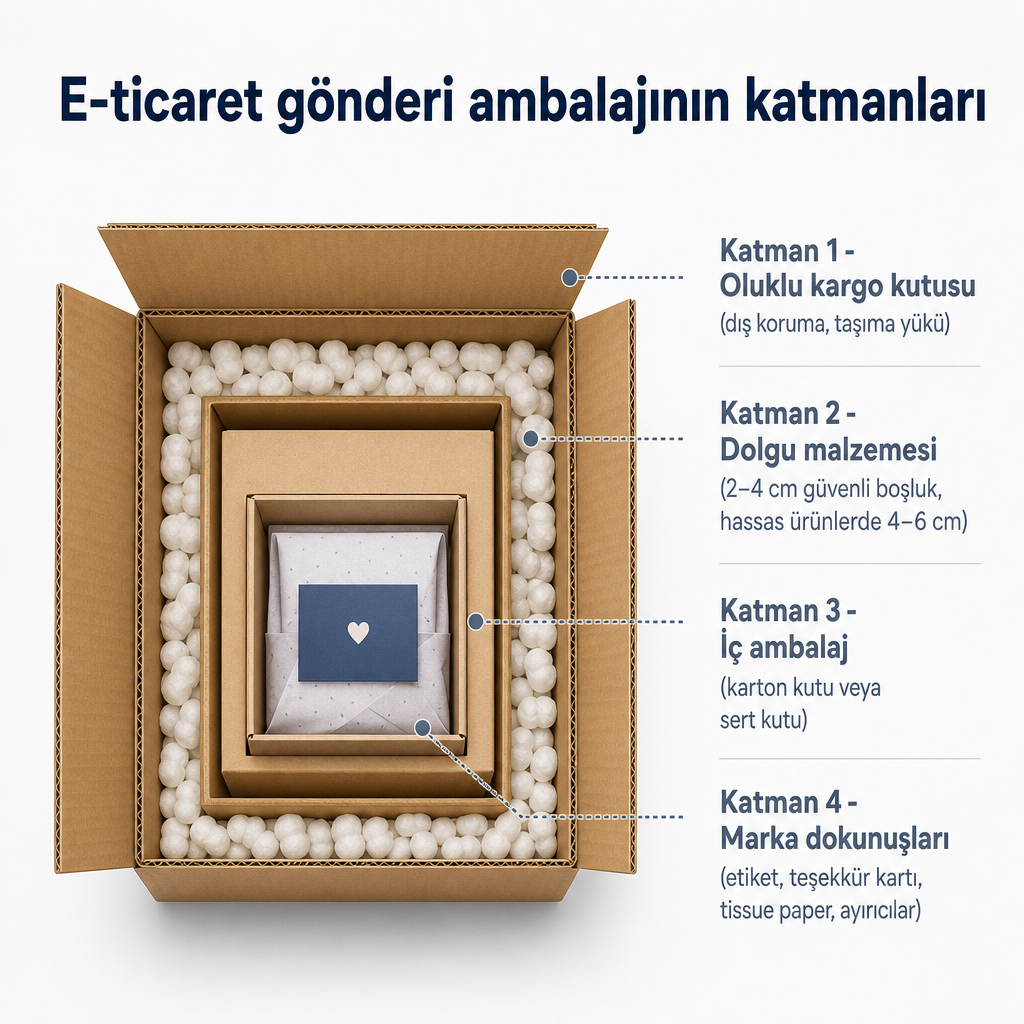
An e-commerce shipping box is not a single object but a system in which several components work together. On the outermost layer is the corrugated cardboard shipping box that protects the product from transport loads. Inside it, there is often the product's own retail or gift packaging—that is, a cardboard box or rigid box. Filling material closes the gap between the two; at the very top, brand touches such as labels, thank-you cards, and tissue paper come into play.
To understand the logic of the system, you need to pay attention to what the box carries. A shipping box carries not the bare product but the packaged product. Therefore, when taking measurements, it is essential to consider the volume that forms together with the product's protective materials. For fragile products, planning about 2–4 cm of safe clearance on each side is recommended, and 4–6 cm for very delicate products; in an alternative approach, the correct size is determined by adding 10–15% to the product's length–width–height values. This margin aims to prevent both cramping and unnecessarily large volume.
In the literature, box selection serves three basic goals: protecting the product from physical damage, ensuring transport and stacking efficiency, and keeping desi and filling costs under control. In the e-commerce context, a fourth axis is added: customer experience and brand image. In other words, the right box is not merely a logistical preference but also a brand decision.
At Kosapack, we handle this system under one roof. From the corrugated shipping box to the inner cardboard box, from the rigid box to dividers, from the label to the thank-you card, we produce all components with brand-specific sizing and printing. This way, an "e-commerce shipping box" can be planned not just as an outer parcel but as an end-to-end shipping ecosystem. In the structural design phase, we determine the box construction, material, and flute type according to the product; in the graphic design phase, we carry the brand identity onto the box with color accuracy.
Types of e-commerce shipping boxes: which one in which scenario?
In shipping packaging, more than one box form can be used together, and each responds to a different product profile. Getting to know the types helps you see which component does which job; this is not about ranking but about matching.
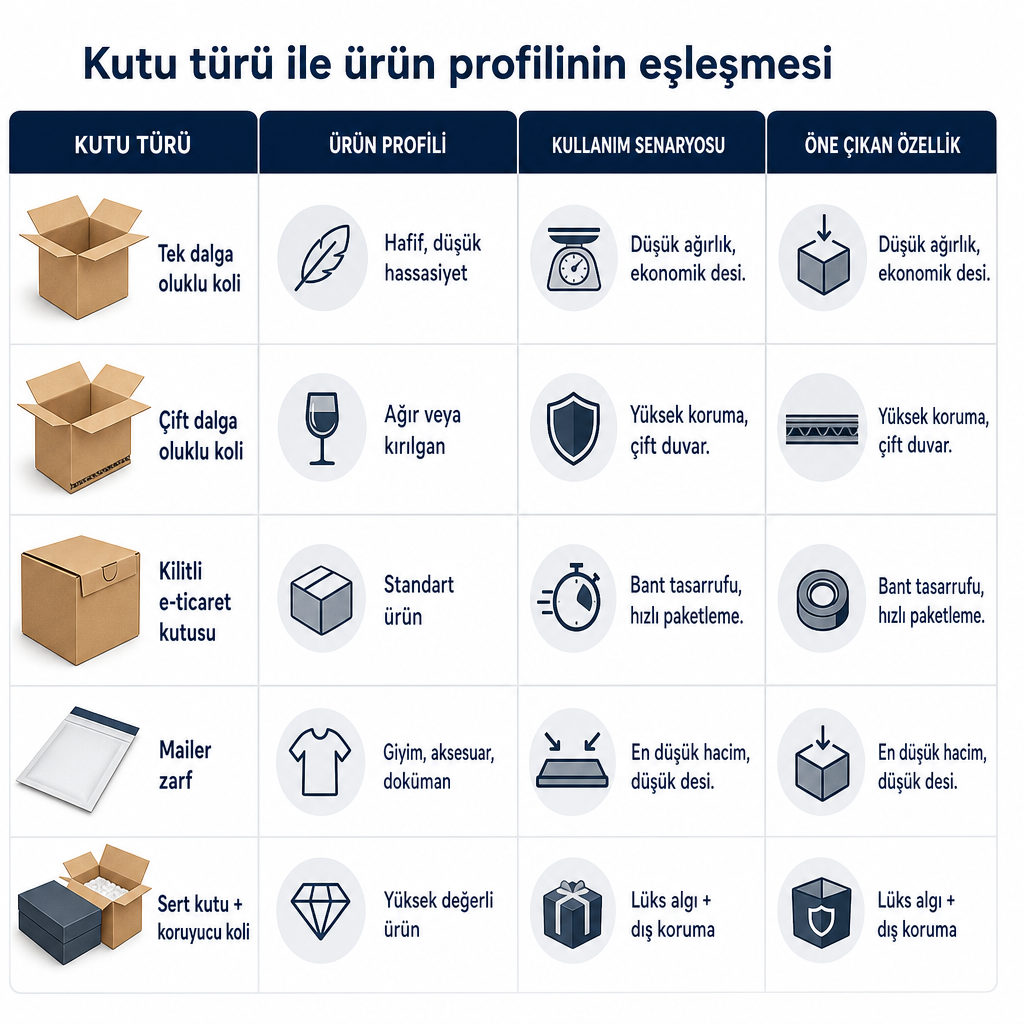
Corrugated shipping boxes are the backbone of e-commerce. Single-wall corrugated cardboard offers sufficient protection and low weight for light and low-sensitivity products. Double-wall corrugated boxes, on the other hand, provide extra durability for heavier, fragile, or high-value products. A commonly recommended approach in e-commerce is thin but durable E-flute or the more balanced B-flute corrugated cardboard, which strikes a balance between print surface, protection, and cost.
Die-cut locking e-commerce boxes are designs that reduce tape use and make opening easier. The locking structure both increases packaging speed and allows the customer to open the box easily and, if needed, reuse it. This detail turns into a practical advantage in categories with high return rates.
Mailer envelopes and box-form locking mailers are ideal for low-volume, low-fragility products such as clothing, accessories, and documents. As the product's volume and sensitivity decrease, envelope-type solutions significantly reduce desi cost.
The combination of a rigid box and a protective shipping parcel comes into play for products with high unit value, such as jewelry, luxury cosmetics, special-series chocolate, or candles. Here, the inner packaging carries the sense of luxury and the unboxing experience, while the outer corrugated parcel takes on the role of protection against impact and crushing. We discuss how this dual structure is designed for premium products in more detail in our guide on rigid box production for premium brands.
The relationship between the cardboard box and the shipping parcel is the often-overlooked layer of the system. The product's own cardboard box is the secondary packaging that goes inside the shipping parcel; the surface paper, weight, and print quality of this box directly affect its brand perception. You can examine the logic of inner cardboard box selection in our guide on cardboard box types and correct selection.
The impact of the right box choice on brand and operations
The box decision affects more than one line item on the balance sheet at the same time. Seeing this impact under four headings takes the choice out of the realm of abstract preference.
Cost. A parcel that is much too large for the product means excess filling and high desi; when the shipping tariff is calculated by volume, every unnecessary centimeter is directly reflected in the cost. A parcel that is too small, on the other hand, increases the risk of damage and the associated return cost. When box dimensions are incompatible with the volume–weight tariffs of shipping companies, a hidden but continuous cost item emerges.
Operational efficiency. Instead of using a separate box for each product, creating a standard box set in three basic sizes for small, medium, and large products significantly speeds up warehouse and packaging processes. Taking the packaged dimensions of your best-selling products and setting standards accordingly is a practical approach that simplifies inventory management. Standardization also creates volume advantages on the purchasing side and a more predictable supply flow.
Customer experience. Clean, tidy packaging that fits the product turns the opening moment into a positive impression. Small touches such as a logo label, a thank-you note, and an orderly interior layout meaningfully improve customer perception. Dividers prevent products from bumping into each other inside the box, supporting both protection and visual order.
Sustainability and brand perception. Boxes made from recyclable and eco-friendly materials are increasingly becoming a decisive preference in e-commerce; both brand reputation and increasing regulatory pressure push in this direction. For premium and DTC brands, sustainable packaging is a powerful storytelling area in customer loyalty and brand communication.
Instead of optimizing these four axes separately, they need to be balanced together; because an extreme preference in favor of one usually works against the other. This is exactly where the function of our consulting and design support begins: we bring the product's physical requirements, shipping compatibility, brand goals, and sustainability priority together in a single box decision. With carbon footprint reporting and recyclable material options, we also incorporate the sustainability side into this balance.
What to consider when choosing an e-commerce shipping box?
The right choice is not a procedure but a matter of judgment. The criteria below show you which questions to ask; their order does not matter—your product determines their weight.
Product characteristics. Size, weight, fragility, and unit value are the primary factors determining the box type and flute type. Fragile products such as glass, ceramic, electronics, or cosmetic bottles require a more durable box and filling. For high-value products, a combination of a rigid box or premium cardboard box on the inside and a protective parcel on the outside forms a sensible pairing.
Shipping and logistics compatibility. The maximum size and weight limits of shipping companies directly constrain box selection. Optimizing the box's desi equivalent is critical for both shipping cost and return processes. For long-distance or international shipments, more robust boxes that can withstand factors such as moisture, temperature, and pressure should be preferred.
Material and flute type. Double-wall boxes stand out for heavy products, and single-flute boxes for light products. E or B flute is often preferred for the balance of print surface, protection, and cost. Some guides recommend that the box chosen—especially for wholesale orders—meet a minimum durability level of 32 ECT or 44 BCT; these metrics define how much the box can withstand under stacking and transport loads.
Printing and brand identity. When a printed or logoed model is planned, the surface paper must support the print quality; otherwise, achieving the color accuracy that premium brands seek becomes difficult. Brand visibility is not just a logo; the combination of color palette, textures, and messages is the main component of the unboxing experience. Our color-sensitive proofing and quality control approach comes into play precisely at this point.
Sustainability. The preference for recyclable cardboard, minimal plastic, and certified raw materials when necessary is valuable both environmentally and reputationally. This preference also turns into a concrete message in brand communication.
Safety and standards. Durability metrics such as ECT (Edge Crush Test) and BCT (Box Compression Test) guide determining which strength level is required for products in certain weight ranges. When working with our manufacturing partners, we evaluate these technical criteria as part of the quality control process.
The step-by-step process for applying these criteria to your own product range and putting the decision into practice belongs to the resource where we explain how brand-specific packaging is designed and produced; you can find the sequential workflow in our guide on how to have custom packaging made for your brand.
Next step: let's design your e-commerce shipping box together
The right box emerges at the intersection of your product's physical characteristics, shipping compatibility, brand goals, and sustainability priority. Instead of leaving this intersection to guesswork, you can share with us the packaged dimensions, weight and fragility profile of the products you ship most, the unboxing feeling you aim for, and, if any, the size limits of your current shipping company.
Based on this information, we design the structural and graphic layout together and recommend the appropriate flute type and material. We enable you to make your decision based on a concrete example—with a quote within 24 hours and a physical sample within 7–15 business days. We also clarify project-specific matters that vary, such as flute type options, standard size set design, and desi optimization, in this meeting.
Frequently Asked Questions
What is the difference between an e-commerce shipping box and a standard parcel?
A standard parcel is mostly a general-purpose, one-size transport box. An e-commerce shipping box, on the other hand, is designed according to the product's packaged volume, fragility, shipping compatibility, and brand identity. The difference lies in its consideration of protection, desi cost, and the unboxing experience all at once. Brand-specific sizing and printing are the key elements that distinguish this box from a general-purpose parcel.
My product is fragile; should I prefer single-flute or double-flute?
As fragility and weight increase, double-wall corrugated boxes become a safer choice; for light and low-sensitivity products, single flute provides sufficient protection while keeping weight and cost low. The final decision is shaped by the product's actual dimensions, weight, and transport distance. If you share your product details, we can determine the appropriate flute type together.
How can I optimize shipping cost through box selection?
The most decisive factor is the box fitting the product. An oversized parcel means excess filling and high desi; a too-small parcel creates damage and return costs. Leaving a reasonable safe-clearance margin around the product's length–width–height values and keeping box dimensions compatible with the shipping company's volume tariff balances the cost. We can work on desi optimization for your specific project together.
Is a minimum quantity required for a printed e-commerce box?
The minimum quantity and production time vary by project; product type, box type, printing, and material preferences directly affect these values. Instead of giving a fixed quantity, we prefer to assess your needs and offer you a customized framework. When you share your goals, we clarify the appropriate quantity and timeline plan together.
Do sustainable shipping boxes really affect customer perception?
The preference for recyclable material is increasingly becoming an important criterion in e-commerce due to both brand reputation and increasing regulatory pressure. Especially for premium and DTC brands, sustainable packaging is a concrete storytelling area that strengthens customer loyalty and brand communication. We support this side with recyclable material options and carbon footprint reporting.
I have many products in different sizes; how many basic box sizes make sense?
The common and practical approach is to determine a few basic standard sizes for small, medium, and large products rather than producing a separate box for every product. A good starting point for this is to take the packaged dimensions of the best-selling products. When we examine your product range, we can recommend a suitable size set that simplifies storage and packaging.