

Custom box design is not just about preparing a beautiful graphic; it is about planning both the structure and the appearance of the box together, according to the product's dimensions, protection needs, sales channel, and brand identity. The right start is established by determining a packaging solution into which the product fits perfectly, is suitable for transport and usage conditions, and is manufacturable. Opening up the initial decisions with three questions clarifies the work: What will be carried in the box, where will it be used, and what kind of experience should it offer the customer? These answers jointly guide the choice of cardboard, rigid box, or corrugated box, the internal protection, printing, and surface treatments.
We prepared this guide so that you can see the decision logic of custom box design as a whole, rather than repeating individual subtopics one by one. At each stage, we will show you which information is needed and why, which decision locks in which, and what you need to lock down before the sample stage.
Table of Contents
First clarify the usage scenario
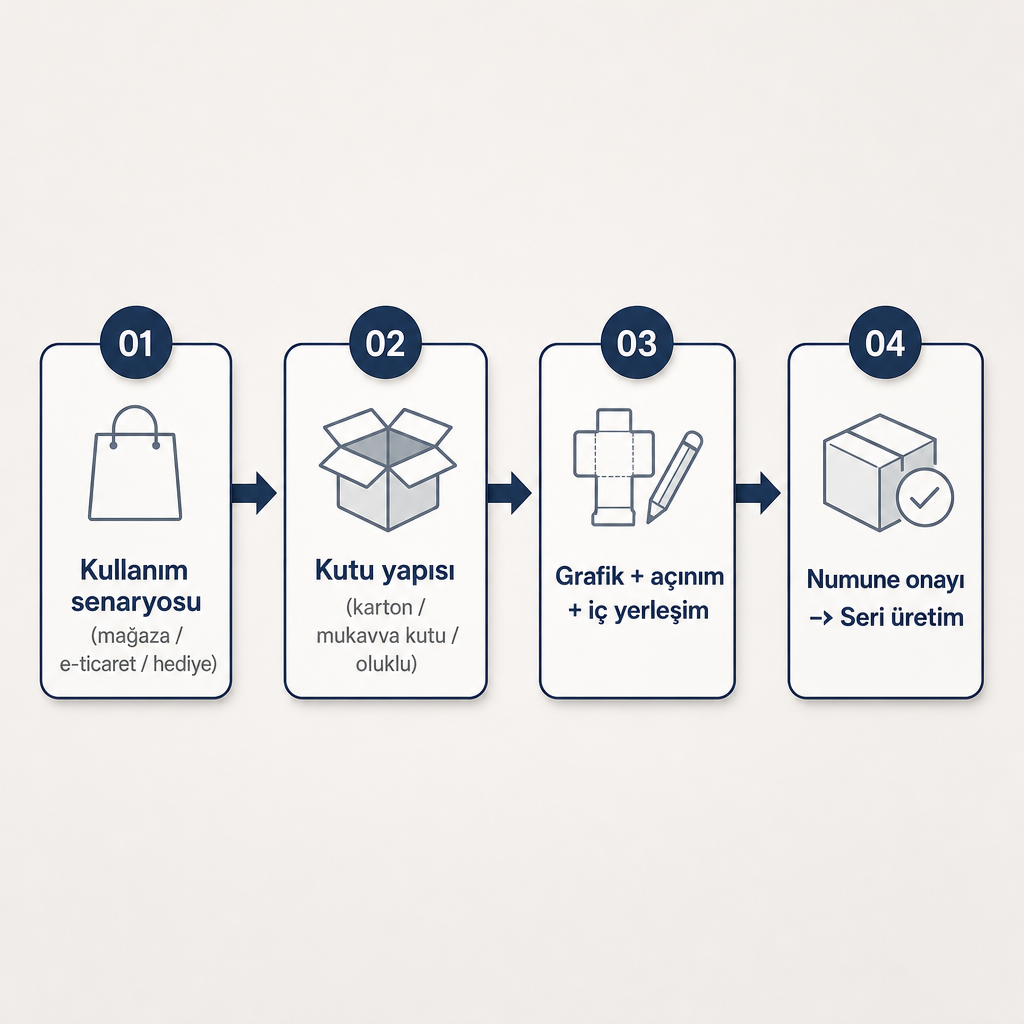
The same product requires different boxes in different sales channels. For a product presented on a store shelf, visual impact comes to the fore, while in e-commerce, transport and impact protection become decisive; in a gift box, the unboxing experience and how the product sits inside the box gain weight. Choosing this scenario before starting the design prevents costly revisions later on.
A solid brief allows the designer to head in a manufacturable direction on the first attempt. Put the following information into your initial file:
- The product's dimensions, weight, and how it sits in the box
- Whether it is a single product or a set; whether there are accessories inside the box
- The sales scenario such as store, e-commerce, gift, or corporate use
- Expected level of protection and transport conditions
- Estimated order quantity, target delivery date, and budget range
- Brand logo, colors, typefaces, and mandatory product information
When this information is not shared from the outset, the design is revised again and again due to dimensions unsuitable for production or needs added later. If the scenario is unclear, decide which channel is the priority; trying to handle multiple channels well with a single box most often results in an average outcome in every channel.
Choose the box structure according to the product and channel
The box structure determines not only appearance but also durability, storage, and shipping efficiency. For light products, a print-friendly folding carton box is often sufficient. For gift, cosmetic, or jewelry products where a more substantial and premium presentation is desired, a rigid box is considered. In cargo and logistics, a corrugated box is considered by taking into account the product's weight, stacking, and risk of impact.
Do not reduce the choice to merely the "sturdiest" or "most luxurious" option. Packaging that is heavier or larger than necessary raises usage and shipping costs; insufficient protection increases the risk of product damage. The right option provides adequate protection under the product's real conditions while also fitting the brand presentation and operational needs.
For a candle sold in e-commerce, an internal layout that reduces the gap around the product is critical regardless of the box type: the box must both secure the product and provide the protection expected during shipping. For the same product to be offered as a gift in a store, however, the visible surface, the manner of opening, and the in-box presentation become more decisive.
If you want to weigh the balance between cost, logistics, and protection among structural preferences in more detail, our guide explaining the process of ordering custom printed cardboard boxes step by step deepens the decision criteria.
Consider graphic design together with the production drawing
Box graphics are not a design applied to a flat surface; the graphic is placed according to the box's cutting and folding plan. This technical drawing contains the cutting, folding, and gluing areas, and the design must be compatible with these areas. Placing important text and logos too close to folding or cutting areas creates readability and alignment problems after production. The bleed required for background colors and images and the delivery format of the technical file must be confirmed with the party producing the box from the outset.
Establish the visual hierarchy according to the box's actual use: the logo and core message should be understood at first glance; product information, patterns, and decorative applications should support them. Do not make color and surface decisions based solely on the on-screen appearance, because the same color looks different on different materials and coatings. A proof or sample taken before production is the only reliable way to see the design's effect on the actual material.
Treat internal layout and surface applications as part of the design
If the product inside the box needs to be secured, separated, or presented in a special way, do not leave the internal layout to last—include it in the brief from the start. In sets containing multiple products, compartments or separators reduce the movement of the products. In gift presentation, tissue paper, a card, or a different internal surface design can complete the experience; however, every additional component expands the scope of production, assembly, and cost. For this reason, choose internal components not at the "nice to have" level, but according to what they truly add to the experience.
Also evaluate applications such as embossing, foil, or matte-gloss surface contrast according to their function and priority. Instead of piling numerous effects onto every surface, highlighting a few elements that best carry the brand identity protects both perception and budget. If your product is in the gift category, our luxury gift box production guide makes these decisions about structure, presentation, and supplier selection concrete.
Don't move to mass production without approving the sample
The design on the screen alone does not show how the actual box will hold up. In the sample, check the box's dimensions, the product's placement, the closure method, the print colors, the surface feel, and the expected performance in transport. If a problem is caught before mass production, it is relatively easy to fix; a change made after production has begun is far more burdensome in terms of both time and cost.
To avoid leaving the approval process ambiguous, determine in advance which features will be evaluated in the sample and who will give the final approval. If the product dimensions, design file, or print expectation change, reconfirm the impact of these changes on the sample and production plan with the supplier. Written approval prevents "I didn't expect it this way" disputes that may arise later.
Add sustainability and regulatory checks to the design
Being "paper-based" does not mean that a box can be recycled under all conditions. FSC states that paper and cardboard packaging can be recyclable, but that it is also important for the paper raw material to be sourced from responsible sources. For this reason, evaluate material, coating, and supply preferences by considering the packaging's real use and the supply chain together; a glossy coating or mixed materials can change the recycling expectation. For an additional framework, you can look at FSC's paper, print, and packaging resources.
Also check the current obligations related to packaging waste in Turkey. The Ministry of Environment, Urbanization and Climate Change announced that the regulation governing the separate collection at source and recycling of packaging waste has been renewed. Since the obligations applicable to your brand's product and packaging vary according to the product category and the conditions of placement on the market, verify separately for your own situation. The Ministry's announcement on the packaging waste regulation can be a starting point for this verification.
Starting custom box design with Kosapack
In custom box design, gathering decisions into a single flow rather than running them in a scattered way reduces both revisions and time. As Kosapack, we run an end-to-end service flow that includes consultancy, structural and graphic design, prototyping, production, and logistics. We also include custom sizing, a proof that observes color accuracy before production, and quality control points within our scope. For customers who share a brief, we aim for a quote within 24 hours, and for a physical sample, 7–15 business days; the actual timeline is confirmed together according to the project's specifics.
To speed up the evaluation, share the box dimensions, a product sample or its images, the estimated quantity, the usage channel, the target date, and your brand files, if any, in your quote request. A clear brief allows us to position the box structure and design scope more accurately from the start; projects started with missing information mostly drag on with additional sample rounds.
Frequently asked questions
What information is needed for custom box design?
The product dimensions and weight, the box's purpose of use, the sales channel, the estimated quantity, the target date, and the brand design files make up a good starting brief. When these six headings are clarified, structure and design decisions proceed by supporting one another.
Should I choose the box's material or its design first?
Evaluate the two together. The product and usage conditions determine the box structure; this structure in turn affects the surfaces on which the design will be applied, the fold lines, and the production drawing. Finalizing the material independently of the design may later result in a dieline mismatch.
Why is the sample so important?
The sample allows you to check the dimensions and the appearance of the design on the actual material before mass production. Functional points such as product placement, closure, and transport performance can also only be reliably evaluated at this stage.
Is a rigid box the right choice for every product?
No. A rigid box is a strong choice in scenarios where a premium presentation or a more substantial structure is sought; however, it must be evaluated together with the product's protection, transport, storage, and budget needs. For light or high-volume shipments, other structures may be more efficient.