
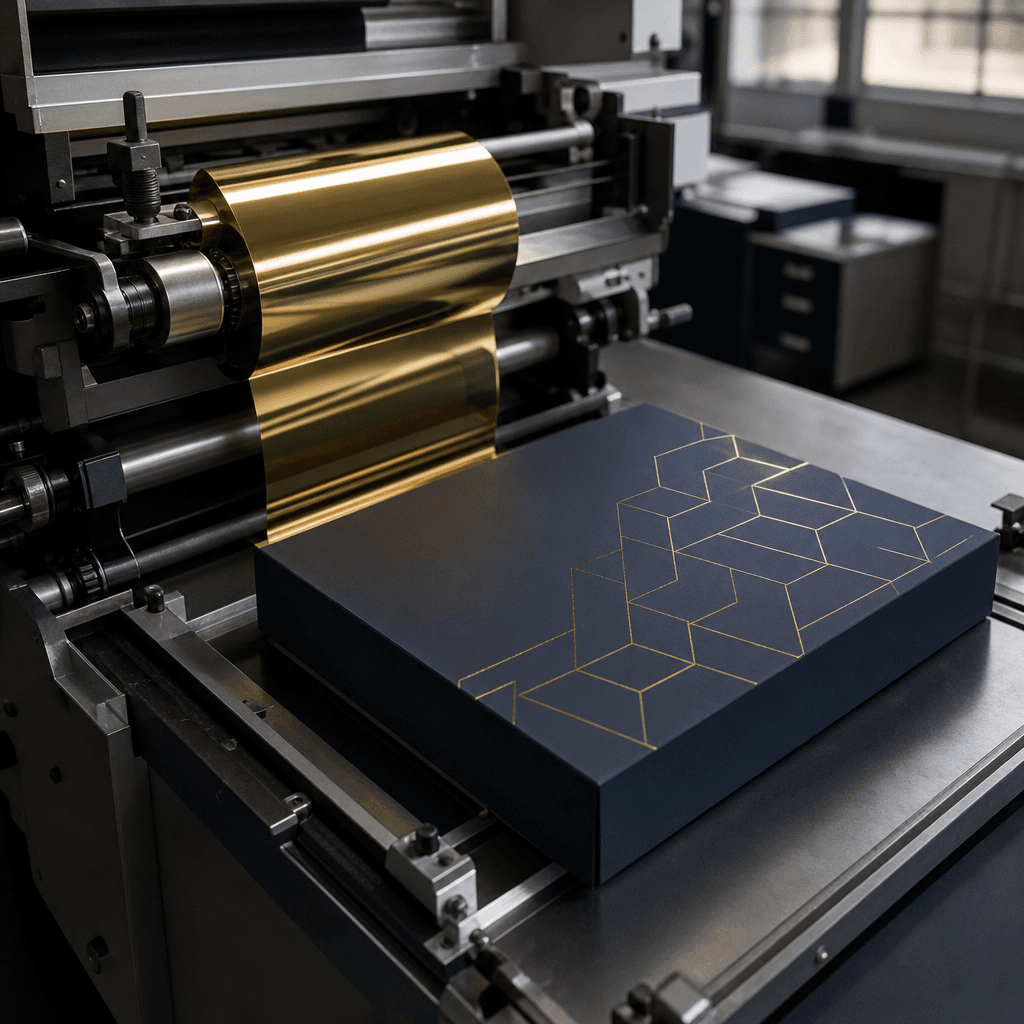
One of the most effective techniques for strengthening the first impression in luxury packaging is foil stamping. So, what is foil stamping? In short, it is the transfer of a metallic or colored foil layer onto the packaging surface through heat and pressure or a special adhesive. This technique, which highlights logos, text, and patterns with gold, silver, bronze, or colored metallic effects, is particularly preferred in cosmetics, jewelry, candle, chocolate, fashion, and corporate gift packaging. When applied with the right choice of material, surface, and design, it gives the cardboard box a more distinguished appearance; however, it is not automatically the best option for every package and every graphic.
In this guide, we explain how foil works, the differences between the hot and cold methods, which surfaces produce successful results, and the criteria you should base your decision on. Our goal is to help you choose the right application that supports the value of your brand.
Table of Contents
How does foil stamping work?
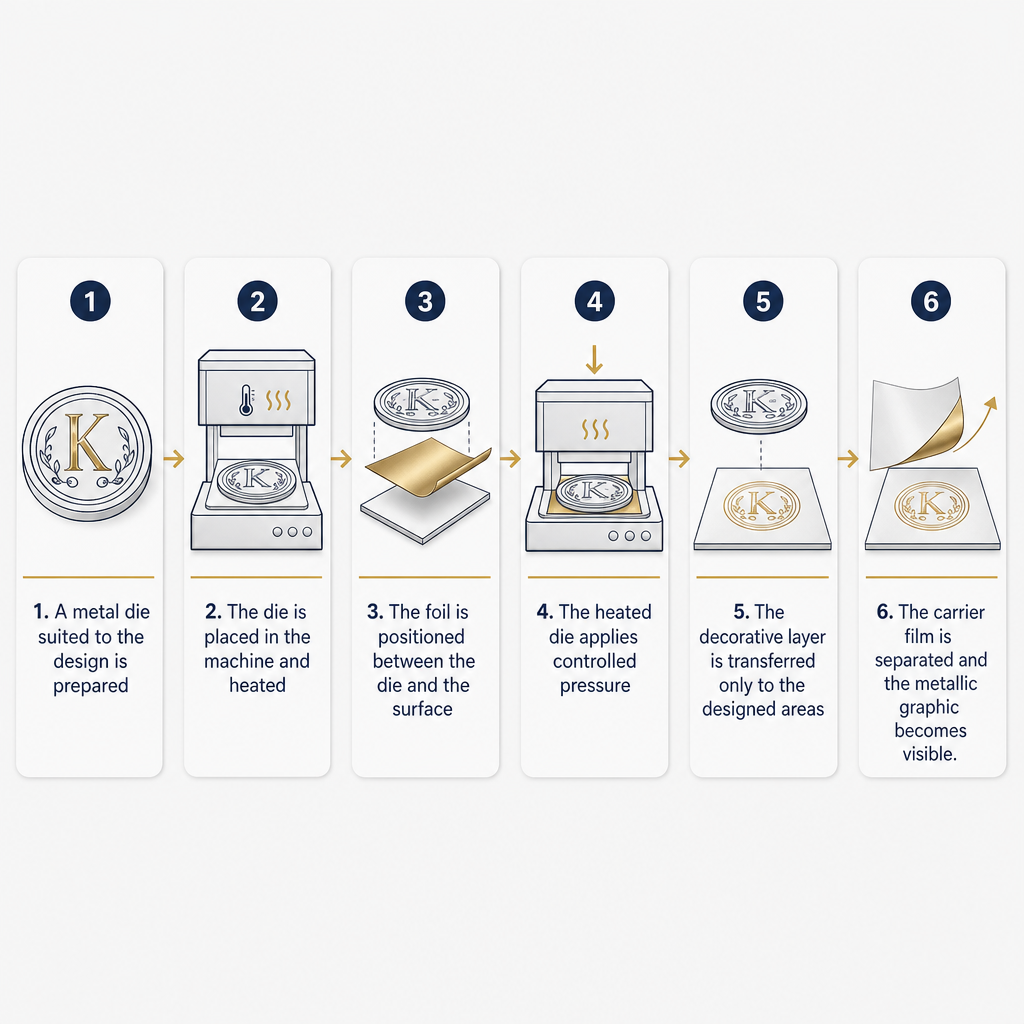
Foil stamping is a printing and surface decoration technique based on foil transfer, also called "foil printing" or "hot foil." Traditional hot application is based on a special foil made up of several layers: a polyester carrier film, a release layer, a metallic or colored layer, and an adhesive layer that enables adhesion to the surface.
The application begins with preparing a die suited to the design. The heated die presses the foil onto the packaging surface with a certain pressure; the heat activates the layer that enables the foil to adhere to the surface. When the carrier film is separated, only the designed metallic or colored area remains. The process flows as follows:
This process differs from classic ink printing. In foil, the goal is not just to print a color; it is to create a light-reflecting, glossy, or matte metallic surface effect. While gold and silver are the most common options, bronze, copper, holographic, colored, and matte foils can also be used.
The temperature, pressure, and contact time of the foil vary according to the type of foil, the properties of the surface, the die detail, and the machine. For this reason, the same design may not produce the same result on different paper, cardboard, or coated surfaces. Foil can be applied to areas such as logos and brand names, product or series names, thin frames, pattern details, cover titles, label and card graphics, and cardboard box lid or drawer surfaces.
The difference between hot foil and cold foil
The fundamental distinction between the two methods is how the foil is fixed to the surface. This distinction directly affects your design decision.
Hot foil uses a heated die and pressure. This method produces strong results especially for sharp-edged logos and text; thanks to the die, the design can be precisely transferred to specific areas. When applied together with embossing, both a visual and tactile effect is created on the surface. Hot foil provides an advantage when there are few prominent graphic areas, when a logo or monogram is to be highlighted, when a premium cover surface is desired, when foil and embossing are to be used together, and when controlled sharp edges are important in the design.
In cold foil, instead of a heated die, a UV-cured adhesive applied in the printing press is used. The foil is transferred to the areas printed with adhesive and fixed with UV light. Because it can work without requiring a die, it may be suitable for larger areas, variable designs, and some high-speed production scenarios. Its notable features: because no heat is used, it may provide an advantage on heat-sensitive surfaces, it may allow CMYK printing over the metallic effect, and it is more conducive to graphic effects such as gradients and halftones; on the other hand, it does not create a prominent embossing effect like hot foil.
Which method to choose should be determined according to the detail of the design, the production quantity, the surface, the desired metallic effect, and whether embossing is needed. If you would like to evaluate the printing technique decision in a broader framework, our article comparison of offset printing and digital printing will help you clarify the technical choice for background printing.
What does foil stamping do in luxury packaging?
Foil stamping can transform packaging from being merely a protective carrier into part of the brand's visual communication. Its effect comes from several distinct mechanisms.
Metallic surfaces, especially when used together with dark-colored and textured materials, help the product be perceived as more special and higher value; this effect is pronounced in perfume, jewelry, premium candle, chocolate, and gift boxes. When the logo or brand name is applied with foil, it is noticed more quickly on the shelf, in the store, or during the unboxing moment — but for readability, the metallic effect must create sufficient contrast with the background color.
While foil alone provides shine, when used together with embossing it also creates a surface difference that can be felt with the finger. This combination is especially effective for monograms, crests, logos, and short titles. Another important point is this: a luxury appearance does not always mean using more effects. On a plain cardboard box, just a small gold logo can give a more refined result than heavy graphic printing; a small foil area used in the right place is often more powerful.
The technique can be adapted to different product categories. In our publicly available product and industry information, hot foil is specified especially together with candle packaging; within the same service model, we also offer premium cardboard box solutions for jewelry, cosmetics, chocolate, gifts, and alcoholic beverages.
Which packages and surfaces does it work on?
Foil stamping can be used on various packages, provided the surface is prepared suitably for printing; however, success depends not only on the foil color but also on the structure of the background.
On the cardboard box side, luxury gift boxes, magnetic-lid boxes, drawer boxes, and jewelry boxes are among the most frequently considered types. Rather than printing over the entire lid, limited use on a logo, frame, or short message provides a more balanced appearance. In folding carton boxes, foil is used on brand names, product variants, or small decorative details in cosmetics, soap, candle, chocolate, and retail products — it must be designed taking into account folding lines, glue tabs, and cutting areas. Foil labels support the premium perception on bottles, jars, and candle containers; the label material, adhesive, and surface coating must be compatible with foil transfer. Foil on thank-you cards, care cards, and certificates inside the box completes the box opening experience. On paper bags, the area around the handle, the logo area, or the front face are suitable; the folding, carrying, and friction conditions of the bag must be taken into account.
Surface and material choice directly affect the result. Surfaces with a flat, controlled coating can help thin text and small details appear cleaner; however, some varnish and lamination types make foil adhesion difficult, so mass production should not begin without sample inspection. Kraft paper, textured paper, and fibrous surfaces offer a natural appearance, but transfer is less sharp on fine lines; on these backgrounds, larger font sizes, thicker lines, and plain graphics should be preferred. Black, navy, dark green, or burgundy backgrounds create high contrast with gold and copper foil, while the visibility of silver foil decreases on light and glossy backgrounds. On the cardboard box surface, the coating paper, lamination, edge turns, and the opening-closing motion of the box must be evaluated together; placing foil on edges or folding areas that are constantly subject to friction increases the risk of wear over time.
For the basic material decisions of packaging, you can look at our guide the structure and uses of corrugated cardboard, and to understand alternative surface and printing techniques, the article how screen printing is applied.
Points to consider in foil design
In foil stamping, not every detail comes out with the same clarity. Very fine lines, small font sizes, and graphic elements close to each other can merge or lose their sharpness during foil transfer. In the file to be sent to production, do not unnecessarily thin small text, avoid overly tight letter spacing, test thin frames and lines on a sample, keep foil areas away from print and cut lines, and leave sufficient contrast between the logo and the background.
Large metallic surfaces can look impressive; however, the premium effect of the design does not increase as the foil area increases. Too much metallic use can weaken the plain or sophisticated perception the brand is seeking. If foil and embossing are to be used together, the height of the embossing, its direction, paper thickness, and die structure must be designed together; this combination is powerful in a single focus area such as a logo, but applying it to the entire box increases cost and production complexity.
Do not evaluate color accuracy only from the screen. Metallic foils are perceived differently on screen and in printed samples; the brightness of the foil, the light direction, and the background color affect the result. For this reason, it is safer to give approval over a physical sample or a proof close to production. In our publicly available service description, we specify the pre-production color-accurate proof and approval process, as well as the possibility of a physical sample within 7–15 business days.
Advantages and limitations
To make the foil decision in a balanced way, it is necessary to see both the strong side and the aspect requiring attention of each dimension together.
| Topic | Advantage | What to consider |
|---|---|---|
| Appearance | Creates a metallic, glossy, or matte premium effect | The foil color must create sufficient contrast with the background |
| Brand perception | Can highlight the logo and product name | Excessive use can complicate the design |
| Design | Powerful in minimal and distinguished graphics | Very fine details must be tested on a sample |
| Tactile effect | Provides a stronger experience together with embossing | Additional die and production control may be required |
| Material | Can be applied on paper, cardboard, label, and cardboard box | Not every coating and lamination is compatible with foil |
| Durability | Gives lasting results with the right surface and application | Friction, folding, and moisture risks must be taken into account |
The impact of foil application on recyclability depends on the paper or cardboard used, the structure of the foil, lamination, ink, and local recycling infrastructure. Some manufacturers state that foil-applied paper and cardboard can be repulped and recycled; therefore, generalizations such as "every foil package is automatically unsustainable" or "it is recycled without any problems in every case" should be avoided. The safest approach is to request foil, lamination, and recyclability information from the supplier.
Checkpoints for food and cosmetic packaging
If foil-stamped packaging accompanies food or cosmetics, in addition to aesthetic decisions, product safety and compliance documents must also be evaluated. In packaging that comes into contact with food, it must be checked whether the material, printing, adhesive, varnish, coating, and foil system pose a migration risk to the product.
The European Food Safety Authority evaluates paper, cardboard, coatings, adhesives, and printing inks within the scope of food contact materials and states that substances must not unacceptably affect the safety, composition, taste, or odor of the food. In Turkey as well, the materials used in packaging and wrapping must not be a source of contamination and must be stored in a way that protects against the risk of contamination.
For this reason, especially in chocolate, confectionery, or food sets, the following questions should be clarified before production: Will the foil come into direct contact with the food? Is there a sufficient barrier between the inner and outer surfaces? Is a compliance document available for the foil, ink, varnish, and adhesive? What are the storage and transport conditions of the packaging? Will the inner packaging that comes into contact with food be designed separately from the outer box? In cosmetic packaging, whether the product comes into direct contact with the inside of the box, the barriers inside the box, and the friction conditions must also be examined separately.
What criteria should you consider when choosing foil stamping?
To determine whether foil is the right choice, it is necessary to evaluate the decision across several axes.
Brand positioning: If the brand wants to establish a premium, boutique, gift-focused, or luxury perception, foil can be a strong option. For a more natural, plain, or eco-focused identity, a small logo application or non-metallic alternatives may be more suitable.
Sales channel: Shelf, store, e-commerce, and corporate gift scenarios give rise to different design needs. In e-commerce, since the packaging is seen by the user while being opened rather than under light, the effect of foil during the unboxing moment stands out; on the store shelf, readability from a distance and brand recognition are decisive.
Printing area: Will just a logo or a broad pattern be applied? Hot foil can be considered for small, focused areas; cold foil for broad, colored, or variable designs.
Surface and coating: The box coating paper, lamination, varnish, texture, and grammage change the adhesion and visual effect of the foil. The decision should not be made solely by looking at the foil color in the catalog.
Production quantity and die cost: Hot foil may require a design-specific die. When evaluating the total cost, not only the per-unit printing cost but also the die, proof, surface treatment, and possible revision costs must be taken into account.
Use and transport conditions: On surfaces that rub when the box is opened, are stacked on top of each other, or are frequently transported, the durability of the foil must be tested. Lid edges, folding lines, and contact points are critical areas.
Sustainability goal: If recyclable material is targeted, the box, coating, print, and foil combination must be evaluated together. Being merely "paper-based" does not mean that the packaging, with all its components, is automatically sustainable.
Working with us for foil-stamped packaging
The foil stamping decision is not a standalone print order; it must be addressed together with the box structure, material, graphic design, surface treatment, sample, and logistics. In our service model, we coordinate structural and graphic design, custom sizing, prototyping, managed production, quality control, and logistics under the same program. We work with verified production partners, offer pre-production proof and approval processes; we aim for 24 hours for a quote and 7–15 business days for a physical sample.
Sharing the following information in a quote request for a foil-stamped cardboard box speeds up the process:
- The exact dimensions and weight of the product
- The desired box model and estimated production quantity
- Box surface and material preference
- Foil color, the area to be applied, and hot/cold foil expectation
- Embossing, lamination, or varnish request
- Inner divider or product fixing need
- Sales channel and transport conditions
- Food or cosmetic compliance requirements
- Delivery date and shipment plan
With this information, we can prepare a foil proposal tailored to your brand, suitable for the surface and usage scenario.
Frequently Asked Questions
Are foil stamping and foil printing the same thing?
In the packaging industry, they are often used with the same or a very similar meaning. Both terms describe the decorative printing application created by transferring metallic or colored foil to specific areas.
Is foil stamping only done in gold?
No. In addition to gold and silver, there are also bronze, copper, colored, holographic, glossy, and matte foil options. The result varies according to the selected foil, background color, and surface coating.
Is foil stamping embossed?
Foil stamping alone does not necessarily create embossing. If embossing is desired, a separate embossing process must be planned along with the foil application.
Which is better, hot foil or cold foil?
There is no single right answer. Hot foil may be more suitable for sharp logos and selected areas; cold foil for broad, variable, or colored metallic graphics. The decision should be made according to the design and the production scenario.
Can foil stamping be applied to every box?
Not every surface gives the same result. The texture, coating, lamination, stiffness, and print area of the paper or cardboard must be evaluated. Taking a physical sample before production is the safest approach.