
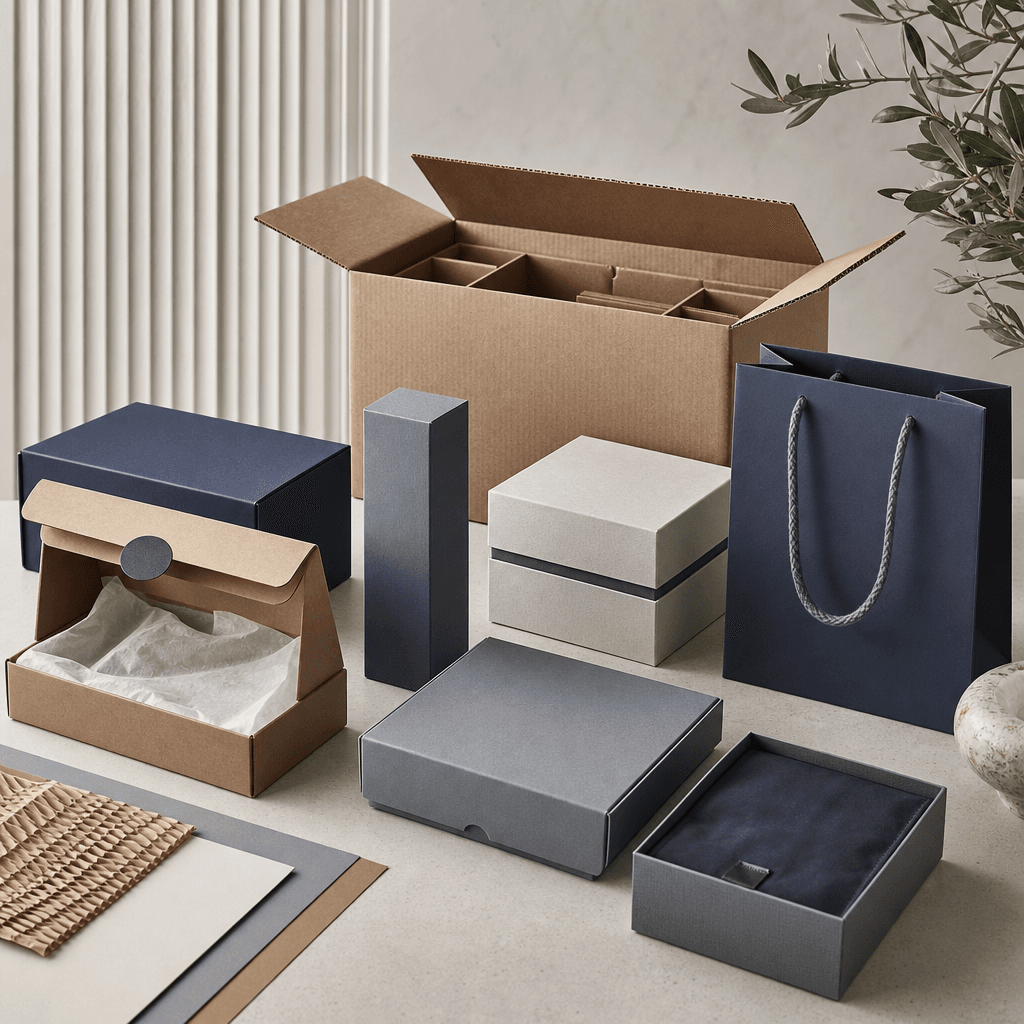
A cardboard box is not a uniform product; it is a family of packaging made from different combinations of cardboard cores and coatings. Gray cardboard core rigid boxes, chromo board folding boxes, coated/bristol board premium boxes, and corrugated kraft shipping boxes are the main members of this family. Making the right choice for your brand means matching the product's weight, distribution channel, printing needs, and sustainability goals with the technical structure of the cardboard. At Kosapack, we build this matching according to brands' commercial goals.
The Packaging Manufacturers Association defines packaging as a valuable material that protects the product and facilitates its delivery to the consumer in a hygienic and safe manner, along with its transportation and storage. The cardboard box lies at the heart of this definition: it is not only a visual carrier but also a logistics and product safety component. Understanding this dual role is the first step to choosing the right box.
Contents
- What is a cardboard box and what is its role in packaging?
- Types of cardboard boxes and their differences
- Why does the right cardboard box become your brand's decision?
- What criteria should you consider when choosing the right box?
- How do these decisions turn into a concrete project with Kosapack?
- Frequently Asked Questions
What is a cardboard box and what is its role in packaging?
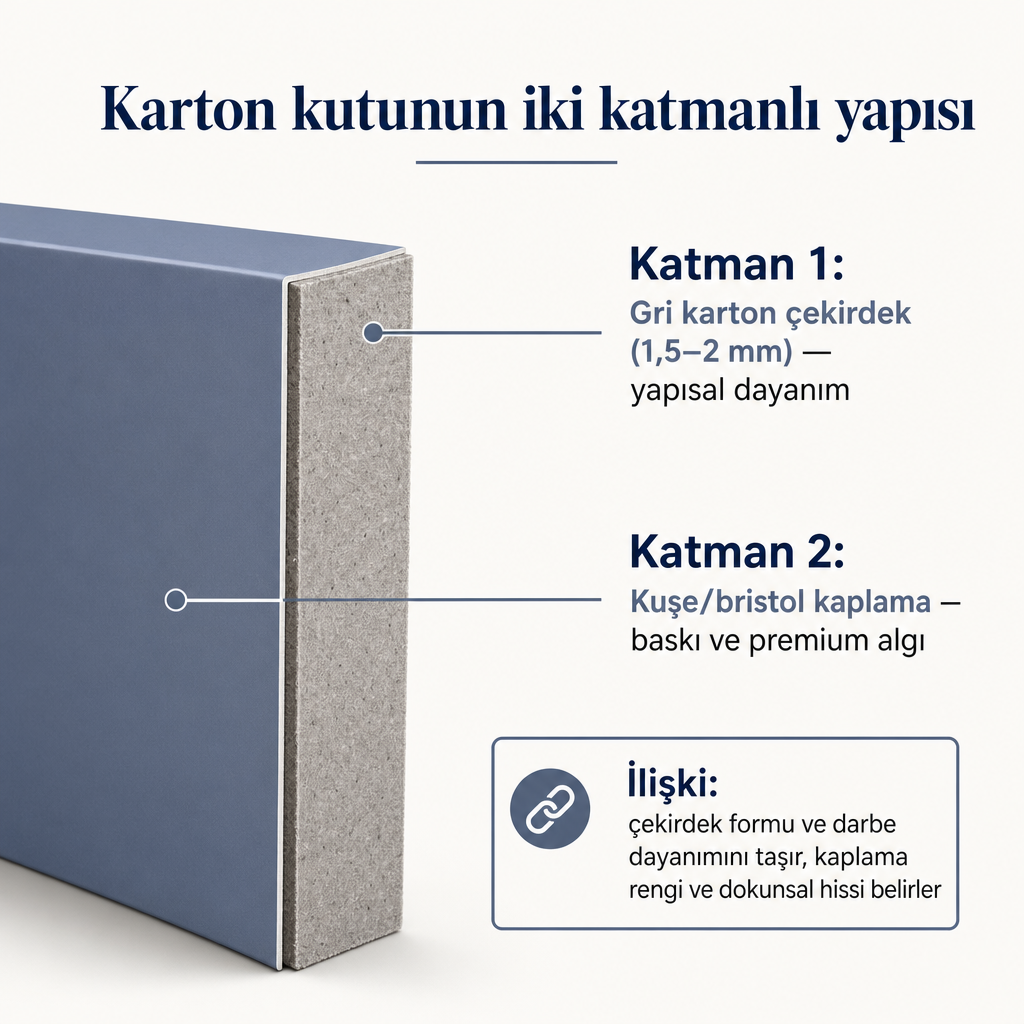
A cardboard box's performance arises from two layers working together: the structural core and the coated surface. The core carries the box's form and impact resistance; the coated surface determines print quality, color, and tactile perception. For example, in a luxury rigid box, 1.5–2 mm gray cardboard forms the structural skeleton, while the outer coated layer handles the glossy print and premium feel. This distinction explains why the same cardboard box can be both sturdy and impressive.
Grammage comes into play at this point. The cardboard's weight is not just thickness; it represents the balance between product protection, foldability, and logistical efficiency. A folding box carrying a lightweight cosmetic product and a corrugated shipping box protecting a fragile ceramic are designed with completely different structural logic. Evaluating this grammage-structure relationship on a per-cardboard-type basis forms the technical foundation of the right choice.
The role of cardboard is not limited to shipping either. The box is the brand's first point of contact on the shelf and, in e-commerce, often the first physical surface the customer sees. Therefore, choosing the right cardboard is both an engineering decision that protects the product and a design decision that establishes the brand experience.
Types of cardboard boxes and their differences
The main factor distinguishing cardboard boxes is the type of cardboard used and the grammage range. The table below compares the four main structures we frequently use in our portfolio and their distinguishing features.
| Cardboard type | Typical grammage | Print surface | Prominent use |
|---|---|---|---|
| Gray cardboard (rigid core) | ~250–400 gsm or 1.5–2 mm | Low, inner layer | Luxury rigid box skeleton |
| Chromo board | 250–350 gsm | Medium–high, single-side coated | Food and pharmaceutical folding boxes |
| Coated/bristol board | 250–400 gsm | High, double-side coated | Cosmetics and premium retail |
| Kraft / corrugated liner | Kraft 50–200 gsm | Matte (brown) or high (white) | E-commerce and cargo shipping |
Gray cardboard on its own has low print quality, but when coated with coated or bristol board on the outside in rigid boxes, it provides both impact and shelf resistance for the premium cosmetic and luxury care segment. Chromo board, with its single-side coated structure, produces the folding form factors that have become the industry standard for pharmaceuticals and food. Coated and bristol board, with their double-side coated, smooth structure, are the most suitable surfaces for bright, high-resolution printing and effects such as spot lacquer and foil.
On the kraft side, it is important to distinguish between two shades. Natural brown kraft (50–170 gsm) offers high durability but absorbs print more; therefore it establishes a matte, warm, and sustainable visual language. Bleached white kraft (60–200 gsm) combines both durability and high print quality, making it usable in premium bags and boxes. Corrugated liner structures stand out with their stacking safety and impact resistance for e-commerce parcels and fragile product shipping.
Why does the right cardboard box become your brand's decision?
Choosing a cardboard box is a decision left too late in most brands. Yet the wrong structure comes back as product damage, returns, and a poor first impression. For a premium skincare brand, a coated rigid box raises the perceived value at the moment of unboxing; but if the same brand uses only a thin folding box for e-commerce shipping, the risk of transit damage increases. The cardboard type decision is a commercial decision that directly affects return rates and brand perception.
The sustainability dimension turns this decision into a necessity. In its announcement summarizing the EU packaging and packaging waste legislation, the Republic of Turkey Ministry of Trade conveys recycling rate targets for paper and cardboard packaging; paper-cardboard is one of the highest-rate categories in these targets. For brands that ship or plan to ship products to the EU market, cardboard box design is now not just about aesthetics but a matter of compliance.
This framework also corrects a common misconception: not all cardboard boxes are automatically sustainable. Multi-layered structures, plastic coatings, or heavy metal-based printing can cause problems in the recycling stream. Material composition and recyclability are decisions to be made at the design stage — not a label added afterwards.
Thicker cardboard does not always mean a better box; the right box is one optimized according to the product's actual needs.
What criteria should you consider when choosing the right box?
There is no single formula that determines the right cardboard box; there is a balance of several interacting criteria. Clarifying these criteria allows you to enter the quotation and design process fully prepared.
- Product type and fragility: Heavy or fragile products require higher grammage and a corrugated structure; for lightweight products, unnecessary thickness turns into a waste of cost and weight.
- Distribution channel: While print quality stands out in shelf and gift boxes, impact and stacking resistance take priority in e-commerce shipping.
- Printing and brand language: Coated/bristol or white kraft is suitable for high-resolution glossy printing and effects; brown kraft is suitable for a natural and sustainable perception.
- Sustainability and regulations: The source reduction standard TS EN 13428 targets reducing unnecessary weight and volume, while TS EN 13430 targets recoverability through material recycling; a single-material approach and the choice of recyclable adhesives are at the center of this criterion.
- Proof of structural durability: Whether the box structure is truly adequate is measured with drop (for example, 1 m), stacking, and folding tests; and in magnetic closures, with open-close cycle tests.
Among these criteria, the most frequently overlooked balance is the alignment between grammage and product needs. Source reduction standards position unnecessary thickness as a mistake both in terms of cost and sustainability. Likewise, the belief that natural-looking surfaces are of low quality is wrong: brown kraft and gray cardboard can establish a premium perception with the right design. The relationship between durability and printing of cardboard types forms the fundamental comparison axis for choosing the right grammage and coating.
How do these decisions turn into a concrete project with Kosapack?
We work as a packaging partner that matches these technical options with your brand goals. In a cardboard box project, we first understand your product category, weight, distribution channel, and sustainability goals; then we manage consultancy, structural and graphic design, prototyping, and production with verified manufacturing partners all under one roof. Having rigid boxes, folding cardboard, kraft bags, and corrugated shipping boxes in the same portfolio makes it easier for you to establish a consistent brand language across your different product lines.
A test-based production culture is the distinguishing part of this process. We apply drop, stacking, and folding tests for cardboard boxes, and open-close cycle tests for magnetic closures; we maintain quality control by randomly drawing samples from mass production. Thus, the structural performance of the box is based on measurement, not assumption.
When you want to enter a concrete selection process, you can review our brand-focused approach in our custom box production guide; you can move on to our cargo box custom printing content for e-commerce shipping, or to our cosmetic packaging production approach for the premium care category. Once you have clarified your product category, weight and fragility information, distribution channel, and sustainability goals, we can prepare a custom cardboard box proposal for you.
Frequently Asked Questions
Is a cardboard box a single product?
No. A cardboard box is a family consisting of subcategories such as gray cardboard core rigid boxes, chromo board folding boxes, coated/bristol premium boxes, and corrugated kraft shipping boxes. Each is produced with a different cardboard type and grammage.
Which cardboard type is suitable for a cosmetics box?
For premium cosmetics and luxury care, coated/bristol board or a rigid structure with a coated layer over a gray cardboard core is commonly preferred; this combination provides both high print quality and impact and shelf resistance.
Is thicker cardboard always better?
No. The source reduction standard TS EN 13428 aims to reduce unnecessary weight and volume. The right approach is grammage and structural design optimized according to the product's actual needs; this is more correct in terms of both cost and sustainability.
Are all cardboard boxes recyclable?
Not automatically. Multi-layered structures, plastic coatings, or heavy metal-based printing can cause problems in the recycling stream. Recyclability depends on material composition and decisions made at the design stage.
What should I clarify first in order to choose the right box?
Clarifying your product type and fragility, your distribution channel, your printing and brand language needs, and your sustainability goals is the starting point for deciding on the right cardboard type and grammage.