
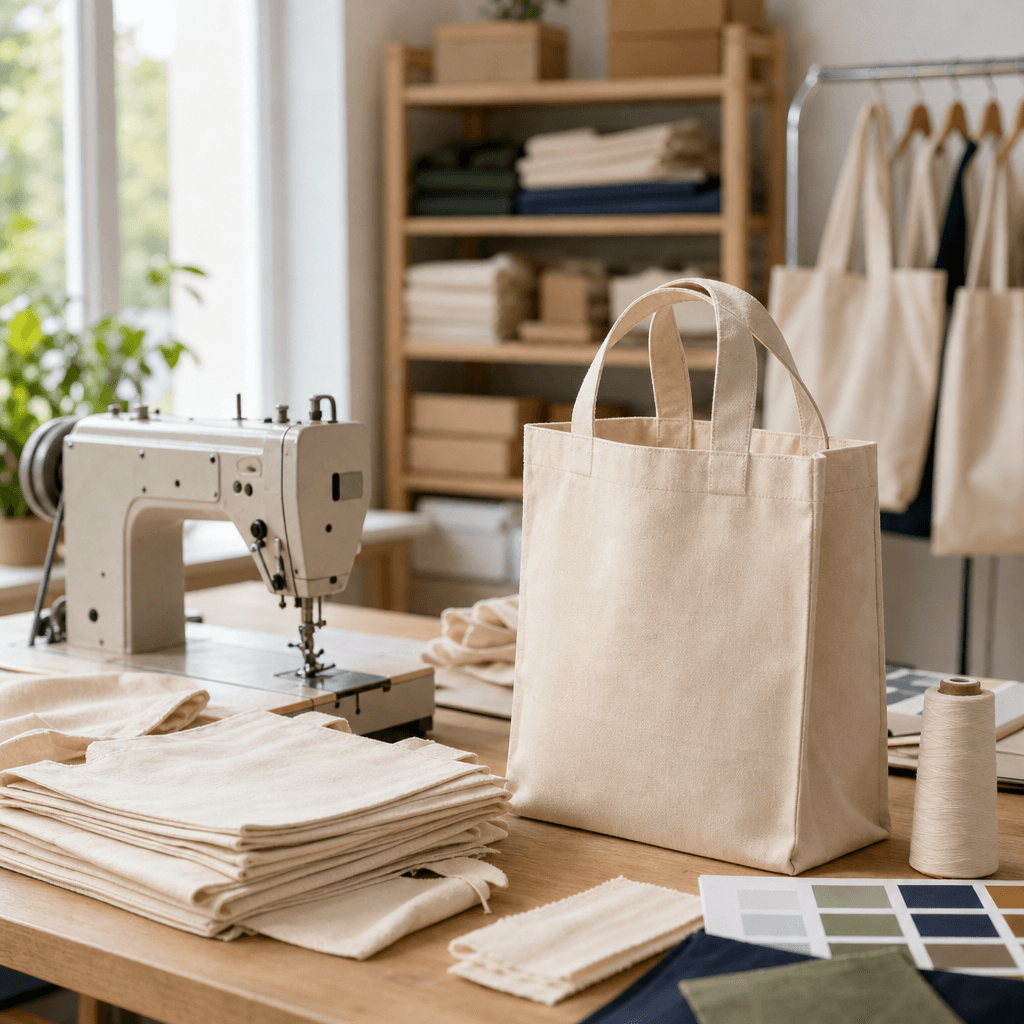
Fabric bag production is not just about making a carrying product with a logo printed on it for brands. Decisions on the right fabric, dimensions, handle, printing and stitching together determine the carrying capacity, lifespan, brand perception and total cost of the bag. A fabric suitable for a lightweight promotional bag cannot be planned with the same logic as a carrier bag that a premium cosmetics, jewelry or fashion brand wants used again and again. In this guide, we explain the technical and commercial decisions you need to make before ordering a fabric bag, under the headings of material, weight, dimensions, handle, printing, sampling, cost, sustainability and labeling.
Contents
What is a fabric bag and what does it do for brands?
A fabric bag is a reusable carrying bag produced from woven or non-woven textile surfaces, which can be customized for the brand through printing and stitching. Production is not just a single printing process: it emerges from the joint planning of selecting the fabric, dimensioning the parts, applying the print, cutting, handle assembly, stitching and quality control stages. That is why printing the logo onto the fabric alone is not enough; the bag's real use scenario, the weight of the product to be carried and the expected frequency of use are also part of the design.
Its value from a brand perspective is that the product remains visible even after it leaves the store. When the user carries the bag again, the logo, color and visual language create new touchpoints. Depending on the purpose of use, the bag takes on different functions; the same design approach does not fit every scenario.
| Use scenario | Primary expectation | Suitable design approach |
|---|---|---|
| Store and retail | Ease of carrying, brand visibility | Medium-high weight fabric, comfortable handle |
| Cosmetics and jewelry | Premium feel, tidy presentation | Firm surface, controlled printing, clean stitching |
| Fashion and textile | Visual integrity, reuse | Fabric matching brand colors, long handle |
| Event and promotion | Quantity and budget efficiency | Economical fabric, simple print |
| Corporate gift | Durability and corporate appearance | Reinforced handle, clear logo application |
| E-commerce gift set | Unboxing and complementary packaging | Use together with box, tissue and card |
A fabric bag provides a more consistent brand experience when planned together with a box, tissue paper, thank-you card and label. We address the fabric bag not on its own, but by coordinating it with the same brand's complementary packaging; this approach preserves both visual integrity and the protective function.
Fabric selection: cotton, canvas, nonwoven and polyester
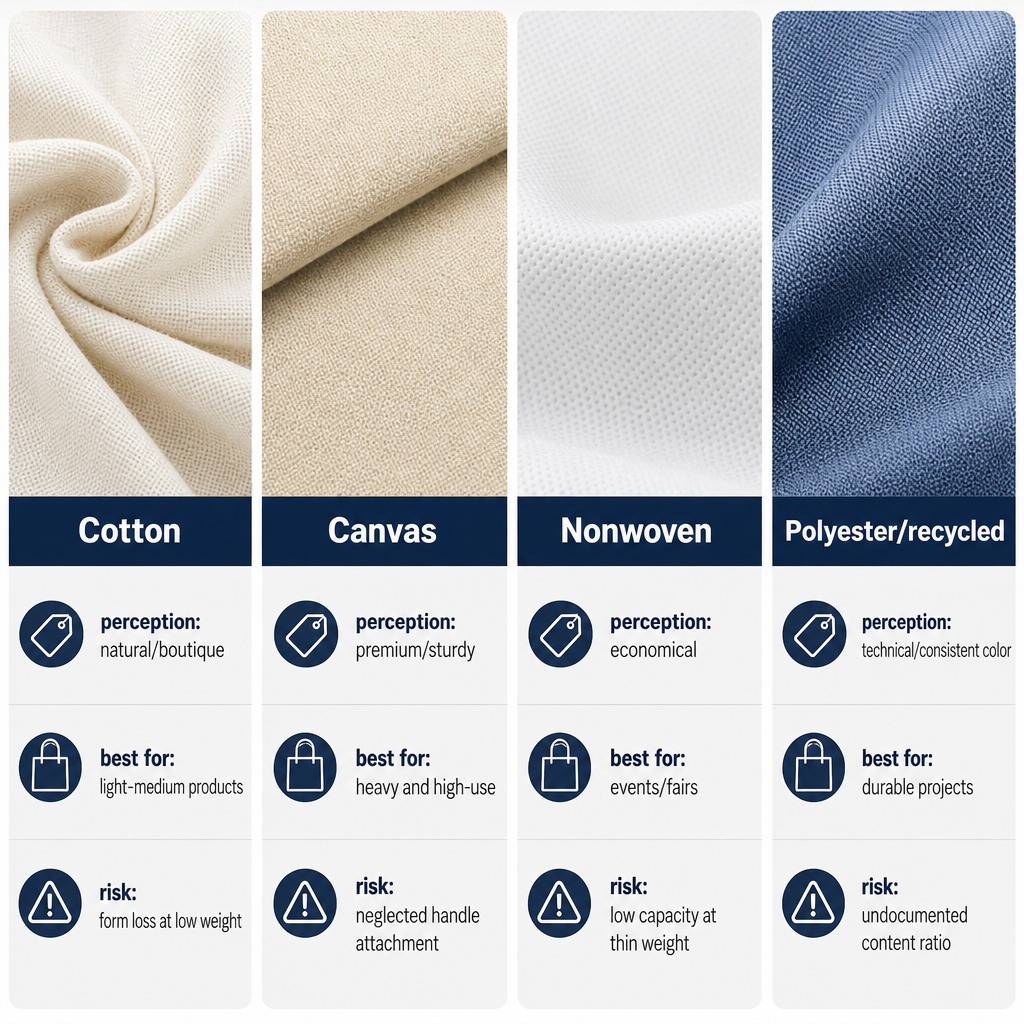
Material selection determines much more than the appearance of the bag. It simultaneously affects print quality, stitching behavior, carrying capacity, foldability and lifespan. Four main groups correspond to different brand scenarios.
Cotton fabric is often preferred for brand bags due to its natural texture and surface suitable for printing. It conveys a natural and warm perception, suits boutique and sustainability-focused positioning, and works well with screen printing. However, if its weight is low, it loses its form with heavy products; natural fibers carry a risk of shrinkage and color variation. The mere fact that a fabric looks natural does not justify an "organic cotton" claim.
Canvas, with its firmer and more durable surface, is a strong option for jewelry sets, candles and gift products, fashion collections, corporate gift kits and carrier bags intended for frequent use. Thick fabric alone does not mean a durable bag; weight, handle connection and stitch reinforcement must be evaluated together.
Nonwoven is a textile-based material obtained by forming the fibers into a surface through methods other than weaving or knitting. It is lightweight, economical at high quantities and suitable for fairs and short-term use. On the other hand, it can create a lower perceived quality compared to premium fabrics, and at thin weights the carrying capacity is limited. If a long life is targeted, canvas or firm woven fabric is more appropriate.
Polyester and recycled fabrics provide an advantage in some projects in terms of color consistency and durability. If recycled polyester is used, the recycled content ratio and the documents supporting this claim must also be verified. For a fabric to be considered "recycled", "organic" or "sustainable" depends not only on the raw material; it depends on the supply chain and certification.
Weight and dimensions: two decisions that determine durability
Weight refers to the mass of the fabric per square meter. On its own it does not indicate durability; however, it gives initial information about whether the fabric will feel firm or thin. Answering the following questions clarifies the decision when determining the weight: What weight of product will the bag carry? Will the product be carried on its own or inside a box? Will it be used once or again and again? Will it be stored folded? Is a premium and firm feel targeted, or a lightweight and economical solution? While thin, foldable fabric is sufficient for lightweight textile products, glass bottles, candles, books or multiple gift sets require firmer fabric, a wider handle and a reinforced connection.
Dimensions, on the other hand, are determined based on the external dimensions of the product to be carried and the manner of use. Just as important as the product fitting in comfortably, is that the bag is not larger than necessary. The dimension brief should include width, height, base or gusset width, handle length and width, inner pocket requirement, product weight and the way the bag folds. A gusset adds volume to the base or sides; a gusseted structure is more functional for boxed products, bottles and multiple sets. A flat bag, on the other hand, is more economical and easier to store for lightweight products.
If the fabric bag is to replace a box, the dimensions must be calculated not only according to the product but according to the total volume of the box and complementary packaging. To define the dimensions, use scenario and product information in a single file, you can benefit from our guide on preparing a packaging design brief. When requesting a quote, the phrase "cotton bag" is not sufficient; the fabric type, weight, dimensions, handle features and stitching standard must be clearly written on the quote.
Handle and stitching: the bag's real test point
The handle is one of the most load-bearing parts of the fabric bag, and its selection is not merely an aesthetic decision. A short handle is suitable for hand-carrying, store delivery and the boutique experience. A long handle makes shoulder-carrying possible; it is more functional in fashion, textile and everyday use. Handles produced from the same fabric as the body give an integrated appearance, but the number of plies and the connection stitch must be checked. A woven webbing or strap handle provides a more distinct and durable carrying feel; it can also be used as a contrast detail in corporate and premium projects.
The critical points in handle design are: handle length, carrying direction, handle width, overlap distance onto the body, reinforcements such as X stitching or box stitching, the maximum weight the bag will carry, and comfort in hand or on the shoulder. For heavy products, simply choosing a thicker handle is not enough. What is decisive is that the handle is stitched onto the body spread over a wider area; this prevents the load from concentrating at a single point on the fabric. The performance of the handle connection can only be seen in a sample test performed with a full bag.
Printing options and color accuracy
The printing technique is selected according to the fabric's color, texture, order quantity, the level of detail of the design and the expected color accuracy. There is no single "best" method; the decision depends on the scenario.
| Printing approach | When it is suitable | Point to pay attention to |
|---|---|---|
| Screen printing | Simple logo, limited colors, high contrast | Fine detail and multi-color gradients may be limited |
| Transfer printing | Detailed or colorful graphics | Surface feel and wash resistance should be tested |
| Digital textile printing | Photographic or variable visuals | Fabric type and color profile affect the result |
| Flexo/rotary | High-quantity, repeated production | Plate and setup cost must be taken into account |
| Embroidery | Premium, tactile, permanent logo | Fine lines, cost and fabric deformation should be checked |
When preparing the print file, a safe area should be left around the logo, the fabric's stitching areas should be kept outside the composition, and how the print color will appear against the fabric background should be examined on a sample. Especially on ecru, beige, kraft-look or dark-colored fabrics, a noticeable difference can arise between the color on screen and the actual print. For this reason, mass production approval should not be given by looking only at the digital visual.
Why is a sample mandatory before mass production?
In a fabric bag, a physical sample makes it possible to see the product's real performance beyond checking the appearance of the print. A bag that looks good when empty may strain the handle stitches when the product is placed in it. The following should be tested on the sample: does the product fit into the bag comfortably, does the bag keep its form when full, is the handle comfortable in hand and on the shoulder, is there any opening at the handle connection or tension in the fabric, is the print in the correct position and sufficiently visible on the fabric background, are the stitches neat and symmetrical, does the base carry the product's weight, does the print surface get damaged when the bag is folded, and is it compatible with the complementary packaging?
The sample approved by the brand should be kept as a reference for the production standard. If a deviation occurs in color, dimensions, stitching or handle during mass production, a physical example is available for comparison. A production decision made without sample approval significantly increases the risk of re-production and delivery delays.
Factors that determine cost and quote comparison
The price of a fabric bag cannot be explained by a single unit price. The total cost consists of the combination of the fabric type and weight, bag dimensions and gusset structure, order quantity, printing technique and number of colors, printing area, handle type and length, stitching and reinforcement details, inner lining or pocket, sample and plate preparation, packaging, and the storage and shipping plan. A low unit price does not always mean a lower total cost: thin fabric tearing during carrying, the print turning out different than expected or the dimensions being incompatible with the product leads to re-production and delays.
When comparing quotes, make sure the following information is written the same way for each supplier: fabric type, weight, bag dimensions, handle dimensions and type, printing technique, print color and area, whether the sample is included, packaging method, delivery time, minimum order quantity and quality tolerances. A comparison made without equalizing these items leads to choosing a product that appears cheap but is actually different.
If you are also evaluating paper-based alternatives, you can check our guide on paper rope bag production cost and process to compare the cost logic. If you want to see how box costs are structured, our article on the factors that determine paper cup prices offers a similar cost reading. When choosing between a fabric bag and a paper rope bag, the duration of use, carrying weight, brand positioning and storage space must be addressed together.
Sustainability claims and labeling in Turkey
A fabric bag may be "reusable"; however, this statement alone does not prove that the entire life cycle of the product is sustainable. The real benefit is related to how long the bag is used, what material it is produced from, the structure of the print and accessories, the production process and the recycling conditions after use. There are distinctions that brands need to clarify: reusability and recyclability are not the same thing; organic cotton and standard cotton are not the same claim; recycled polyester does not mean the entire product is recyclable; a certificate should indicate whether the fabric or the finished product is within scope; general statements such as "eco-friendly" should not be used without documentation and a measurable explanation.
Two standards frequently come up at this point. The GOTS standard defines criteria for the processing, manufacturing, packaging, labeling, trading and distribution of textiles containing at least 70 percent certified organic natural fibers. If a GOTS claim is to be used, the certified organization, the approved certification body and the supply chain records must be verified. OEKO-TEX STANDARD 100 is a safety standard that tests textile products for harmful substances; it shows that the product meets the relevant test requirements, but on its own it does not mean the product is organic or carbon neutral.
Textile products placed on the market in Turkey must be labeled or marked to indicate the fiber composition within the framework of the relevant rules; the manufacturer and distributor are responsible for the accuracy of the label information (current product rules guide). Whether or not the fabric bag is considered a textile product offered for sale should be examined according to the product's purpose of use, manner of presentation and the relevant product scope. For this reason, before mass production the fiber composition should be verified, whether a label or product information is required should be checked, statements such as "organic" and "recycled" should be supported with documents, and for imported products the origin and supply documents should be kept. Since the legislation may be updated, we recommend that you additionally check the current rules, especially in retail sales, export and corporate distribution projects.
Common risks and the right supplier criteria
The recurring risks in fabric bag projects are well known and most can be resolved at the sample stage. Inadequate carrying tests lead to a bag that looks good when empty straining at the handle stitches when full. The print position being too close to the cutting or stitching areas causes the design to be distorted in mass production; the print area should be defined in advance on the technical drawing. Some natural fabrics may show dimensional changes due to washing, humidity or production conditions; the manufacturer should explain whether pre-treatment is applied before cutting. Since the fabric's texture and background color can change the perceived tone of the print, if brand colors are critical a physical print sample should be obtained. Undocumented environmental claims create loss of trust and legal risk. An oversized bag, even if it seems useful, creates unnecessary material consumption, high storage volume and a weaker brand experience; dimensions should be determined according to the real total volume of the product and complementary packaging.
When choosing a supplier, looking only at the sample's appearance or the unit price is not enough. The supplier must be able to read a technical brief, produce a sample, perform print and stitching quality control and manage the delivery plan. The evaluation should consider the explainability of fabric and accessory options, technical dimension and sample standards, print color control, handle and stitch reinforcement, certificate verification approach, clarity of minimum order quantity, pre-mass-production approval mechanism, packaging and logistics management, and the ability to coordinate complementary packaging for the same brand.
At Kosapack, we combine consultancy, structural and graphic design, prototyping, production management through verified factory partners and logistics in a single service model for custom packaging projects. Planning the fabric bag together with the same brand's box, tissue and card is a direct advantage of this model. For information on your project's current production scope, quantity and lead time, we recommend requesting a quote directly along with your technical brief; this way we can clarify the material, production method, sample requirement and logistics plan according to your brand.
Frequently Asked Questions
How long does fabric bag production take?
The time varies depending on whether the fabric is ready, the printing technique, the sample, the order quantity and the production plan. Custom dimensions, custom color, certificate verification and multi-color printing can extend the time. A definite lead time should be given after the technical brief and sample approval.
Is a fabric bag or a paper bag better?
There is no single right answer. If reuse and durability are the priority, a fabric bag; if lightness, fast consumption and paper-based presentation are the priority, a paper bag may be more suitable. Product weight, store experience, storage and brand positioning must be evaluated together.
Can a fabric bag be washed?
This depends on the fabric type, the printing technique and the manufacturer's care instructions. If washability is to be the brand's core promise, it should be tested before production; it should not be assumed as a default feature.
Which is the most durable fabric for a fabric bag?
Durability does not depend only on the fabric type. Weight, weave structure, handle material, connection area and stitch reinforcement are collectively decisive. For heavy products, firm fabric and a reinforced handle connection should be preferred.
What is needed to have an organic fabric bag made?
A valid document proving the fabric is organic and supply chain verification are required. If a certificate such as GOTS is to be used, not only the raw material but also the relevant production and certification scope must be checked.