

The short answer to the question of how to prepare a packaging design brief is this: you write a short, measurable project document that explains what your product is, what you expect from the packaging, and the technical constraints within which the manufacturer will work. A well-prepared brief turns a design idea into a producible package; it makes quotes comparable and reduces the risk of costly revisions at the sample stage. At Kosapack, we consider this document the starting point of projects: when we receive the brief, we typically aim for a quote within 24 hours and a physical sample within 7–15 business days. This guide clearly explains exactly what should be included in the brief and which decision each heading affects.
Table of Contents
What exactly does a packaging design brief solve?
The brief is the project framework given to the design team or packaging manufacturer. The sentence "we want a stylish, premium box" is a wish; the brief, on the other hand, is the collection of concrete information that directs that wish. With a single document, it meets three different needs at once: the brand need (how the packaging should look, what perception it should create), the product need (how the product should be protected, transported, presented) and the production need (at what scale, in what material, in what quantity and in what timeframe it should be produced).
This triple structure distinguishes the brief from a simple graphic instruction. Sharing a logo and colors alone is not enough; structural design, material, printing, interior layout, logistics and regulatory decisions are also tied to the same document. The more measurable the brief, the more accurate and comparable the quote returned to you. This is also why we evaluate projects through a brief rather than a fixed list price: without the same headings being filled in, you cannot be sure that two quotes cover the same job.
First decision: what is the packaging's job?
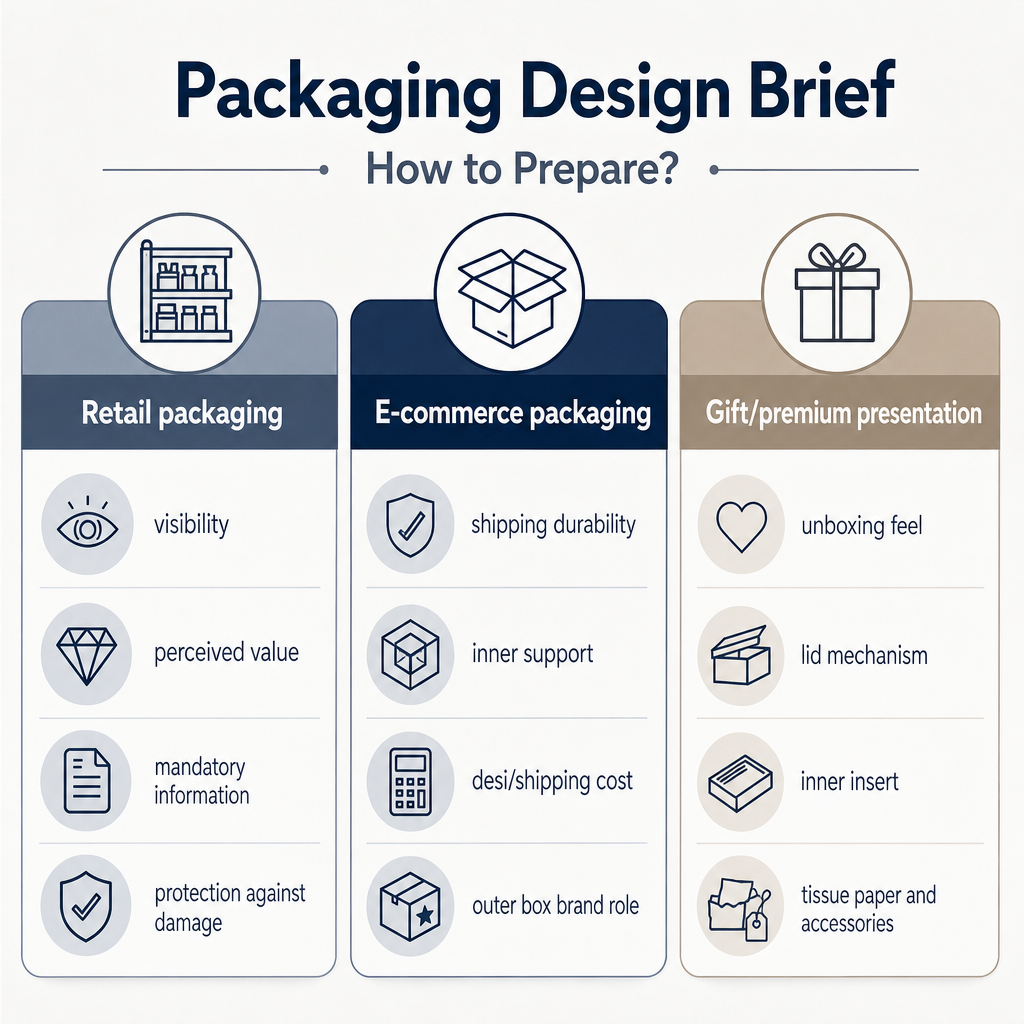
Before moving on to design, define the packaging's primary job. The same product may require a completely different packaging solution across different sales channels. Making this decision at the very beginning aligns all subsequent technical choices.
In retail shelf packaging — cosmetics, candles, chocolate, jewelry — the job is to make the brand visible on the shelf, elevate the perception of value, present mandatory information in an orderly way, and protect the product from damage. In this scenario, color, typography, surface texture, the opening experience and the interior nest are evaluated together.
In e-commerce packaging, the product is exposed to impact and pressure during the shipping process. Add to the brief the nature of the shipping process, whether the product is fragile, the need for internal support, the role of the outer box in the brand experience, and the effect of box dimensions on shipping cost. Because box volume directly affects desi and shipping cost, the dimension decision is not only aesthetic but also a logistics decision; we cover this relationship in detail in our desi and shipping box cost guide.
In gift and premium presentation, the brief requires that the opening experience, lid mechanism, magnet, ribbon, interior nest, tissue paper and accessories be evaluated together. The goal here is not to add the most details, but to build the experience that supports the product's price positioning.
The backbone of the brief: which headings should be included?
The table below is a practical brief skeleton that can be sent directly to us or to any manufacturer. Each row closes an uncertainty in the quote.
| Brief heading | Information to be written |
|---|---|
| Brand | Brand name, sector, positioning, brand personality |
| Product | Product name, contents, weight, fragility information |
| Target audience | Age, purchase motivation, income group, usage context |
| Sales channel | E-commerce, store, boutique, dealer, corporate gift, export |
| Packaging purpose | Protection, shelf visibility, gift presentation, shipping, unboxing |
| Product dimensions | Width, length, height, weight, the product's position inside the box |
| Packaging type | Folding carton, rigid board box, corrugated box, bag or combination |
| Interior layout | Divider, foam, cardboard nest, paper filler or custom mold |
| Visual direction | Color, logo usage, typography, references and examples to avoid |
| Printing | Offset, digital or other printing expectation |
| Surface finish | Matte/gloss lamination, soft touch, varnish, foil, embossing |
| Quantity | First order, monthly estimate, number of variants |
| Schedule | Sample, approval, production, delivery dates |
| Budget | Unit target, total budget or priority order |
| Delivery | City, shipping method, storage or assembly need |
| Sustainability | Recyclability, recycled content, certification |
| Regulations | Label, warning, contents, recycling mark, category-specific information |
The core inputs that speed up our quoting process are gathered with the same logic: product name and usage scenario, product dimensions, box type, quantity, printing and finishing, interior layout and delivery information. When most of these headings arrive filled in, the quoting time shortens; as the gaps multiply, the process turns into a round of questions and answers.
How to write product and dimension information?
General expressions like "a cosmetic product" or "a special gift" are insufficient for a quote. Write the product's actual behavior inside the packaging. For example:
50 ml glass jar. The product is fragile. It will be sold individually. The box will be used both on store shelves and in e-commerce shipments. The jar should not move inside the box. A premium and simple experience is targeted upon opening.
This description enables the manufacturer to evaluate not only the external appearance but the interior nest, tolerance, protection and sales channel together. If possible, add a product photo, technical dimension drawing, product weight, the product placed inside the packaging, the dimensions of parts such as the cap/pump/bottle, and whether more than one product will be in the same packaging.
The most critical distinction in dimensions is between interior and exterior dimensions. The safest method is to first give the product's actual dimensions and ask the manufacturer to propose the packaging's interior dimensions. In the brief, clearly use one of these expressions: "Product dimensions: 80 × 50 × 25 mm", "Packaging interior dimensions should be: 85 × 55 × 30 mm", "For exterior dimensions, shipping volume and desi should be optimized" or "Manufacturer's recommendation is expected for the support between product and box."
Tolerance is a separate decision too. If the product fits too tightly, inserting and removing it becomes difficult; too much space moves the product and creates a risk of damage. The correct tolerance is given together with the interior layout decision.
How to describe graphics, printing and finish expectations?
In the graphic design section, sharing the logo and brand color is a start, not an end. Explain which communication task the design will undertake: what the packaging should convey at first glance, whether the brand should look premium or natural or technological, whether the logo should be dominant or secondary on the front, on which surface the product name should appear, what message the consumer should encounter when the packaging is opened, which colors and styles should not be used, and whether the same design will be adapted to different variants.
When using reference visuals, present them not as a design to be copied, but as an example that facilitates the decision, and add a short note next to each: "The matte tactile surface in this example is liked", "The lid opening style can be taken as a reference", "This color palette is not preferred". This method turns visual preference into a technical expectation.
In printing and surface finishes, "quality printing" is subjective. Instead, write the expected application: CMYK or Pantone, single/double-sided printing, matte or gloss lamination, soft touch, spot varnish, hot foil, embossing, foil or special ink. Each effect affects cost and production risk. Also, the color seen on screen may look different on the actual material; therefore, a proof or physical sample is essential before final approval.
Check the following on the sample: logo position, color tone, readability of text, cut and fold marks, lid closure, surface's tendency to scratch, interior nest–product fit and the opening experience. On a physical sample, the die-cut, folding, print tone, material and product fit can be seen in real use; you can find step-by-step instructions on how to request a sample in our packaging sample guide.
When choosing the packaging type too, describe the scenario rather than the appearance. Folding carton is advantageous for lightweight, stackable, high-volume products, but the premium feel depends on grammage and design — you can examine its structure and areas of use in our folding carton guide. A rigid board box is considered when a more rigid structure and higher perceived value are required; in the brief, instead of saying "premium box", write details such as whether it is lidded or drawer-style, whether magnetic closure is wanted, whether an interior nest is needed, whether the box will be shipped assembled or flat, and how the product will be removed from the box. In a corrugated box, the priority is protection; add the shipping process, stacking conditions, interior filling and exterior printing expectation. If a project requires both premium presentation and shipping protection, a two-layer structure is considered: a rigid board box inside, a corrugated shipping box outside, and tissue or dividers in between.
Sustainability and regulations: clarify before design
The phrase "sustainable packaging" is not clear enough on its own. Specify in the brief which environmental goal is the priority: recyclable single material, recycled content, reduction of plastic lamination, FSC-certified paper, less material, lower transport volume, reuse or carbon footprint reporting.
These goals sometimes conflict. A multi-layer surface application can increase the premium appearance while making recycling more difficult. For this reason, a priority statement is more functional than "the most sustainable solution": "Our priority is recyclability; the surface effect is secondary" or "The premium tactile effect must be preserved, plastic-based coating should be limited as much as possible."
With the placing of packaging on the market, packaging waste and marking obligations come into play. In Turkey, the Regulation on the Control of Packaging Waste covers packaging placed on the market and its waste; marking rules regarding the packaging type and material are also regulated. We recommend verifying the current obligations from the text of the Regulation on the Control of Packaging Waste.
If regulatory information is added at the final stage, the hierarchy on the front, font size and usable space are disrupted. Therefore, give the product category and mandatory information at the beginning of the brief. In food packaging, mandatory elements such as product name, ingredients, allergens, net quantity, date information, storage conditions and operator information may come into play; these rules are regulated under the Turkish Food Codex Food Labeling Regulation. In cosmetic packaging, the information on the inner and outer packaging must be indelible, easily readable and visible, and the ingredient list must appear on the outer packaging. Therefore, add to the cosmetic brief the product name and function, net quantity, ingredient list, directions for use, warnings, responsible person information, origin and texts compliant with the product notification. The design team does not replace regulatory responsibility; final texts must be verified by the brand and the relevant responsible persons.
Why are quantity, budget and schedule written together?
Packaging cost is not determined by box dimensions alone. Quantity affects how the mold, print setup, material supply and production cost are distributed per unit. For this reason, if possible, provide three quantity figures: the first order quantity, the expected monthly or annual consumption and the number of variants of the same packaging. For example: first order 1,000 units, estimated monthly consumption 2,500 units, 3 color variants with the same structure.
If the budget is not definite, write the priorities: "Priority order: product protection, color accuracy, premium surface, low unit cost." This way, it is clear from the outset which feature can be compromised when necessary.
The delivery date should not be written as "as soon as possible." Instead, share dated targets: design approval December 15, physical sample December 22, mass production approval January 5, delivery to warehouse January 25. A dated schedule allows us to evaluate whether the proposed structure can actually be ready in time; otherwise, a technically correct solution that does not fit the schedule may be proposed.
What risks does a poor brief create?
An incomplete brief usually brings costs back at the sample and production stage. The main risk items are:
- Wrong dimensions: If only an approximate box size is shared without giving the product dimensions, the product may not fit or too much space may remain.
- Non-producible design: Even if the graphics are complete, the cutting, folding, gluing, lid tolerance or material direction may not be suitable for production; graphic and structural design should be developed together.
- Color and surface mismatch: The design on screen does not show the result on real paper or board exactly. A physical sample and color proof reduce this risk.
- Redesign due to regulations: If mandatory information is left to the end, the font size, surface area and hierarchy are disrupted.
- Increase in logistics cost: Even if the box is right for the product, the transport volume, desi, palletizing and storage may not have been evaluated.
- Budget overrun: When foil, embossing, magnet, custom interior nest and multi-layer surface are used together, the cost rises rapidly. In the brief, separate the "must-have" and "nice-to-have" features.
All these risks stem from the same root: sharing wishes instead of measurable information. When you tie each heading to a concrete value, both the quote and the sample increase the chance of being accurate on the first attempt.
Copyable packaging design brief template
You can adapt the text below directly to your quote request:
Brand: Product: Product category: Target audience: Sales channel: Main purpose of the packaging: Product dimensions and weight: Product sensitivities: Preferred packaging type: Interior layout or protection need: Desired interior/exterior dimensions: Printing expectation: Surface finishes: Brand colors and files: Reference visuals: Design examples to avoid: First order quantity: Number of variants: Target budget or cost priority: Sample expectation: Launch and delivery date: Delivery city: Sustainability criteria: Mandatory information: Additional notes:
When sending the brief, include logo files, technical drawings, product photos and, if any, existing packaging samples. So that the quote is comparable, also ask separately whether design, sample, mold, printing, surface finish, interior layout, assembly, packaging, shipping, VAT, waste, tolerance and revision conditions are included.
When sharing a brief with us, a product photo or technical dimensions, the desired box type, interior and exterior dimensions, estimated quantity, logo and design files, surface finishes, interior support or divider need, delivery city and launch date are sufficient. Since we handle consulting, structural design, graphic design, prototyping, production management and logistics within the same project flow, we would like to remind at this point that the brief should include not only visual expectations but also product and supply conditions. If your design file is not yet ready, explaining your brand colors, examples you like, the perception you are targeting and the styles you want to avoid is also sufficient for a start.
Frequently Asked Questions
How many pages should a packaging design brief be?
For a simple project, a one-page brief may be sufficient. For projects with multiple products, different variants, custom interior layouts or regulatory requirements, additional technical drawings and visual references are needed. What matters is not the length, but that the information is measurable.
Can I send a brief if I don't have a design file?
Yes. If your logo or corporate identity files are not ready, you can explain your brand colors, examples you like, the perception you are targeting and the styles you want to avoid. If you want structural and graphic design support, state this expectation clearly in the brief.
Can a price be obtained without a brief?
An approximate price can be obtained; however, for a comparable and accurate quote, product, dimensions, box type, quantity, printing, interior layout and delivery information are needed. We evaluate projects through a brief rather than a fixed list price.
Is a physical sample mandatory?
A physical sample is recommended, especially for premium, custom-sized, nested or multi-part packaging. A sample allows checking dimensions, closure, print tone, surface, product fit and protection performance before mass production.
What is the difference between a brief and a design file?
The brief explains the project's goals and constraints. The design file, on the other hand, is the production-ready form of the logo, visuals, texts and graphic layout. In a good project, the two documents work together.