
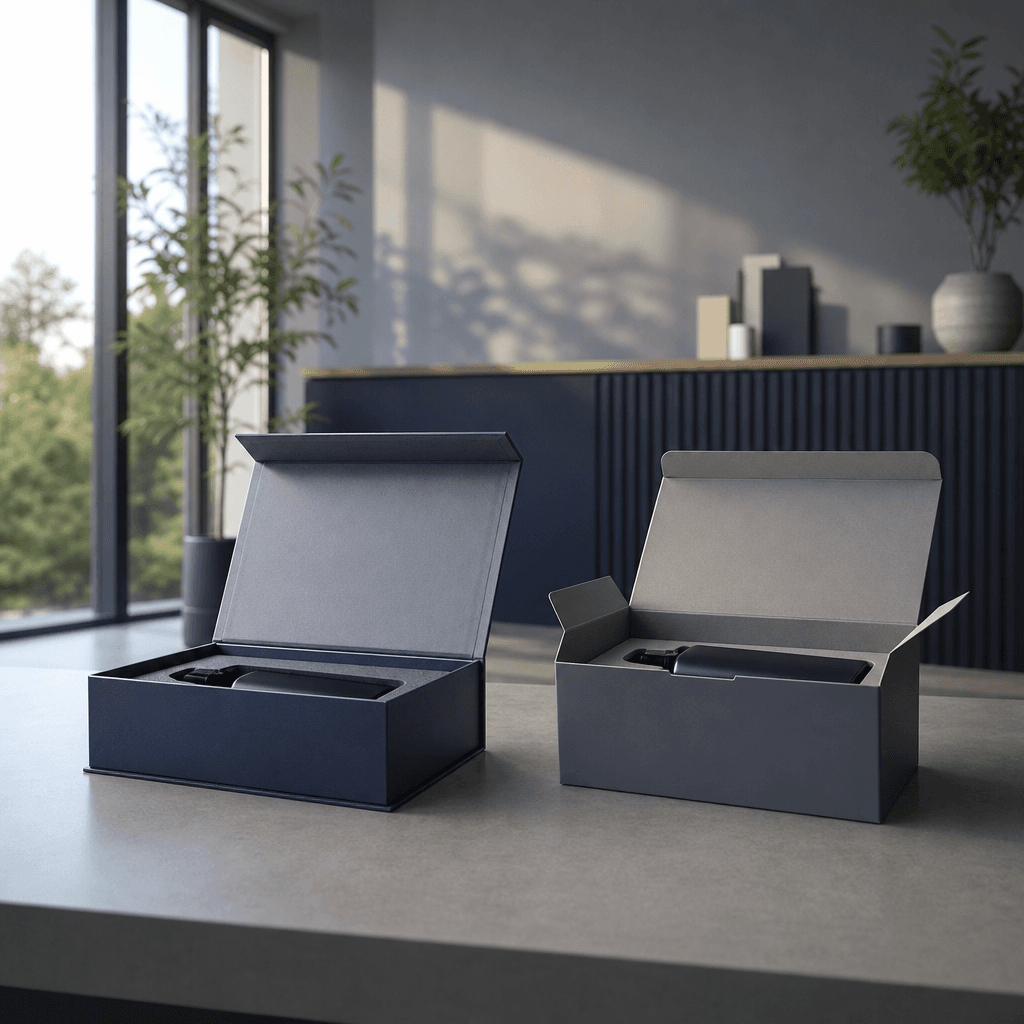
If you sell premium products such as cosmetics, jewelry, chocolate, or candles, packaging is now an investment item that carries as much weight as the product itself. Since the box is your customer's first physical contact with your brand, the decision of rigid box or folding box directly affects both perceived quality and profitability. The good news: there is no single right answer to this question. Your product's positioning, quantities, logistics realities, and unboxing expectations all pull the decision in different directions. Because we at Kosapack handle both rigid box and folding carton production under one roof, we recommend that most brands set up the right combination based on channel and intended use rather than "one or the other."
Table of Contents
The alternatives: what exactly are a rigid box and a folding box?
Before getting into the comparison, it's worth clarifying the physical difference between the two structures, because although their names sound similar, their production logic is entirely separate.
A rigid box (setup box) is a structure that does not fold and permanently retains its form, made by applying decorative materials such as special wrapping paper, textile, or foil over thick gray board. It is typically produced from rigid board 1.5–3 mm thick, fully assembled at the factory, and includes parts such as a body and a lid. Its most important operational difference: it cannot be shipped flat; it is always transported and stored in three-dimensional form. Printing is mostly applied not directly to the board but to the wrapping material that covers the box. Magnetic-closure boxes, drawer boxes, and bottle boxes mostly belong to this family.
A folding carton, on the other hand, is a structure produced from thin board such as SBS or kraft, shipped flat and folded into form at the point of filling. Board in the 250–450 gsm range is generally used; it is folded along die-cut and score (crease) lines. Because it is shipped entirely flat-pack, it takes up minimal space in the warehouse. Printing is done directly on the box board; classic finishes such as CMYK, varnish, and lamination are used. It is widely used in food, fast-moving consumer goods, shelf-type cosmetics, pharmaceuticals, and e-commerce shipping boxes.
If you want to evaluate this distinction in more depth according to product type, our carton box selection guide explains different usage scenarios with examples.
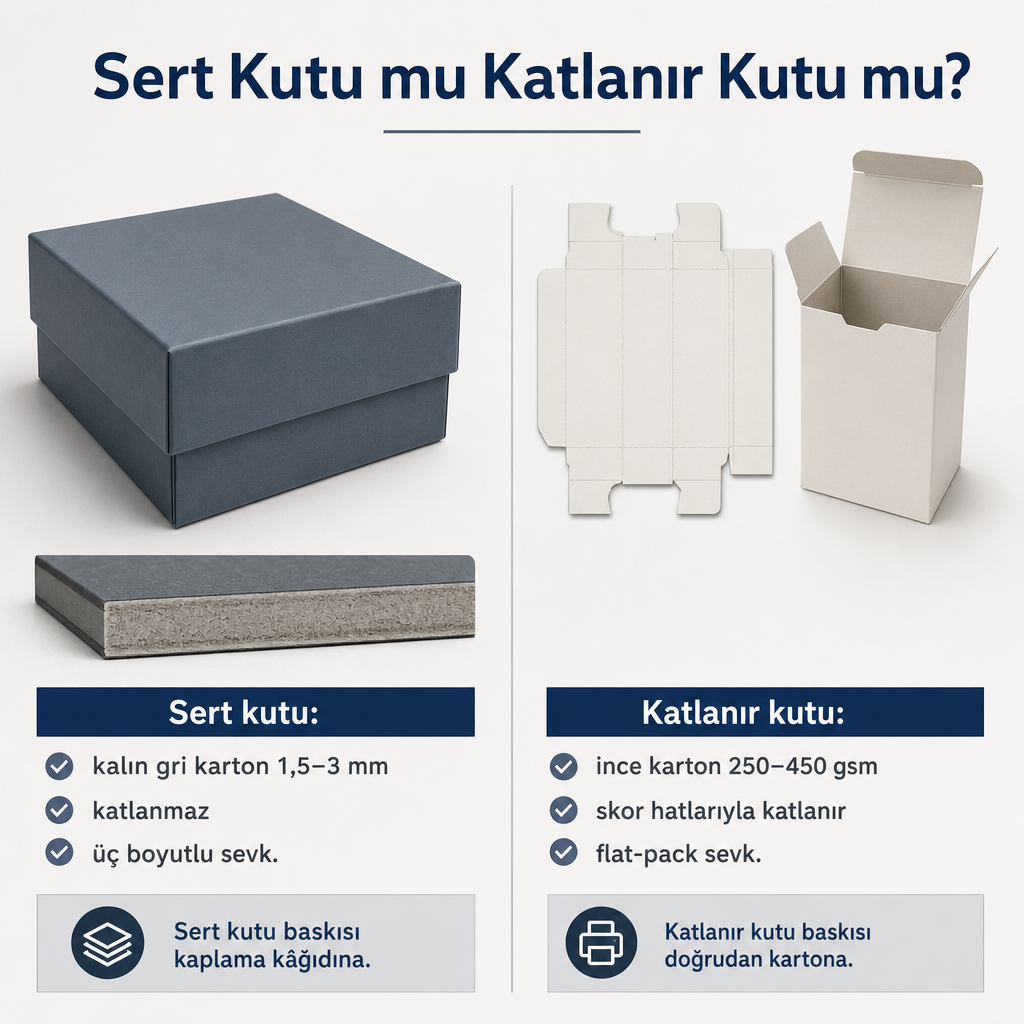
Criteria-based comparison table
When you place the two options side by side under commercial decision headings, the differences become much more concrete. The table below was prepared to summarize the decision at a glance rather than repeating flat comparison sentences over and over.
| Criterion | Rigid Box | Folding Box |
|---|---|---|
| Structure and material | Thick gray board, 1.5–3 mm, non-folding structure | Thin board, 250–450 gsm, structure folded along score lines |
| Logistics and storage | Always three-dimensional form; more volume in shipping and storage | Shipped flat; significant space savings in storage and transport |
| Level of protection | Higher mechanical protection against impact and crushing | Medium level; ideal for light products or with a second outer protection |
| Perceived value | Strongly conveys a gift, premium, and "special" perception | Functional and shelf-focused; branded through design but more understated |
| Unboxing experience | Top-tier experience with magnetic lid, drawer, two-piece designs | Good but more practical experience with tuck-end, auto-bottom |
| Printing and finishing | Embossing, hot foil, soft touch on wrapping paper very suitable | CMYK, lamination, spot varnish on board; premium effect possible, with structural limits |
| Typical use | Jewelry, luxury cosmetics, chocolate, perfume, corporate gifts | Food, standard cosmetics, pharmaceuticals, FMCG, high-volume e-commerce |
The main message from the table is not that one is superior to the other; each column serves a different commercial priority. When a brand has more than one priority at the same time, the decision splits at the product-line level.
Which criterion pulls the decision which way?
Reading the comparison table is easy, but the real point is knowing which criterion is binding for you. Five decision mechanisms cover the real tension points for most brands.
Brand positioning and price level. If your product is gift-focused, has a relatively high unit price, and you want to emphasize a "luxury" perception, a rigid box conveys that perception more clearly. If your product is more functional, faces high shelf competition, and is sold to an audience with greater price sensitivity, a well-designed folding box conveys the same brand message in a cost-effective way.
Quantities and production planning. If you work with tens of thousands of units, a folding box provides a clear advantage in logistics and production speed. For more limited-quantity, campaign- or collection-based premium products, it is easier to track the return on a rigid box investment, and the product's story is strengthened.
Logistics and storage realities. If warehouse space and shipping cost are among your critical KPIs, a folding box shipped flat-pack lowers volume costs. On the other hand, in scenarios where the box will stay on display for a long time and in-store presentation stands out, the form stability and durability of a rigid box create an advantage.
Product protection requirement. For fragile, heavy, or sensitive products such as glass bottles, ceramics, or jewelry, a rigid box, with its thick structure, offers better protection against impact and crushing. For light products with low impact risk, a folding box provides sufficient protection, supported if needed with an inner separator or a second outer box.
Unboxing and storytelling. If you aim for a "stage moment" such as influencer collaborations, social media unboxing videos, and corporate gifts, the rigid box's magnetic lid, drawer, or multi-piece structures enrich the experience. If speed and practicality are your priority in e-commerce, you can build a branded yet operationally fluid experience with creative graphics, inner printing, and message cards on a folding box.
In categories such as cosmetics where both shelf and gift sets coexist, we address how these balances are struck by segment in our cosmetic packaging production guide.
When rigid, when folding, when neither?
Once you know the criteria, the decision becomes clear, but in practice it leads to three separate paths.
Rigid box scenarios. A rigid box is the right foundation if the product is gift-focused and you want to add a ritual to the moment of opening; if the unit price is relatively high and you expect the packaging to increase perceived value; if the product is fragile, heavy, or has collectible value (perfume, premium chocolate, jewelry, collector's bottle); or if your brand is positioned as premium and you want the box to be kept as a "lasting piece."
Folding box scenarios. A folding box is more sensible if you are producing for a high-volume category with intense shelf competition and high price sensitivity; if warehouse and shipping costs are your critical KPIs and you want to take advantage of the flat-pack benefit; if you use automation on your filling line and manage an operation that requires fast box setup; or if the product is light and the packaging's primary role is functional protection combined with shelf communication.
When neither alone is sufficient. In some cases, neither a rigid box nor a classic folding box is the right answer on its own:
- Heavy product with a limited budget: If the rigid box's perception is needed but the budget or logistics are tight, a hybrid model can be set up that uses a rigid box only for the display or gift set and a folding box for high-volume SKUs.
- Multiple protection in e-commerce: A combination of a folding box with a corrugated outer box can be more flexible than a rigid box in terms of both logistics efficiency and product safety.
- Sustainability-focused campaigns: Some brands remove the box entirely and switch to minimal packaging concepts such as labeled products, pouches, or envelopes; here, reusable or single-material solutions come to the fore.
In these intermediate scenarios, by examining your product portfolio and channel breakdown together, we model on a segment basis which SKU makes more commercial sense in a rigid, folding, or alternative structure. By analyzing the requirements of the product, brand, and logistics, we recommend the right size, board type, and printing combination; through the physical sample we deliver within 7–15 business days, we let you see the material quality, color accuracy, and mechanical durability. We apply systematic quality control at critical points such as corner workmanship and wrapping tension in rigid boxes, and folding lines and print misalignment in folding boxes. With recyclable materials, FSC-certified paper options, and carbon footprint reporting, we align both box types with your environmental goals.
Next step: designing both boxes together under the same brand
Instead of viewing the decision as an "either rigid or folding" dilemma, it's healthier to think of your packaging architecture in three layers: the brand and story layer, the channel and logistics layer, and the product and protection layer. Through these layers, you can build a packaging portfolio with a rigid box for gift, PR, and premium segments; a folding box for high-volume, shelf- or shipping-focused products; and, when needed, a third structure (corrugated outer box, fabric bag, envelope). This way, instead of making a single choice, you create an ecosystem aligned with your brand strategy.
If you want to see how this portfolio is customized and what custom packaging means for brands in a broader context, you can take a look at our custom packaging fundamentals guide. If you're curious about how the sizing and production flow work, our custom-sized box production process moves step by step.
Frequently Asked Questions
How big is the cost difference between a rigid box and a folding box?
The cost varies according to board type, finishing, and quantity. As a general trend, because a rigid box requires thicker material and more labor, it sits in a higher cost band per unit than a folding box. For premium products, the increased perceived value and reuse can offset this difference within the overall brand experience.
Which box is more suitable for e-commerce?
Because flat-pack shipping, warehouse efficiency, and shipping cost are critical in e-commerce, most brands lean toward a folding box or a combination of a folding box with an outer corrugated box. A rigid box, on the other hand, is preferred for special collections, influencer shipments, and corporate gifts.
Is a rigid box disadvantaged in terms of sustainability?
Both structures can be produced with recyclable board and eco-friendly finishes; the environmental impact largely depends on the choice of material and lamination. Since consumers have a high tendency to keep and reuse a rigid box, it can, in practice, turn into a longer-lasting piece.
When should small brands start investing in a rigid box?
Switching to a rigid box makes more sense once your brand story is established, the product reaches a certain price and profitability level, and your unboxing strategy is clear. A common path is to first test the brand identity with a folding box, then gradually add a rigid box for premium sets.
Can both rigid and folding boxes be used for a single product line?
Yes. Using a folding box for standard sales and a rigid box for gift or collection sets is effective in terms of both operational efficiency and brand layering. We support your brand consistency by maintaining the design harmony between these two structures.