

A paper string bag is a type of carrier bag that stands out with its handmade texture and natural identity, created by weaving string obtained from recycled or specially processed paper fibers. Unlike classic printed paper bags, it relies not on a printing surface but on woven texture and style perception. For premium and naturally-identified brands, it works both as an accessory and as a brand carrier that creates visibility with every customer leaving the store. In this guide, we explain firsthand what a paper string bag is, how it is produced, which brands it is the right choice for, and how it combines with cardboard boxes and paperboard packaging.
Table of Contents
What is a paper string bag?
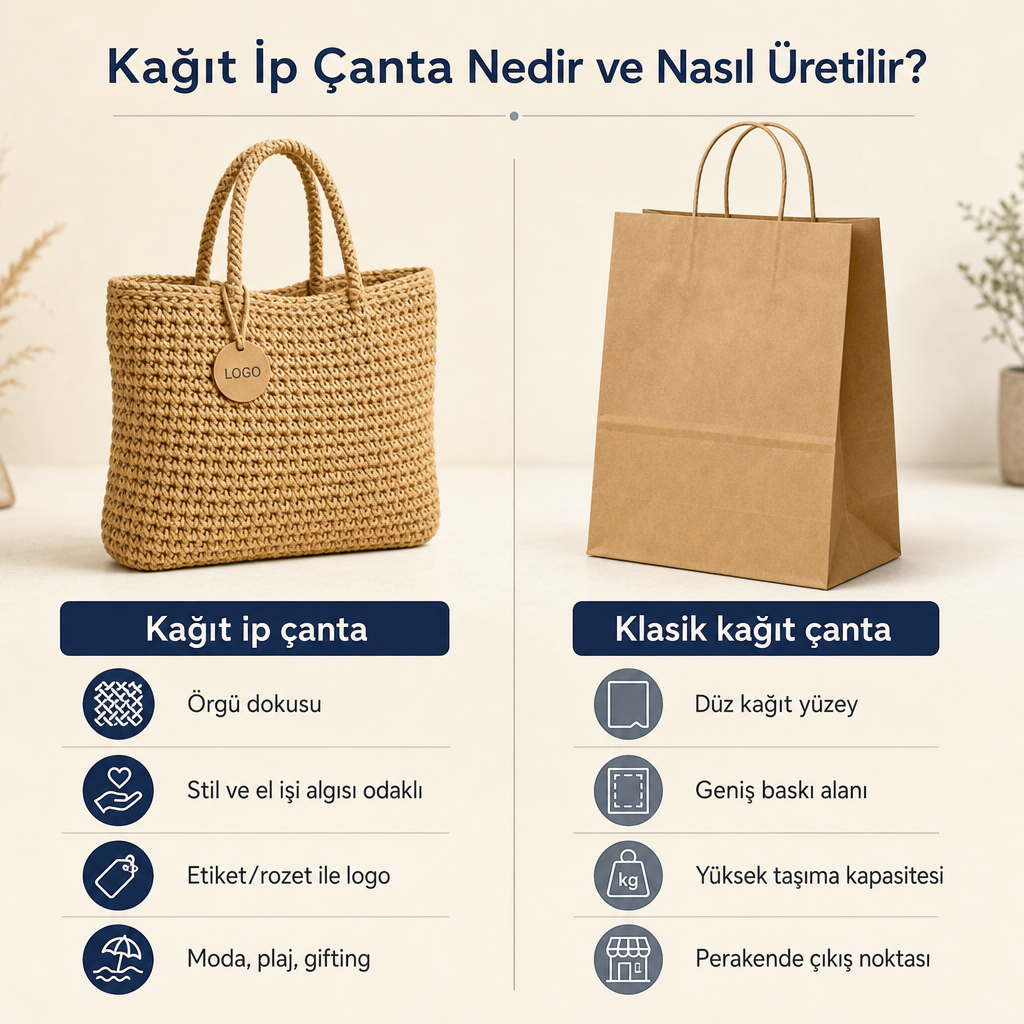
Paper string is a weaving yarn obtained by cutting recycled or specially processed paper fibers into thin strips and twisting them. It is made entirely of paper, is lightweight, but thanks to its woven structure it holds its form surprisingly well, and because it comes from recycling it is considered environmentally friendly. Paper string bags emerge when these strings are shaped into a body and handle form using crochet or knitting techniques.
In product guides, these bags are described as a modern and sustainable interpretation of traditional wicker bags, with their naturalness, simplicity, and handcrafted texture. In the world of fashion and accessories, they are positioned as an elegant, environmentally friendly option. In our packaging guide, we treat paper bags as fundamental carriers made from kraft or coated paper that serve as "walking advertisements" at the retail exit point. The paper string bag is a more textile-like, handcrafted, and style-focused interpretation of this world; particularly in the fashion, beachwear, accessory, and gifting segments, it strengthens the brand's message of being "natural, sincere, sustainable."
Paper string material: technical and visual properties
The character of the paper string directly determines the character of the bag. The material is produced by twisting paper fibers into thin strips and can be offered in different colors and thicknesses. Thanks to its lightweight, weavable, and form-holding structure, it is heavily preferred in bags, hats, and decorative products.
It is possible to summarize the prominent features of paper string bags along three axes:
- Natural and handmade perception: The woven surface gives a sense of craftsmanship; it offers elegance in simple outfits and summer styles.
- Environmentally friendly identity: The paper origin of the fibers and the fact that they can be obtained through recycling support the brand's sustainability communication.
- Balance of lightness and durability: Although the material is lightweight, thanks to its woven structure it can retain its form and is suitable for daily use.
In our kraft paper guide, we explain that the grammage and fiber structure of paper have a direct impact on durability and printing suitability; and that choosing the right grammage is critical, especially for bags with high carrying capacity. The logic is similar in paper string bag design: the thickness of the string used and the density of the weave are the two fundamental parameters that determine carrying capacity and durability. Thin string and loose weave produce a more elegant but less load-bearing bag, while thick string and dense weave give a body more ready for daily loads.
How is a paper string bag produced?
Producing bags from paper string is a weaving-centered process, unlike classic printed paper bags. The process is divided into several distinct stages, from material preparation to weaving techniques and brand applications.
Design and sizing. First, the size and intended use of the bag are clarified: shoulder bag, small clutch, beach bag, and so on. The amount of string needed is calculated accordingly. This decision is directly related to carrying capacity and the targeted premium perception; in our cardboard bag guide, we explain with tables the effect of different sizes and grammages on carrying capacity and premium perception.
Producing the paper string. String production can be summarized as cutting paper into thin strips, tightly twisting these strips into a string form, and drying them. Processing recycled paper into string reinforces the product's environmentally friendly identity.
Base weave and body. For a sturdy bag, a durable base is first created using a tight single crochet or slip stitch technique. Then, weaving continues without increases to raise the bag walls; thus a rectangular or oval body form is obtained. This body gives the paper string bag its distinctive texture and allows for creating a brand-specific look with different weaving patterns.
Handle and opening area. The handle is either woven and integrated into the body, or ready-made handles are sewn on afterward. In our paper bag guide, we emphasize that the handle structure, opening thickness, and bottom reinforcement are critical details that determine the difference between bags that look cheap and those that look premium. In paper string bags too, reinforcing the handle points and designing the opening area to retain its form are decisive for a premium feel.
Lining, closure, and brand applications. Adding a lining to the interior increases form stability and durability; closure systems such as zippers or buttons can also be applied over this lining. In fashion products, paper string bags are often enriched with inner linings, small inner compartments, and metal or leather details.
All of these stages can be designed as part of a single packaging set. In our rigid (cardboard) box production guide, we note that our portfolio covers a complete set including cardboard boxes, folding boxes, paper bags, labels, tissue paper, thank-you cards, and in-box dividers. Within this set, paper string bags can be designed as outer carriers especially in fashion and gifting projects; while cardboard boxes and paperboard boxes serve together as inner packaging that reinforces product protection and premium feel.
Which brands is a paper string bag the right decision for?
In our guide on choosing the right packaging material, we emphasize the need to determine a packaging combination according to the sector, sales channel, and priority need. The paper string bag decision can also be evaluated along several clear axes.
Brand positioning. For fashion, beachwear, jewelry, accessory, natural cosmetics, and lifestyle brands, a paper string bag establishes a warm, natural, and sincere brand language. For more corporate, very formal, or ultra-minimalist technology brands, however, a classic paper bag or cardboard box may give a more consistent line.
Use case. Paper string bags are a strong carrier for summer season, resort and beach collections, boutique store shopping bags, and special gift sets. In e-commerce shipments, the bag often adds value through its "second life" (use as an accessory) after the product reaches the end user; the main logistics packaging role is taken on by paperboard boxes and cardboard boxes.
Carrying capacity and durability. The lightweight and weavable structure provides sufficient durability for daily city use; with the right thickness of string and dense weave, bags can be long-lasting. On the other hand, for high-risk products such as heavy glass bottles or large electronics, a high-grammage cardboard bag or cardboard box is safer for the carrier role.
Premium perception and unboxing. One of the strongest aspects of paper bags is that they create brand visibility on the street with every customer who leaves the store. The paper string bag achieves this effect with a more fashion-focused accessory identity; together with the custom box, tissue paper, and thank-you cards used inside, a memorable opening experience can be crafted. We cover in detail how this experience is planned in our unboxing experience guide.
Risks and things to consider
When choosing a paper string bag, a few points directly affect premium brand perception and operational safety. Evaluating these early reduces post-production surprises.
Moisture and water sensitivity. Paper-fiber materials are more prone to deformation when exposed to heavy water. For this reason, paper string bags are advantageous in dry weather conditions, urban settings, and summer use. For projects to be used in wet and heavy conditions, a combination with a cardboard bag or cardboard box as the carrier packaging should be considered.
Printing and logo application options. Due to the woven texture, it is difficult to apply classic offset or screen printing directly to the surface. Fashion and accessory brands usually carry the logo onto the bag with leather or textile labels, metal badges, woven labels, or small cardboard tags with printing applied. The label and tissue paper solutions in our portfolio can play a complementary role at this point.
Craftsmanship and quality control. Since most paper string bags are produced by hand, weave density, handle symmetry, cleanliness of the inner lining, and stitching quality are decisive for premium perception. In packaging projects, while we manage structural design, prototyping, and production through our verified factory partners, we apply strict quality control and color accuracy processes; this approach ensures the standardization of critical details such as form, stitching, and label placement in paper string bag projects as well.
Combining paper string bags with cardboard boxes and paperboard packaging
The true value of a paper string bag emerges not on its own but as part of a packaging set. We work as an end-to-end packaging partner offering consulting, structural and graphic design, prototyping, verified production, consolidated logistics, and sustainability reporting all together for brands. Our focus is to determine the right material combination suited to the sector and channel, to strike a balance between premium perception and cost, and to design a consistent opening experience. While establishing this balance, we can plan the cost items together based on the factors explained in our custom box production price guide.
The typical contributions we can provide in paper string bag projects are as follows:
- Determining the right bag form, size, and color palette according to the brand identity.
- Holistic design of the set of cardboard boxes, folding boxes, cardboard bags, labels, tissue paper, and thank-you cards that complement the paper string bag.
- Testing weave density, handle form, label position, and inner packaging details together with a physical sample.
- Supporting brand sustainability commitments with recyclable materials and carbon footprint reporting.
A typical setup works like this: the paper string bag is the outer carrier, the cardboard box is the protective and premium presentation element of the product, and the tissue paper and thank-you card are the details that complete the moment of opening. If you want to clarify the right combination for your own brand, sharing your sector, product weight, sales channel, and target season is enough for us to prepare a customized recommendation and sample plan for you. We explain step by step how we run the process end to end in our custom brand packaging steps guide.
Frequently asked questions
How durable are paper string bags?
Although paper string is lightweight, thanks to its fiber structure and woven form it offers durability suitable for daily use. With the right string thickness and dense weave, long-lasting use is possible in shoulder bag, small clutch, or beach bag formats.
What happens when a paper string bag gets wet?
Heavy water exposure can cause the paper fibers to swell and lose their form; therefore, paper string bags are more suitable for dry use scenarios. For projects where wet and harsh conditions are expected, a cardboard bag or cardboard box should be preferred as the carrier packaging.
How is a brand logo applied to a paper string bag?
Since the woven texture makes direct printing difficult, the logo is mostly carried with leather or textile labels, metal badges, woven labels, or hanging cardboard tags. Our label and paper bag solutions can be designed together for the design and production of these logo carriers.
How can I combine a paper string bag with a cardboard box?
We design our rigid (cardboard) box solutions together with paper bags and other packaging elements as brand-specific sets. You can position the paper string bag as the outer carrier and the cardboard box as the protective and premium presentation element of the product, and by adding tissue paper and a thank-you card inside, you can build a cohesive opening experience.
Can a paper string bag replace the classic kraft paper bag?
Kraft paper bags serve as "walking advertisements" at the retail exit point with their high carrying capacity and wide printing area. The paper string bag, however, relies more on style and handcrafted perception than on printing area; therefore, rather than replacing the kraft paper bag, it is more appropriate to position it as a more niche and fashion-focused second carrier that complements it.