
Custom box production pricing is not a fixed tariff that can be given with a single "X TL per box" figure. It is calculated separately for each project through a combination of dimensions, material, printing, quantity, and logistics items. For this reason, instead of a list price selected from a catalog, a quote structured according to your brand's actual needs delivers far more accurate results. This is exactly our approach for premium and growing brands: at Kosapack, we receive your brief, get in touch within 24 hours, and work out a project-specific price with itemized cost breakdowns.
In this article, we explain each of the cost drivers one by one, clarify what is included in the price and what is planned separately, and offer a practical framework so you can fairly compare the quotes you receive. The goal is to get you out of the "cheapest price per box" trap and enable you to make decisions based on total cost of ownership.
Table of Contents
Why can't custom box production pricing be given as a fixed range?
Packaging cost guides show that unit costs for corrugated boxes, cardboard boxes, and rigid boxes vary within a wide range depending on material, labor, and overhead. One source states that according to 2023 data, the average packaging cost for small and medium-sized businesses can range between 0.50–5.00 USD per unit, and that this can rise even higher depending on material and box type. This figure is not a "ready-made price list" that can be directly converted to TL and used, due to exchange rates and paper, printing, and labor conditions in Türkiye; it only shows how project-dependent the cost is.
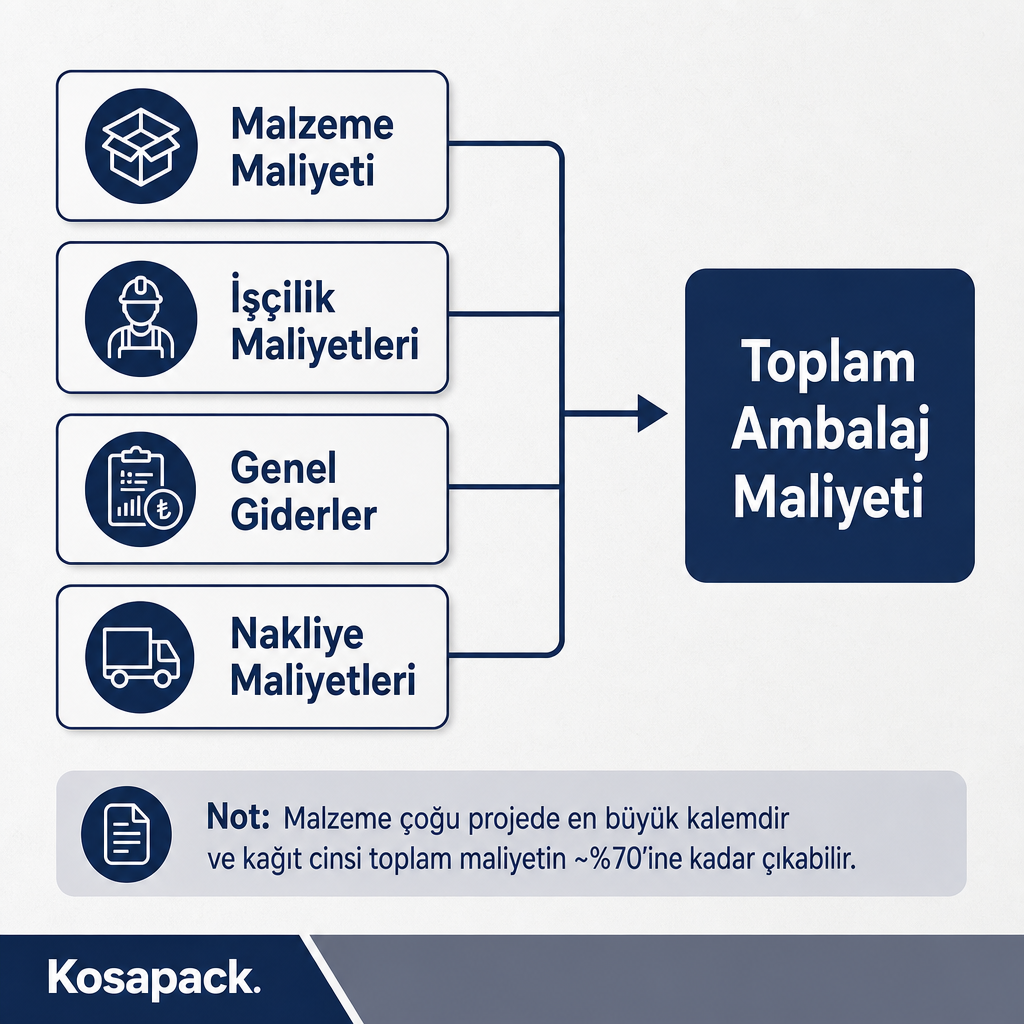
Technical sources summarize cardboard box cost with a simple logic: packaging cost is the sum of material cost plus labor, overhead, and shipping costs. In most projects, the largest item is material; it is calculated by multiplying the net unfolded box dimension (open area), the grammage used, and the raw material price per kilogram. For custom-sized cartons and boxes, the waste that occurs when moving from roll paper to the desired dimension and machine setup times noticeably drive up the unit cost compared to standard dimensions.
Türkiye-focused pricing guides also emphasize that dimension and quantity information are absolutely required for an accurate price. As the dimension grows, the material used increases, and consequently both the box cost and the shipping volumetric weight increase. Guides prepared for offset-printed boxes list box size, material quality, printing and design detail, and production quantity as the primary determinants of unit price. In short, the price is not a single figure selected from a catalog, but a result calculated in light of the technical information you provide.
Main cost factors that determine the price
The way to build a realistic budget is to see each of the items that make up the cost one by one. Typical drivers for premium brands are as follows:
Box type and dimensions. Folding carton, corrugated shipping box, rigid gift box, drawer structure, or magnetic lid; each structure requires different material and labor. Dimension is the most important determinant of cardboard box price; as the dimension grows, material use and cost increase. If you are curious about the effect of custom sizing on the production flow, you can review how custom-sized box production works.
Material type and grammage. The unit costs and grammages of corrugated board, folding carton, and rigid box board differ from each other. In most scenarios, the type of paper used can account for up to around 70% of the total cost. Since material cost is calculated by open area × grammage (kg/m²) × price per kilogram, as the grammage rises, the unit cost increases directly.
Printing, color, and finishing processes. Applications such as color offset printing, custom design, embossing (emboss/deboss), lamination, and spot varnish increase both the printing cost and the labor time. The fact that these additional processes increase cost is a pattern also observed in different materials such as metal boxes; the same logic applies to premium cardboard boxes.
Production quantity. As the order quantity rises, setup and die costs are spread across more units and the unit cost decreases. In low-quantity boutique productions, setup time weighs more per box. The summary in the guides is clear: bulk orders lower the unit price, low quantities raise the unit price.
Waste, die, and structural design. In custom-sized boxes, the amount of waste and the cutting die used are the most commonly forgotten items in calculations, yet they can change the unit cost by up to 20%. Die preparation and machine setup times stand out as significant components of cost, especially in custom-sized cartons and boxes.
Logistics and shipping volumetric weight. As the volumetric weight calculation (Width × Length × Height / 3000) grows, the shipping cost and total cost of ownership increase. While many brands focus only on the box price, the real cost may arise in shipping; that's why shipping is explicitly included in the cost formula. In e-commerce shipping box selection, volumetric weight optimization can be as decisive as unit price.
Quality control and sustainability. In premium production, choosing eco-friendly, durable, and high-quality materials creates additional cost on the material side and added value in brand perception. Recyclable materials, carbon footprint reporting, and rigorous quality control processes are elements that affect the final price but preserve brand value in the long run.
Kosapack's pricing approach and scope
At Kosapack, instead of a fixed catalog-based list, we work out a project-based custom box production price for each brand; we share the net figure in TL only once your needs are clarified. The process is simple: we receive your brief to determine the packaging solution suited to the brand's needs, and our expert team gets in touch within 24 hours. We prepare the quote by evaluating the selected box type, dimensions, material, printing and finishing processes, order quantity, and logistics requirements together. By handling rigid boxes, cardboard boxes, shipping boxes, paper bags, labels, and other printed packaging under one roof, we build a consistent packaging experience for your brand.
What is typically included in the price (though it varies by project):
- Packaging consultancy and selecting the box structure suited to the project.
- Preparation of print files and high color-accuracy proof/sample processes.
- Physical sample production; in our projects, the sample is usually ready within 7–15 business days.
- Mass production and quality control managed on the basis of the approved sample.
- Consolidating multiple boxes, bags, and supplementary printed materials with a single supplier.
Items that are generally not included in the price and planned separately upon request:
- Placing the product into the box, fulfillment, and warehouse operations.
- Shipping to the end consumer and the brand's own logistics costs.
- Customs, taxes, and external costs tied to regulations.
- Marketing services outside of packaging, such as product photography and campaign creatives.
Within this framework, we always approach pricing with a "quote based on the brief" logic: a needs-focused approach with itemized cost breakdowns instead of a fixed TL list. To see the effect of packaging decisions on price in sensitive categories such as cosmetics, you can take a look at our cosmetics packaging production guide.
What should you look for when comparing quotes?
To correctly compare quotes from different suppliers, all of them must be given according to the same technical framework. Otherwise, a price that appears cheaper may actually be a narrower-scope quote. The table below summarizes the key questions to ask when comparing quotes like-for-like.
| Item | Detail you should ask | Effect on price |
|---|---|---|
| Box type and dimension | Are the box type and net inner/outer dimensions the same? | As the dimension grows, material and cost increase; as the type changes, the unit cost differs. |
| Material and grammage | What is the paper/board type and grammage? | The paper type can account for up to ~70% of the total cost; high grammage raises the price. |
| Printing and finishing | Number of colors, technique, is lamination/varnish/embossing included? | Custom printing and finishing processes raise cost with additional machine processes. |
| Quantity and minimum | For what quantity is the quote; what is the minimum production? | Low quantities raise the unit price because they spread the setup cost across fewer boxes. |
| Die and waste | How are die cost, waste rate, and setup reflected? | When forgotten, the unit cost can deviate by up to 20%. |
| Logistics and delivery | Is it ex-factory or delivery to the warehouse; how about volumetric weight? | Volumetric weight and logistics play a critical role in the total cost of ownership. |
| Sample and quality | Are physical sample and quality control included? | If included, the unit price rises slightly but reduces the risk of revisions and returns. |
Comparing quotes whose framework has been clarified with these questions produces a far more reliable decision than looking only at the price per box in TL. The lowest line price, when die, sample, and logistics are left out, most often turns into the highest total cost.
Information needed to get an accurate quote
For the quotes we prepare within 24 hours to be accurate, your brief needs to be as clear and measurable as possible. For custom box production pricing, we typically request the following information:
- Product and sector. The type of product (cosmetics, jewelry, food, textile, electronics, etc.) and the intended use of the packaging (shelf, e-commerce shipping, gift, launch, corporate gift).
- Box type and target experience. Rigid gift box, folding product box, shipping box, drawer/magnetic structure, inner separator, or inner support needs.
- Dimensions. Inner and outer dimensions (Width × Length × Height) and the expected gap between the product and the box; it directly determines the volumetric weight calculation and material use.
- Material preferences. Corrugated board quality, carton type, grammage, and sustainability expectations (recyclable, eco-friendly options).
- Printing and design. Number of colors, logo and visual density, inner/outer printing, embossing, lamination, and finishing processes such as spot varnish.
- Production quantity and plan. Initial print quantity, possible repeat orders, campaign periods, and minimum production tolerance.
- Logistics and delivery. Delivery address (city, warehouse), palletizing/partitioning requests, and whether the boxes will be delivered flat or assembled.
With this information, based on the brief you share, we prepare a TL-based quote with itemized cost breakdowns, taking into account 2026 Türkiye conditions. An incomplete brief produces a slow and uncertain price; a clear brief, on the other hand, is the shortest path to a fast, comparable quote suited to your brand.
Frequently Asked Questions
Why can't I find a ready-made price list on the internet?
Since cardboard and rigid box prices are determined jointly by dimension, material, printing, and quantity, a single standard price is often misleading. Türkiye guides also state that dimension and quantity information are absolutely required for an accurate price. For this reason, we calculate the price according to your brief.
Can you tell me an average price range?
International guides mention a packaging cost range of 0.50–5.00 USD per unit according to 2023 data; for rigid boxes this range can rise even higher. However, this value does not directly correspond to a 2026 TL price due to exchange rates, paper-printing-labor conditions in Türkiye, and project-specific requirements; it only shows how variable the cost is.
How is the price affected if I order a low quantity (100–500 boxes)?
In custom-sized production, when machine setup time and die cost are spread across a low quantity, the unit price rises. It is known that in boutique productions the setup weighs more heavily on the unit cost. Therefore, in low-quantity premium projects, the unit price may be positioned higher than in high-quantity standard productions.
Does choosing sustainable material increase the price a lot?
The unit cost of eco-friendly, high-quality materials may be higher than classic options. Since material is the main cost item in most projects, you feel this difference; however, sustainability is an important investment in terms of brand perception. We determine the material selection together in a way that aligns with your brand strategy.
Do I pay separately for the sample and quality control?
In our projects, we include physical sample and rigorous quality control processes within the scope of the quote to minimize risks before mass production. Being able to present the sample usually within 7–15 business days after the brief is shared is an important advantage that guarantees quality as part of the price.
In summary, custom box production pricing under 2026 Türkiye conditions is determined by the combination of box type, dimension, material, printing detail, quantity, and your logistics requirements. Preparing a comprehensive brief that clarifies these factors is enough for you to receive a transparent TL quote suited to your brand in a short time.